Showing posts with label Slings and Arrows. Show all posts

Saturday, March 14, 2015

V.ii. Duel and Deaths - Slings & Arrows

Though the sequence includes a brief shot of the fight, the montage focuses principally on Hamlet's death and Jack Crew's emotional release after getting through the entire play (he turns his head away from the audience in death, but faces us, the other audience, and smiles). If indeed Hamlet (like many, if not most of Shakespeare's plays) is about the Actor on Stage. Hamlet's sufferance is dramatized as an inability to leave the stage for extended periods of time; it's a marathon. So when he's allowed to rest, Hamlet's relief is the actor's.

Slings & Arrows also plays on a behind-the-scenes irony: The sequence is intercut with shots of the audience, and among them (just off-stage), Mark McKinney's character, the theater manager Richard Smith-Jones, was, through the whole of Series 1, trying to undermine the Festival's Shakespearean mission, and push a Broadway Musical agenda. By turns the equivalent of Claudius, Gertrude and Polonius, in the end he is a Fortinbras figure, there to supplant the "Danish" regime, and yet, like Fortinbras, reluctant in the end to do so. It illuminates a character we don't see a lot of in the play. Norway's prince may have conquered Denmark, but so potent is the play and its central character, that he is filled with regret and elevates his defeated foe to a higher stage, somehow becoming a kind of Hamlet, one that can carry on.

Monday, June 2, 2014

V.i. The Gravedigger Scene - Slings & Arrows

There's a bit in Slings & Arrows in which Oliver, the director's dead mentor/antagonist/haunter has asked for his skull to be part of the production, but this detail is forgotten until the last minute, so Geoffrey is forced to run to his office, where he keeps the skull as a mint dispenser, during the Gravedigger Scene to get it. It's black comedy, just as the scene on stage is. Most the scene is heard on the P.A. system, and we rejoin the world of the stage just as Oliver's skull makes it to the grave. In the staging of the play inside the show, it's lucky that Yorick's skull doesn't make an appearance until Hamlet picks it up. It stays in the pit until needed. Would this have an effect on the play? In such a version, Ophelia might have lain next to Yorick, her open grave a symbolic doorway to Hell, an infinite space that can contain multitudes. As Hamlet picks it up, we see there are still mints clenched in its jaw. The shot occurs on the line "excellent fancy", which is perfect.

The real world of the actors performing the play, as ever, informs the play itself in Slings & Arrows. In this case, Hamlet is played by Jack Crew, a Hollywood movie star cast by Olivier, dead director turned hack. When Jack holds Oliver's skull in his hands, he holds that of a surrogate father, just like Hamlet does, one he barely knows. He takes his true direction from Geoffrey, a former Hamlet, and so, for Jack, the Ghost of Hamlet Sr. But Jack wouldn't be there without Oliver, tapping into the questions of paternity that animate the play itself.

Saturday, June 1, 2013

IV.v. Ophelia's Madness - Slings & Arrows

Allow me to upend the usual order by starting with Slings & Arrows, but while the scene is part of the onscreen performance (above), the show also features, in the season's penultimate episode, one of my favorite moments of dramatic criticism, and it relates to that scene and to this entire endeavor.

One of the subplots of the show around the play focuses on the character of Claire (Sabrina Grdevich), a talentless brown-noser the play's director, Geoffrey Tennant (Paul Gross), has inherited. In rehearsals, she's going on sense memory to simulate Ophelia's madness, reenacting what it's like to be stoned because she surmises that it's the same thing. So it's a whole lot of staggering about, mouth open, twirling... After all, there's nothing Claire can take from the text. Ophelia is just singing nonsense songs.
Geoffrey's intense piece of advice to Claire is wasted on her (hilariously, she's back to twirling in the background of the next scene), but I can't watch it without tearing up. Let me just reproduce it here in toto:

"Ophelia is a child. She has been dominated by powerful men all of her life and suddenly they all disappear. Her brother goes to France. Her father is murdered by her boyfriend. And he is shipped off to England. She is alone for the first time, grieving and heartbroken and guilty because, as far as she's concerned, it's all her fault. She ignored her brother's advice and fell in love with Hamlet and now, her father is dead, all because of her. And the pain, and the loss, and the shame, and the guilt, all of this is gnawing away inside that little child's mind, and it comes out as little... songs. 'And will he not come again? And will he not come again? No, no, he is dead.' My father is dead and I killed him."

This is dead on, and hearing the quote he uses spoken by a man, reveals how the songs also relate to Hamlet's own situation. He too has gone mad from losing a father (or three, if we count surrogate Yorrick and stay-at-home uncle who betrayed his trust Claudius), and Geoffrey makes us feel that loss and how guilt played a part in his own bout of madness. We almost intuit what his own legendary Hamlet was like.

Thankfully, something happens to Claire and understudy Kate (Rachel McAdams) must take over for her. Her performance as Ophelia, make-up dripping, voice shaking and breaking, even gets to Claire, who bitterly wipes a tear away in the audience. Ellen (Martha Burns) playing Gertrude is also visibly affected, another case of seeing the actress behind the role, not expecting that level of emotion. It makes me realize how important Gertrude's reaction to Ophelia is in this scene. In the text, she isn't particularly kind to her. She doesn't even want to deal with her at the moment. But if she lets herself be touched by this moment, or if she visibly doesn't, it changes how we might understand Gertrude's later narration of Ophelia's final moments. On one end of the scale, deep empathy, on the other, the sense she might have played a sinister. part in those events.

Saturday, May 4, 2013

Act IV, Scene 4 - Slings & Arrows

In the play inside the show, Luke Kirby's Jack Crew is getting into the "home stretch", as this is the last of six soliloquies. What we see of it in the montage is a simple close-up, but it shows how Jack, an insecure Hollywood actor, has become much more confident by this point in the performance, which can also be said of Hamlet. Meta-textually, one might very well see how the actor on stage would get an energy boost from knowing his exile (long-over due break) was coming next. The story structure must play into the mood of the actor.

But that's not the only meta-textual trick Slings & Arrows plays on its audience. As Jack/Hamlet speaks his words, his director Geoffrey is reminded to get his mentor's skull for the Yorick scene, and has to make a mad dash for it. As he does, we stay in touch with Hamlet through the backstage P.A. system, and the mention of a "delicate and tender prince" seems to give Geoffrey that association. If Fortinbras is a mirror held up to Hamlet, and Hamlet is an actor/director, taking on various roles and instructing the Players on how to act, can Fortinbras be any different? And in that context, the futile enterprise, the "egg shell", of his war with Poland IS, in a sense, the act of putting on a play. So much goes into the endeavor, and yet, each performance is ephemeral.

The juxtaposition made here makes Hamlet chide himself for not giving his all when the actor who plays him obviously is. He is himself the First Player, able to conjure emotions out of thin air for a world imaginary. Hamlet keeps breaking the fourth wall and running into itself.

Saturday, December 15, 2012

III.iv. The Closet Scene - Slings & Arrows

Playing it on the floor, Slings & Arrows offers a simple, paired down staging that really speaks to the power of the scene. We don't get enough of it to discuss any particulars, but the fact that such a brief excerpt still manages to move this viewer speaks volumes. The scene is, of course, helped by a shot of the audience, enraptured, but that's one of the things the Canadian series does very well - show the power theater AS theater (as opposed to the adaptations in other media this blog is forced to use). Due to my location, I have never had the pleasure of seeing Hamlet on stage, but I can only imagine. What must it be like to actually be PRESENT as actors/characters experience Shakespeare's poetically-heightened emotions.

Why haven't you watched Slings & Arrows yet? It's just three 6-episode seasons, and I'll guarantee you'll love it.

Wednesday, September 26, 2012

III.iii. The Confessional - Slings & Arrows

Though we hear Hamlet's speech, we don't see it. Instead, the camera pans across the reactions of the characters backstage, watching from the side. First is Richard Smith-Jones (Mark McKinney), the putative "Claudius" in the meta story (S&A's plots always take a great deal of inspiration from the play the characters are staging... the play outside the play, if you will), and though he would have "sold out" and turned the festival into an American-style theme park with a strong focus on mainstream musicals, the play has really grabbed him by this point. The moment is well-chosen, with the play's Claudius experiencing a crisis of faith on stage.

But it's the group pictured above that is most touching. Nahum (Rothaford Gray) is an African immigrant who works as the theater's custodian who sees the play for the first time, with fresh eyes. He comments that "fate plays with our Prince", which confuses the other actors. His explanation (that Hamlet cannot kill the king while he prays) is what we've always known. Like those actors, we know the play left and right. There are no surprises on this order anymore. Except there must be. At one point, we must have seen the play for the first time (unless we were told about it, which I'm afraid happens a lot in this universe of Cliffs Notes and Wikis and popular media referencing everything). At one point, we must have been like Nahum, experiencing the play's twists and turns for a first, joyous time. It makes Kate (Rachel McAdams) smile broadly, and in that moment, we're all seeing Hamlet as if for the first time.

I always discover new things in Hamlet, but by now, they're small things. Lines, images, new ways of reading or staging a moment, or inferences. Nahum's reaction is each of those moments writ large. And since Slings & Arrows is about the actorly work of discovering a play and its characters so that you may inhabit them, it's that as well.

Wednesday, July 18, 2012

III.ii. Critical Reception - Slings & Arrows

The only part of the sequence that makes it into the performance montage is the soliloquy, but we don't see it. Instead, we're with the play's director, Geoffrey Tennant (Paul Gross), mouthing the words backstage, praying to the Shakespearean gods for a good outcome. In the show, he was a much-praised Hamlet until he cracked on stage, and the "witching hour" in terms of that story is when he must redeem himself and walk back from that disaster (through a proxy). As the soliloquy ends, he signals the number of soliloquies to the actress playing Gertrude, a countdown that refers to the five key moments an actor must nail as he gets through the play, something he told "Jack Crew" to reassure him that this performance was possible. In relating it to the play, it refers to Hamlet's delay of the action, a self-imposed countdown that creates the tension in the play. Hamlet is a time-bomb, each soliloquy counted down a means to talk himself into taking action. By the end, when all soliloquies are done, words turn to action, and the dialog shrinks until the rest is, indeed, silence.

Wednesday, April 25, 2012

III.ii. The Mouse-Trap - Slings & Arrows

The very brief part of this scene used in Slings & Arrows amounts to Hamlet's opening insults to Ophelia, but there are still lessons to be gleaned from it. On staging, you'll note that Ophelia and Hamlet are sitting/crouching near the ground, which fits the low-brow humor of the "country matters" line. Hamlet is in full madcap mode, rubbing his hands with devilish glee as Ophelia is continually hurt.

Hamlet turns to the audience to say "That's a fair thought to lie between maids' legs" and gets a laugh without need for Ophelia's questioning retort. The audience gets it because the punchline precedes the joke. In the text, the fact that Ophelia asks for the joke to be explained isn't strictly necessary, though it does inform her traumatized character and works within the rhythm of the scene. By making Hamlet's line an aside, Ophelia does not have to react to it and comes off as even more wounded, unable to properly interact. An aside at this point, and once that elicits a laugh at that, makes the audience share in Hamlet's cruelty. Because he shares his lewd thought with us, we empathize with him, which makes us his accomplices. Subtle, but subversive stuff.

Sunday, December 25, 2011

III.i. The Nunnery Scene - Slings & Arrows

The Nunnery Scene is not in the broadcast Slings & Arrows, but can be found as a deleted scene on the DVD. While the group is rehearsing outside, they coax Jack Crew into using the text instead of his usual paraphrasing - a natural cut because it revealed too early that Jack knew the words and could do them, undercutting the later scene where his director forces him to do "To be or not to be" with the text. His paraphrasing IS pretty ridiculous at times. There is no reason not to use Shakespeare's original on lines like "I loved you, once", for example, since it already sounds modern. The one paraphrase that was interesting to me was the line about the paradox, translated as "Beauty will turn a virgin into a slut before honor will turn a slut into a virgin". This blunt interpretation paints Hamlet as someone who believes there's no coming back from sin. An honorable slut cannot recapture her virginity. Some things cannot be undone. Is he simultaneously talking about the revenge he must take? Is this part of his delay? Truly, murder cannot be undone.

When he switches to the Shakespearean original, Jack proves he can not only do it, but do it well. And his choices are interesting too. He puts a venomous emphasis on the word "mother", for example, highlighting the fact that she's more germane to the discussion than Ophelia is. He puts a manic spin on his ambitions, acts like a mischievous creature, makes Ophelia laugh... How would this have played in context? Making Hamlet impish in this moment rather than cruel wouldn't quite have worked, not without excising Ophelia's implorations to Heaven and soliloquy. It might work within the framework of a more mercurial performance, where he turns to cruelty suddenly, or a production that, through cuts and inferences, made Ophelia more of a knowing ally to Hamlet. In any case, we don't find out because the sprinklers start and Jack switches to King Lear's storm speech. While it does bring up the larger question of the way madness is portrayed in Shakespeare, and draws a connection between the two characters and how, in each play, the protagonist's state of mind is projected onto the environment, it does abort a possible staging for the Nunnery Scene.

Because S&A takes inspiration from the plays in its greater story, it is a nice touch here that the festival administrator, plotting against the production's success, is, Polonius-like, watching the scene from his car.

Thursday, October 27, 2011

III.i. To Be or Not to Be - Slings & Arrows

"To be or not to be" is a pivotal moment in Slings & Arrows (Season 1, episode 5), as movie star Jack Crew is taken aside by director Geoffrey Tennant and asked to finally do a scene with the text. Up to that point, Jack has been paraphrasing, frustrating his cast mates and preventing the director from "seeing the play". Jack's problem is every actor's. How do you make these words - this speech especially - sound fresh? How do you escape from the shadow of all the great actors who have gone before? On a meta-textual level, the speech IS about to be Hamlet or not to be Hamlet. To make something of oneself, or to fail. In the text, though Hamlet is nominally talking about actual, lethal suicide, on another level he's talking about professional suicide. Hamlet is a role filled with risk. It is fearsome. The fear of "dying" on stage may keep you from ever attempting the role, but if it does, you deny yourself the possibility of an enterprise of great pith and moment. That's what's at stake for the actor as much as it is for Hamlet, himself an improvized actor and playwright.

Geoffrey also asks him to make an important choice: Does Hamlet know he is being overheard or not? Jack doesn't have to reveal his choice so long as he makes it. Ambiguity lingers. Jack sits his back to the spies, but also smirks at the end of it. That smirk may be directed at the appearance of Ophelia to stage right though. So did Hamlet just perform for Claudius and Polonius and smiles to himself, a job well done? Or is he darkly amused at remembering his sins thanks to Ophelia's appearance? Or while unaware of the spies' presence, does he nevertheless see through the transparent ploy of his ex-girlfriend being "loosed" upon him? In any case, while Jack's delivery is solid, if without much nuance, his body language makes good use of the actor's own discomfort and shame. Jack is visibly contemptuous of his ability to portray Hamlet, and that makes his Hamlet contemptuous of his own ability to trap Claudius and avenge his father.

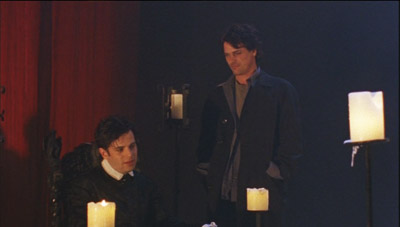
As Jack utters the speech, Geoffrey starts to see the play take shape (with the usual musical cue the show uses to render the theater as a magical place), and he and the ghostly Oliver walk through the fantasy. Geoffrey's image of scene has the spies behind a red curtain, steeped in blood as they are, and Hamlet surrounded by candles, a symbol of spiritual illumination, or perhaps an image of mortal life's brevity and snuffability. As the sequence ends, we return to reality and Hamlet stands up to face his Ophelia, a look of marked disappointment in himself on his face. The regret is palpable.
During the play in episode 6, we briefly alight on the sequence again. Budget cuts have made the fantasy version of the play impossible, but the show must go on. Jack's new Hamlet costume is a simple hoodie out of his own wardrobe. The jewelry, including the appropriate skull ring, is also his, part of the osmosis between role and actor that is part and parcel of Slings & Arrows.

Sunday, July 17, 2011

II.ii. O, what a rogue and peasant slave am I - Slings & Arrows

The montage from Slings & Arrows Season 1, episode 6, cuts this speech down to a single line (the first). In the context of the show, the actors playing Hamlet has been told the play is just five speeches - all you need is to get those right - to help him get through it. Jack Crew's own insecurities are transposed into the performance, and with this awkward gesture and disdainful delivery, he tells us as much about the actor than he does about the character. Hamlet is a play about play-acting, and Slings & Arrows certainly knows how to blur the line further. At once, we see Hamlet's auto derision at being a bad actor (i.e. unable to act in a non-Thespian context) and Jack Crew's fear that he is not a proper actor either (coming from action films rather than classical theater). And it's done sparingly, with a single line. Of course, as with all things, it's a single line that works because we, the audience, know both Hamlet's and Jack Crew's contexts.

Thursday, November 11, 2010

II.i. Ophelia Affrighted - Slings & Arrows

In Slings & Arrows, Ophelia is played by Kate McNab, who in turn is played by the now ubiquitous Rachel McAdams. In the show, which continually blurs the line between the characters and the actors who play them, Kate has a relationship with Jack/Hamlet. She's his tether, finding him when he runs for it and bringing him back to the theater. This is a notion from the play as well. Ophelia is Hamlet's tether, one he deliberately cuts in the unseen moment before this scene. By letting her go (reluctantly but necessarily), he loses hope for the normal life she represents (but then, Hamlet has lost the sense than marriage is any sort of normalcy).

McAdams/McNab gives an excellent and properly "affrighted" performance. Other characters believe she's really good, and Slings doles out humor in the midst of drama, by having the Culture Minister's wife claim the same based on her cleavage. The show often undercuts its drama with comedy, and vice-versa, which is a perfectly Shakespearean thing to do.

Saturday, November 7, 2009

I.ii. Enter Hamlet - Slings & Arrows

In Slings & Arrows, the faith people have in the character of Jack Crew, action movie star trying to find legitimacy on a Canadian stage, is pretty slim. As he comes into the light to deliver his first speech (we do not see the confrontation with his parents), other actors call it "the moment of truth" and critics sharpen their pencils. Jack himself has little confidence in his performance, and visibly has a hard time swallowing as he eyes the attentive crowd, who are only waiting for him to screw up.

We only get to "That it should come to this", but Jack does quite well. As with many characters in S&A, he "uses" his own feelings t inform his character. His insecurity becomes Hamlet's, his outrage and hurt stemming from resident pencil pusher Richard Smith-Jones (who in the previous episode had tried to sabotage his performance) becomes Hamlet's. Jack has his own unweeded garden here, and his sarcasm is palpable.

It is said that Hamlet is such a deep character, there are as many legitimate performances of him as there are actors to play him. S&A plays with that by showing us how an actor's particularities come to inhabit the character and thus the play. They further merge the real world and the world of the play by making Jack as reticent as Hamlet (though of course, there's another Hamlet analog in the story to incarnate his brilliance/madness).

Though I can only discuss Slings & Arrows briefly on this blog, I hope people will try to discover its three 6-episode seasons (Hamlet, MacBeth, King Lear). It's excellent television, and a real charm for Shakespeare fans especially.

Sunday, September 27, 2009

I.ii. The Wedding Banquet - Slings & Arrows

Slings and Arrows is rather playful with the banquet scene, using our knowledge of the actors' stories to give each scene an extra level, one that actually manages to comment on the play. The Claudius of this play is only known as "Alan" and is not really a character in the series. Once he gets going, we cut to Cyril and Frank watching the performance on closed circuit and saying how he's got a good voice tonight. Cyril notes that it's really "all he's got". A perfect moment for these guys who regularly act as a comic chorus, as if on a balcony at The Muppet Show, but also a poke at Claudius as a character. He is an arrogant blowhard full of hot air and no substance, contrasting with the quiet and sensitive Hamlet. Note how Hamlet is right at the front of the stage in the staging.While we don't see most of the scene (the editing basically cuts from the first speech to Claudius' exit), we can imagine Claudius going through the motions and addressing everyone in turn, very much ignoring the elephant in the room. When you reveal that Hamlet was there and draw him out, then Claudius was perhaps forgetting him. When he's in full view like this, Claudius is actively ignoring him and prioritizing other characters over him.

During the initial speech, there is a nice bit of double-acting from Gertrude as played by Ellen Fanshaw played by Martha Burns. Jack Crew (Luke Kirby) is deathly afraid of being shown a fool (he's the action movie/teen heartthrob cast as Hamlet) and is just keeping from throwing up. Ellen/Gertrude looks down at him with a look of sudden concern.
The actress wonders if this will turn out to be the disaster she predicted, but the character seems to register something amiss with her son, motivating the interrogation/comforting to come. Works perfectly in the series, where "use it" is often used in response to something that should distract the actor (just as Jack is "using" his nausea in the scene).

Friday, August 7, 2009

Act I Scene 1 - Slings & Arrows

So we come to our first play within a play - Hamlet as done on the brilliant Slings & Arrows. Because the show is about the behind the scenes aspect of a theater festival, we don't usually see complete scenes. And yet what we see of the plays is very sensitive to the text and even insightful. Note that while I'm not above talking about scenes only shown in rehearsal, I've tried to use Season 1 Episode 6's performance as the standard. I wasn't really expecting Act I Scene 1 to make it, but as the play begins, we do get a handful of lines. Onward!

A Minimalist HamletAn early decision of the show's artistic director was to let the text do the work of setting the scene. Black drapes and minimal sets, and costumes taken off the rack by the actors, with no concern for period. Speaks to both the power of the text and its universality.

The play opens on the character of Cyril (Graham Harley) playing the shivering Francisco, relieved by Frank (Michael Polley, father of Sarah) as Bernardo. Now, these two guys are a classic double act, often acting as a chorus on the show, and in the Hamlet parallels of the first season, standing in less for Rozencrantz and Guildenstern than the gravediggers. In the company at New Burbage, they are career thespians who play all those bit parts, often more than one per play. It's very fitting that they would open this version of Hamlet, because they also open Slings and Arrows itself, with juicy tune played at a wrap party.

And yet, for clowns, they give an excellent performance in their Scene 1 snippet. When Francisco confirms that the noise he heard is Bernardo, he is quite obviously relieved.
No enemy from Norway. No Ghost*. Phew. Which brings up one of those puns Shakespeare is notorious for. For some reason I'd never read "For this relief much thanks" as a pun, but there it is in Cyril's performance.

Shame about Frank's Asterix the Gaul costume.

*We're backstage during the Ghost's appearance, so I can't comment on it.