
After more than a year of Hyperioneering, we finally slice into Act II. I never claimed this was going to be a short ride, did I? Act II's first scene I will divide in two parts. The first is Polonius' talk with his spy Reynaldo, a sequence that is often cut from dramatic presentations, and the second is Ophelia's description of Hamlet's mad visitation, which DOES generally make the cut. Why is Reynaldo so often left out? Well, for one thing, the play is excessively long and most directors want to pair it down. Reynaldo is a minor character who does not reappear in the play later, and his scene is basically there to show what Polonius is capable of (spying on his own son and even maligning him) and to increase the sense of paranoia in Elsinore.
Essentially, adaptations that feature this sequence create a more sinister Polonius than those that do not. That sinister Polonius is a better rounded character, a better match for Hamlet, and understandably in league with Claudius. The actor playing Polonius puts his own spin on it of course, and we'll see how the text lends itself to variable interpretations in the next few articles. Is his rambling calculated to test Reynaldo, or is he actually distracted? It varies. Let's have a look at the text itself (in italics):
SCENE I. A room in POLONIUS' house.
Enter POLONIUS and REYNALDO
LORD POLONIUS: Give him this money and these notes, Reynaldo.
REYNALDO: I will, my lord.
LORD POLONIUS: You shall do marvellous wisely, good Reynaldo,
Before you visit him, to make inquire
Of his behavior.
REYNALDO: My lord, I did intend it.
LORD POLONIUS: Marry, well said; very well said. Look you, sir,
Inquire me first what Danskers are in Paris;
And how, and who, what means, and where they keep,
What company, at what expense; and finding
By this encompassment and drift of question
That they do know my son, come you more nearer
Than your particular demands will touch it:
Take you, as 'twere, some distant knowledge of him;
As thus, 'I know his father and his friends,
And in part him: ' do you mark this, Reynaldo?Though Reynaldo's actions in France will all occur off-stage and not be referenced again, we can compare the methods Polonius teaches here with his own in the case of Hamlet. Polonius is not direct. He attempts to get information by subterfuge, in a roundabout manner. In the same way that he has Reynaldo make inquiries for him, asking not pointed questions, but obfuscating ones, so will he try to find out the cause of Hamlet's madness with honey traps and interrogation masked in conversation. One should wonder if Hamlet would have been more forward with information is asked directly.
REYNALDO: Ay, very well, my lord.
LORD POLONIUS : 'And in part him; but' you may say 'not well:
But, if't be he I mean, he's very wild;
Addicted so and so:' and there put on him
What forgeries you please; marry, none so rank
As may dishonour him; take heed of that;
But, sir, such wanton, wild and usual slips
As are companions noted and most known
To youth and liberty.
REYNALDO: As gaming, my lord.
LORD POLONIUS: Ay, or drinking, fencing, swearing, quarrelling,
Drabbing: you may go so far.
REYNALDO: My lord, that would dishonour him.
LORD POLONIUS: 'Faith, no; as you may season it in the charge
You must not put another scandal on him,
That he is open to incontinency;
That's not my meaning: but breathe his faults so quaintly
That they may seem the taints of liberty,
The flash and outbreak of a fiery mind,
A savageness in unreclaimed blood,
Of general assault.
REYNALDO: But, my good lord,--
LORD POLONIUS: Wherefore should you do this?
REYNALDO: Ay, my lord,
I would know that.
LORD POLONIUS: Marry, sir, here's my drift;
And I believe, it is a fetch of wit:
You laying these slight sullies on my son,
As 'twere a thing a little soil'd i' the working, Mark you,Something I've noticed throughout this speech is the frequent use of ellipses, as if Polonius talks so much that he must fit more words in the pentameter line. I wouldn't be surprised if it was done on purpose.
Your party in converse, him you would sound,
Having ever seen in the prenominate crimes
The youth you breathe of guilty, be assured
He closes with you in this consequence;
'Good sir,' or so, or 'friend,' or 'gentleman,'
According to the phrase or the addition
Of man and country.
REYNALDO: Very good, my lord.
LORD POLONIUS: And then, sir, does he this--he does--what was I
about to say? By the mass, I was about to say
something: where did I leave?Here is a good example of giving the actors a choice as to interpretation. The exchange could read as Reynaldo being condescending to Polonius (in retaliation for that same treatment) and Polonius testing to see if he was really listening. Or it could be that Reynaldo is attentive and it's Polonius who gets distracted. The line between sinister and foolish can be drawn in different places depending on those choices.
REYNALDO: At 'closes in the consequence,' at 'friend or so,'
and 'gentleman.'
LORD POLONIUS: At 'closes in the consequence,' ay, marry;
He closes thus: 'I know the gentleman;
I saw him yesterday, or t' other day,
Or then, or then; with such, or such; and, as you say,
There was a' gaming; there o'ertook in's rouse;
There falling out at tennis:' or perchance,
'I saw him enter such a house of sale,'
Videlicet, a brothel, or so forth.Whether a rambler or in love with his own voice, one thing we can say for Polonius is that he is tedious. The entire scene is replete with multiple examples to support each idea.
See you now;
Your bait of falsehood takes this carp of truth:An interesting metaphor to resonates with that of the "worm that ate of a king" and Polonius later becoming worm food. If he becomes a worm eating at a king (similar to the sponge of another line, but better suited to a decaying realm), he can be thought of as this "bait of falsehood", a liar trying to catch the "carp of truth", which is Hamlet's true self. That truth will prove too elusive for him.
And thus do we of wisdom and of reach,
With windlasses and with assays of bias,
By indirections find directions out:
So by my former lecture and advice,
Shall you my son. You have me, have you not?
REYNALDO: My lord, I have.
LORD POLONIUS: God be wi' you; fare you well.
REYNALDO: Good my lord!
LORD POLONIUS: Observe his inclination in yourself.
REYNALDO: I shall, my lord.
LORD POLONIUS: And let him ply his music.
REYNALDO: Well, my lord.
LORD POLONIUS: Farewell!
Exit REYNALDORight to the end of the exchange, Polonius must have the last word. Though the play survives without this sequence in it, I find its revelations about Polonius extremely interesting. His hubris is palpable ("we of wisdom") and he suddenly seems like a threat to Hamlet. My first movie Hamlet was Zeffirelli's, where this sequence does not appear, and Ian Holm, for all his prowess, seems to me wasted in the two-dimensional role of the old fool. Had this been in the film, it would have changed his whole character and been much more fascinating.


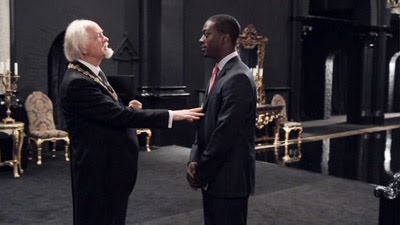 The 2009 Hamlet features an outwardly patient Reynaldo in the service of an aging and dottering Polonius. He smiles at jokes he doesn't really get and tries to walk away before the rather lengthy conversation starts again (the comedy exit is brilliant). This is a fair way to play since Polonius' long-windedness is Shakespeare's big joke. Just as he ironically has Polonius later go on and on about being brief, and in a later moment pointing out that a speech is too long, here he basically talks to himself, as the other character in the scene barely gets a word in edge-wise. It strikes me now that Polonius asks the questions he immediately answers ("Wherefore should you do this?").
 It's an episode of Alzheimer's or dementia which puts in question Polonius' entire agenda. Why IS he sending a spy to follow his son? The genial Polonius in this version doesn't usually seem sinister. It's like the evil he does is almost accidental, casual and without reflection. It's just what he does because he's always done it. Does he even know there's been a change of kings? His mental competence is certainly in question. If he's obsessed with what the director calls hyper-surveillance, then what should we make of the shot of the conversation from the security camera?
 Even as Polonius instructs his spy, he's the victim of surveillance. From whom? Claudius? Some unknown agency? The audience? Basically, he's under surveillance by dramatic irony. The shot is there to show us a man who has lost control of his own tools (whether that be spycraft or words). In general, whatever Polonius says in the play, the opposite has a better claim to the truth. He will be brief only by being long-winded. He will spy only by being spied upon. And he will never be right about anything - not Hamlet's madness, not his designs on his daughter, and not where to hide in Gertrude's closet. Everything he says is thus suspect, including his suspicions about Laertes' behavior, later to be refuted in everyone's dialogue (calling him a valiant youth, etc.).


