Showing posts with label III.ii. The Mouse-Trap. Show all posts

Thursday, May 10, 2012

III.ii. The Mouse-Trap - French Rock Opera

Un trône sans roi/Throne Without a King is a transitional piece of music on Johnny Hallyday's album, but if you use your imagination, you might see how it would have underscored action in the staged rock opera. It is placed where the Mouse-Trap would be, and through the repetition of the dirge motif Le vieux roi est mort/The Old King Is Dead already used twice before, has a similar recap function. Here is the text and a quick translation.

Un trône sans roi
Le vieux roi et mort
Depuis moins d'un mois
L'herbe sur sa tombe
Ne pousse encore pas

Le vieux roi est mort
Le temps d'une messe
Il est notre roi
Il cale ses fesses

Throne Without a King
The old king is dead
For less than a month
The grass on his tomb
Still does not grow

The old king is dead
The span of a [church] service
He is our king
He sinks his ass

It is telling that the chorus sings here and not Hamlet, though as we know from the play, he has written their words. This is the murder as presented by the Players. We could well imagine the processional music underscoring the arrival of the Court to the playhouse. Then, suspenseful stings over the dumb show, probably dance-like. Finally, we end with the result of a king's death, and the familiar Dead Old King theme. The first two lines are the same, but reiterate, as Hamlet does in the text, the temporal collapse caused by his grief. Using the chorus/Players translates that collapse to the People, foreshadowing their later rebellion. In fact, the lines here go further, from "less than a month" to "the span of a church service". The King has been forgotten by the time his funeral service is over.

And then time is collapsed even further when a new King shows up in the next line, so Hamlet Sr. has been forgotten in the breath between two lines. Those final lines do play on an ambiguity, as the "king" is actually two separate characters in the play. On the one hand, there is a resistance to a new leadership, the dead king being that of the people, even as his descent into the ground is mocked with colorful language. On the other, the new king is now that of the people - speaking to an ironic interchangeability as far as commoners are concerned - and a mockery of his sitting on that empty throne, now filled. That is the story of The Mouse-Trap.

Saturday, May 5, 2012

III.ii. The Mouse-Trap - Classics Illustrated

The original
Surprisingly, the old "boys' adventure" comics version includes both the dumb show and the speaking play, though it makes huge cuts through the use of captions to fit them in. In other words, they both "happen", but are not necessarily seen. The pantomime that precedes the play is visual, of course, so becomes the backbone of the comics version.There are number of interesting touches, as if the artist, freed from the Classics Illustrated constraint of heavy work balloons, has finally been allowed to show his quality. As the Player Queen leaves the sleeping king, for example, there's an odd expression on her face. Is she worried she might wake him? Or is she colluding with the murderer, but already feeling guilty? I also like the purely graphic juxtaposition of crown and poison separating the two bottom panels, showing how one can act as a gateway to the other. The sequence continues on the next page, where the Queen is offered jewels, but she seems to refuse from her body language. So it's not always clear what she's thinking.

A puzzled Ophelia asks about the argument of the play - the only live commentary made in this heavily edited version - but Hamlet leaves it to the Prologue. There is no cruelty towards Ophelia or the Royals, the play being the only possible impetus for Claudius to lose it. Hamlet's antics do not play a part or muddy the waters. On purpose perhaps, the Player Queen is a dead ringer for Ophelia, wearing the same kinds of clothes as well.
After a few words from the Prologue, the action cuts to Claudius' fit. We've seen the play's action through the pantomime, and we know the story because it's a mirror of Hamlet Sr.'s murder, so this is quite economical, while respecting the events of the play. Needlessly? If Claudius had reacted to the dumb show, it would have made more structural sense. As is, even though we know everything we do, there still seems to be a scene missing. It makes you want to see the trigger.

The Berkley version
Hamlet is likewise more pleasant to Ophelia in Tom Mandrake's version, his smiles turning cruelties into mere teasing. His art makes good use of shadows throughout the sequence, often keeping the Royals hidden, even when they speak lines. The darkness of their sins and their initial ambiguity make justify it, but it is starting to feel like they are shadows, ciphers or otherwise non-characters. Even the "protests too much" line is given to Ophelia instead of Gertrude. One place where shadows are better used is in Hamlet's face. The darkness of Ophelia's lap plays across it when he turns more serious and thinks of his father, ironically while entering a motherly womb.
Mandrake does away with the dumb show in favor of the spoken play, his painted Players in various cultural costumes separating the heightened reality of the Mouse-Trap with the Medieval trappings of the play outside the play, though I'll never get used to Claudius' Santa Claus outfit.
In the absence of a preceding panto, Claudius now sees the accusation for the first time, and reacts. Again, there are few public antics from Hamlet, so his idleness is not what distracts or affects the King. Both comics versions have chosen to make the King unambiguously guilty.

Thursday, April 26, 2012

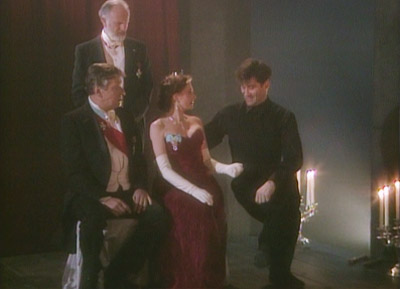
III.ii. The Mouse-Trap - A Midwinter's Dream

It's likely this version of Hamlet, if actually staged, would be exhausting to both audience and actors. Because it is presented as a quick-paced montage, its energy level is consequently very high. It drives the montage well however. Maloney's Hamlet is always moving around with a barely contained fury. Every line is an attack that justifies a more defensive tone from the Royals.

This short sequence takes us from "Madam, how like you this play" to "The Mouse-Trap", the latter spoken in the direction of the audience, played as an important reveal. In the montage, it plays the role of "the play's the thing" and tells us how those early scenes with the players could be removed from a particular staging, hiding from the audience Hamlet's true purpose until Act 3 Scene 2.

Wednesday, April 25, 2012

III.ii. The Mouse-Trap - Slings & Arrows

The very brief part of this scene used in Slings & Arrows amounts to Hamlet's opening insults to Ophelia, but there are still lessons to be gleaned from it. On staging, you'll note that Ophelia and Hamlet are sitting/crouching near the ground, which fits the low-brow humor of the "country matters" line. Hamlet is in full madcap mode, rubbing his hands with devilish glee as Ophelia is continually hurt.

Hamlet turns to the audience to say "That's a fair thought to lie between maids' legs" and gets a laugh without need for Ophelia's questioning retort. The audience gets it because the punchline precedes the joke. In the text, the fact that Ophelia asks for the joke to be explained isn't strictly necessary, though it does inform her traumatized character and works within the rhythm of the scene. By making Hamlet's line an aside, Ophelia does not have to react to it and comes off as even more wounded, unable to properly interact. An aside at this point, and once that elicits a laugh at that, makes the audience share in Hamlet's cruelty. Because he shares his lewd thought with us, we empathize with him, which makes us his accomplices. Subtle, but subversive stuff.

Sunday, April 22, 2012

III.ii. The Mouse-Trap - The Banquet

Set in China, The Banquet of course presents the play-within-a-play as Chinese opera. The full court is in attendance, but the Royals are quite far from the stage. It's all dumb show, with masked acrobats, but interestingly, the Hamlet character is sitting on the stage, masked, facing his parents and keeping the beat on a drum. A ghost clad in white (the color of death) comes to kill a ref-faced king and already, even before a puff of scorpion venom is blown into the figure's ear, the King recognizes something. As the opera makes its points, close-ups of the King and Queen reveal unease, while those of Hamlet rather show a cold fury, thought it's difficult to divine the expression behind the mask. These are intercut with close-ups of the previous King's armor, shedding tears of blood. In this way, this version of the play includes the Ghost.
In fact, the Ghost is quite prominent, not only in the cuts to the armor that has come to represent it, but in the garb of the people on stage. There are two white figures, including Hamlet whose facelessness turns him into a ghost himself. This osmosis presents characters doing the Ghost's bidding, as if he were the one putting on the play and observing well the guilty party.

At the end of the dumb show, the murdered Player King keels over, a shot that is played over and over again, lending it psychological weight. The Royals gets up from their thrones and walk over to the stage where the King examines the dead body. Cool and collected, smiling even, he starts a slow clap filled with sarcasm, though the court doesn't take any chances and starts to applaud as well. In this mockery, he hides his own guilt. He then turns to confront the Prince in what seems a mirror of the Prince's first scene of the play. "Hamlet" is asked to remove his mask (i.e put an end to his mourning) and in seeming madness, doesn't want to be touched by the King lest the black scorpion venom get on him. In response, the King sends him on a mission to the North because it is time he resume his service to the country. This combines the ideas of Hamlet's first scene and the exile forced on him after he has killed Polonius, making the Mouse-Trap reason enough for the Prince's exile, one during which he will suffer an assassination attempt.

This being a Chinese martial arts epic, Rosencrantz & Guildenstern will however be replaced by snow-tunneling ninjas...

Sunday, April 15, 2012

III.ii. The Mouse-Trap - Tennant (2009)

Tennant's Hamlet is a petulant and mischievious child in this scene. The audience's entrance is scored with the Danish national anthem, as a barefoot Hamlet insolently whistles along. They ignore him, and we get the sense that his parents are already tired of his shenanigans. They do not appear to be particularly excited at the prospect of a night at the theater with him, and indeed, the audience is rather small. This is an intimate affair, not the public one other versions have created. We are definitely in the wake of Hamlet's attack on Ophelia. She comes in with her head down. Her father looks ever so puzzled. No one trusts Hamlet's mood. As if to give them reason, his giddy idleness is immediately disrespectful, throwing in an army salute with the chameleon's dish line, mocking the normal obedience one should show a father and a king.

In the early part of the scene, everything is more intimate. Hamlet asks Polonius about his acting days in private conversation, and only Polonius laughs at the prince's pun. It's interesting however to see Polonius so confounded by the fact he had to be killed in the play, a precursor to his actual senseless death in THIS play. Hamlet runs off with Ophelia, grabbing her out of her seat and to a position from where he can better observe the Royals. At this, Polonius breaks the fourth wall to ask us if we "mark that". Again, the scene's intimacy prevents him from being more public about his thoughts. Hamlet drags Ophelia down to the floor and wraps her arms around himself, mockingly bites her arm. It is a parody of a normal romantic relationship, and in a sense, perhaps a disguise. Sitting across from his parents, he appears to be getting back together with his girlfriend, but his cruel, unheard words tell another story. Tennant underlines the dirty pun in "country matters" (cunt-ry matters) to make it harsh indeed. And yet, his "as woman's love" later is a private statement, sounding more sorry than mean.

These private moments contrast with the moment when Hamlet actually flings an accusation his parents' way, as he shows more and more difficulty reigning himself in. At the jig-maker line, he gets up and dances humorously on the rug that will serve as a stage, making his mother laugh, which is the moment he chooses to begin his open cruelties. His very bitter delivery of "die two months ago, and not forgotten yet" gives it a strong ironic bent. For Hamlet, two months is no more appropriate than two hours, recalling the Hamlet from earlier in the play who was told to stop his grieving.
The dumb show is a most depraved affair meant to shock perhaps more than amuse. A tiny king with giant ears comes out of bald, fat queen's skirts and speaks unintelligibly (I was reminded of Pingu) until he is poisoned by a glam murderer with a heart over his crotch which, when removed, reveals an uncoiled slinky. The dead king's shroud becomes a ghostly sheet that runs off to let them have sex. Through this ridiculous piece of bawdry, Claudius laughs not at all, holding his temper in check. We do see his reaction to he mock poisoning, which makes this Claudius quite aware of the insinuation from early on. He stews in his own guilt longer as a result. As the dumb show starts, Hamlet takes out his camera and starts filming it, or really, the Royals' reactions to it. In this way, the film keeps the energy up by layering in Hamlet's point of view. When does he look at the characters and at what gestures or words do he focus in on his mother or stepfather?
The play itself features rather extreme Elizabethan costumes, and a staging that mirrors that of the Royals (king-left, queen-right). Gertrude is bitter and impatient at the text. She knows very well what she is being accused of and finds it insulting. With great poise, she questions whether the Player Queen protests too much, and gets a laugh from the audience. It's a show of power against Hamlet, and the audience seems to be on the Queen's side in this. As for Claudius, the cracks start to show. Silent up to this point, he asks if there's offense in it, in fact proposing there is, at which Polonius makes an odd gesture as if to stop him from speaking out. Have they decided prior to the play to let Hamlet have his fun and show no reaction? Reacting, even with a smaller audience, is dangerous at this point because Hamlet is filming them. The (Mouse-)trap is theirs to get caught in.

After mouthing many of the lines himself, it's time for the murder, and Hamlet can't help but get up and spoil the ending, just to force the reaction he's looking for, triumphant even has he ruins his own device. Does he succeed? The king rises, but walks calmly to a stagehand and requests light. He then brings the lantern over and shines it on Hamlet, as if revealing the prince's madness for all to see. He shakes his head as if to say "You won't get me so easily". To the assembly, this may instead mean that he pities and softly chides Hamlet, but we know better, and the slightest of smiles from Patrick Stewart speaks volumes. That Hamlet thinks he's found a chink in the King's armor may be wishful thinking on his part however.

Sunday, April 8, 2012

III.ii. The Mouse-Trap - Fodor (2007)

The Mouse-Trap is translated into a German experimental film in Fodor's vision. It was made very quickly, although the play does allow for temporal anomalies like this, as we've often discussed. In the film, we first see a hammer and a screwdriver, the murder weapons, as it turns out. Then the murderer, thinking, plotting. The Queen getting her picture taken, an image of the people's adulation. At this point, we cut to Hamlet in the audience, nodding along. Even in the text as written, the Queen hammers her point a bit stridently - Gertrude's evaluation is not far off - so this might indicate that her dialog was manipulated by Hamlet. A similar idea is used here to "get" Gertrude as well as Claudius. In the text, it makes her a betrayer of her word. In this version's film, she is a co-conspirator whose motivation seems to be greater fame and power.

The film continues... The Queen is having dinner and flirting (insincerely) with the King. In the audience, there are uncomfortable shots of Claudius and Polonia - in this version, his new mistress. Does she see herself onscreen? Is she actually the Queen character who seduces the King to slip him poison? We assume it's the Player Queen, because that's what it is in the text. Fodor's gender-switching game may give a different interpretation where the character is both women. On screen, drinks are brought to the table, and in the audience, it sparks Ophelia's "You are merry", but as with most of the dialog that should intercut the Mouse-Trap, it is done in voice-over, making it very ambiguous as to when these words were actually spoken. Usually, we can assume they were said before the start of the film. In others, such as Getrude's "The lady doth protest too much", that wouldn't make sense. Are these words just the imaginings of Hamlet, taking the place of memories? Or since we never see her "protest", are we hearing something said in an earlier part of the projection?

Back in the film, the King drinks and topples over (Polonia and Claudius share a look, and again we wonder if she's the woman). Horribly, the poison is just a knock-out drug and the murderer must stab the King in the ear, driving the screwdriver down with his hammer. At the first stab, we hear a horse neighing, perhaps an image imposed by Hamlet to represent his noble father.
Claudius starts getting hot under the collar, and at the murder, Fodor flash cuts to every character's reaction. Shock is registered on almost all faces, even on Rosencrantz/Guildenstern's, though he soon starts to laugh at how cool the violence is like the sociopath he is. Children's laughter is heard on the soundtrack at this point. The King rises and distraught, goes to stand before everyone, the movie projection flickering on his face. He's lost it completely and he stands revealed, the projection putting the murder on him, like blood on his hands. Everyone then leaves behind him, and only a judgmental Gertrude stays a moment to give her son a stern look (setting up the next scene), before leaving Hamlet and smiling Horatio alone in the dark to enjoy their victory.

Sunday, April 1, 2012

III.ii. The Mouse-Trap - Hamlet 2000

Hamlet 2000 features some important cuts, including the entirety of the play within the play, replaced by a dialogless art film of Hamlet's creation. While it serves the same function as the play, by showing images designed to perturb the King and Queen, it does mean a lot of commentary on the play had to be cut as well ("'Tis brief", "doth protest too much" and "is there no offense", for example). Still, staging the scene in a movie theater does have its uses. There's a depth to such a room that allows the entire audience to be seen at different levels in the same shot, and the director keeps the Royals in the background kissing until Claudius finally pulls focus by speaking. Hamlet's words are for Ophelia alone, keeping up the barrage of insulting words started in their previous scene together, playful but highly sardonic. What comes across is that Ophelia really doesn't understand him. Everything she says in this section is wrong, either a misunderstanding or really Hamlet switching things on her. Hamlet seems angry with her for not understanding him, though it's also his fault for behaving differently.

Only at the end of his diatribe about people forgetting his father does he raise his voice enough for Claudius to notice him and ask "How fairs my cousin Hamlet?" The answer is cut down to a simple "excellent" after a pregnant pause that dismisses the King and let's it be known he really has nothing to say to his stepfather. Polonius, meanwhile, is absent from this scene entirely, and after all, there's no reason for him to have the Brutus lines seeing as there are no Players or talk of acting.
The film starts with white on red title cards that plays on Hamlet (the play)'s own title: "The Mouse-Trap, a Tragedy by Hamlet, Prince of Denmark", a visual reminder, perhaps of his aborted rise to the throne. The images shown include time-lapse photography, clips from old movies and Monty-Python-style animation. In order, we see a flower opening, clips of a happy childhood with a father and his son, the world turning, a bottle of poison, animation showing the poison going into the ear, scenes of murder and death, athletes falling like dominoes, the flower wilting, a child comes down the stairs, Mark Anthony and Cleopatra (a reference to another adulterous relationship in Shakespeare), some pornographic material, a crowd applauding and a king crowning himself before the mirror.
At the sight of the poison, Claudius starts to sweat, catching the obvious accusation. For Gertrude, the difficult part of the film is the pornography, and given her innate lasciviousness, it must be because she gets the inference. She is the pornographic Cleopatra on the screen, and it's her son (there are no other authors of this drama, no "Murder of Gonzago" template) who has represented her this way. Claudius will walk out of the theater at the end, fighting with his demons, while Gertrude attempts to follow, speechless as she turns towards her son.

By virtue of the many cuts, this Hamlet is less active than the text's, but he needs to prod the King and Queen much less because he made the film, whereas in the text, The Mouse-Trap is meant to be a play he ordered from the Players' repertoire. The message is more direct, and Hamlet need not jump on stage to make his own intent clear.

Saturday, March 24, 2012

III.ii. The Mouse-Trap - Kline '90

In Kline's adaptation, the Royals sit on the stage, facing the audience, and the Players perform their play midway between the Royals and the audience, using profiles to play to both. This is an ingenious use of stage space that in the theater, would allow the real audience (us) to see both The Mouse-Trap and the characters' reactions. While Hamlet doesn't sit on stage, he and Ophelia are off to the side, still facing us in ¾ view. This staging also works thematically, enhancing the mirror effect between the Royals and the Players.

Ironically, though Hamlet has dramatized his parents, both by rewriting the play and placing them on the stage for all to observe, he's the star of the show. As the Court enters, he is draped in a red curtain, Christ-like. He initiates applause that an already impatient Claudius stops with a look and a gesture. He falls off the stage as if it were a cliff, making his voice recede, an echo of the fate Horatio feared he would meet by following the Ghost some days prior. Indeed, while we'll soon find out the Ghost wasn't lying about the murder, the play is the moment that truly embarks him on his doom. It will lead to Polonius' murder, his exile, subsequent return, and "all we mourn for". His falling off a cliff here makes that point. Kline also makes good use of his mime skills by sitting next to his mother on an invisible chair, as absent as their relationship.
Hamlet also makes Polonius squirm by letting him go on about his university days, a brilliant comic delivery from Josef Sommer as Polonius, adding information haltingly to cover the lack of reaction. The crowd does laugh at Hamlet's punchline, as it does at some of his early cracks at Ophelia. Her humiliation feels all the more public, and her quick look at her father when Hamlet makes an obscene remark may indicate she's hiding a sexual relationship (older-looking Ophelias, and those from more modern settings, give this impression rather easily). And of course, Hamlet flings accusatory comments in his parents' direction, which displease, but do not seem to embarrass.

Claudius is a character to watch in this sequence, and not just because Hamlet has asked us to observe him. Brian Murray plays him fresh off the Nunnery scene, wary of what might happen, rather than, as it is sometimes played, seeing a turn for the better in Hamlet's passion for the theater. As the play begins, rather suddenly and without Prologue or dumb show (and yes, that means the brevity of woman's love isn't mentioned), Claudius gets somewhat lost in the story. The visual mirror makes Gertrude see herself in the Queen, of course, but mistakenly see Claudius in the King. In the background, she tenderly pets her husband, not seeing her forgotten former lord. Claudius is no less affectionate, though he does look in Hamlet's direction whenever the prince blurts out a line, trying to figure him out.

His other hand is on a drink, one we see him refill during the sequence (as Hamlet mentions poison, another visual irony). Playing on Claudius' weakness for alcohol goes a long way in showing how such a practiced politician could give himself away during this scene. He's had too much too drink and loses control. It's also interesting to see him puzzled at the title of the play, for indeed, why is it called that unless it ends with a Player Prince catching the murderer? Claudius might even think Hamlet has made changes to the play, and a clue exists in Lucianus switching from dagger to poison as he enters. One of the changes Hamlet has made? As the veiled accusation is UNveiled, Claudius drops his glass and stands, a gesture that shocks the assembly. Here, Kline creates a motivation for the otherwise redundant line "The King rises". The audience must be prompted to stand (as they must) because they've forgotten their manners in the wake of this incident. Chaos ensues as Claudius disentangles himself from Gertrude's kind ministrations, as she is part and parcel of the guilt he's suddenly experiencing.

Saturday, March 17, 2012

III.ii. The Mouse-Trap - Zeffirelli '90

Despite his adaptation's many cuts, Zeffirelli acknowledges this scene's importance by not only showing a good part of the play-within-a-play as written, but by collapsing parts of various other scenes into it. For example, Polonius is here part of the show, gives a cue to the musicians and introduces the players on stage with the "pastoral-historical" speech from Act II Scene 2. He makes a meal of it too, enjoying the laughter he gets from the audience, sincere in his praise but also over-egging the pudding to get a reaction. Hamlet then has good reason to ask about Polonius' university days, coming around with a cup of wine and an inebriated step. Claudius, already in high spirits, laughs at Hamlet's Brutus pun (which is ironic given that like Julius Caesar, he's to be murdered by an adopted son - I'm surprised I never saw the connection before), but is puzzled by the "promise-crammed" comment. He's still trying to figure Hamlet out.

Ophelia is at once impatient and hurt by Hamlet's words and actions, rolling wet eyes at the ceiling. It's a small moment, but one of Bonham-Carter's best. Before the play, we're offered acrobats, clowns and jugglers, during which time Hamlet and Ophelia have part of the Nunnery scene (as already described in a previous article; Zeffirelli is also a juggler, of scenes). It's their one private moment in the scene, as otherwise, Hamlet lets the King and Queen overhear things just to make them squirm, treating them as if they weren't there. In fact, during the play, Ophelia is mostly forgotten and some of her lines are given to others. The Queen says of the Prologue "T'is brief, my son" so Hamlet an direct his barb straight at her. Later, Claudius gets "You are as good as a chorus, cousin" as the director wants this to be a duel between the two men.
After the Prologue, rather big and clownish because Hamlet never instructs the Players in this version, the play starts without the dumb show and cut down to essential lines. The important lines are intact, but this collapse does hammer the point home aggressively, giving Gertrude, all forced smiles and gritted teeth, reason to opine that the lady doth protest too much. The Royals immediately feel targeted, and a satisfied Hamlet, grins eagerly at their reaction. His plan is working and he can't help but participate by mouthing words he apparently wrote, or talking out of turn, mischievously pushing a patron back so he can slip the King a comment or two. Claudius can't be sure Hamlet knows the truth and the way he pitches his question about whether or not he knows the argument, you can tell he finds it strange Hamlet already knows the story. By this point, Claudius is avoiding Hamlet's eyes, sweating, gulping down wine nervously. This Hamlet may be hyperactive, but he doesn't shout his less-than-veiled accusations at the whole assembly, he takes the Royals into his confidence, in a hushed voice, manically pulling at threads on his clothes as the story and Claudius' composure unravel. He doesn't tell "Gonzago" what to do, though that player does lose his lines and simply enacts the murder (an echo of the dumb show). We instead focus (as Hamlet does) on Claudius' reaction.
At first he leans in, then rises, holds his head in pain and drops his cup. On stage, the Player King has dropped down hard enough to dislodge his crown, a nice piece of stagecraft and mirror to Claudius' own loss of control. Hamlet steps all over the audience to follow the advancing Claudius, fixed on his expression. Claudius points at the murderer who looks positively dumbstruck, then begins to laugh insanely, turning towards the audience. No one seems to know how to take this, least of all the Players, and he runs out of the castle to get some air, chaos in his wake. The verdict definitely points to Guilty.

Sunday, March 11, 2012

III.ii. The Mouse-Trap - BBC '80

Hamlet begins the scene in a cloak and skull mask which makes Claudius laugh and Gertrude smile. The staging, in which Claudius immediately recognizes Hamlet under the mask is ironic. What Claudius actually recognizes is that Hamlet will be the death of him. In fact, everyone who interacts with Hamlet-as-Death will be dead by the end of the play.

Hamlet's initial interaction with Ophelia shocks and grieves her, so he corrects his intent and puts the shame on her, acting disgusted that she thought of "country matters". To him - because of her recent betrayal, or possibly simply because of her gender - she is a whore and a deviant. He reiterates the idea when he says woman's love is brief, pointing it at her rather than his mother. Is there a difference in his mind, or does he paint all women with the same brush?
The play is well-realized through stagecraft that creates an optical illusion of depth in the set, and a lot of time is spent on the mime show. As it plays out, the clown versions of the King, Queen and murderer make the real King, Queen and murderer laugh. Hamlet acts like he's evaluating the events the play is based on for the first time, but also seems disturbed at how much fun Claudius is having with it. The King doesn't clue in that the murder is an image of the one he committed, and roars with laughter. The mime show ends with the murderer quelling the Player Queen's grief with a rich gift of jewels. She's essentially being bought, another reference to her being a whore in Hamlet's eyes.

The play itself appears in slightly abridged form, but nothing major is lost and it moves along quite nicely. It's only at "wormwood" that Hamlet finally attracts the attention of the Royals - all previous accusations were made in Ophelia's confidence alone - and it is perhaps only then that the King and Queen realize the play might be about them. Up to that point, they were fresh teenagers on a date, but now there are more silence and squirming. After the first scene, Gertrude is so caught up in her own thoughts, she almost forgets to applaud, and does only awkwardly, with too much enthusiasm. She's the one who "protests too much". Hamlet puts the accent on "her" in "She'll keep HER word", a veiled accusation, and by this point, though Claudius is far less easy to read, he's lost all of his cheer.

With the Player King confused by Hamlet's interruption and attempt to spoil the play's ending, the prince waves the murderer onto stage. Jacobi shows Hamlet's impatience quite well here, losing his temper when the player doesn't immediately start speaking the lines. And finally, Hamlet loses it altogether, in a rush to see Claudius' reaction, interjecting just as the Player King is poisoned and wracked with pain. He makes sure to mention the garden, so that no detail of the accusation is lost. He over-eggs the pudding. This adaptation makes us realize that though the play is designed to catch the conscience of the King, Hamlet never lets it do that. He wants to rumble Claudius himself. Does he succeed? From the staging, it's really not clear he does. It's not even clear he's guilty of the crime he's accused of.
Though he accuses Claudius of being "frighted", the King's reaction is really to stand and approach Hamlet, bringing a torch too close to his eyes. It's a stand-off. He asked for light not because he struggled with his own darkness, but because he wants to expose Hamlet's. Violence almost breaks out before the King catches himself. Hamlet starts to giggle insanely, giving Claudius the chance he needs to turn around and smile at the assembly. He sends everyone home and it's understood that this evening's diversion has been just another of mad Hamlet's shenanigans. We're left wondering if anyone really did catch the King's conscience or even if there was anything to catch in the first place.

Sunday, March 4, 2012

III.ii. The Mouse-Trap - Olivier '48

Trumpets sound, everyone enters, Hamlet in darkness in the center. First, courtiers and players, showing deference, and only then do the Royals come down the stairs. Hamlet goes up to help his mother come down. Is he lulling her into a false sense of security? That would be coherent with the whole idea of putting on a show (the play and his high spirits). His first shot at her, choosing to sit by Ophelia instead of her, seems even more mercurial from her point of view, and calculated cruelty from ours. The courtiers gasp at this slight. The idea that this sequence scandalously upends Denmark's hierarchy is something today's audiences might not at first get. Not that Ophelia is kindly treated. Hamlet grabs her by the wrist and pushes her down into a chair. Though this is a violent gesture, her father Polonius is rather pleased that it seems to confirm his still-held theory. The poor man is completely oblivious in this version, the only one to laugh when Hamlet publicly humiliates him. Ophelia's own humiliation in this scene is more private. Gertrude and Claudius don't even hear Hamlet's loud accusations before the play starts, so as if we were watching it as a play, the actors are projecting their voices, but intimacy is nevertheless retained. This Ophelia is an innocent, naive girl, so the references to her lap do shock her.
Of The Mouse-Trap, only the Prologue and mime show are in the film. The Prologue seems almost embarrassed at how short the text is, though he may just be intimidated by the royal audience. Did Hamlet write this? Since there's no dialog, where are the lines he inserted? If he did write the prologue, we might believe he set himself up for his "As woman's love" line. The "mischief" is definitely Hamlet's. On stage, the orchard is represented by a sickly-looking cactus-like tree and the camera stays mobile as if to show a shared point of view. With no words spoken, we're allowed to focus on the audience's reactions. Ophelia catches Hamlet looking at the King. Horatio is also looking in that direction. And there's something to look at. Even Polonius notices the King having difficulty, though he assumed Claudius to have taken ill. The play continues regardless, with the Player Queen finding her dead husband and being comforted by the murderer. There's a lot of gossip in the crowd, but it looks strange without Hamlet's more public accusations, as is the fact the King is moved in such a fashion.
Though he melodramatically asks for light, he acts as if blinded by the images in his mind. Hamlet brings a torch much too close to his face and he flinches and runs off. Olivier follows this up with utter chaos. The Queen looks at Hamlet with a "what have you done" kind of look, while everyone else runs in every possible direction, as in a scene from a monster movie. The natural order has been completely destroyed. As the King loses all control, so does the populace, and though Olivier doesn't explore every aspect of that idea, in the text it does thematically lead to, first, the peasants proclaiming Laertes potential king, and second, the invasion of Denmark by Norway. In a sense, Olivier covers the cut of those plot elements with this scene which does something similar through visuals.

Saturday, February 25, 2012

III.ii. The Mouse-Trap - Branagh '96

We enter the scene on a kiss between Claudius and Gertrude before the camera pans down to the stage even as a chandelier rises and the audience applauds. It doesn't applaud in the stage's direction, however, but in the royal couple's. What is actually the show, here? Even to the audience within the film, Hamlet's play is probably less important than the Courtly soap opera of the couple so quickly nuptialed after the death of the old King and the mad ravings of the Prince. Like Horatio, they'll be watching Claudius and Gertrude. In fact, Branagh cuts to Horatio and the gossiping Court often, reminding us of this public scrutiny. When Hamlet appears on stage, a spotlight is immediately lit. He is the country's beloved Prince - as Claudius mentions elsewhere in the context of not being able to easily dispose of him - and the audience laughs at all his jokes. At least until they become too cruel. Claudius' voice is strained when addressing Hamlet, while Gertrude is happy to see him in good spirits. It seems likely Claudius has not shared what he heard Hamlet say in the previous act. Ophelia, for her part, seems quietly sad, even embarrassed. She was no doubt the object of gossip even before this night, and Hamlet's public cruelties would make this a very difficult evening to bear. And then there's Polonius, who grits his teeth and takes Hamlet's humiliating him by dragging him on stage. Here, Branagh shows how showing the audience's reactions can influence our understanding of the play. The way people roll their eyes and smile when Polonius says he once played Julius Caesar resonates with them. The King's chief courtier playing an emperor? Perfect casting for someone the Court probably sees as a brown-nosing opportunist with too-elevated ambitions.

As Hamlet plonks himself down next to Ophelia, he mocks her and his mother openly, shouting his lines so that everyone can hear, letting his rising anger drive the scene. The Court actively ignores him, though he does set them to whispering. Hamlet even manages to make his mother blush at the shortness of her grieving period. Though Claudius may be guilty of murder, Gertrude is guilty of not loving her first husband enough, and she is just as caught in the "Mouse-Trap". Branagh continues to mix the play on stage and the play in the audience together, having these early mockeries end on applause. It sounds like they're applauding Hamlet's bit, but they're really cheering for the Players who have just come on stage. Eventually, Hamlet will be on stage too and it won't matter what's in or out of the play.

Hamlet's mischief gives way to the dumb show's, which is played so broadly and quickly that it doesn't give away the plot of the play. That's the advantage with doing the whole play - many versions will use the dumb show and nothing else to save time - as it allows for a more mysterious dumb show. Here, Ophelia doesn't seem stupid for asking whether the show contains the argument of the play, just as it's reasonable for Claudius not to see the image of his murder in the action as yet.
The Players' costumes set the play in the Middle Ages, contrasting well with the more Napoleonic look of the film's events while winking at the period in which Hamlet is actually set. The Players give an intimate and very emotional performance, in keeping with Hamlet's instructions and the First Player's qualities from his earlier monologue. It's powerful stuff that should connect with the Royals. But Hamlet is anxious because the King and Queen aren't always watching the play, instead feeding each other bits of Turkish Delight, kissing, or drinking (we're often reminded that it is Claudius' vice). Will Hamlet miss his chance to show the King's guilt? It helps explain why he later jumps on stage to draw their attention. When they do watch the play, they empathize with the wrong things. The love between the Player King and Player Queen, for example, makes Claudius and Gertrude get closer and publicly cuddle. Their reaction tells us they really are in love, no matter what has happened before. At the mention of the "second husband", however, the Court starts looking back at them. The play is suddenly quite scandalous, and the Royals' point of view heightens the paranoia.

The Player King is so kind and loving - an idealized Hamlet Sr. - that he gives the Player Queen permission to wed again, but it's her that swears she won't. It is in moments like these that Hamlet seems more intent to show his mother as an unfaithful whore, than his stepfather as a murderer. Or perhaps it's a feint, letting the Court (and the King) think he's going after his mother, to hit them with a surprising revelation about Claudius. In the play, the Player Queen does not betray the Player King, she betrays HERSELF. Is this at cross-purposes with Hamlet's intent and opinion? Or is betraying oneself worse than betraying others? Let's not forget the theme of the play can be found in the line "To thine own self be true". Hamlet's true self is not a murderer-avenger, which is what delays the action of the play and causes the tragedy. Here, he accuses Gertrude of not being true to herself, or to the image he has of her (the wife of his father). During all this, Ophelia seems quite taken by the play. Again, Branagh makes a lot of inferences through reaction shots. Is Ophelia seeing there the image of the relationship she wishes she had with Hamlet? Does she idealize, perhaps, the unseen relationship between her father and dead mother? Polonius may well tell his stories of suffering much for love around the house. As the scene runs its course, Hamlet slowly creeps down to the stage...
He gets the Royals' reactions to the play and starts to play the chorus. In another cruel exchange with Ophelia, he plays on her "better/worse" remark, linking it to wedding vows (for better or for worse). Does Branagh's pronunciation create an additional layer of pun? The line is "So you must take your husbands", but I hear "So you mistake your husbands", a potential dig at his mother's swinging allegiances. Savage with his own potential wife and with his parents, Hamlet, by osmosis, is the same with the Player Murderer on stage, an image of his stepfather. The accusation is not so much in the play as it is in Hamlet staring up at Claudius from the stage. It is implicit, verging on explicit, and people start to squirm in their seats. Slow zoom on Hamlet and the King as the editor cuts in with scenes from Hamlet Sr.'s murder. Are we seeing Hamlet's imagination, or Claudius' memory? The edit seems to infer the latter. If the King is moved to stand, it is likely not because the play holds a mirror to his own actions, but rather that Hamlet seems to know what happened. Claudius shows restraint however. "Give me some light" and his bitter "Away" are said in a low, menacing voice that communicate that he has been insulted, but not that he's been rumbled.

The Court leaves in a hurry, probably fearing for their lives if the King catches them in the wrong expression. Will the events of this evening spread like wild fire and cause the almost-revolution during which the rabble at the gates proclaim Laertes king? Quite possibly. Gertrude's reaction is of interest as well. She keeps her eyes on Claudius all the way through... in anger? Outrage? Hard to say. Later, she'll blame Hamlet for offending the King, but in this moment, she wonders if it's all true, and if the man she loves today killed the man she loved the day before. Ophelia holds her head, ever closer to a breakdown. Ophelia's story is one of disillusionment, of a young girl who probably saw the best in everyone finding out reality is a much more cynical and corrupt place.

Thursday, February 16, 2012

III.ii. The Mouse-Trap

The next sequence contains both the play-within-the-play and the conversations held by the audience during its presentation. I wonder if it's a mirror of how audiences behaved in Elizabethan times, perhaps special presentations for the Court in particular. Hamlet's behavior is especially appalling and disrespectful to the Players. Are noisy audiences supposed to see themselves in this mirror? The staging may reveal each director's opinion on the subject. It is not their only challenge however. Though large parts of the play are often cut for time, it must still convincingly reveal the King's guilt. Directors and actors must juggle time and emotional impact, the Players' drama and Hamlet's cruel comedy, and Players and Audience to create an effective whole. No small order. Let's first look at the text itself (in italics) and see what resonates, staging unseen.

Danish march. A flourish. Enter KING CLAUDIUS, QUEEN GERTRUDE, POLONIUS, OPHELIA, ROSENCRANTZ, GUILDENSTERN, and others

KING CLAUDIUS: How fares our cousin Hamlet?
HAMLET: Excellent, i' faith; of the chameleon's dish: I eat the air, promise-crammed: you cannot feed capons so.


Words well chosen. Hamlet eats of the chameleon's dish because he is in fact a chameleon, changing in this very scene from director to sincere friend to actor to madman before our very eyes.

KING CLAUDIUS: I have nothing with this answer, Hamlet; these words are not mine.
HAMLET: No, nor mine now.
[To POLONIUS] My lord, you played once i' the university, you say?
LORD POLONIUS: That did I, my lord; and was accounted a good actor.
HAMLET: What did you enact?
LORD POLONIUS: I did enact Julius Caesar: I was killed i' the Capitol; Brutus killed me.
HAMLET: It was a brute part of him to kill so capital a calf there. Be the players ready?


An inside joke, since Shakespeare himself has a play called Julius Caesar. It also presages Polonius' own stabbing. Hamlet jokes about Hamlet's "brute part", much he will later sincerely apologize to Laertes for killing his father, claiming that his madness was guilty, but he was not, divorcing the murderer from the part of himself that committed the murder.

ROSENCRANTZ: Ay, my lord; they stay upon your patience.
QUEEN GERTRUDE: Come hither, my dear Hamlet, sit by me.
HAMLET: No, good mother, here's metal more attractive.
LORD POLONIUS: [To KING CLAUDIUS] O, ho! do you mark that?
HAMLET: Lady, shall I lie in your lap? [Lying down at OPHELIA's feet]
OPHELIA: No, my lord.
HAMLET: I mean, my head upon your lap?
OPHELIA: Ay, my lord.
HAMLET: Do you think I meant country matters?


My pocket edition, obviously meant for the classroom, omits this lascivious exchange.

OPHELIA: I think nothing, my lord.
HAMLET: That's a fair thought to lie between maids' legs.
OPHELIA: What is, my lord?
HAMLET: Nothing.
OPHELIA: You are merry, my lord.
HAMLET: Who, I?
OPHELIA: Ay, my lord.
HAMLET: O God, your only jig-maker. What should a man do but be merry? for, look you, how cheerfully my mother looks, and my father died within these two hours.
OPHELIA: Nay, 'tis twice two months, my lord.
HAMLET: So long? Nay then, let the devil wear black, for I'll have a suit of sables. O heavens! die two months ago, and not forgotten yet? Then there's hope a great man's memory may outlive his life half a year: but, by'r lady, he must build churches, then; or else shall he suffer not thinking on, with the hobby-horse, whose epitaph is 'For, O, for, O,the hobby-horse is forgot.'


The "hobby-horse" was a traditional pantomime in which two men dressed as a horse danced to a tune, died a "magical death", and rose again when the music changed. As a metaphor for the revenant Hamlet Sr., it is appropriate, as it is for the context of the dumb-show we are about to see. The contraction of time ("out of joint" as it is) is a theme that repeats throughout the play.

Hautboys play. The dumb-show enters
Enter a King and a Queen very lovingly; the Queen embracing him, and he her. She kneels, and makes show of protestation unto him. He takes her up, and declines his head upon her neck: lays him down upon a bank of flowers: she, seeing him asleep, leaves him. Anon comes in a fellow, takes off his crown, kisses it, and pours poison in the King's ears, and exit. The Queen returns; finds the King dead, and makes passionate action. The Poisoner, with some two or three Mutes, comes in again, seeming to lament with her. The dead body is carried away. The Poisoner wooes the Queen with gifts: she seems loath and unwilling awhile, but in the end accepts his love
[Exeunt]

OPHELIA: What means this, my lord?
HAMLET: Marry, this is miching mallecho; it means mischief.
OPHELIA: Belike this show imports the argument of the play.


We should wonder, if all the details of the murder are in the dumb-show, why Claudius doesn't react right then and there. Directors may stage the scene so that he isn't paying attention in this moment, but that's hardly satisfying. What the text seems to indicate is that the text of The Mouse-Trap is an important component in making Claudius relate the play's events to those of his own life, or else that his conscience is "caught" less by the play's incidents than by Hamlet's rather clear accusation at the end of it.

Enter Prologue
HAMLET: We shall know by this fellow: the players cannot keep counsel; they'll tell all.
OPHELIA: Will he tell us what this show meant?
HAMLET: Ay, or any show that you'll show him: be not you ashamed to show, he'll not shame to tell you what it means.
OPHELIA: You are naught, you are naught: I'll mark the play.


Here, Hamlet accuses Ophelia of herself putting on a show, that her love was false, etc. though at the same time intimating that she is a whore unashamed to expose herself. Her retort sounds like a pun on "naughty" and "naught" to me. She returns the insult of being "nothing" by signifying his words are meaningless (or that she refuses to acknowledge their meaning).

PROLOGUE: For us, and for our tragedy,
Here stooping to your clemency,
We beg your hearing patiently.
[Exit]


Whereas Shakespeare's worlds already take place in a heightened, poetic reality, he gives the play-within-the-play some extra height by making the verses rhyme.

HAMLET: Is this a prologue, or the posy of a ring?
OPHELIA: 'Tis brief, my lord.
HAMLET: As woman's love.

Enter two Players, King and Queen

PLAYER KING: Full thirty times hath Phoebus' cart gone round
Neptune's salt wash and Tellus' orbed ground,
And thirty dozen moons with borrow'd sheen
About the world have times twelve thirties been,
Since love our hearts and Hymen did our hands
Unite commutual in most sacred bands.
PLAYER QUEEN: So many journeys may the sun and moon
Make us again count o'er ere love be done!
But, woe is me, you are so sick of late,
So far from cheer and from your former state,
That I distrust you. Yet, though I distrust,
Discomfort you, my lord, it nothing must:
For women's fear and love holds quantity;
In neither aught, or in extremity.
Now, what my love is, proof hath made you know;
And as my love is sized, my fear is so:
Where love is great, the littlest doubts are fear;
Where little fears grow great, great love grows there.
PLAYER KING: 'Faith, I must leave thee, love, and shortly too;
My operant powers their functions leave to do:
And thou shalt live in this fair world behind,
Honour'd, beloved; and haply one as kind
For husband shalt thou--


Whether or not this is part of Hamlet's addition to "The Murder of Gonzago" (and the Player Queen's lines that follow almost assuredly are), it draws an idealized picture of his parents' marriage and of the country of Denmark ("this fair world"). In the play, the family and national environments are the same, and we get a glimpse of how things were before Hamlet Sr.'s murder, if from a biased point of view.

PLAYER QUEEN: O, confound the rest!
Such love must needs be treason in my breast:
In second husband let me be accurst!
None wed the second but who kill'd the first.
HAMLET: [Aside] Wormwood, wormwood.


"Wormwood" has a double meaning we can almost certainly be sure is exploited by Shakespeare. On the one hand, it is a plant with emetic properties, and he is trying to use the words to force Claudius to vomit up his guilt. Wormwood is also the name of a star from the Book of Revelations related to the Apocalypse, which Hamlet might invoke (as a pun, his frequent idiom) as a metaphor for the end of his journey, the end of Claudius' kingship, the coming end of all their lives. Either way, it supports the notion that these lines in particular were inserted by the Prince.

PLAYER QUEEN: The instances that second marriage move
Are base respects of thrift, but none of love:
A second time I kill my husband dead,
When second husband kisses me in bed.
PLAYER KING: I do believe you think what now you speak;
But what we do determine oft we break.


Compare to Claudius' "wick or snuff" when he tries to ascertain if Laertes really has it in him to kill Hamlet even once he's cooled off.

Purpose is but the slave to memory,
Of violent birth, but poor validity;
Which now, like fruit unripe, sticks on the tree;
But fall, unshaken, when they mellow be.
Most necessary 'tis that we forget
To pay ourselves what to ourselves is debt:
What to ourselves in passion we propose,
The passion ending, doth the purpose lose.
The violence of either grief or joy
Their own enactures with themselves destroy:
Where joy most revels, grief doth most lament;
Grief joys, joy grieves, on slender accident.
This world is not for aye, nor 'tis not strange
That even our loves should with our fortunes change;
For 'tis a question left us yet to prove,
Whether love lead fortune, or else fortune love.


Note how several stylistic figures create mirror effects in the play's text. "Grief joys, joy grieves" and "Whether love lead fortune, or else fortune love", for example. Thematically, these support the idea that the play itself is a mirror of the Court. The rhyming scheme may also be part of the effect.

The great man down, you mark his favourite flies;
The poor advanced makes friends of enemies.
And hitherto doth love on fortune tend;
For who not needs shall never lack a friend,
And who in want a hollow friend doth try,
Directly seasons him his enemy.
But, orderly to end where I begun,
Our wills and fates do so contrary run
That our devices still are overthrown;
Our thoughts are ours, their ends none of our own:
So think thou wilt no second husband wed;
But die thy thoughts when thy first lord is dead.
PLAYER QUEEN: Nor earth to me give food, nor heaven light!
Sport and repose lock from me day and night!
To desperation turn my trust and hope!
An anchor's cheer in prison be my scope!
Each opposite that blanks the face of joy
Meet what I would have well and it destroy!
Both here and hence pursue me lasting strife,
If, once a widow, ever I be wife!
HAMLET: If she should break it now!
PLAYER KING:'Tis deeply sworn. Sweet, leave me here awhile;
My spirits grow dull, and fain I would beguile
The tedious day with sleep.
[Sleeps]
PLAYER QUEEN: Sleep rock thy brain,
And never come mischance between us twain!
[Exit]
HAMLET: Madam, how like you this play?
QUEEN GERTRUDE: The lady protests too much, methinks.


In other words, Gertrude did not protest as much and sees the performance as a flawed mirror of her own life. Consequently, her own guilt (for betraying a dead husband) is NOT revealed. She does not see herself in this. The promise made by the Player Queen is the fruit of Hamlet's imagination and Gertrude was never bound by it.

HAMLET: O, but she'll keep her word.
KING CLAUDIUS: Have you heard the argument? Is there no offence in 't?
HAMLET: No, no, they do but jest, poison in jest; no offence i' the world.
KING CLAUDIUS: What do you call the play?
HAMLET: The Mouse-trap. Marry, how? Tropically. This play is the image of a murder done in Vienna: Gonzago is the duke's name; his wife, Baptista: you shall see anon; 'tis a knavish piece of work: but what o'that? your majesty and we that have free souls, it touches us not: let the galled jade wince, our withers are unwrung.


Hamlet seems to give the game away here, basically telling Claudius to confess if his soul be not free, or rather, NOT to confess if he doesn't want to get caught. Note also that the murder on stage is the image of a real murder in Vienna. Hamlet is skirting the truth. The play is actually based on two true stories.

[Enter LUCIANUS] This is one Lucianus, nephew to the king.
OPHELIA: You are as good as a chorus, my lord.
HAMLET: I could interpret between you and your love, if I could see the puppets dallying.
OPHELIA: You are keen, my lord, you are keen.
HAMLET: It would cost you a groaning to take off my edge.

Another pair of lines censored in my pocket edition. The violent image of Hamlet's erection as a sword may prove fodder for other critics than I when we get to the sword fight between Hamlet and Laertes.

OPHELIA: Still better, and worse.
HAMLET: So you must take your husbands. Begin, murderer; pox, leave thy damnable faces, and begin. Come: 'the croaking raven doth bellow for revenge.'
LUCIANUS: Thoughts black, hands apt, drugs fit, and time agreeing;
Confederate season, else no creature seeing;
Thou mixture rank, of midnight weeds collected,
With Hecate's ban thrice blasted, thrice infected,
Thy natural magic and dire property,
On wholesome life usurp immediately. [Pours the poison into the sleeper's ears]
HAMLET: He poisons him i' the garden for's estate. His name's Gonzago: the story is extant, and writ in choice Italian: you shall see anon how the murderer gets the love of Gonzago's wife.
OPHELIA: The king rises.
HAMLET: What, frighted with false fire!
QUEEN GERTRUDE: How fares my lord?
LORD POLONIUS: Give o'er the play.
KING CLAUDIUS: Give me some light: away!
ALL: Lights, lights, lights!

Exeunt all but HAMLET and HORATIO


The play is interrupted by the King's exclamation, but it's up to each director and actor to decide what makes him rise, ask for light and leave. Is it his conscience playing a trick on him despite Hamlet's obvious goading? The light is for the darkness in his soul. Certainly, he would be surprised that Hamlet knew such specific details as the ear poison (a distinctive way to administer poison, surely). Or he might be outraged at the inferred accusation in open Court and want to remove himself from Hamlet's scandalous spectacle. The interpretation may differ from adaptation to adaptation, as we'll see in the coming weeks.