The original
Obviously, "Hamlet's Own Boy Adventure" is going to give a sword battle its due. To keep it as concise as it needs to be, expository narration does a lot of the work, and the artist's limited expressions replace what would normally be an actor's nuanced portrayal with basic goodness or villainy. Case in point:
Couldn't this panel be right out of a dream sequence in an Archie comic? I'm actually surprised that there isn't MORE swordplay. We don't even see the "touch" of the second bout. The adaptation at least recognizes that the important part of that sub-sequence is the Queen drinking the poison cup. Here, while the King's expression is minimal, Gertrude's is that of an offended coquette.
In the previous panel, the comic sends us to a footnote to translate "fat and scant of breath" as "in poor condition", which put an interesting spotlight on the line. One never really thinks of Hamlet as "fat" or that he should be breathing hard at the end of these exchanges, but that's what the lines say (and from a character sympathetic to him, in response to the King's contention that he shall win). The Queen does NOT believe he'll win the wager, and carouses not to his skill, but to his FORTUNE.
Chaos ensues, and the artwork follows suit, with dueling in the foreground, and people milling about, queens dying, etc. in the background. Everyone is killed, with some small cuts here and there (the whole wager with the pearl is absent, so too is the King's double poisoning at the end, and Horatio's suicidal intentions), and the comic ends on Horatio's prayer, no Ambassadors or Norwegian Princes. The last panel has very strange perspectives, which puts us in mind of a Medieval painting.
For the uninitiated, before the "invention" of perspective, art would routinely give characters and objects the size they deserved, rather than their naturalistic size as perceived by the human eye. So Kings would be bigger than soldiers, and so on. The artist here may have accidentally or willingly created the same effect, hard to say, but note how small the King, Queen and Laertes look in the tableau, shrunken next to the now immortal Hamlet who resonates with power even in death.
The Berkley version
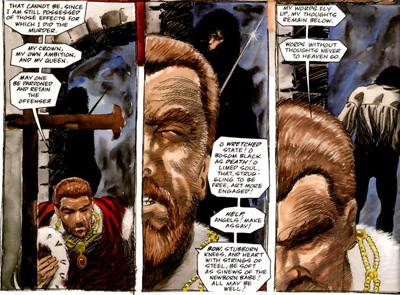
The Grant/Mandrake adaptation gives one more page to the sequence than the original did (5 instead of 4), and includes, as usual, much more of the Shakespeare's dialog. But it's also more violent, with swords piercing the flesh, and thin sprays of blood (nothing TOO gory, but standards have definitely changed between 1943 and 1990). Mandrake also uses speed lines in the background to give the action more energy.
Things get a little confused during the second bout. The "touch" Laertes confesses to looks like it goes through his shoulder, which makes the reader realize there's no question either of the swords are unbaited, no question this duel will end with the participants bleeding. The poison is the only treachery here, and Hamlet gets his hand on the poison blade by accident, not to give Laertes a taste of his own medicine. Likewise, the staging of the Queen's poisoning leaves something to be desired. She states her intent to "carouse" in one panel, then grabs the cup from the King in another, which is awkward and makes the King look like he's got a weak grip.
Much of the action that follows is bracketed by shocked expressions from onlookers, but the Queen's strange word-to-action pacing problem continues through to the end of the book. Hamlet will say "Venom, to thy work" in one panel where its meaning isn't clear, then in the next, scratch the King. Sometimes it even seems like panels are missing, though the disconnect between "Drink off this potion! Is thy union here?" and the panel in which it is featured, which just shows Hamlet impaling the King with his sword, does have a certain poetry to it. The "potion" is merely the poison, "drunk" from the blade, but it's still a little clunky.
Though the action settles down at the end, Mandrake still puts speed lines on one key panel, where the dying Hamlet hears cannon fire outside. This gives the moment the feel of someone getting shot, and sure enough, with Hamlet's death so too does his Denmark (his royal line) die. This is the shot we hear. As he dies, the colors darken, Fortinbras and the English Ambassador come in for their lines, and Hamlet is carried out by soldiers into the fog of Mandrake's watercolors...
Showing posts with label Classics Illustrated. Show all posts
Friday, March 27, 2015
Saturday, November 29, 2014
V.ii. The Readiness Is All - Classics Illustrated
The original
Classics Illustrated spends two thirds of a page on Hamlet telling the story (with the help of forward-moving captions) of Rosencrantz & Guildenstern getting their comeuppance. Uncommon for this comic book adaptation, the artist uses the staging to reveal something about Hamlet:
Shrouded in flames from our and Horatio's point of view, this is a hellish Hamlet who thinks nothing of sending former friends to their deaths, one who will become a devil to destroy a devil. What a king is this, indeed. The scripter isn't as kind to the Danish prince. In the scroll-shaped caption that replaces Osric's appearance entirely, he explains Hamlet's motivation in accepting to take part in a duel:
"Somewhat distressed by his quarrel with Laertes, [he] falls easily into the trap set for him". This is a new, and not particularly compelling interpretation, made possible by the removal of the "readiness is all" speech. This Hamlet may be more ruthless, but he is not at peace with his fate, merely unaware that it is to come.
The Berkley version
The more modern adaptation spends almost three pages on this sequence, even moving the action to a new venue (from graveyard to kitchen) mid-speech. While Hamlet tells Horatio about R&G, as is usual, he handles a knife and gets more animated (through the emphasis placed on certainly words in his speech balloon, not through any real moments of action) when he talks about the King. Artist Tom Mandrake gives us a preview of what Hamlet is planning for Claudius.
And then Osric shows up with a massive comedy hat. He stays for all of three panels, scarcely enough time to play up the comedy. The script cuts to chase quickly, with Osric getting mocked only for his response about Laertes' twin weapon, and from the art's standpoint, his general discomfort. As Horatio shares one last barb, Osric runs off and - this amuses me - seems to trip on the link between two word balloons. Accidental?
In the sequence's last panel, Horatio warns Hamlet, and the Prince defies augury, while practicing his moves. He does not, however, say the famous speech. Cutting to "has aught if what he leaves" makes his attitude even more fatalistic.
Classics Illustrated spends two thirds of a page on Hamlet telling the story (with the help of forward-moving captions) of Rosencrantz & Guildenstern getting their comeuppance. Uncommon for this comic book adaptation, the artist uses the staging to reveal something about Hamlet:
Shrouded in flames from our and Horatio's point of view, this is a hellish Hamlet who thinks nothing of sending former friends to their deaths, one who will become a devil to destroy a devil. What a king is this, indeed. The scripter isn't as kind to the Danish prince. In the scroll-shaped caption that replaces Osric's appearance entirely, he explains Hamlet's motivation in accepting to take part in a duel:
"Somewhat distressed by his quarrel with Laertes, [he] falls easily into the trap set for him". This is a new, and not particularly compelling interpretation, made possible by the removal of the "readiness is all" speech. This Hamlet may be more ruthless, but he is not at peace with his fate, merely unaware that it is to come.
The Berkley version
The more modern adaptation spends almost three pages on this sequence, even moving the action to a new venue (from graveyard to kitchen) mid-speech. While Hamlet tells Horatio about R&G, as is usual, he handles a knife and gets more animated (through the emphasis placed on certainly words in his speech balloon, not through any real moments of action) when he talks about the King. Artist Tom Mandrake gives us a preview of what Hamlet is planning for Claudius.
And then Osric shows up with a massive comedy hat. He stays for all of three panels, scarcely enough time to play up the comedy. The script cuts to chase quickly, with Osric getting mocked only for his response about Laertes' twin weapon, and from the art's standpoint, his general discomfort. As Horatio shares one last barb, Osric runs off and - this amuses me - seems to trip on the link between two word balloons. Accidental?
In the sequence's last panel, Horatio warns Hamlet, and the Prince defies augury, while practicing his moves. He does not, however, say the famous speech. Cutting to "has aught if what he leaves" makes his attitude even more fatalistic.
Saturday, September 6, 2014
V.i. Ophelia's Funeral - Classics Illustrated
The original
Though this adaptation condenses a lot of sequences it believes won't interest the young boys its producers evidently think are the target audience, the funeral gets more than three pages of large panels. Perhaps they felt that audience would respond well to two guys fist-fighting in an open grave.
One strange element is that they have Hamlet running up to the burial party as soon as he realizes the body is Ophelia's, which means everyone is essentially ignoring him until he jumps into the grave. Of course, the way the flowers fall from Gertrude's hand, it may be a case of wonky perspective:
This might be an intriguing staging notion that would lend sincerity to Laertes' plight, in his grief oblivious to his nemesis' presence, while everyone else is just stunned speechless.
The Berkley version
This adaptation covers the same ground in half the space, but restores a lot of the dialog (but not the fantastical list of tasks Hamlet is prepared to undertake). The words are there, but the visuals are sacrificed. For example, Gertrude's "sweets to the sweet" line asks the reader to already know what's supposed to be going on:
There are no flowers, and the words are spoken before Ophelia's corpse is even set down. This robs the adaptation of Ophelia's symbolic leitmotif and the line of its usual sense. Perhaps it can be salvaged if we interpret the "sweets" to be kind words rather than flowers. Also strange is the exclusion of the priest's judgment, considering Laertes still tells him (or someone) that he'll lie howling. The big cut, however, is Laertes' leap into Ophelia's grave, which sets the adaptation well apart from what seemed like the original Classics Illustrated's whole reason for being. The two boys still fight, but are quickly separated. In the rush to get out of the scene, no sooner is Hamlet out of earshot that he's already telling Horatio about Rosencrantz & Guildenstern.
So one adaptation is too decontracted, the other too rushed.
Though this adaptation condenses a lot of sequences it believes won't interest the young boys its producers evidently think are the target audience, the funeral gets more than three pages of large panels. Perhaps they felt that audience would respond well to two guys fist-fighting in an open grave.
One strange element is that they have Hamlet running up to the burial party as soon as he realizes the body is Ophelia's, which means everyone is essentially ignoring him until he jumps into the grave. Of course, the way the flowers fall from Gertrude's hand, it may be a case of wonky perspective:
This might be an intriguing staging notion that would lend sincerity to Laertes' plight, in his grief oblivious to his nemesis' presence, while everyone else is just stunned speechless.
The Berkley version
This adaptation covers the same ground in half the space, but restores a lot of the dialog (but not the fantastical list of tasks Hamlet is prepared to undertake). The words are there, but the visuals are sacrificed. For example, Gertrude's "sweets to the sweet" line asks the reader to already know what's supposed to be going on:
There are no flowers, and the words are spoken before Ophelia's corpse is even set down. This robs the adaptation of Ophelia's symbolic leitmotif and the line of its usual sense. Perhaps it can be salvaged if we interpret the "sweets" to be kind words rather than flowers. Also strange is the exclusion of the priest's judgment, considering Laertes still tells him (or someone) that he'll lie howling. The big cut, however, is Laertes' leap into Ophelia's grave, which sets the adaptation well apart from what seemed like the original Classics Illustrated's whole reason for being. The two boys still fight, but are quickly separated. In the rush to get out of the scene, no sooner is Hamlet out of earshot that he's already telling Horatio about Rosencrantz & Guildenstern.
So one adaptation is too decontracted, the other too rushed.
Saturday, June 14, 2014
V.i. The Gravedigger Scene - Classics Illustrated
The original
In this ever-thrifty adaptation, the conversation between Hamlet and the Gravedigger is lost, and we go from Hamlet mentioning the skull "jowled" to the ground (which actually sticks to the Gravedigger's spade most unnaturally) to being handed Yorick's skull. In visual terms, it looks like the the two skulls are one and the same, and only the caption tells us different. And it's too bad, because that would have made a good contraction. As is, it feels like the Gravedigger recognizes Hamlet as someone who might know Yorick because he has no motivation for his little show-and-tell. In the last panel, a cadaverous-looking Hamlet remembers his old jester, and the art has a rare flourish, Yorick's head and wand floating above the curved frame. But the scene ends here, content with giving us the jist and making sure it includes its most famous line. Is this enough to render Hamlet's existential questioning of life and death?
The Berkley version
An odd juxtaposition of images occurs in the more modern adaptation, with the previous sequence ending in the cemetery as Laertes hears of his sister's death, and without provocation, this one starting by her graveside, the Gravedigger singing while he digs. The contraction the original Classics Illustrated fails to make above, the Grant/Mandrake team manage expertly:
Now it becomes a kind of justification for the disrespect shown these earthly remains. A jester isn't very high in the social hierarchy, and this one caused the Gravedigger some grief. By removing the other skulls hurled around the grave, the contraction makes this particular "jowling" more personal, to both the First Clown and Hamlet.
Smelling the skull, Hamlet throws it down into the grave again in disgust, and the mention of Alexander in that exchange stands in for all the talk of great men returning to dust that normally comes later. This is a more efficient way of contracting the story than the original adaptation managed, using a short line to evoke Hamlet's concerns as they relate to his own abbreviated greatness, though perhaps the intended audience would have been ill-prepared to understand it.
In this ever-thrifty adaptation, the conversation between Hamlet and the Gravedigger is lost, and we go from Hamlet mentioning the skull "jowled" to the ground (which actually sticks to the Gravedigger's spade most unnaturally) to being handed Yorick's skull. In visual terms, it looks like the the two skulls are one and the same, and only the caption tells us different. And it's too bad, because that would have made a good contraction. As is, it feels like the Gravedigger recognizes Hamlet as someone who might know Yorick because he has no motivation for his little show-and-tell. In the last panel, a cadaverous-looking Hamlet remembers his old jester, and the art has a rare flourish, Yorick's head and wand floating above the curved frame. But the scene ends here, content with giving us the jist and making sure it includes its most famous line. Is this enough to render Hamlet's existential questioning of life and death?
The Berkley version
An odd juxtaposition of images occurs in the more modern adaptation, with the previous sequence ending in the cemetery as Laertes hears of his sister's death, and without provocation, this one starting by her graveside, the Gravedigger singing while he digs. The contraction the original Classics Illustrated fails to make above, the Grant/Mandrake team manage expertly:
Now it becomes a kind of justification for the disrespect shown these earthly remains. A jester isn't very high in the social hierarchy, and this one caused the Gravedigger some grief. By removing the other skulls hurled around the grave, the contraction makes this particular "jowling" more personal, to both the First Clown and Hamlet.
Smelling the skull, Hamlet throws it down into the grave again in disgust, and the mention of Alexander in that exchange stands in for all the talk of great men returning to dust that normally comes later. This is a more efficient way of contracting the story than the original adaptation managed, using a short line to evoke Hamlet's concerns as they relate to his own abbreviated greatness, though perhaps the intended audience would have been ill-prepared to understand it.
Thursday, March 27, 2014
IV.vii. Ophelia's Death - Classics Illustrated
Both comic book adaptations teach us about rushing through the play and its effects, though on stage, we would hardly get the same kind of superimposition caused by placing speech bubbles in the same panel/space.
The original
Gertrude is rather thrifty when it comes to telling Laertes his sister has drowned, the words coming out of her mouth even as she rushes through the door. Again, this is due to the way comics work, but keeping everything in the same speech bubble keeps pauses and hesitations out of the Queen's "voice". Her account of Ophelia's death is more detailed, taking up an entire page:
Pitched at a younger audience, Ophelia's death appears to be entirely accidental, albeit as result of her madness. In her poor judgment, she climbs up on a very slim branch, which breaks under her weight. An important lesson about safety, perhaps, but not a suicide. In the end, even her garlands desert her as she sinks to the bottom of the brook.
The Berkley version
The Grant/Mandrake adaptation is even more rushed, though it includes more dialog. Laertes is told not while he's kneeling (or did he just fall to his knees upon hearing the news?) in the cemetery. It's likely that is his father's grave. The next panel looks beautiful, though there seems to be some confusion as to who's crying eyes those are. The speech bubble pointing to the face means them to be the Queen's, but they rather look more like Laertes'. Regardless, the one shot of Ophelia is evocative of John Everett Millais' famous painting of Ophelia.
The cemetery setting underscores Laertes' loss of all family. Notably, his crying despite his announced restraint is cut, so this Laertes manages to hold it together. See also how Claudius' last lines, because they are included in a panel in which Laertes has not yet exited, plays like an aside. Does this Claudius actually fear Laertes' rage against HIM will start up again, or is it an unnecessary confusion resulting from the medium?
The original
Gertrude is rather thrifty when it comes to telling Laertes his sister has drowned, the words coming out of her mouth even as she rushes through the door. Again, this is due to the way comics work, but keeping everything in the same speech bubble keeps pauses and hesitations out of the Queen's "voice". Her account of Ophelia's death is more detailed, taking up an entire page:
Pitched at a younger audience, Ophelia's death appears to be entirely accidental, albeit as result of her madness. In her poor judgment, she climbs up on a very slim branch, which breaks under her weight. An important lesson about safety, perhaps, but not a suicide. In the end, even her garlands desert her as she sinks to the bottom of the brook.
The Berkley version
The Grant/Mandrake adaptation is even more rushed, though it includes more dialog. Laertes is told not while he's kneeling (or did he just fall to his knees upon hearing the news?) in the cemetery. It's likely that is his father's grave. The next panel looks beautiful, though there seems to be some confusion as to who's crying eyes those are. The speech bubble pointing to the face means them to be the Queen's, but they rather look more like Laertes'. Regardless, the one shot of Ophelia is evocative of John Everett Millais' famous painting of Ophelia.
The cemetery setting underscores Laertes' loss of all family. Notably, his crying despite his announced restraint is cut, so this Laertes manages to hold it together. See also how Claudius' last lines, because they are included in a panel in which Laertes has not yet exited, plays like an aside. Does this Claudius actually fear Laertes' rage against HIM will start up again, or is it an unnecessary confusion resulting from the medium?
Sunday, January 26, 2014
IV.vii. Claudius' Seduction - Classics Illustrated
The original
One of the side-effects of converting Hamlet to a "boys' adventure" comic is that while many scenes are reduced to a single panel or even caption, the ones that feature ghosts or swordplay are expanded. This is how this scene, despite extensive cuts in the dialog, comes out to almost four pages. This is achieved by having the plotters both flash back to moments prior to the play or imagine their plot coming to fruition. So for example, the story of Lamond (though note the alternative spelling) is recounted and seen:
As gratuitous a panel as they come, though it presents the Normand's prowess on horseback without actually mentioning it. The next panel has Hamlet sparring with him and admitting his jealousy of Laertes, clumsily re-purposing Claudius' line into "I wish and beg Laertes sudden coming o'er to play with him." We then see Laertes' successfully getting his revenge; we're into fantasy.
And strangely, after Laertes gets his poison out, a caption tells us the King has his own poison, not making it clear Laertes is told this.
<
As a staging idea, it's interesting. The King could speak those lines as an aside and let Laertes believe he is indeed the best swordsman in the land instead of impugning his abilities with his back-up plan.
The Berkley version
Taking the opposite tack, the more modern adaptation doesn't use the scene at all, which may turn out to be a mistake. In a film, moments and expression can make clear that props have been poisoned, that the plotters are working together, and so forth. In a comic, it is much more difficult given the space available. Meaningful cuts to a face, a weapon, a cup, may not come across the same way. We'll see.
One of the side-effects of converting Hamlet to a "boys' adventure" comic is that while many scenes are reduced to a single panel or even caption, the ones that feature ghosts or swordplay are expanded. This is how this scene, despite extensive cuts in the dialog, comes out to almost four pages. This is achieved by having the plotters both flash back to moments prior to the play or imagine their plot coming to fruition. So for example, the story of Lamond (though note the alternative spelling) is recounted and seen:
As gratuitous a panel as they come, though it presents the Normand's prowess on horseback without actually mentioning it. The next panel has Hamlet sparring with him and admitting his jealousy of Laertes, clumsily re-purposing Claudius' line into "I wish and beg Laertes sudden coming o'er to play with him." We then see Laertes' successfully getting his revenge; we're into fantasy.
And strangely, after Laertes gets his poison out, a caption tells us the King has his own poison, not making it clear Laertes is told this.
<
As a staging idea, it's interesting. The King could speak those lines as an aside and let Laertes believe he is indeed the best swordsman in the land instead of impugning his abilities with his back-up plan.
The Berkley version
Taking the opposite tack, the more modern adaptation doesn't use the scene at all, which may turn out to be a mistake. In a film, moments and expression can make clear that props have been poisoned, that the plotters are working together, and so forth. In a comic, it is much more difficult given the space available. Meaningful cuts to a face, a weapon, a cup, may not come across the same way. We'll see.
Thursday, November 14, 2013
IV.vi. Hamlet's Letter - Classics Illustrated
The original
A strange choice from comics makers so focused on the "boys' adventure" elements of the play. This would have been a perfect place to insert a visual flashback with ships and pirate battles. Instead, though the adaptation is often merciless with its cuts, we get the entire letter in what is practically a splash page. In other words, the authors have given a lot of weight to what is essentially a linking scene, but did not use that space to do Hamlet's story justice. The most we get is a sailor with an eye patch. So what effect does this rather poor decision (in terms of medium) have on the story? It may tell us Hamlet's story is at least in part a fabrication, and we might imagine a Machiavellian Hamlet who had a ship loyal to him waiting to take him off his stepfather's. The letter to Horatio would be a smokescreen filled with tall tales in case it was ever intercepted. Perhaps Horatio knows this is coded, perhaps he doesn't, but the image above makes clear he's taking a pirate into Elsinore. Why would he provide access for an outlaw if they weren't part of the same rebel faction loyal to the prince? No, I don't think the adaptation thought it through this much, but the creative team's poor visual choice does evoke staging and interpretation ideas.
The Berkley version omits the letter entirely.
A strange choice from comics makers so focused on the "boys' adventure" elements of the play. This would have been a perfect place to insert a visual flashback with ships and pirate battles. Instead, though the adaptation is often merciless with its cuts, we get the entire letter in what is practically a splash page. In other words, the authors have given a lot of weight to what is essentially a linking scene, but did not use that space to do Hamlet's story justice. The most we get is a sailor with an eye patch. So what effect does this rather poor decision (in terms of medium) have on the story? It may tell us Hamlet's story is at least in part a fabrication, and we might imagine a Machiavellian Hamlet who had a ship loyal to him waiting to take him off his stepfather's. The letter to Horatio would be a smokescreen filled with tall tales in case it was ever intercepted. Perhaps Horatio knows this is coded, perhaps he doesn't, but the image above makes clear he's taking a pirate into Elsinore. Why would he provide access for an outlaw if they weren't part of the same rebel faction loyal to the prince? No, I don't think the adaptation thought it through this much, but the creative team's poor visual choice does evoke staging and interpretation ideas.
The Berkley version omits the letter entirely.
Sunday, October 13, 2013
IV.v. Laertes Returns - Classics Illustrated
The original
Interestingly, the old Classics Illustrated shows us Laertes outside Elsinore, leading the rabble at the gates. That might have given the sequence a bit more menace, but Laertes is then immediately seen to enter the unguarded throne room. It's notable that no mention is made in the play, nor all that frequently in the adaptations, of guards who could have met their end in Laertes' action. The Switzers are inquired after, but aren't guarding the door. The dramatic effect is to show a deserted Elsinore where the Royals have been abandoned in the wake of the country's instability. In the comic, the mob enters the room while Claudius protests his innocence to a determined Laertes, and I'd like to think their swords have been blooded. But then Ophelia walks in.
That song and that one flower are all that remain of the sequence as scripted. It's a terrible piece of shorthand that gives Laertes pause, but diminishes this adaptation's already slim portrayal of Ophelia. As usual, this is part of the old Classics Illustrated remit of "boys' adventure" comics, with female characters sidelined in favor of sword fights and ghostly apparitions. The adapters probably didn't know how to make the flower-giving scene meaningful to their intended audience.
Strangely, Laertes is immediately cowed by this short excerpt and follows the royals out of doors, while the mob exits from another doorway entirely (and not the one they came in through; one might imagine a quiet massacre going on behind the scenes).
The Berkley version
The newer adaptation makes the same kind of outrageous cut. The confrontation is here again cut short by Ophelia's appearance (very short, he doesn't even have time to say he wants revenge for his father), though she just appears out of nowhere, sings the same song and a snatch of another in the same panel, drawn from afar, and that's it. She doesn't even have flowers with her. The character's last speaking appearance is thus wasted. Grant and Mandrake are just racing through this sequence for the plot's sake. They need their page count for things that interest them more.
Interestingly, the old Classics Illustrated shows us Laertes outside Elsinore, leading the rabble at the gates. That might have given the sequence a bit more menace, but Laertes is then immediately seen to enter the unguarded throne room. It's notable that no mention is made in the play, nor all that frequently in the adaptations, of guards who could have met their end in Laertes' action. The Switzers are inquired after, but aren't guarding the door. The dramatic effect is to show a deserted Elsinore where the Royals have been abandoned in the wake of the country's instability. In the comic, the mob enters the room while Claudius protests his innocence to a determined Laertes, and I'd like to think their swords have been blooded. But then Ophelia walks in.
That song and that one flower are all that remain of the sequence as scripted. It's a terrible piece of shorthand that gives Laertes pause, but diminishes this adaptation's already slim portrayal of Ophelia. As usual, this is part of the old Classics Illustrated remit of "boys' adventure" comics, with female characters sidelined in favor of sword fights and ghostly apparitions. The adapters probably didn't know how to make the flower-giving scene meaningful to their intended audience.
Strangely, Laertes is immediately cowed by this short excerpt and follows the royals out of doors, while the mob exits from another doorway entirely (and not the one they came in through; one might imagine a quiet massacre going on behind the scenes).
The Berkley version
The newer adaptation makes the same kind of outrageous cut. The confrontation is here again cut short by Ophelia's appearance (very short, he doesn't even have time to say he wants revenge for his father), though she just appears out of nowhere, sings the same song and a snatch of another in the same panel, drawn from afar, and that's it. She doesn't even have flowers with her. The character's last speaking appearance is thus wasted. Grant and Mandrake are just racing through this sequence for the plot's sake. They need their page count for things that interest them more.
Friday, July 26, 2013
IV.v. Ophelia's Madness - Classics Illustrated
The original
Probably because there was too much sexual subtext in the sequence, the original Classics Illustrated adaptation chose to explain Ophelia's madness in no uncertain terms in a caption (Claudius will repeat some of this information in verse in his short speech), and reduced the scene to two mostly harmless snatches of song (though "cockle" survived as a rude pun, as did "maid" which is implicitly sexual). In fact, it's all about Hamlet. Nothing about Polonius' death, despite what the caption might say. Note also Ophelia's flowers which will play a part in her next (and last) appearance.
Gotta love the royals' comic take in the first panel. They're also given a panel (not shown) in which to despair, again in mirroring poses that would suggest these versions of Claudius and Gertrude are still a solid couple. The adaptation sadly doesn't do a lot to flesh out the characters, so the underwritten Gertrude is more underwritten (underdrawn?) still, often just an ornament on Claudius' arm, placidly receiving dialog more than she ever doles it out. We can't really know what she thinks of the King, if anything.
The Berkley version
The Grant/Mandrake version has also been sanitized, cutting everything that relates to Hamlet, so Claudius is right to invoke her father's death as the reason for her madness. In this adaptation too the royal couple seems as solid as ever. Look at the staging: It's Gertrude who brings Ophelia to the King, placing the Queen in a servile position. As for the art, I wondered what those pill-like shapes on the edge of the first panel were and decided they were hinges. Unstuck from the second panel, they're an image of the "unhinged". A clever little piece. I've looked and it's not a recurring motif. A clue that Ophelia's madness is real, whereas Hamlet's was not?
Claudius gets to say his piece on the next page, and you'll note the bloody wash that frames the panel, the same kind of wash that framed Polonius' murder. It gives Claudius' speech about "murd'ring" an ironic bent, showing how selfish he is to moan about his woes when those of others are much greater (and indeed, stem from his own misdeeds). Ophelia in this panel becomes a dark figure, disappearing into the walls of Elsinore. She has become a truth-speaking ghost, not unlike Hamlet Sr. though less intelligible. Of course, the Ghost was an enigmatic figure until Hamlet came. This time, Hamlet will come too late to wring any meaning out of Elsinore's resident ghost.
Probably because there was too much sexual subtext in the sequence, the original Classics Illustrated adaptation chose to explain Ophelia's madness in no uncertain terms in a caption (Claudius will repeat some of this information in verse in his short speech), and reduced the scene to two mostly harmless snatches of song (though "cockle" survived as a rude pun, as did "maid" which is implicitly sexual). In fact, it's all about Hamlet. Nothing about Polonius' death, despite what the caption might say. Note also Ophelia's flowers which will play a part in her next (and last) appearance.
Gotta love the royals' comic take in the first panel. They're also given a panel (not shown) in which to despair, again in mirroring poses that would suggest these versions of Claudius and Gertrude are still a solid couple. The adaptation sadly doesn't do a lot to flesh out the characters, so the underwritten Gertrude is more underwritten (underdrawn?) still, often just an ornament on Claudius' arm, placidly receiving dialog more than she ever doles it out. We can't really know what she thinks of the King, if anything.
The Berkley version
The Grant/Mandrake version has also been sanitized, cutting everything that relates to Hamlet, so Claudius is right to invoke her father's death as the reason for her madness. In this adaptation too the royal couple seems as solid as ever. Look at the staging: It's Gertrude who brings Ophelia to the King, placing the Queen in a servile position. As for the art, I wondered what those pill-like shapes on the edge of the first panel were and decided they were hinges. Unstuck from the second panel, they're an image of the "unhinged". A clever little piece. I've looked and it's not a recurring motif. A clue that Ophelia's madness is real, whereas Hamlet's was not?
Claudius gets to say his piece on the next page, and you'll note the bloody wash that frames the panel, the same kind of wash that framed Polonius' murder. It gives Claudius' speech about "murd'ring" an ironic bent, showing how selfish he is to moan about his woes when those of others are much greater (and indeed, stem from his own misdeeds). Ophelia in this panel becomes a dark figure, disappearing into the walls of Elsinore. She has become a truth-speaking ghost, not unlike Hamlet Sr. though less intelligible. Of course, the Ghost was an enigmatic figure until Hamlet came. This time, Hamlet will come too late to wring any meaning out of Elsinore's resident ghost.
Saturday, May 11, 2013
Act IV, Scene 4 - Classics Illustrated
The original adaptation omits this scene entirely, but the Berkley version doesn't, though by staging the action just as Hamlet's party leaves Elsinore does have a variety of effects.
First, it puts Fortinbras' army very close to the Danish throne, and reinforces the idea that Claudius is a fool to trust Norway. We're looking at a huge army within a stone's throw of what looks like a largely undefended castle, overgrown with weeds and surrounded by crumbling walls. Denmark is on the wane, and artist Tom Mandrake represents this visually. Another change is that the Captain's lines seem to have been given to one of Hamlet's guards, which justifies the cursory information given when you cut most of the Captain's lines.
Removing the Captain's lines about the futility of this particular battle means Hamlet's condemnation of it as a "trick of fame" is really a condemnation of all war. He doesn't need to know the details of the Norway-Poland engagement to know many men will die and for what? Their leader's glory and some patch of land? This tells us something about Hamlet's relationship to his father, reputedly a great warrior. He's an academic and as the play has made clear to date, a man more of words than actions. He sees something of his father in Fortinbras, and that compels him to finally act, but he's also critical of the type of action. Even in a speech about finally committing to action, there is still a resistance, an attempt to justify why HE might act when others' violence is so distasteful to him. To become one's father, or to forge one's own way, is in many ways Hamlet's dilemma.
Mandrake's active pose in the last panel does a good job of visually representing that leap into a new mode of being for our Prince.
First, it puts Fortinbras' army very close to the Danish throne, and reinforces the idea that Claudius is a fool to trust Norway. We're looking at a huge army within a stone's throw of what looks like a largely undefended castle, overgrown with weeds and surrounded by crumbling walls. Denmark is on the wane, and artist Tom Mandrake represents this visually. Another change is that the Captain's lines seem to have been given to one of Hamlet's guards, which justifies the cursory information given when you cut most of the Captain's lines.
Removing the Captain's lines about the futility of this particular battle means Hamlet's condemnation of it as a "trick of fame" is really a condemnation of all war. He doesn't need to know the details of the Norway-Poland engagement to know many men will die and for what? Their leader's glory and some patch of land? This tells us something about Hamlet's relationship to his father, reputedly a great warrior. He's an academic and as the play has made clear to date, a man more of words than actions. He sees something of his father in Fortinbras, and that compels him to finally act, but he's also critical of the type of action. Even in a speech about finally committing to action, there is still a resistance, an attempt to justify why HE might act when others' violence is so distasteful to him. To become one's father, or to forge one's own way, is in many ways Hamlet's dilemma.
Mandrake's active pose in the last panel does a good job of visually representing that leap into a new mode of being for our Prince.
Thursday, March 14, 2013
Act IV, Scenes 1-3 - Classics Illustrated
The original
With no space to spare after that giant ghost visitation double-page splash, this three-scene sequence is reduced to a single panel, with a caption box explaining what happens and Claudius, finally alone, reveals his true agenda - the execution of Hamlet at England's hands. The original Classics Illustrated was nothing if not precipitous when it came to talking scenes. The single panel is more or less used as a punchline, a surprise twist that Hamlet has been sent to his death.
The Berkley version
In three panels, going from a claustrophobic close-up to an airy wide shot - perhaps representing how Claudius feels trapped by the situation, and freed by his decision - Tom Mandrake's Hamlet also reduces the sequence to a single moment. Once again, Hamlet has been caught offscreen, and no final confrontation between Prince and King is to be had on the page. Thrift, thrift, Horatio. Strangely, Rosencrantz & Guildenstern are allowed to stand there while Claudius pronounces his usually secret soliloquy. This makes them more obviously complicit in Hamlet's murder. They know the contents of the letters they carry and perhaps better deserve their deaths. Of course, part of this is the freeze-frame aspect of the comics form. A panel's action represents a single second, but the dialog takes far longer. Might R&G have left in between the two speech bubbles, and thus never heard the King's more private words? It's an ambiguity that wouldn't exist on the stage or on film.
With no space to spare after that giant ghost visitation double-page splash, this three-scene sequence is reduced to a single panel, with a caption box explaining what happens and Claudius, finally alone, reveals his true agenda - the execution of Hamlet at England's hands. The original Classics Illustrated was nothing if not precipitous when it came to talking scenes. The single panel is more or less used as a punchline, a surprise twist that Hamlet has been sent to his death.
The Berkley version
In three panels, going from a claustrophobic close-up to an airy wide shot - perhaps representing how Claudius feels trapped by the situation, and freed by his decision - Tom Mandrake's Hamlet also reduces the sequence to a single moment. Once again, Hamlet has been caught offscreen, and no final confrontation between Prince and King is to be had on the page. Thrift, thrift, Horatio. Strangely, Rosencrantz & Guildenstern are allowed to stand there while Claudius pronounces his usually secret soliloquy. This makes them more obviously complicit in Hamlet's murder. They know the contents of the letters they carry and perhaps better deserve their deaths. Of course, part of this is the freeze-frame aspect of the comics form. A panel's action represents a single second, but the dialog takes far longer. Might R&G have left in between the two speech bubbles, and thus never heard the King's more private words? It's an ambiguity that wouldn't exist on the stage or on film.
Sunday, December 23, 2012
III.iv. The Closet Scene - Classics Illustrated
The original
While the original adaptation cuts a lot of the play down to the bare essentials, it gives this scene seven pages, including a two-page splash. It shouldn't come as too much of a surprise, since these comics had a Boy's Own Adventure style, and the scene features both a sword killing and the Ghost. There are still a lot of cuts, mind you. The extra space is given over to action, not words.
As you can imagine, though this Gertrude looks young and sexy, the comic removes Hamlet's rage his mother's sexuality. Classics Illustrated was hardly an innovative enterprise, but we do get a very comic book moment in the showing of the counterfeit presentment of the two brothers, with their pictures inset in the corner, facing each other.
Something else comics do differently than plays and films is the use of captions that interpret the action in third person omniscient. The adaptation does so to cover cuts or clarify actions that would not be clear to its likely pre-teen audience. Some of those interpretations are a little dubious. As Hamlet attacks his mother in the panel following the one above, we learn that he "continues as though the queen had not spoken", suggesting the author believes her expressed regret was contrition enough. Captions are also quick to clarify that she can't see the Ghost.
Above is the two-page splash designed to entrance young readers. While lines are cut like so much fat, a lot of space is devoted to keeping this audience interested. Is that so different from how it's done in the theater? Speaking of cuts, the scene soon wraps up with massive ones made to Hamlet's final conversation with his mother. After "Thou has cleft my heart in twain", she doesn't speak again. Hamlet simply tells her to throw away the worst part and that he's off to England. Even the "grave" pun is omitted in the rush to drag Polonius' body out of the Queen's closet and move on.
Footnotes - Words kids are not expected to know: Glass (mirror); adders (very poisonous snakes).
The Berkley version
In contrast, the Steven Grant/Tom Mandrake adaptation keeps the scene down to three pages, but manages to keep more of the text intact. As usual, Mandrake's art expresses a dark and foreboding mood. Coming into the room, Hamlet already has his sword out and the Queen is already running from it, which changes the tenor of her lines, and Hamlet's too. "Would it were not so, you are my mother" has a murderous edge with a sword in frame, as if the prince is ready to end that state, just as his "father" became a "ghost". When there are cuts, they're unusual and striking. Polonius doesn't cry for help, nor does Hamlet look for a "rat". Either he noticed someone behind the arras beforehand, or he heart a shuffling there, but he just stabs the arras out of the blue, as panel borders get drenched with blood.
Mandrake raises the level of intensity in Hamlet's tirade, closing in with each successive panel on Hamlet's eye and his mother's tear, a skull appearing in the prince's pupil (a Mandrake trademark).
There is no actual movement, no throwing on the bed, no counterfeit presentment, just the sense that Hamlet is dominating his mother, his image impossibly close to hers in that last panel, even as his voice goes down to a whisper. A threat has never been so well implied with so little.
The Ghost breaks the spell and creates another. Unusually, it stays in the picture after Hamlet says it steals away (crucially, "out of the portal" is omitted). So it is present when the prince gives his mother instructions to stop sleeping with Claudius. As with the previous adaptation, this end sequence is heavily cut, though it retains such lines as "I must be cruel only to be kind". Still, Gertrude stops speaking even earlier, at "yet all there is I see". In other words, she does not actually repent. Hamlet only takes it for granted that she does. In this version, it's the Ghost that makes Hamlet realize he should endeavor to save his mother, and her own reactions have nothing to do with his volte-face.
While the original adaptation cuts a lot of the play down to the bare essentials, it gives this scene seven pages, including a two-page splash. It shouldn't come as too much of a surprise, since these comics had a Boy's Own Adventure style, and the scene features both a sword killing and the Ghost. There are still a lot of cuts, mind you. The extra space is given over to action, not words.
As you can imagine, though this Gertrude looks young and sexy, the comic removes Hamlet's rage his mother's sexuality. Classics Illustrated was hardly an innovative enterprise, but we do get a very comic book moment in the showing of the counterfeit presentment of the two brothers, with their pictures inset in the corner, facing each other.
Something else comics do differently than plays and films is the use of captions that interpret the action in third person omniscient. The adaptation does so to cover cuts or clarify actions that would not be clear to its likely pre-teen audience. Some of those interpretations are a little dubious. As Hamlet attacks his mother in the panel following the one above, we learn that he "continues as though the queen had not spoken", suggesting the author believes her expressed regret was contrition enough. Captions are also quick to clarify that she can't see the Ghost.
Above is the two-page splash designed to entrance young readers. While lines are cut like so much fat, a lot of space is devoted to keeping this audience interested. Is that so different from how it's done in the theater? Speaking of cuts, the scene soon wraps up with massive ones made to Hamlet's final conversation with his mother. After "Thou has cleft my heart in twain", she doesn't speak again. Hamlet simply tells her to throw away the worst part and that he's off to England. Even the "grave" pun is omitted in the rush to drag Polonius' body out of the Queen's closet and move on.
Footnotes - Words kids are not expected to know: Glass (mirror); adders (very poisonous snakes).
The Berkley version
In contrast, the Steven Grant/Tom Mandrake adaptation keeps the scene down to three pages, but manages to keep more of the text intact. As usual, Mandrake's art expresses a dark and foreboding mood. Coming into the room, Hamlet already has his sword out and the Queen is already running from it, which changes the tenor of her lines, and Hamlet's too. "Would it were not so, you are my mother" has a murderous edge with a sword in frame, as if the prince is ready to end that state, just as his "father" became a "ghost". When there are cuts, they're unusual and striking. Polonius doesn't cry for help, nor does Hamlet look for a "rat". Either he noticed someone behind the arras beforehand, or he heart a shuffling there, but he just stabs the arras out of the blue, as panel borders get drenched with blood.
Mandrake raises the level of intensity in Hamlet's tirade, closing in with each successive panel on Hamlet's eye and his mother's tear, a skull appearing in the prince's pupil (a Mandrake trademark).
There is no actual movement, no throwing on the bed, no counterfeit presentment, just the sense that Hamlet is dominating his mother, his image impossibly close to hers in that last panel, even as his voice goes down to a whisper. A threat has never been so well implied with so little.
The Ghost breaks the spell and creates another. Unusually, it stays in the picture after Hamlet says it steals away (crucially, "out of the portal" is omitted). So it is present when the prince gives his mother instructions to stop sleeping with Claudius. As with the previous adaptation, this end sequence is heavily cut, though it retains such lines as "I must be cruel only to be kind". Still, Gertrude stops speaking even earlier, at "yet all there is I see". In other words, she does not actually repent. Hamlet only takes it for granted that she does. In this version, it's the Ghost that makes Hamlet realize he should endeavor to save his mother, and her own reactions have nothing to do with his volte-face.
Sunday, September 30, 2012
III.iii. The Confessional - Classics Illustrated
The original
This page is preceded by two brief panels whose sole function is to keep the plot alive. In the first, Claudius dispatches Rosencrantz & Guildenstern to take Hamlet to England. In the second, Polonius describes his plan to hide in the Queen's closet, to which Claudius merely says "thanks". Such brevity is in complete contrast to the page above, which forces the characters to let out an entire speech fixed in a single pose. That's a weakness of the comics medium, but does it inform our reading of the play anyway? Claudius says his speech with an obvious headache and because he doesn't actually kneel before the next panel, he seems to decide that prayer, which he believed impossible, remains the only avenue left open to him. Hamlet, in the second, never approaches the King, and so likely does not hear the coda in the last panel, but note that in that panel, the King does not stop praying. In this version then, Claudius' attempts at prayer may go on longer, and might even succeed off-panel. These words become part of the same self-doubt he shows in the preceding speech. Can he overcome it and find salvation?
That large candle in front of him reminds us that he asked for "light" in the previous scene, and that this light may be physical or spiritual. He needs to shed light on his darkened soul. Should have caught that link earlier, but see how a simple (and fairly primitive) image can, uhm, shed light on Shakespeare's text.
The Berkley version
Tom Mandrake's adaptation omits Polonius (keeping his appearance in the closet scene as something of a surprise), but keeps Claudius' orders to R&G. As in the previous adaptation, they don't get to say their lines, and Claudius, his face in constant, unreadable shadow, dismisses them with his back turned. This is a man who cannot bear to let anyone see him in this state and he might even run from a mirror at this point. Before they've even left, his voice goes to a whisper (smaller lettering) as he starts on his speech. Finally, we're allowed to see his eyes, but he's hiding his face from the reader with his metaphorically blood-soaked hand. Mandrake, as always, is very strong at representing anxiety, and we won't see the King's eyes again in the scene, as he can't bear to look at any part of himself.
Behind his, a shadow with sword drawn. Is that pity in Hamlet's glittering eye? Or regret to find such a pioous Claudius? It does seem like he overhears the prayer if not the admission of murder, and yet, is powerless to act on that confirmation. He turns away and likely misses Claudius' final lines, but you'll note that his own speech is completely omitted. Mandrake is well aware that his reader has probably read or seen the play before, and allows us to fill in that blank. For the uninitiated however, he avoids the theological discussion and lets them assume... what? That Hamlet is satisfied with the King asking for forgiveness? That his mother is the greater target and that this is a result of his "blunted purpose"? It's a rather more ambiguous representation of the scene.
This page is preceded by two brief panels whose sole function is to keep the plot alive. In the first, Claudius dispatches Rosencrantz & Guildenstern to take Hamlet to England. In the second, Polonius describes his plan to hide in the Queen's closet, to which Claudius merely says "thanks". Such brevity is in complete contrast to the page above, which forces the characters to let out an entire speech fixed in a single pose. That's a weakness of the comics medium, but does it inform our reading of the play anyway? Claudius says his speech with an obvious headache and because he doesn't actually kneel before the next panel, he seems to decide that prayer, which he believed impossible, remains the only avenue left open to him. Hamlet, in the second, never approaches the King, and so likely does not hear the coda in the last panel, but note that in that panel, the King does not stop praying. In this version then, Claudius' attempts at prayer may go on longer, and might even succeed off-panel. These words become part of the same self-doubt he shows in the preceding speech. Can he overcome it and find salvation?
That large candle in front of him reminds us that he asked for "light" in the previous scene, and that this light may be physical or spiritual. He needs to shed light on his darkened soul. Should have caught that link earlier, but see how a simple (and fairly primitive) image can, uhm, shed light on Shakespeare's text.
The Berkley version
Tom Mandrake's adaptation omits Polonius (keeping his appearance in the closet scene as something of a surprise), but keeps Claudius' orders to R&G. As in the previous adaptation, they don't get to say their lines, and Claudius, his face in constant, unreadable shadow, dismisses them with his back turned. This is a man who cannot bear to let anyone see him in this state and he might even run from a mirror at this point. Before they've even left, his voice goes to a whisper (smaller lettering) as he starts on his speech. Finally, we're allowed to see his eyes, but he's hiding his face from the reader with his metaphorically blood-soaked hand. Mandrake, as always, is very strong at representing anxiety, and we won't see the King's eyes again in the scene, as he can't bear to look at any part of himself.
Behind his, a shadow with sword drawn. Is that pity in Hamlet's glittering eye? Or regret to find such a pioous Claudius? It does seem like he overhears the prayer if not the admission of murder, and yet, is powerless to act on that confirmation. He turns away and likely misses Claudius' final lines, but you'll note that his own speech is completely omitted. Mandrake is well aware that his reader has probably read or seen the play before, and allows us to fill in that blank. For the uninitiated however, he avoids the theological discussion and lets them assume... what? That Hamlet is satisfied with the King asking for forgiveness? That his mother is the greater target and that this is a result of his "blunted purpose"? It's a rather more ambiguous representation of the scene.
Saturday, July 21, 2012
III.ii. Critical Reception - Classics Illustrated
The original
The black comedy of the recorder exchange between Hamlet and Rosencrantz & Guildenstern cannot be easily reproduced on the comics page, not with the page count inherent to the format, so I'm sad to report the sequence was cut from both version of Classics Illustrated. R&G still show up to deliver the Queen's message, but it acts merely as prologue to Hamlet's soliloquy. This is especially true of the original comic, which has Hamlet spare his cruelties, unless one considers an abrupt answer "cruel".
Note also how the bloodier language was excised from the speech, pitching it to its younger audience.
The Berkley version
Tom Mandrake's adaptation uses an entire page, but is still very economical. Hamlet's delirious rhymes are kept, but spoken over the panel in which the King runs off, showing more clearly that he is the "stricken deer" of Hamlet's song. Mandrake's gloomy Hamlet has a very different expression from the original Classics Illustrated too, replacing joy with anguish. Gone is the euphoria, and in its place is the realization that now he must carry out a bloody revenge. For this Hamlet, it's made things worse and it seems he'd rather have been told that the Ghost was lying, tormenting him.
R&G's arrival restores a lot of dialog lost in the original comic, but still no recorder business (which would probably have been bitter and violent rather than manic). In fact, Hamlet's response, cutting to a later line in the scene, is almost a non sequitur. "By and by is easily said" seems strange here, but it is basically Hamlet telling them what answer to go, without the prompt of it being their own, plain answer. The comics form shows another of its weaknesses at adaptation when Hamlet starts his speech in the same panel he dismisses his friends, making it look like they'll hear that part of it. However, it does kind of work, and makes the witching hour the reason for their dismissal. Instead of saying it's late, Hamlet goes into poetic detail the likens night to evil. I could see this used in a proper staging of the play as a way to give Hamlet another "madness" moment in front of the traitors, putting a mirror up to their own evil or acting as a veiled threat.
The rest is the speech is as written and performed alone, either with Hamlet in close-up, or walking towards his mother's closet.
The black comedy of the recorder exchange between Hamlet and Rosencrantz & Guildenstern cannot be easily reproduced on the comics page, not with the page count inherent to the format, so I'm sad to report the sequence was cut from both version of Classics Illustrated. R&G still show up to deliver the Queen's message, but it acts merely as prologue to Hamlet's soliloquy. This is especially true of the original comic, which has Hamlet spare his cruelties, unless one considers an abrupt answer "cruel".
Note also how the bloodier language was excised from the speech, pitching it to its younger audience.The Berkley version
Tom Mandrake's adaptation uses an entire page, but is still very economical. Hamlet's delirious rhymes are kept, but spoken over the panel in which the King runs off, showing more clearly that he is the "stricken deer" of Hamlet's song. Mandrake's gloomy Hamlet has a very different expression from the original Classics Illustrated too, replacing joy with anguish. Gone is the euphoria, and in its place is the realization that now he must carry out a bloody revenge. For this Hamlet, it's made things worse and it seems he'd rather have been told that the Ghost was lying, tormenting him.
R&G's arrival restores a lot of dialog lost in the original comic, but still no recorder business (which would probably have been bitter and violent rather than manic). In fact, Hamlet's response, cutting to a later line in the scene, is almost a non sequitur. "By and by is easily said" seems strange here, but it is basically Hamlet telling them what answer to go, without the prompt of it being their own, plain answer. The comics form shows another of its weaknesses at adaptation when Hamlet starts his speech in the same panel he dismisses his friends, making it look like they'll hear that part of it. However, it does kind of work, and makes the witching hour the reason for their dismissal. Instead of saying it's late, Hamlet goes into poetic detail the likens night to evil. I could see this used in a proper staging of the play as a way to give Hamlet another "madness" moment in front of the traitors, putting a mirror up to their own evil or acting as a veiled threat.
The rest is the speech is as written and performed alone, either with Hamlet in close-up, or walking towards his mother's closet.
Saturday, May 5, 2012
III.ii. The Mouse-Trap - Classics Illustrated
The original
Surprisingly, the old "boys' adventure" comics version includes both the dumb show and the speaking play, though it makes huge cuts through the use of captions to fit them in. In other words, they both "happen", but are not necessarily seen. The pantomime that precedes the play is visual, of course, so becomes the backbone of the comics version.
There are number of interesting touches, as if the artist, freed from the Classics Illustrated constraint of heavy work balloons, has finally been allowed to show his quality. As the Player Queen leaves the sleeping king, for example, there's an odd expression on her face. Is she worried she might wake him? Or is she colluding with the murderer, but already feeling guilty? I also like the purely graphic juxtaposition of crown and poison separating the two bottom panels, showing how one can act as a gateway to the other. The sequence continues on the next page, where the Queen is offered jewels, but she seems to refuse from her body language. So it's not always clear what she's thinking.
A puzzled Ophelia asks about the argument of the play - the only live commentary made in this heavily edited version - but Hamlet leaves it to the Prologue. There is no cruelty towards Ophelia or the Royals, the play being the only possible impetus for Claudius to lose it. Hamlet's antics do not play a part or muddy the waters. On purpose perhaps, the Player Queen is a dead ringer for Ophelia, wearing the same kinds of clothes as well.
After a few words from the Prologue, the action cuts to Claudius' fit. We've seen the play's action through the pantomime, and we know the story because it's a mirror of Hamlet Sr.'s murder, so this is quite economical, while respecting the events of the play. Needlessly? If Claudius had reacted to the dumb show, it would have made more structural sense. As is, even though we know everything we do, there still seems to be a scene missing. It makes you want to see the trigger.
The Berkley version
Hamlet is likewise more pleasant to Ophelia in Tom Mandrake's version, his smiles turning cruelties into mere teasing. His art makes good use of shadows throughout the sequence, often keeping the Royals hidden, even when they speak lines. The darkness of their sins and their initial ambiguity make justify it, but it is starting to feel like they are shadows, ciphers or otherwise non-characters. Even the "protests too much" line is given to Ophelia instead of Gertrude. One place where shadows are better used is in Hamlet's face. The darkness of Ophelia's lap plays across it when he turns more serious and thinks of his father, ironically while entering a motherly womb.
Mandrake does away with the dumb show in favor of the spoken play, his painted Players in various cultural costumes separating the heightened reality of the Mouse-Trap with the Medieval trappings of the play outside the play, though I'll never get used to Claudius' Santa Claus outfit.
In the absence of a preceding panto, Claudius now sees the accusation for the first time, and reacts. Again, there are few public antics from Hamlet, so his idleness is not what distracts or affects the King. Both comics versions have chosen to make the King unambiguously guilty.
Surprisingly, the old "boys' adventure" comics version includes both the dumb show and the speaking play, though it makes huge cuts through the use of captions to fit them in. In other words, they both "happen", but are not necessarily seen. The pantomime that precedes the play is visual, of course, so becomes the backbone of the comics version.
There are number of interesting touches, as if the artist, freed from the Classics Illustrated constraint of heavy work balloons, has finally been allowed to show his quality. As the Player Queen leaves the sleeping king, for example, there's an odd expression on her face. Is she worried she might wake him? Or is she colluding with the murderer, but already feeling guilty? I also like the purely graphic juxtaposition of crown and poison separating the two bottom panels, showing how one can act as a gateway to the other. The sequence continues on the next page, where the Queen is offered jewels, but she seems to refuse from her body language. So it's not always clear what she's thinking.A puzzled Ophelia asks about the argument of the play - the only live commentary made in this heavily edited version - but Hamlet leaves it to the Prologue. There is no cruelty towards Ophelia or the Royals, the play being the only possible impetus for Claudius to lose it. Hamlet's antics do not play a part or muddy the waters. On purpose perhaps, the Player Queen is a dead ringer for Ophelia, wearing the same kinds of clothes as well.
After a few words from the Prologue, the action cuts to Claudius' fit. We've seen the play's action through the pantomime, and we know the story because it's a mirror of Hamlet Sr.'s murder, so this is quite economical, while respecting the events of the play. Needlessly? If Claudius had reacted to the dumb show, it would have made more structural sense. As is, even though we know everything we do, there still seems to be a scene missing. It makes you want to see the trigger.The Berkley version
Hamlet is likewise more pleasant to Ophelia in Tom Mandrake's version, his smiles turning cruelties into mere teasing. His art makes good use of shadows throughout the sequence, often keeping the Royals hidden, even when they speak lines. The darkness of their sins and their initial ambiguity make justify it, but it is starting to feel like they are shadows, ciphers or otherwise non-characters. Even the "protests too much" line is given to Ophelia instead of Gertrude. One place where shadows are better used is in Hamlet's face. The darkness of Ophelia's lap plays across it when he turns more serious and thinks of his father, ironically while entering a motherly womb.
Mandrake does away with the dumb show in favor of the spoken play, his painted Players in various cultural costumes separating the heightened reality of the Mouse-Trap with the Medieval trappings of the play outside the play, though I'll never get used to Claudius' Santa Claus outfit.
In the absence of a preceding panto, Claudius now sees the accusation for the first time, and reacts. Again, there are few public antics from Hamlet, so his idleness is not what distracts or affects the King. Both comics versions have chosen to make the King unambiguously guilty.
Wednesday, February 8, 2012
III.ii. Instructing the Players - Classics Illustrated
The original
The bottom of page 15 shows how the comic restructured the sequence leading up to the play:
First, Hamlet thinks up his Mouse-Trap plan. The very next panel shows Hamlet seeking out Horatio to ask for his help. It's all very brisk, and not surprisingly for the pacey comic, omits the instructions to the Players. In a way, we have the off-stage scene, often inferred in performances, in which Hamlet first reveals his plans to Horatio. As often played, Hamlet seems to be reminding Horatio of the plan, with the only new information being what role Horatio will play in it. The artist has drawn them out of the way (Elsinore is in the background), creating a more conspiratorial feel, though the harsh, bright white does work against this. The bottom panel goes back one scene to reveal, in a caption, that Rosencrantz & Guildenstern have been unsuccessful, though it seems like they didn't work very hard at it because we haven't seen them AT ALL since they bowed their heads in front of the King and said they'd give it the old Wittenberg try. Though the caption back tracks, the image pushes us forward to the play, with the audience already in their seats (or sitting on the floor, or standing). Hamlet is most definitely NOT in Ophelia's lap, lounging on the ground with Horatio, neither particular well placed to catch Claudius' expression. Polonius and R&G are left standing, servile.
The Berkley version
Tom Mandrake's adaptation also omits the instructions to the Players, but does set the Hamlet-Horatio scene backstage, with the players getting ready. In a reversal of the expected staging, Hamlet finds Horatio there, rather than the opposite. So it's not possible to imagine a time skip that would have allowed Scene ii to have occurred between panels. It's fairly understandable for both comics adaptations to do away with the sequence, and not just for space reasons. Comics cannot do sound or movement in traditional terms, which would make directions as to voice and gesture difficult to gauge later when the play begins. Concentrating on Horatio then:
Mandrake has cut into the compliments section of the speech, but retains the longer text of Horatio's mission. He also sets the scene in among the Players, and keeps it confidential through the tried and true method of a dotted line around the speech bubble (as well as slightly smaller lettering). As the Royal party appears, they are in shadow, a darkness Hamlet means to dispel with his play, one that ends when Claudius will shout for light.
The bottom of page 15 shows how the comic restructured the sequence leading up to the play:
First, Hamlet thinks up his Mouse-Trap plan. The very next panel shows Hamlet seeking out Horatio to ask for his help. It's all very brisk, and not surprisingly for the pacey comic, omits the instructions to the Players. In a way, we have the off-stage scene, often inferred in performances, in which Hamlet first reveals his plans to Horatio. As often played, Hamlet seems to be reminding Horatio of the plan, with the only new information being what role Horatio will play in it. The artist has drawn them out of the way (Elsinore is in the background), creating a more conspiratorial feel, though the harsh, bright white does work against this. The bottom panel goes back one scene to reveal, in a caption, that Rosencrantz & Guildenstern have been unsuccessful, though it seems like they didn't work very hard at it because we haven't seen them AT ALL since they bowed their heads in front of the King and said they'd give it the old Wittenberg try. Though the caption back tracks, the image pushes us forward to the play, with the audience already in their seats (or sitting on the floor, or standing). Hamlet is most definitely NOT in Ophelia's lap, lounging on the ground with Horatio, neither particular well placed to catch Claudius' expression. Polonius and R&G are left standing, servile.The Berkley version
Tom Mandrake's adaptation also omits the instructions to the Players, but does set the Hamlet-Horatio scene backstage, with the players getting ready. In a reversal of the expected staging, Hamlet finds Horatio there, rather than the opposite. So it's not possible to imagine a time skip that would have allowed Scene ii to have occurred between panels. It's fairly understandable for both comics adaptations to do away with the sequence, and not just for space reasons. Comics cannot do sound or movement in traditional terms, which would make directions as to voice and gesture difficult to gauge later when the play begins. Concentrating on Horatio then:
Mandrake has cut into the compliments section of the speech, but retains the longer text of Horatio's mission. He also sets the scene in among the Players, and keeps it confidential through the tried and true method of a dotted line around the speech bubble (as well as slightly smaller lettering). As the Royal party appears, they are in shadow, a darkness Hamlet means to dispel with his play, one that ends when Claudius will shout for light.
Subscribe to:
Posts (Atom)