Cheer Up, Hamlet! is a paper doll available for free online from Les Vieux Jours, and for which there are 16 costumes plus sundry accessories and counting. An amusing diversion, the makers at last know their Shakespeare, and find proper quotes from the play to juxtapose each image. Obviously, there's the classic look:
Alternate wear based on lines from the play:
(That's a sweet Horatio.)
Some jokes are best appreciated by fans of certain actors who have played the role.
And then there's the completely outlandish...
But Hamlet IS an avenger, right?
For more costumes, accessories, and humor, in larger sizes, check out the website.
Showing posts with label Tennant (2009). Show all posts
Saturday, April 25, 2015
Sunday, March 8, 2015
V.ii. Duel and Deaths - Tennant (2009)
In the final sequence, the film keeps its hyper-surveillance conceit up, pulling away from the action to a security camera from time to time, even though there are no characters left whose POV this could accurately reflect. But in the for a penny...
And that's my segue to say Penny Downie as Gertrude is really the one to watch during this scene. She's always active, looking to one character or another, trying to understand what's going on, where the dangers lie, what's real and what isn't. After all, Laertes has just attacked Claudius and then Hamlet, but they're all smiling at each other and playing a "game" now. And knowing what she does of Hamlet's fragility, and his allegations about her husband, which she probably believes, something HAS to be up. And so on her face, often in the background, there are reactions that are crucial to understanding her character. She's surprised and perhaps relieved that Hamlet can throw off the shackles of madness. She tries to decipher whether Laertes means it when he accepts Hamlet's apology. And what of Claudius, all smiles and out of breath? She's in evident pain as she tries to pierce the web of lies around her. In that context, it makes perfect sense that when she realize the cup is poison (the staging is impeccable too, as Claudius, out of focus in the background, turns his head at the tray behind him and realizes which cup she's holding). She drinks deep, as if to save her son from this trap, but then offers him that cup, a suicide pact so that she, Hamlet, his father and Ophelia can all be reunited in the afterlife. At the moment of her death, still holding the cup, she pushes it once more towards Hamlet. A dark interpretation nonetheless consistent with Tragedy.
The duel presents three bouts that are more or less the same - we're not dealing with a big budget production here - but longer and more aggressive each time. Paranoid Laertes lets himself be riled by Hamlet's quips, or rather more by the assembly' laughter, and realizing he will lose, starts to cheat. He thrusts at Hamlet before the judge (Osric) allows it, so Hamlet fights without headgear, and still not scoring, slices the back of Hamlet's back when his back is turned. Hamlet drops his sword and jumps him, and once subdued, takes the poison sword, and in anger over its unblunted end, inflicts the same wound on his opponent. With the Queen dead and both duelists poisoned, Hamlet cries treachery and Claudius is still in a position to get away with it. But afraid Laertes will tell on him, he points to guards to get his co-conspirator out of the room, which is when Laertes decides to point fingers. The last of his family, Laertes doesn't care to die a traitor and stain his name, possibly. After all, would it be so hard for Claudius to brand him such posthumously? A man who just recently incited revolt and tried to kill him?
Claudius' death is amazing. Instead of the usual force-feeding of the poison cup, Claudius is handed the cup and ASKED to drink it. In the play, this a redundant (if poetically just) action anyway, since Hamlet has already stabbed him with the poison sword. In this version, Claudius grabs the sword around the tip to stop Hamlet from stabbing him, but the Prince twists it out of his hand, scratching his palm ("I am but hurt"). So he's doomed anyway, and Patrick Stewart conveys this in great way, that's also darkly comical. He raises his shoulders in defeat, silent asking "meh, why not?", and drinks deeply. This is a stronger Claudius that at least makes a show of dying by his own hand, even though the poison was already in his system. In the end, he still tries to reach for Gertrude.
Handed back to him, Hamlet still holds the cup when he falls over, and he must struggle to keep it out of Horatio's hands. I just struck me that Hamlet's last act was to save a life, and there's hope in that, even if the more cynical among us could see this as a selfish act - Horatio must live to keep HAMLET alive as a story. In his last moment, Hamlet looks off-stage in a mix of awe and fear, as if seeing his ghostly father one more time, or that undiscovered country which can sometimes act as a metaphor for a New Denmark. And yet, once his noble heart has cracked and Horatio cries over him, the credits roll. There is no Fortinbras to herald that New Denmark, no funeral, no questions or revelations from England's ambassador. Director Gregory Doran attributes its importance in the play to an Elizabethan obsession with succession (who would replace the aging Virgin Queen?), and while filmed, seemed an easy cut to make given modern audiences can be satisfied without the coda.
And that's my segue to say Penny Downie as Gertrude is really the one to watch during this scene. She's always active, looking to one character or another, trying to understand what's going on, where the dangers lie, what's real and what isn't. After all, Laertes has just attacked Claudius and then Hamlet, but they're all smiling at each other and playing a "game" now. And knowing what she does of Hamlet's fragility, and his allegations about her husband, which she probably believes, something HAS to be up. And so on her face, often in the background, there are reactions that are crucial to understanding her character. She's surprised and perhaps relieved that Hamlet can throw off the shackles of madness. She tries to decipher whether Laertes means it when he accepts Hamlet's apology. And what of Claudius, all smiles and out of breath? She's in evident pain as she tries to pierce the web of lies around her. In that context, it makes perfect sense that when she realize the cup is poison (the staging is impeccable too, as Claudius, out of focus in the background, turns his head at the tray behind him and realizes which cup she's holding). She drinks deep, as if to save her son from this trap, but then offers him that cup, a suicide pact so that she, Hamlet, his father and Ophelia can all be reunited in the afterlife. At the moment of her death, still holding the cup, she pushes it once more towards Hamlet. A dark interpretation nonetheless consistent with Tragedy.
The duel presents three bouts that are more or less the same - we're not dealing with a big budget production here - but longer and more aggressive each time. Paranoid Laertes lets himself be riled by Hamlet's quips, or rather more by the assembly' laughter, and realizing he will lose, starts to cheat. He thrusts at Hamlet before the judge (Osric) allows it, so Hamlet fights without headgear, and still not scoring, slices the back of Hamlet's back when his back is turned. Hamlet drops his sword and jumps him, and once subdued, takes the poison sword, and in anger over its unblunted end, inflicts the same wound on his opponent. With the Queen dead and both duelists poisoned, Hamlet cries treachery and Claudius is still in a position to get away with it. But afraid Laertes will tell on him, he points to guards to get his co-conspirator out of the room, which is when Laertes decides to point fingers. The last of his family, Laertes doesn't care to die a traitor and stain his name, possibly. After all, would it be so hard for Claudius to brand him such posthumously? A man who just recently incited revolt and tried to kill him?
Claudius' death is amazing. Instead of the usual force-feeding of the poison cup, Claudius is handed the cup and ASKED to drink it. In the play, this a redundant (if poetically just) action anyway, since Hamlet has already stabbed him with the poison sword. In this version, Claudius grabs the sword around the tip to stop Hamlet from stabbing him, but the Prince twists it out of his hand, scratching his palm ("I am but hurt"). So he's doomed anyway, and Patrick Stewart conveys this in great way, that's also darkly comical. He raises his shoulders in defeat, silent asking "meh, why not?", and drinks deeply. This is a stronger Claudius that at least makes a show of dying by his own hand, even though the poison was already in his system. In the end, he still tries to reach for Gertrude.
Handed back to him, Hamlet still holds the cup when he falls over, and he must struggle to keep it out of Horatio's hands. I just struck me that Hamlet's last act was to save a life, and there's hope in that, even if the more cynical among us could see this as a selfish act - Horatio must live to keep HAMLET alive as a story. In his last moment, Hamlet looks off-stage in a mix of awe and fear, as if seeing his ghostly father one more time, or that undiscovered country which can sometimes act as a metaphor for a New Denmark. And yet, once his noble heart has cracked and Horatio cries over him, the credits roll. There is no Fortinbras to herald that New Denmark, no funeral, no questions or revelations from England's ambassador. Director Gregory Doran attributes its importance in the play to an Elizabethan obsession with succession (who would replace the aging Virgin Queen?), and while filmed, seemed an easy cut to make given modern audiences can be satisfied without the coda.
Saturday, November 22, 2014
V.ii. The Readiness Is All - Tennant (2009)
The sequence is set in a cluttered storeroom where the broken mirror from Polonius' accidental murder is now housed. From a staging point of view, it allows the actors and the world to be reflected in a fractured way. The Hamlet now before Horatio is much changed from the one who left Denmark. Cutting out the details of Rosencrantz & Guildenstern's deaths makes Hamlet's part in those deaths more ambiguous, and potentially more direct. Like Hamlet, Denmark itself is cracked. Why else would someone like Osric be considered for a role in the Court's inner circle? The storeroom in shambles speaks to a broken and messy country where the monarchy has lost the plot. On a literal level, Hamlet has gone back to the scene of the crime that sent him on this journey. His "readiness" was born here, and a murderer looks back at him from the glass.
Osric is played very amusing by Ryan Gage (who also played the Player Queen, make of that what you will), a boyish sycophant with a huge, forced smile. He's quick to respond to Hamlet's requests regarding his hat, but finds it harder and harder to keep concentration as Hamlet proceeds to insult and humiliate him at every turn. The Prince sits down and lounges on the floor in the middle of a sentence, openly mocks him while Horatio chuckles along, and makes rude gestures at him. They mock his effete delivery, his body language, and florid language. In response, Osric swallows hard, sweats bullets and looks pitiful. Part of the reason is that Hamlet dares him to be disrespectful to him, and so perhaps hang himself with his own words. This is how Tennant makes us understand the exchange in which Osric says Hamlet is not ignorant. It's a case of being damned if you do and damned if you don't. Osric can either talk down to the Prince and explain things that should be clear, or else continue to mystify the Prince and be termed opaque and tedious. It's clear in this version, thanks to the CCTV point of view and Osric eye-rolling glance at that camera at the very end, that he's being auditioned for a greater role at Court. If Hamlet were to say no, he would have failed his mission and that audition. So Hamlet makes a threat there. Ultimately, he's ready to face the consequences of his return, and accepts the fencing vest Osric offers.
Interestingly, Horatio expresses no dread at the prospect of Hamlet losing the duel. He doesn't foresee the King's treachery. At least, not until Hamlet expresses his own doubts. This is a less suspicious Horatio, one that truly deserves to be in Hamlet's heart of hearts perhaps, because he doesn't immediately see the bad in people. And following that argument, it means he doesn't see the bad in Hamlet and that's how he can remain a loyal friend to a famous self-loather.
Osric is played very amusing by Ryan Gage (who also played the Player Queen, make of that what you will), a boyish sycophant with a huge, forced smile. He's quick to respond to Hamlet's requests regarding his hat, but finds it harder and harder to keep concentration as Hamlet proceeds to insult and humiliate him at every turn. The Prince sits down and lounges on the floor in the middle of a sentence, openly mocks him while Horatio chuckles along, and makes rude gestures at him. They mock his effete delivery, his body language, and florid language. In response, Osric swallows hard, sweats bullets and looks pitiful. Part of the reason is that Hamlet dares him to be disrespectful to him, and so perhaps hang himself with his own words. This is how Tennant makes us understand the exchange in which Osric says Hamlet is not ignorant. It's a case of being damned if you do and damned if you don't. Osric can either talk down to the Prince and explain things that should be clear, or else continue to mystify the Prince and be termed opaque and tedious. It's clear in this version, thanks to the CCTV point of view and Osric eye-rolling glance at that camera at the very end, that he's being auditioned for a greater role at Court. If Hamlet were to say no, he would have failed his mission and that audition. So Hamlet makes a threat there. Ultimately, he's ready to face the consequences of his return, and accepts the fencing vest Osric offers.
Interestingly, Horatio expresses no dread at the prospect of Hamlet losing the duel. He doesn't foresee the King's treachery. At least, not until Hamlet expresses his own doubts. This is a less suspicious Horatio, one that truly deserves to be in Hamlet's heart of hearts perhaps, because he doesn't immediately see the bad in people. And following that argument, it means he doesn't see the bad in Hamlet and that's how he can remain a loyal friend to a famous self-loather.
Sunday, August 31, 2014
V.i. Ophelia's Funeral - Tennant (2009)
Hamlet, skull still in hand, hides in the bushes as the funeral procession proceeds to give (slim) rites to Ophelia in the shadow of (presumably) Elsinore, a strange corner outside a building. It is clear from his body language that Horatio knows what this is and has failed to tell his princely friend. He keeps a comforting hand on Hamlet, never takes his eyes off his friend to look at the burial party... He just didn't know how to tell him.
The burial itself is observed mostly from Hamlet point-of-view. Laertes usually has his back to us, even when he has lines to deliver. By necessity of the location, perhaps. You could also say we're seeing it from his point of view, hypersensitive to how others react to his sister's death. The priest's disdain. The gravedigger in the background checking his watch. Gertrude is the kindest, so is in close-up, but Laertes only focuses on her because she dares suggest a marriage between his sister and his most hated foe, Hamlet. It leads him to try and hold Ophelia in his arms once more, her arms flopping about in a sickeningly macabre embrace. For Hamlet, this is unbearable, and he shows himself, his sadness turning to outrage and anger. Defiance even.
Hamlet tries to warn Laertes that he is dangerous and that he shouldn't try his patience, he can hardly finish a sentence before Laertes jumps him. There's a scuffle, as a skull looks on from the mound of mud. Foreshadowing. Creepier still is Claudius looking on, a cruel smile creeping on his lips. This is exactly what he wants, to keep Laertes in the right frame of mind so he can kill Hamlet for him. When he says "He's mad", it's to fuel Laertes' fire and stain Hamlet's reputation with any onlookers.
Hamlet's vitriolic "eat a crocodile" speech takes a tone of mockery, exposing the futility of Laertes' grief (and thus his own) and yet admitting he would go to the same lengths (give the first four acts, this is debatable). He humiliates Laertes and calls him a whiner, even as he further incenses him by holding himself over his sister's grave in a parody of sexual posture. Then he's in shock. He doesn't understand Laertes' anger, looks at the grave as if trying to still process its meaning, and disrespectfully bumps into Claudius as he leaves. He completely ignores his mother, the sinner, who is left whirling in her own confused state.
Tennant's performance is, as usual, energetic, but also violently destructive. No one is spared, though some weather it better than others. Having indirectly caused Ophelia's death, he lashes out at everyone and insures the duel that will be his undoing.
The burial itself is observed mostly from Hamlet point-of-view. Laertes usually has his back to us, even when he has lines to deliver. By necessity of the location, perhaps. You could also say we're seeing it from his point of view, hypersensitive to how others react to his sister's death. The priest's disdain. The gravedigger in the background checking his watch. Gertrude is the kindest, so is in close-up, but Laertes only focuses on her because she dares suggest a marriage between his sister and his most hated foe, Hamlet. It leads him to try and hold Ophelia in his arms once more, her arms flopping about in a sickeningly macabre embrace. For Hamlet, this is unbearable, and he shows himself, his sadness turning to outrage and anger. Defiance even.
Hamlet tries to warn Laertes that he is dangerous and that he shouldn't try his patience, he can hardly finish a sentence before Laertes jumps him. There's a scuffle, as a skull looks on from the mound of mud. Foreshadowing. Creepier still is Claudius looking on, a cruel smile creeping on his lips. This is exactly what he wants, to keep Laertes in the right frame of mind so he can kill Hamlet for him. When he says "He's mad", it's to fuel Laertes' fire and stain Hamlet's reputation with any onlookers.
Hamlet's vitriolic "eat a crocodile" speech takes a tone of mockery, exposing the futility of Laertes' grief (and thus his own) and yet admitting he would go to the same lengths (give the first four acts, this is debatable). He humiliates Laertes and calls him a whiner, even as he further incenses him by holding himself over his sister's grave in a parody of sexual posture. Then he's in shock. He doesn't understand Laertes' anger, looks at the grave as if trying to still process its meaning, and disrespectfully bumps into Claudius as he leaves. He completely ignores his mother, the sinner, who is left whirling in her own confused state.
Tennant's performance is, as usual, energetic, but also violently destructive. No one is spared, though some weather it better than others. Having indirectly caused Ophelia's death, he lashes out at everyone and insures the duel that will be his undoing.
Saturday, May 31, 2014
V.i. The Gravedigger Scene - Tennant (2009)
The Doran/Tennant adaptation goes outside for the first time for this scene, set in a corner off a church-like building. The gravediggers are dressed, absurdly, in suits and ties, despite the fact they are surrounded by heaps of mud. The First Clown is in the grave eating a sandwich and drinking his tea, while the Second stands off to the side with a yellow security vest and a clipboard. On the one hand, it presents these characters as middle class tradesmen; on the other, their choice of attire seems foolish, bordering on work-safe parody. Though we don't get the gallows joke, the discussion on the sinfulness of suicide is retained, and the Gravedigger uses his food to demonstrate his ideas (man as sandwich, water as tea). In that sense, the overly formal attire makes him look like he could be a country lawyer. Having lost the argument, the Second Clown trudges off with a final rude gesture that makes the First laugh.
Laughing is very much his thing, and it's obvious that as fools go, he's a voluntary one. No dimwit here, he knows his dumb answers are jokes and that he's playing with Hamlet. In most stagings of the play, the Prince stops at the grave, curious to see who is to be buried in it, and stays because of the fool's wit. In this case, Hamlet might have gone right past and it's the skulls thrown in his way that make him stop. Or as one might see it, the inevitability of death. Yorick's skull is never thrown, but has been set aside reverently on the edge of the grave since the very beginning. The Gravedigger has a history with its owner, and that fondness seems to extend to his remains. Of course, there's also a real world reason for it: This is Tchaikovsky's skull, bequeathed to the Royal Shakespeare Company after the great composer's death, so rather precious. Whether the audience registers it or not, for the actors, there's a difference. Not only is it a real human skull, but one that used to be a great man's, lending weight to the lines about Caesar and Alexander.
Hamlet remembers who this object used to be, and is aghast, unable to reconcile the one with other. The way he balances it in his hands, makes it almost dance, it's like he's trying to inject Yorick's life and jolliness into it. Alas, it is a dead thing, and completes its metaphysical arc when he mimes using it to stop up a hole. Hamlet's relationship to these human remains evolves through the scene, from a slightly revolted nudge with his foot to holding Yorick's head in front of him, to eventually running off with it when the funeral procession arrives. It stays with him. Again, in the real world, it's so it doesn't get chucked away like the others, but in the world of the play, Hamlet's simply unable to let go, just as perhaps he isn't able to let go of his biological father (Yorick, a surrogate), and also a mirror of Laertes leaping into his sister's grave, another unbreakable bond between the living and the dead.
Laughing is very much his thing, and it's obvious that as fools go, he's a voluntary one. No dimwit here, he knows his dumb answers are jokes and that he's playing with Hamlet. In most stagings of the play, the Prince stops at the grave, curious to see who is to be buried in it, and stays because of the fool's wit. In this case, Hamlet might have gone right past and it's the skulls thrown in his way that make him stop. Or as one might see it, the inevitability of death. Yorick's skull is never thrown, but has been set aside reverently on the edge of the grave since the very beginning. The Gravedigger has a history with its owner, and that fondness seems to extend to his remains. Of course, there's also a real world reason for it: This is Tchaikovsky's skull, bequeathed to the Royal Shakespeare Company after the great composer's death, so rather precious. Whether the audience registers it or not, for the actors, there's a difference. Not only is it a real human skull, but one that used to be a great man's, lending weight to the lines about Caesar and Alexander.
Hamlet remembers who this object used to be, and is aghast, unable to reconcile the one with other. The way he balances it in his hands, makes it almost dance, it's like he's trying to inject Yorick's life and jolliness into it. Alas, it is a dead thing, and completes its metaphysical arc when he mimes using it to stop up a hole. Hamlet's relationship to these human remains evolves through the scene, from a slightly revolted nudge with his foot to holding Yorick's head in front of him, to eventually running off with it when the funeral procession arrives. It stays with him. Again, in the real world, it's so it doesn't get chucked away like the others, but in the world of the play, Hamlet's simply unable to let go, just as perhaps he isn't able to let go of his biological father (Yorick, a surrogate), and also a mirror of Laertes leaping into his sister's grave, another unbreakable bond between the living and the dead.
Saturday, March 22, 2014
IV.vii. Ophelia's Death - Tennant (2009)
Penny Downie is a most vulnerable Gertrude, running in covered in a black shroud, with no make-up, as if having just been awakened with this news. She's actually caught out by Laertes' simple question "where?", hesitating as if she wasn't expecting him to ask. She reaches for the details, possibly inventing them based on the rough outline she's been given, perhaps hoping it actually happened as she tells it, and at times, regretting her choice of words. For example, she seems disturbed by her realization that long purples are also called dead men's fingers. The emphasis brings to the fore the idea that Ophelia is in a way in her dead father's grip, the flowery metaphor turning macabre and dragging her down to her death, in an echo of Hamlet Sr.'s ghostly manifestations. Ophelia, the female (and thus socially powerless) Hamlet, isn't visited by the specter of her father, except in this image.
Claudius seems stunned by the whole affair. Not just Gertrude's story, but Laertes' weepy reaction as well. It's true that he surprisingly lets them speak without ever interjecting, even though Ophelia's death may affect his plans. At most, he seems tired. When Gertrude reaches out for comfort, he fails to notice her gesture and instead rebukes her for what Laertes might now do. She's shaken by how little he cares about her or Ophelia, and how much he cares for his own safety.
One last note, about the director and cinematographer's intent. While Gertrude speaks, the camera moves to a slightly overhead angle so the black polished floor can take on the properties of a murky reflective pool, bringing the muddy brook into the room. It's a neat piece of staging, but not as obvious as the production would have liked it, I think. Still, an element to steal and realize better in future adaptations.
Claudius seems stunned by the whole affair. Not just Gertrude's story, but Laertes' weepy reaction as well. It's true that he surprisingly lets them speak without ever interjecting, even though Ophelia's death may affect his plans. At most, he seems tired. When Gertrude reaches out for comfort, he fails to notice her gesture and instead rebukes her for what Laertes might now do. She's shaken by how little he cares about her or Ophelia, and how much he cares for his own safety.
One last note, about the director and cinematographer's intent. While Gertrude speaks, the camera moves to a slightly overhead angle so the black polished floor can take on the properties of a murky reflective pool, bringing the muddy brook into the room. It's a neat piece of staging, but not as obvious as the production would have liked it, I think. Still, an element to steal and realize better in future adaptations.
Sunday, January 19, 2014
IV.vii. Claudius' Seduction - Tennant (2009)
This whole section is one of the biggest structural changes director Gregory Doran made to the play. By moving the "My thoughts be bloody" speech where Horatio usually receives the letters, and cutting the messengers entirely, he a jump cuts from Hamlet's bloody thoughts to Laertes' own. The young man is sitting in the straircase we associate with the Polonius household and Ophelia, playing with a sharp object. Claudius walks in and immediately asks if his father was dear to him, everything before - and a lot of what comes after - is cut. There's an interesting repurposing of the line "Hamlet comes back". Instead of acting as a premise for the next question, it's a statement of fact, an announcement as Claudius holds up the prince's letter. A change of venue brings the two of them to Claudius' domain, the dark throne room.
It's obvious Laertes has been told, off-stage, about Hamlet's participation in his father's murder, and he's already thinking about getting his revenge. He's quick to answer when the King tells him about his plan, though one should wonder, as Doran does on the commentary track, why Laertes already has the poison. What would this have been for? He came back to Denmark sword in hand, so it wasn't for the King. For himself, perhaps? For a sort of honorable suicide after committing regicide? Or is he just the kind of person who buys such things in case he ever needs it, and thus quite dishonorable? It's not clear. But though he has his own ideas about how to kill Hamlet, the cuts make the scene play out as less of a seduction. Claudius brings fewer arguments to bear, even assumes Laertes will participate and do what he's told. Laertes is eager. As usual, these cuts weaken Laertes' character, reducing him to a pawn. In his wrathful state, he doesn't even question the King's laugh as he thinks of his back-up plan.
Sunday, November 10, 2013
Act IV Scene 4 - Tennant (2009)
An omission on my part, because it was out of normal order and I'd lost track of it, is the scenes that includes the speech "How all occasions do inform against me". Doran introduces it later than usual, where Hamlet's letter would normally be read, as a way to juxtapose its final line "my thoughts be bloody" with Laertes' own bloody thoughts just before Claudius comes in to seduce him into murdering Hamlet.
The modernized staging is interesting, with the camera up above as if Fortinbras and then the Captain are looking up at a helicopter, either dropping men off or taking them in. We're still on the same black, mirrored stage most of the play is filmed in, but with snow on the ground, contrasting with black soil and black sky (once we change angles). Hamlet is out in the cold, in darkness, lost. It gives the scene an eerie, dream-like feel, as if these are spirits come to taunt him in the night. The Captain, with his wry barracks humor, smiling contemptuously at the meaningless war he's been asked to fight. Fortinbras, standing in for the ghost of Hamlet's father, a warlike action man throwing Hamlet's inaction back in his face. Fortinbras waging a war for no real reason is the anti-Hamlet, ALL action and no thought, and is meant to prompt the Danish prince TO action.
But look at what actually happens in the staging of it. Hamlet's first reaction is to sit down and talk! The video diary device introduced earlier is hear used to justify the soliloquy, in which Hamlet perhaps sarcastically calls Fortinbras "delicate and tender", and ends with the entirely ironic "my thoughts be bloody." My THOUGHTS. So while Hamlet seems to be telling us that NOW he will act, he does not actually move beyond thinking of acting.
The modernized staging is interesting, with the camera up above as if Fortinbras and then the Captain are looking up at a helicopter, either dropping men off or taking them in. We're still on the same black, mirrored stage most of the play is filmed in, but with snow on the ground, contrasting with black soil and black sky (once we change angles). Hamlet is out in the cold, in darkness, lost. It gives the scene an eerie, dream-like feel, as if these are spirits come to taunt him in the night. The Captain, with his wry barracks humor, smiling contemptuously at the meaningless war he's been asked to fight. Fortinbras, standing in for the ghost of Hamlet's father, a warlike action man throwing Hamlet's inaction back in his face. Fortinbras waging a war for no real reason is the anti-Hamlet, ALL action and no thought, and is meant to prompt the Danish prince TO action.
But look at what actually happens in the staging of it. Hamlet's first reaction is to sit down and talk! The video diary device introduced earlier is hear used to justify the soliloquy, in which Hamlet perhaps sarcastically calls Fortinbras "delicate and tender", and ends with the entirely ironic "my thoughts be bloody." My THOUGHTS. So while Hamlet seems to be telling us that NOW he will act, he does not actually move beyond thinking of acting.
Sunday, September 29, 2013
IV.v. Laertes Returns - Tennant (2009)
One motive for the Queen defending Claudius in this scene despite what Hamlet told her about him we haven't discussed is one of the motives attributed to her marrying him in the first place. While it may or may not apply to this version of the play, something in Penny Downie's performance - Gertrude's mixture of protectiveness and doubt - made me think of it. If a Queen cannot rule alone in this society, then it's in her best interest to keep the King alive, especially given the unknown fate of her son, and how this mutiny would not, in fact, end with Hamlet taking the throne. She married swiftly to keep her country stable and now can't let it slip (further) into chaos.
And the danger is very real here. Laertes comes in brandishing a handgun, pushes the Queen down to the ground, and waves the pistol in Claudius' face. It could go off at any time, without much effort, if he thinks he's being juggled with. Claudius is completely calm throughout, and by keeping the Gentleman who comes in with the news of the rebellion in the room, a nice contrast is created between two sorts of men. At one point, Laertes waves the gun in HIS face and the Gentleman falls down in terror, trying to squirm away from imagined bullets. He's the common man, Claudius is something else - a King protected by divine favor. He can even afford to walk towards the gun.
Enter Ophelia, her arms full of branches. Though she turns to bitterness occasionally, Mariah Gale is perhaps the saddest of all the Ophelias, overwhelmed by her grief, her voice often breaking and tears flowing. For that reason, she's among the most touching. One of the few breaks in that sadness is when she slings fennel and columbines at the King, her tone contemptuous. Rue's nickname makes her laugh sadly, and Gertrude tries to comfort her with a similar smile. The daisy is noncommittally thrown at the Gentleman. Its folk meaning, innocence, is something Ophelia just throws away. Her line about her father making a good end seems a small comfort to her, but a comfort nonetheless. Then comes the long funereal song as she kneels down and lays her "flowers" on an imaginary grave before leaving, a blank look in her eyes, completely emptied. Her character's arc done, she goes to throw herself in the river.
Usually, Claudius then crassly approaches the stunned Laertes and continues his appeal as if nothing happened. In this case, Laertes takes his gun out again, giving the King a lot more justification for the continued appeal. I love to watch Downie's performance here. Gertrude is riveted by Claudius' speech, and I can't decide if it's because she's fascinated by his charisma, impressed/alarmed that he would give up everything if found wanting by Laertes, or in the final seconds of the scene, shocked at how Claudius just threw Hamlet under a bus.
And the danger is very real here. Laertes comes in brandishing a handgun, pushes the Queen down to the ground, and waves the pistol in Claudius' face. It could go off at any time, without much effort, if he thinks he's being juggled with. Claudius is completely calm throughout, and by keeping the Gentleman who comes in with the news of the rebellion in the room, a nice contrast is created between two sorts of men. At one point, Laertes waves the gun in HIS face and the Gentleman falls down in terror, trying to squirm away from imagined bullets. He's the common man, Claudius is something else - a King protected by divine favor. He can even afford to walk towards the gun.
Enter Ophelia, her arms full of branches. Though she turns to bitterness occasionally, Mariah Gale is perhaps the saddest of all the Ophelias, overwhelmed by her grief, her voice often breaking and tears flowing. For that reason, she's among the most touching. One of the few breaks in that sadness is when she slings fennel and columbines at the King, her tone contemptuous. Rue's nickname makes her laugh sadly, and Gertrude tries to comfort her with a similar smile. The daisy is noncommittally thrown at the Gentleman. Its folk meaning, innocence, is something Ophelia just throws away. Her line about her father making a good end seems a small comfort to her, but a comfort nonetheless. Then comes the long funereal song as she kneels down and lays her "flowers" on an imaginary grave before leaving, a blank look in her eyes, completely emptied. Her character's arc done, she goes to throw herself in the river.
Usually, Claudius then crassly approaches the stunned Laertes and continues his appeal as if nothing happened. In this case, Laertes takes his gun out again, giving the King a lot more justification for the continued appeal. I love to watch Downie's performance here. Gertrude is riveted by Claudius' speech, and I can't decide if it's because she's fascinated by his charisma, impressed/alarmed that he would give up everything if found wanting by Laertes, or in the final seconds of the scene, shocked at how Claudius just threw Hamlet under a bus.
Sunday, July 21, 2013
IV.v. Ophelia's Madness - Tennant (2009)
Starting in front of the broken mirror, a metaphor now for Ophelia's broken mind, Gertrude's broken spirit, and Claudius' broken Denmark, we see tensions run high in Elsinore. Only Horatio's calming influence makes Gertrude agree to see Ophelia. Left alone for an instant, Gertrude speaks her only soliloquy in the play, laughing bitterly at the irony of it all, but keeping it brief as if unwilling to look (and speak) into that mirror for too long. When Ophelia walks in disheveled, it's like the Queen sees her for the first time and is suddenly worried for her (rather than the realm). It's made real. But for the audience, it takes a moment longer before we're shown Ophelia directly. We initially remark on her madness only as it plays on Gertrude's face. Is this an image of the Queen's greatest fear about herself? Is one of the reasons the Queen doesn't want to see Ophelia that she feels herself slipping into madness and can't bear one more "spill"?
Ophelia begins with a sad song, but as soon as either of the royals try to touch her - as Claudius walks in with papers that later prove to be news of Laertes' rebellion - she grows manic, screams "PRAY MARK" and starts whirling about the room. She's a dangerous creature to the realm and that sense is given by sudden moves, like her jumping at the Queen's hair, or ripping off the King's jacket. Director Greg Doran apparently rehearsed Ophelia separately from the other actors at first, so that their reactions would be truthful and the mad girl's antics all the more surprising. As she moves to the mirror and goes to touch a sharp shard of glass, they fear she might do a desperate outrage to herself (and she will, through something else that gives a reflection). Some of her madness is real, as in the moment where she looks vacantly into the distance reliving her father's burial, but sometimes she feigns madness to terrorize the royals. The story about the owl, for example, is accompanied by an epileptic fit to mime the transmogrification. This ties her more solidly with Hamlet. She's his mirror, but perhaps in more realistic psychological terms, her imitator. Note also the hilarious reading of the line "I hope all will be well" as a mockery of Patrick Stewart's mannerisms and voice. As such, it means Ophelia does not hope all will be well, and indeed wishes doom on this entire family at her brother's vengeful hands.
The production does not shy away from the more sexual aspects of the scene. In her manic state, Ophelia quickly removes her dress and slip during the tumbling song and refuses the Queen's attempts to drape a shawl over her nakedness. Although Ophelia still has underwear, Claudius looks away embarrassed, contradicting Hamlet's portrait of him as a lust-filled beast. She runs off, clothes in hand, when she suddenly finds herself vulnerable with the thoughts she'd been avoiding all along, those touching her father's death. But make no mistake, this was a coded attack on the royal family.
Claudius, ever the unctuous politician, seems all too calm about the situation, his priority to cajole the distance Gertrude into his frame of mind. His smooth tones betray his intentions, this is a spin job, and he makes sure to blame Hamlet for their problems, an accusation she shrugs off angrily, as if it's been his mantra now for a while and she's tired of hearing it. But he's not exactly wrong.
Ophelia begins with a sad song, but as soon as either of the royals try to touch her - as Claudius walks in with papers that later prove to be news of Laertes' rebellion - she grows manic, screams "PRAY MARK" and starts whirling about the room. She's a dangerous creature to the realm and that sense is given by sudden moves, like her jumping at the Queen's hair, or ripping off the King's jacket. Director Greg Doran apparently rehearsed Ophelia separately from the other actors at first, so that their reactions would be truthful and the mad girl's antics all the more surprising. As she moves to the mirror and goes to touch a sharp shard of glass, they fear she might do a desperate outrage to herself (and she will, through something else that gives a reflection). Some of her madness is real, as in the moment where she looks vacantly into the distance reliving her father's burial, but sometimes she feigns madness to terrorize the royals. The story about the owl, for example, is accompanied by an epileptic fit to mime the transmogrification. This ties her more solidly with Hamlet. She's his mirror, but perhaps in more realistic psychological terms, her imitator. Note also the hilarious reading of the line "I hope all will be well" as a mockery of Patrick Stewart's mannerisms and voice. As such, it means Ophelia does not hope all will be well, and indeed wishes doom on this entire family at her brother's vengeful hands.
The production does not shy away from the more sexual aspects of the scene. In her manic state, Ophelia quickly removes her dress and slip during the tumbling song and refuses the Queen's attempts to drape a shawl over her nakedness. Although Ophelia still has underwear, Claudius looks away embarrassed, contradicting Hamlet's portrait of him as a lust-filled beast. She runs off, clothes in hand, when she suddenly finds herself vulnerable with the thoughts she'd been avoiding all along, those touching her father's death. But make no mistake, this was a coded attack on the royal family.
Claudius, ever the unctuous politician, seems all too calm about the situation, his priority to cajole the distance Gertrude into his frame of mind. His smooth tones betray his intentions, this is a spin job, and he makes sure to blame Hamlet for their problems, an accusation she shrugs off angrily, as if it's been his mantra now for a while and she's tired of hearing it. But he's not exactly wrong.
Sunday, March 10, 2013
Act IV, Scenes 1-3 - Tennant (2009)
Scene 1
Patrick Stewart's Claudius is as ambiguous a figure as he is creepy in this sequence. Gertrude is startled out of her sobs by hands around her neck, a killer's hands, though it's of course meant to be a massage. Because we're experiencing the scene through her, the camera focused on showing us her reactions, everything Claudius says is does is imbued with a threatening quality, even though, on the surface, he shows her nothing but kindness. But is he asking her questions out of concern for her well-being, or sounding her to see if Hamlet revealed his murderous secret? She's very careful not to give too much away, weighs every word and scrutinizes his face, looking for a sign that he might do her or her son harm. Claudius too, weighs his words, but as a slick politician does, making cool choices to control others' perception of him. Though she is shocked at his assertion that his love (for her? for his adopted son?) was too much to stop this from happening, he eventually wins her over when he admits his soul is full of dismay, reacting to his pain and finally finding the man she loves and was evidently seeking for. We cut away before the embrace, though the director says they did indeed kiss at this moment when the scene was shot.
Gertrude may be desperate to cling to what she once had and resolve her mixed feelings, there's no denying Claudius' selfish streak here. Yes, his first reaction to Polonius' death is shock that he might have been the target of the assassination, but beyond that, there's the moment when he calls Rosencrantz & Guildenstern into the room, thoughtlessly exposing Gertrude to humiliation. She's in her night gown and has been crying and looks quite vulnerable. As R&G walk in, she goes running with a yelp, and sits her back to them, mortified. At no point does Claudius even notice. He's playing the part he wrote for himself, that of the concerned father, tiredly apologetic when asking Hamlet's two school chums to go and find the prince and the corpse. There's definitely a vein of black comedy in the matter-of-fact way it is played.
Scene 2
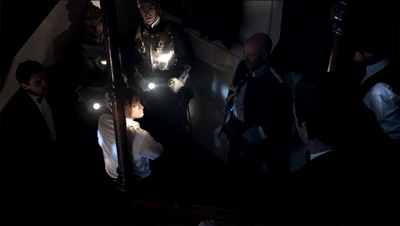
And then the comedy explodes with the apprehensive, not to say terrified, duo (and a host of guards) running around corridors and staircases, Ã la Marx Brothers, through Elsinore in search of the killer Prince. The music is humorous, and stops when they stop, so they can hear the body being dragged down stairs. Darkly funny. The Hamlet they find is Mad Hamlet, waiting for them, in complete control, and soon doing voices (pitching up on "squeeeeeeeeezed" for example, or giving the next few lines a swinging cadence as his body sways around a post, appropriately ape-like). The scene is lit by torches (or as we say in North America, flashlights), giving it an uneasy feeling, through which we well understand R&G's reaction. Hamlet is having fun, but no thinks it's funny. Not getting a reaction, he gives up and asks to be brought to the King... at which point he resumes running, jumping the balustrade and leading a merry chase once again.
Scene 3
At the bottom of a stairwell, a new venue, an ugly basement with mysterious stains on the concrete floor and a broken mirror over a dirty wash basin. A place where things are done in secret. Torture? Covert murder? People made to disappear. The cool and collected, even reasonable, Claudius is attended by lawyer types in suits, one of which will turn out to be a doctor. Again we have the push and pull of a reasoned leader protecting his family, who could also be about to kill Hamlet and have his body wash up somewhere innocuous (at least, for an audience who doesn't know the play). Enter Hamlet, taped to a chair on casters, a piece of tape on his mouth as well. It's an interrogation/torture scene. The threat to his life doesn't deter Hamlet from his mockeries. He makes his wild speeches and responds to Claudius' single loss of temper ("Where is Polonius?") with a silly shouting voice ("In heaven!"). The doctor in the room shoots him up with some drug, precursor to his exile, a way to smuggle him, sedate, out of the country. There's a nice moment when Hamlet looks straight into the camera at his mention of a cherub that sees Claudius' purposes, something that can easily be translated to the stage. The audience sees all, and it's true to say that soliloquies are a kind of compact between character and audience. It admits our existence in the world of the play, as observers... and judges. In the film, we're part of the paranoid hypersurveillance theme, but our function is the same.
And wheeeeeeeeeeeeeeeeeee, Hamlet is rolled out of the room, eager to get to England now that he's done with Claudius. Acting the child to the end. Claudius' brief soliloquy is told in the broken mirror, a match to the one upstairs in Gertrude's closet, and a reference to the mirror used in the stage production. This is an Elsinore that is falling apart, disjointed and fractured, just like its royal family unit. Like Ophelia's mind. And that's where Doran's Hamlet goes next.
Gertrude may be desperate to cling to what she once had and resolve her mixed feelings, there's no denying Claudius' selfish streak here. Yes, his first reaction to Polonius' death is shock that he might have been the target of the assassination, but beyond that, there's the moment when he calls Rosencrantz & Guildenstern into the room, thoughtlessly exposing Gertrude to humiliation. She's in her night gown and has been crying and looks quite vulnerable. As R&G walk in, she goes running with a yelp, and sits her back to them, mortified. At no point does Claudius even notice. He's playing the part he wrote for himself, that of the concerned father, tiredly apologetic when asking Hamlet's two school chums to go and find the prince and the corpse. There's definitely a vein of black comedy in the matter-of-fact way it is played.
Scene 2
And then the comedy explodes with the apprehensive, not to say terrified, duo (and a host of guards) running around corridors and staircases, Ã la Marx Brothers, through Elsinore in search of the killer Prince. The music is humorous, and stops when they stop, so they can hear the body being dragged down stairs. Darkly funny. The Hamlet they find is Mad Hamlet, waiting for them, in complete control, and soon doing voices (pitching up on "squeeeeeeeeezed" for example, or giving the next few lines a swinging cadence as his body sways around a post, appropriately ape-like). The scene is lit by torches (or as we say in North America, flashlights), giving it an uneasy feeling, through which we well understand R&G's reaction. Hamlet is having fun, but no thinks it's funny. Not getting a reaction, he gives up and asks to be brought to the King... at which point he resumes running, jumping the balustrade and leading a merry chase once again.
Scene 3
At the bottom of a stairwell, a new venue, an ugly basement with mysterious stains on the concrete floor and a broken mirror over a dirty wash basin. A place where things are done in secret. Torture? Covert murder? People made to disappear. The cool and collected, even reasonable, Claudius is attended by lawyer types in suits, one of which will turn out to be a doctor. Again we have the push and pull of a reasoned leader protecting his family, who could also be about to kill Hamlet and have his body wash up somewhere innocuous (at least, for an audience who doesn't know the play). Enter Hamlet, taped to a chair on casters, a piece of tape on his mouth as well. It's an interrogation/torture scene. The threat to his life doesn't deter Hamlet from his mockeries. He makes his wild speeches and responds to Claudius' single loss of temper ("Where is Polonius?") with a silly shouting voice ("In heaven!"). The doctor in the room shoots him up with some drug, precursor to his exile, a way to smuggle him, sedate, out of the country. There's a nice moment when Hamlet looks straight into the camera at his mention of a cherub that sees Claudius' purposes, something that can easily be translated to the stage. The audience sees all, and it's true to say that soliloquies are a kind of compact between character and audience. It admits our existence in the world of the play, as observers... and judges. In the film, we're part of the paranoid hypersurveillance theme, but our function is the same.
And wheeeeeeeeeeeeeeeeeee, Hamlet is rolled out of the room, eager to get to England now that he's done with Claudius. Acting the child to the end. Claudius' brief soliloquy is told in the broken mirror, a match to the one upstairs in Gertrude's closet, and a reference to the mirror used in the stage production. This is an Elsinore that is falling apart, disjointed and fractured, just like its royal family unit. Like Ophelia's mind. And that's where Doran's Hamlet goes next.
Sunday, December 9, 2012
III.iv. The Closet Scene - Tennant (2009)
Penny Downie's Gertrude starts the Closet Scene by taking off her Queen's reinments. This is to be an intimate scene, without benefit of make-up or hair piece, played in simple gray silk pajamas. When Polonius comes in, she's smoking a cigarette, drinking scotch whiskey and generally angry at both her son and this little man who imposes his presence on the moment. He hides behind a mirrored closer door, which will become an important symbol, as she downs her liquid courage. Hamlet can be heard coming from deep inside Elsinore, shouting and ranting, cawing "Mother" as if a crow. When he enters, he's still wearing his player's crown, which takes off his head impatiently. For all her outrage and bluster, she misses the point that this is exactly what she did to him by marrying his uncle, interrupting the normal succession. She took a crown from him. But Gertrude, though sharp-witted, has a particular blind spot when it comes to her family relationships and for example, did not catch the suggestion that Claudius killed her first husband from the details of Hamlet's play. The trouble they have communicating, likely a recent development, is what makes them act so impatiently towards one another. She almost slaps him, but turns into a kinder tap on the chest. Emotional blackmail rather than punitive violence, but Hamlet, at this point, will have none of it and responds with violence.
Tennant's acting strategy is to discover the text as he says it, which creates an impressive freshness to words more than 400 years old. For example, he plays with "your husband's brother's wife" as if comically working out its complexities. Later he'll find epithets like "fanged" only after a pause, considering the word "adders" less than sufficient to describe the treacherous Rosencrantz & Guildenstern. And so it is with the violence and intensity of the scene. He throws Gertrude on the bed, pulls her face towards newspapers with photos of the two kings, jumps on the bed, and makes it all seem unchoreographed and dangerous. He also discovers Gertrude's text. When she asks if he would murder her, it makes him take pause, disturbs him, shocked that he might have done it in a fit of rage. She starts to crawl towards her nightstand, in fear for her life, and in the drawer is a gun, but she doesn't draw it. That's when she starts to shout for help, making it very clear that she's asking for Polonius specifically, her eyes darting to the closet. Typically, he's slow on the uptake. Hamlet grabs the gun and shoots him, shattering the mirror (a device also used on a large mirrored wall in the stage play). Polonius stumbles out and collapses behind more mirrors, and it's only when Hamlet illuminates his form with a match that he realizes it wasn't the King. As the match burns out, Polonius' life on stage is extinguished forever.
The fractured mirror is an important element in the staging of this adaptation. Hamlet looks at himself in it, an image of his fractured mind (even if we accept he is not mad, he is still split between competing motivations, as is the Queen by the end of this scene). The shattered mirror occurs when Polonius is killed, representing the fracturing of Danish society. Remember that Laertes will return to avenge his father, revolt in his voice, and rebels at his heels. And it's also a play on the idea that Claudius and the Ghost are played by the same actor, the latter character walking "out of the portal" i.e. that shattered mirror. The presentment of two brothers, nearly identical, takes the bent of irony, but as we accept them as two different men, we'll note that Gertrude looks long and hard at her first husband in the newspaper, still apparently grieving. She knows what she's lost and that her second love doesn't invalidate her first. In fact, she turns to Hamlet and recognizes his father's bearing in him. The love she bears for her son informed by Hamlet being all that's left of Hamlet Sr.
We were warned about the witching hour, and it arrives with a gently chiming clock on the dresser. It's midnight and the Ghost makes its appearance, a gray figure, pointing at its son, angry. When it notices Gertrude, it grows kinder, and director Gregory Doran's contribution to the scene is to place them in the same shot, close together, an image of a family reunited. The Ghost even touches her hair, which she slips back into place without noticing. It's an image that will make Hamlet accept he must work with his mother rather than against him, but it's also an ironic image. For all his allusions to Claudius being death itself, a somehow revolting rotting thing, here his mother is sitting on the bed with an actual dead man. This is the state Hamlet would have preferred for his mother, a widow sleeping with the ghost of her husband forever more. Gertrude's subtle reaction to his saying her blood is tame says it all. Children seldom want to recognize their parents' sexuality, even though they obviously sprang from it.
Because she can't see this apparition, her fears that Hamlet is truly mad are confirmed, and his attempts to reel her back into his plan very nearly fall on deaf ears. What she responds to is the childish part of him, which comes and goes. They are trying to reconnect, but though he can plead with her "don't tell [step]dad" and hug her waist, and she can play a game of secrets with him, fingers on lips, and shush him while he cries, it's not long before he must become an adult again, one that talks of killing. They don't need to find the old connection, they need to forge a new one, and it's what they do as uneasy co-conspirators. Gertrude's reactions in this last sequence are incredible. When Hamlet asks her to throw away the worse part of her cleft heart, she laughs in his face with an expression that says "easier said than done" (because it's not a woman's place to refuse her husband's advances? Or because she can't deny someone she loves or, perhaps, someone who could kill her?). It's why he keeps giving her advice in that sense, showing her how she might stay on the wagon, as it were. Penny Downie's performance is incredibly naturalistic as Gertrude's own mind is in danger of snapping under the emotional strain.
Before Hamlet leaves, a final cruelty. Though he repents what he's done to Polonius, he can't help but pronounce a disdainful eulogy for the man. He gives his mother a quick and surprising kiss on the lips, and knavishly intones his good nights. The absurdity of it all makes her break out laughing, a laugh that immediately turns into a tear-stained grimace. This adaptation of the play continues to enchant and surprise.
Tennant's acting strategy is to discover the text as he says it, which creates an impressive freshness to words more than 400 years old. For example, he plays with "your husband's brother's wife" as if comically working out its complexities. Later he'll find epithets like "fanged" only after a pause, considering the word "adders" less than sufficient to describe the treacherous Rosencrantz & Guildenstern. And so it is with the violence and intensity of the scene. He throws Gertrude on the bed, pulls her face towards newspapers with photos of the two kings, jumps on the bed, and makes it all seem unchoreographed and dangerous. He also discovers Gertrude's text. When she asks if he would murder her, it makes him take pause, disturbs him, shocked that he might have done it in a fit of rage. She starts to crawl towards her nightstand, in fear for her life, and in the drawer is a gun, but she doesn't draw it. That's when she starts to shout for help, making it very clear that she's asking for Polonius specifically, her eyes darting to the closet. Typically, he's slow on the uptake. Hamlet grabs the gun and shoots him, shattering the mirror (a device also used on a large mirrored wall in the stage play). Polonius stumbles out and collapses behind more mirrors, and it's only when Hamlet illuminates his form with a match that he realizes it wasn't the King. As the match burns out, Polonius' life on stage is extinguished forever.
The fractured mirror is an important element in the staging of this adaptation. Hamlet looks at himself in it, an image of his fractured mind (even if we accept he is not mad, he is still split between competing motivations, as is the Queen by the end of this scene). The shattered mirror occurs when Polonius is killed, representing the fracturing of Danish society. Remember that Laertes will return to avenge his father, revolt in his voice, and rebels at his heels. And it's also a play on the idea that Claudius and the Ghost are played by the same actor, the latter character walking "out of the portal" i.e. that shattered mirror. The presentment of two brothers, nearly identical, takes the bent of irony, but as we accept them as two different men, we'll note that Gertrude looks long and hard at her first husband in the newspaper, still apparently grieving. She knows what she's lost and that her second love doesn't invalidate her first. In fact, she turns to Hamlet and recognizes his father's bearing in him. The love she bears for her son informed by Hamlet being all that's left of Hamlet Sr.
We were warned about the witching hour, and it arrives with a gently chiming clock on the dresser. It's midnight and the Ghost makes its appearance, a gray figure, pointing at its son, angry. When it notices Gertrude, it grows kinder, and director Gregory Doran's contribution to the scene is to place them in the same shot, close together, an image of a family reunited. The Ghost even touches her hair, which she slips back into place without noticing. It's an image that will make Hamlet accept he must work with his mother rather than against him, but it's also an ironic image. For all his allusions to Claudius being death itself, a somehow revolting rotting thing, here his mother is sitting on the bed with an actual dead man. This is the state Hamlet would have preferred for his mother, a widow sleeping with the ghost of her husband forever more. Gertrude's subtle reaction to his saying her blood is tame says it all. Children seldom want to recognize their parents' sexuality, even though they obviously sprang from it.
Because she can't see this apparition, her fears that Hamlet is truly mad are confirmed, and his attempts to reel her back into his plan very nearly fall on deaf ears. What she responds to is the childish part of him, which comes and goes. They are trying to reconnect, but though he can plead with her "don't tell [step]dad" and hug her waist, and she can play a game of secrets with him, fingers on lips, and shush him while he cries, it's not long before he must become an adult again, one that talks of killing. They don't need to find the old connection, they need to forge a new one, and it's what they do as uneasy co-conspirators. Gertrude's reactions in this last sequence are incredible. When Hamlet asks her to throw away the worse part of her cleft heart, she laughs in his face with an expression that says "easier said than done" (because it's not a woman's place to refuse her husband's advances? Or because she can't deny someone she loves or, perhaps, someone who could kill her?). It's why he keeps giving her advice in that sense, showing her how she might stay on the wagon, as it were. Penny Downie's performance is incredibly naturalistic as Gertrude's own mind is in danger of snapping under the emotional strain.
Before Hamlet leaves, a final cruelty. Though he repents what he's done to Polonius, he can't help but pronounce a disdainful eulogy for the man. He gives his mother a quick and surprising kiss on the lips, and knavishly intones his good nights. The absurdity of it all makes her break out laughing, a laugh that immediately turns into a tear-stained grimace. This adaptation of the play continues to enchant and surprise.
Sunday, September 23, 2012
III.iii. The Confessional - Tennant (2009)
Though he kept his cool during the Hamlet's play, Claudius now seems slightly more agitated. Still, he deals with Rosencrantz & Guildenstern with calm and diplomacy, giving them orders to ferry his dangerous stepson to England. While the scripted fawning can make the audience grow as impatient as Claudius in this scene, this version's R&G keep the moment alive with comedy. Guildenstern is, as usual, in deadly earnest and prompts the less resolute Rosencrantz to fawn along with him. So Rosencrantz looks at Guildenstern, not Claudius, while he searches for the right metaphor, then realizes almost too late that he's gone on too long, that the King is looking at him, so he gulps down the last words. Might this "wheel" metaphor also betray a lower birth, which is doubly embarrassing for Rosencrantz? I'm thinking specifically of Polonius' line about keeping a farm and carters, and something as mundane as a wheel not being a fit symbol for a King. R&G's gauche imagery could stem from their essentially being posers, men whose ambitions outpace their place in the hierarchy (contrast with Horatio's humility). As for Polonius, he is still deluded, and laughs through his lines as if all will be well as soon as the Queen speaks to her son. Not only is he wrong about Hamlet's motivations, but he completely misgauges Claudius' mood.
As soon as he's alone, Claudius' guilt - or perhaps his fear of being caught - catches up to him and makes him retch in a handkerchief. Patrick Stewart gives reality to the rank smell mentioned in the lines. It's a very physical performance, one that betters 1980's version by a mile. The act of prayer is denied him, his hands acting as polar opposites and refusing to make contact. He laughs at the absurdity of praying with bloody hands, linking the pious position to the metaphysical state of prayer. At the end of the speech, when he is finally able to touch his palms together, that seems enough to give him the hope that "all may yet be well". If it's all about the physical with Claudius, it's in direct opposition to Hamlet who is all thought and no action, and it also relates well to his carnal motivations. Claudius is a man of this Earth, a man of flesh, not one of Heavenly spirituality.
Enter Hamlet with a switchblade, his crooked theater crown still on his head, a visual link to the killer king who murdered his father. In the theater, this was a cliffhanger where their put the intermission. Clever to put it in the middle of a scene rather than at the end of an Act, even if today's audiences know very well the scene ends in anti-climax. The energy of the scene is all and insures patrons will return promptly to their seats. On DVD, of course, there is no such break, and the action continues with Hamlet standing right over the kneeling Claudius who is putting his whole body into a semblance of prayer. Hamlet switches to voice-over for realism's sake, but soon runs off behind a pillar, breathless, to speak more directly to the audience.
An ambiguity: At the very end, Claudius wakes from his useless prayer and smiles, turning his eyes on us. It's slightly creepy, and through the self-disgust, you might wonder if there's a also a sense of satisfaction at having tricked Hamlet. Did he feel him there? Did he intensify his physicality to MAKE Hamlet come to that conclusion? In the midst of prayer, did Claudius suddenly let go of his guilt and self-servingly feigned piousness to selfishly save his own life? Whatever the case may be, he then rips his jacket open in anger, defeated and frustrated by that "physic" (and a well-chosen pun it is, in the wake of this discussion).
As soon as he's alone, Claudius' guilt - or perhaps his fear of being caught - catches up to him and makes him retch in a handkerchief. Patrick Stewart gives reality to the rank smell mentioned in the lines. It's a very physical performance, one that betters 1980's version by a mile. The act of prayer is denied him, his hands acting as polar opposites and refusing to make contact. He laughs at the absurdity of praying with bloody hands, linking the pious position to the metaphysical state of prayer. At the end of the speech, when he is finally able to touch his palms together, that seems enough to give him the hope that "all may yet be well". If it's all about the physical with Claudius, it's in direct opposition to Hamlet who is all thought and no action, and it also relates well to his carnal motivations. Claudius is a man of this Earth, a man of flesh, not one of Heavenly spirituality.
Enter Hamlet with a switchblade, his crooked theater crown still on his head, a visual link to the killer king who murdered his father. In the theater, this was a cliffhanger where their put the intermission. Clever to put it in the middle of a scene rather than at the end of an Act, even if today's audiences know very well the scene ends in anti-climax. The energy of the scene is all and insures patrons will return promptly to their seats. On DVD, of course, there is no such break, and the action continues with Hamlet standing right over the kneeling Claudius who is putting his whole body into a semblance of prayer. Hamlet switches to voice-over for realism's sake, but soon runs off behind a pillar, breathless, to speak more directly to the audience.
An ambiguity: At the very end, Claudius wakes from his useless prayer and smiles, turning his eyes on us. It's slightly creepy, and through the self-disgust, you might wonder if there's a also a sense of satisfaction at having tricked Hamlet. Did he feel him there? Did he intensify his physicality to MAKE Hamlet come to that conclusion? In the midst of prayer, did Claudius suddenly let go of his guilt and self-servingly feigned piousness to selfishly save his own life? Whatever the case may be, he then rips his jacket open in anger, defeated and frustrated by that "physic" (and a well-chosen pun it is, in the wake of this discussion).
Thursday, July 12, 2012
III.ii. Critical Reception - Tennant (2009)
The sequence doesn't start with the usual rhymes in this version, but instead with Horatio trying to tell Hamlet that was he noted most definitely was NOT conclusive proof of Claudius' guilt. Hamlet won't listen, of course, an almost violent euphoria overtaking him. He asks for music, but also grabs a silver tray from a servant, banging it in the man's face like a gong. Horatio attends him and laughs at his jests, but he doesn't speak or try to broach the subject of the King again. The focus changes, in any case, to Rosencrantz & Guildenstern, surely Horatio's rivals in the friendship department, so perhaps there's a psychological, personal reason why he falls in with Hamlet again despite the unspoken disagreement.David Tennant's Hamlet is at his funniest in this scene. His "with drink?" is impish and a confidential "he's drunk again eh? yeah, that happens a lot", traitor's talk that makes R&G co-conspirators if anyone were listening. As they continue, Hamlet more or less ignores them, putting the Player's crown on his head, using the silver tray as a mirror, hiding his face from them. He's their mock King, the King that should have been if only they (and the rest of the Court) would follow the right man, the true heir. He's also mocking Claudius, sitting on the throne misunderstanding everything they say on purpose. It is a sly condemnation of Claudius' decisions to date, prefiguring Denmark's downfall at the hands of Fortinbras. When they demand an answer from him, he raises his hand excitedly, like a school boy, only to reveal he can't make a wholesome one. It's with mock pride that he says the "oh wonderful son" line. It's all a caricature of his false King/Father.
And he does the same with the friendship he bears these men. At "pickers and feelers", he gets up to tickle Rosencrantz, freaking him out. And he should. They are failing at their appointed task, and that will have consequences. For this Rosencrantz, it's really about getting it over with so he can leave this hellish place before the axe falls on him. He tries to keep back, he's rather sincere when he asks Hamlet to stop what he's doing before it ruins them all. Guildenstern is the more political, albeit gauche, animal. He tries to find the right words and hopes to get favor from the King. But of course, neither of them are aware that Claudius may be a murderer and usurper. They just don't get it, perhaps because they can't. It's shown, for example, when Rosencrantz gives Hamlet a blank stare at "While the grass grows". There's a funny beat before the next line, and Hamlet obnoxiously slaps him, but doesn't awaken him to the very real danger of trusting Claudius.
The recorders arrive, and the production plays on the plural in that line to make Hamlet throw one to Horatio, which will come into play later. The interplay between Hamlet and Guildenstern is sweeter and less violent than usual, initially, Hamlet acting all innocent, not understanding why Guildenstern won't play and laughing at the irony. Guil, for his part, tries to understand what is being said and takes the Prince's explanations with a measure of respect, as if he agrees he's been rumbled. Then BAM! A rare musical sting accompanies Hamlet attacking Guildenstern with the pipe, trying to choke him, even as Rosencrantz tries to gently separate them. What actually does it is Polonius' arrival.Coming into a violent moment, Polonius gets a loud pipeful in the face, followed by Hamlet and Horatio playing a tune together over his words. By having the old councilor mouth words at R&G with a certain degree of ire, the production motivates his presence. Thematically, I've said that Polonius is entirely redundant in the scene because he always makes the wrong choices, and that Hamlet feels he's irrelevant all the time. Here, he comes because R&G are taking too long. We have to remember he plans to hide in the Queen's closet (even if he hasn't said so yet), so his impatience stems from that. He's been kept waiting as much as the Queen has. Showing impatience and even anger is rare for him, so perhaps his head too, is on the chopping block. When the King is angry, chaos reigns in Elsinore. And it's because he's impatient and in a hurry that Hamlet chooses to play the game of clouds with him, pushing him to show disrespect. Polonius catches himself each time, but his composure does break.
The soliloquy is done straight into Hamlet's movie camera, a point of view we get to see. Sitting askew on the throne while he speaks of being cruel to his mother creates a visual inversion of what is natural, and may put the lie to his words. Hamlet looks quite demented here. His successive victories over Claudius, R&G, and Polonius have pushed him over the line of what may be reasonable or acceptable.
Sunday, April 15, 2012
III.ii. The Mouse-Trap - Tennant (2009)
Tennant's Hamlet is a petulant and mischievious child in this scene. The audience's entrance is scored with the Danish national anthem, as a barefoot Hamlet insolently whistles along. They ignore him, and we get the sense that his parents are already tired of his shenanigans. They do not appear to be particularly excited at the prospect of a night at the theater with him, and indeed, the audience is rather small. This is an intimate affair, not the public one other versions have created. We are definitely in the wake of Hamlet's attack on Ophelia. She comes in with her head down. Her father looks ever so puzzled. No one trusts Hamlet's mood. As if to give them reason, his giddy idleness is immediately disrespectful, throwing in an army salute with the chameleon's dish line, mocking the normal obedience one should show a father and a king.In the early part of the scene, everything is more intimate. Hamlet asks Polonius about his acting days in private conversation, and only Polonius laughs at the prince's pun. It's interesting however to see Polonius so confounded by the fact he had to be killed in the play, a precursor to his actual senseless death in THIS play. Hamlet runs off with Ophelia, grabbing her out of her seat and to a position from where he can better observe the Royals. At this, Polonius breaks the fourth wall to ask us if we "mark that". Again, the scene's intimacy prevents him from being more public about his thoughts. Hamlet drags Ophelia down to the floor and wraps her arms around himself, mockingly bites her arm. It is a parody of a normal romantic relationship, and in a sense, perhaps a disguise. Sitting across from his parents, he appears to be getting back together with his girlfriend, but his cruel, unheard words tell another story. Tennant underlines the dirty pun in "country matters" (cunt-ry matters) to make it harsh indeed. And yet, his "as woman's love" later is a private statement, sounding more sorry than mean.
These private moments contrast with the moment when Hamlet actually flings an accusation his parents' way, as he shows more and more difficulty reigning himself in. At the jig-maker line, he gets up and dances humorously on the rug that will serve as a stage, making his mother laugh, which is the moment he chooses to begin his open cruelties. His very bitter delivery of "die two months ago, and not forgotten yet" gives it a strong ironic bent. For Hamlet, two months is no more appropriate than two hours, recalling the Hamlet from earlier in the play who was told to stop his grieving.
The dumb show is a most depraved affair meant to shock perhaps more than amuse. A tiny king with giant ears comes out of bald, fat queen's skirts and speaks unintelligibly (I was reminded of Pingu) until he is poisoned by a glam murderer with a heart over his crotch which, when removed, reveals an uncoiled slinky. The dead king's shroud becomes a ghostly sheet that runs off to let them have sex. Through this ridiculous piece of bawdry, Claudius laughs not at all, holding his temper in check. We do see his reaction to he mock poisoning, which makes this Claudius quite aware of the insinuation from early on. He stews in his own guilt longer as a result. As the dumb show starts, Hamlet takes out his camera and starts filming it, or really, the Royals' reactions to it. In this way, the film keeps the energy up by layering in Hamlet's point of view. When does he look at the characters and at what gestures or words do he focus in on his mother or stepfather?
The play itself features rather extreme Elizabethan costumes, and a staging that mirrors that of the Royals (king-left, queen-right). Gertrude is bitter and impatient at the text. She knows very well what she is being accused of and finds it insulting. With great poise, she questions whether the Player Queen protests too much, and gets a laugh from the audience. It's a show of power against Hamlet, and the audience seems to be on the Queen's side in this. As for Claudius, the cracks start to show. Silent up to this point, he asks if there's offense in it, in fact proposing there is, at which Polonius makes an odd gesture as if to stop him from speaking out. Have they decided prior to the play to let Hamlet have his fun and show no reaction? Reacting, even with a smaller audience, is dangerous at this point because Hamlet is filming them. The (Mouse-)trap is theirs to get caught in.After mouthing many of the lines himself, it's time for the murder, and Hamlet can't help but get up and spoil the ending, just to force the reaction he's looking for, triumphant even has he ruins his own device. Does he succeed? The king rises, but walks calmly to a stagehand and requests light. He then brings the lantern over and shines it on Hamlet, as if revealing the prince's madness for all to see. He shakes his head as if to say "You won't get me so easily". To the assembly, this may instead mean that he pities and softly chides Hamlet, but we know better, and the slightest of smiles from Patrick Stewart speaks volumes. That Hamlet thinks he's found a chink in the King's armor may be wishful thinking on his part however.
Saturday, February 4, 2012
III.ii. Instructing the Players - Tennant (2009)
One of the things David Tennant is very good at as Hamlet is making his lines sound fresh and unrehearsed. Somehow, when his Hamlet speaks, it's like neither he nor you have ever heard the words before. Where other Hamlets seem to give the Players instructions with a prepared speech (or at least holding a discourse he's had before, say with his school chums), Tennant's is entirely motivated by his plans against the King. He hesitates, searches for words, and is less "on text" than in any other scene, and in a sense, he must be at his most naturalistic in this speech about "holding a mirror up to nature". While asking actors to play true, he (Tennant/Hamlet) must be at his most human. And it's a reactive performance too. His notes to the Players are motivated by their actions. One mouths, one saws, and when a clown seems to be fooling around, Hamlet entreats the First Player to keep him under control - it's a confidential aside, not a public accusation. In this directorial request, Hamlet's obsession with proving Claudius' guilt shows through. Outrage and impatience at the idea that his trap might not work because of some "villainous" distraction. And Hamlet is funny too. He tells seasoned professionals how to do their jobs - though they keep silent respect, it shows that they're being condescended to - and then realizes what he's doing and apologizes with his "Be not too tame neither." Not a further command, but a concession that though he's going a little crazy with anxiety just before the show, he does trust their judgment.We've seen how there's much mirroring in the play as written, but Gregory Doran's direction amplifies this element. On stage, there was a mirrored wall, and on film, there's a mirrored floor, to remind you of the theme. When Hamlet here talks about holding a mirror up to nature, he does so with a mirror in hand, shining reflected light on each Player in the company. (On stage, he aimed the mirror at the audience instead.) It's a strong, even poignant punctuation to the scene, giving each Player their little moment, either smiling, ignoring him, or in the case of the Player King, wincing. That last reaction foreshadows Claudius' guilt being exposed by the human mirrors that are the Players. Doran's other trope is hyper-surveillance, and it shows up at the very top of the scene when Hamlet films one of the players with a hand-held film camera. Since this is the point in the play where Hamlet takes control, it makes sense for him to symbolically take ownership of the thing that has been plaguing him, the ever watchful eyes of the Court. It's the film within a film that mirrors the play within a play concept.
Rosencrantz & Guildenstern are still trying to ingratiate themselves to Hamlet, to some hilarity. They show up with a punchy "ta-tannn!" and some champagne - party boys to the last - and immediately get dismissed as common servants (an irony when you remember their introduction). Hamlet's complete disinterest in them in a highlight. They leave to "hasten" the Players, Hamlet sits on the throne, his stepfather's seat. Trying to imagine Claudius' point of view? A reminder of the broken Danish succession? More mirrors? Horatio rushes in, late, fixing his tuxedo and gets the usual sincere compliments, but hyperactive Hamlet is quick to change the subject (minor cuts help him get to the point). The way Horatio plays it, he wasn't aware of the Mouse-Trap plan before this moment. Again, the 2009 Hamlet moves away from rehearsed formal speech (Hamlet telling Horatio what he knows for the audience's benefit) to a more naturalistic place (Hamlet delivers new information to his friend). Tennant's energy carries through to the next part of the scene as the trumpets sound and it's almost panic that sets him into action.
Monday, December 19, 2011
III.i. The Nunnery Scene - Tennant (2009)
The 2009 adaptation also uses a two-way mirror to hide (or rather, frequently cut to) the spies. Ophelia is steady, at first, while Hamlet is visibly upset and keeps his distance from her. Confronting this part of his life is painful, and seeing him like this, Ophelia quickly starts to break down too. There's a nice hesitation from her on "redeliver", as if looking for the word. She draws attention to that choice. She's not "giving back", she's "redelivering". What, if any, and aside from being more "poetic", are the meanings behind that word? One might infer here a more chaste relationship between Hamlet and Ophelia, a romance through correspondence more than intimate contact. Gifts were "delivered" and must now be "redelivered". Not that this adaptation means to paint the Hamlet-Ophelia relationship that way. Perhaps Ophelia is playing down their intimacy for her watching father.The way Hamlet tries to keep her at a distance, batting and waving her approaches, also gives a slightly different meaning to "I never gave you ought". It seems clearer that he means he's not the same person who gave her those gifts. By accepting his father's mission, he erased all other things from his mind (or tried to, that's the central conflict of the play). He's already renounced Ophelia and love, but here they both are again, and he must reassert his "new self" and push away any and all distractions. New Hamlet cannot be involved with Ophelia and even that past is erased. Compare to how the memory of his father has likewise been excised from the Court's memories. What Gertrude has done to Hamlet Sr., Hamlet Jr. is doing to Ophelia. She's not dead, but of course, the Ghost is a "living" character too. So even when he grabs her, he seems to push her away too, like he's defending himself from her touch and all the earthly concerns it represents. This push and pull is very much symbolic of Hamlet's attitude throughout the play. His goal goes against his values, and he hates the women he loves. "You should not have believed me" is spoken with hands on his head. The paradoxes of the play are making him crack.
While the spies behind the mirror are quiet, the hyper-surveillance element in this adaptation does make a noise as our point of view shifts to that of the security camera zooming in. That's when he realizes it's a set-up and gets angry at Ophelia, shouts at the air to make sure he's heard/recorded, etc. Ophelia is not thrown to the ground, she gets down on her knees to pray. Hamlet's violence is only verbal, though he does rip up the love letters as if they were "broken wedding vows", while she gestures ineffectually to try and save them. When he accuses women of nicknaming God's creatures, he holds up her Bible (which she was reading to color her loneliness). Given how quick she falls to praying, it makes sense this would be her book, but what does Hamlet's line mean? I've struggled with it. According to the Old Testament, Adam was given the task of naming all living things. Is Hamlet really condemning women for subverting God's wishes and in effect RE-naming the animals? It's an image of falsification (like the attack on cosmetics or love/sex games), and I now notice that it's something we get back to in Ophelia's madness scenes where different flowers are given different names and meanings (Gertrude does it too when talking about the suicide). If Shakespeare wasn't such a feminist in other plays, it would be easy to see a vicious misogynistic streak in this one. Women in Hamlet's world are not allowed to define or create their own world, and the naming of creatures and plants has a thematic relationship with Gertrude naming Claudius as her husband. Hamlet's revolt is against his world being shaken up by a woman.
After he leaves, Ophelia sobs through her entire speech and drops to the mirrored floor. As in other mirror-based stagings (like Branagh's), the things she sees and that haunts her is herself, that ugly thing she has become by participating in her father's schemes. In effect, she agrees with Hamlet's evaluation of himself as a monster created by women, and feels responsible for that transformation. However, he also told her not to believe a word he says. Was this a coded message she somehow missed? Part of the tragedy of these characters is that they do not understand one another. Ophelia should know Hamlet well enough to see through his act, read those coded warnings and heed his advice to leave Elsinore. She doesn't. This may be a problem with the Polonius family in general. Polonius certainly doesn't understand why Hamlet does what he does, and Laertes will allow himself to be convinced to work against Hamlet by the play's villain, and need to repent in his last moment.Polonius, as usual uncomfortable with emotion, comes out of hiding and hands his daughter a handkerchief, and in embarrassment, stresses that he heard it all. That "all" seems to represent all manner of unpalatable things which he doesn't want to rehash, examine or understand. The structure of the play only now has Polonius board Hamlet as the prince runs back and Ophelia scurries away. It makes Polonius even thicker than normal, pursuing a line of inquiry Claudius has just rejected.
Wednesday, October 19, 2011
III.i. To Be or Not to Be - Tennant (2009)
One thing the restructured Hamlets make clear is that putting "To be or not to be" before the Players arrive, rather than after, works better if Hamlet is not spied upon or at least doesn't know he's being spied upon. A Hamlet so structured has yet to see a glimmer of hope and may thus be more sincere in his mediation on self-oblivion. And so it is here, and though spies lie in wait, the moment is so intimate, and actually outside the room, so we may infer that the spies do not hear him. The speech is played around the corner of a wall, in near-darkness, with Hamlet progressively revealed. The way he is initially framed and backlit makes him skeletal (something supported by his t-shirt print), an image of mortality and vulnerability, and of revealing something to the audience that is under the surface.Tennant has a fresh approach to almost every line in the speech, something that's very much not obvious with "To be or not to be". He uses long, pregnant pauses to make us feel like he's thinking those words up for the first time. One of Tennant's best qualities in the role is that he doesn't seem to know what he'll say next, even though he's speaking some of the best known words in all of English literature. The best example of this "freshness" is that though "To be or not to be" is the question, he asks another, putting a question mark on the end of "by opposing, end them?" Hamlet is filled with anguish, which slowly builds towards bitterness. His eyes are closed in pain until he finally looks at us on "there's the rub". At "must give us pause", he swallows hard. Just as his "gorge rises at it" in the graveyard scene later, Hamlet is here physically repulsed by what lies waiting in the afterlife, by extension, his own father's ghost. Bringing a measure of fear to this speech makes perfect sense in the context of having met an undead parent earlier. The physical signs of that repulsion continue through to "sicklied o'er", manifesting what is in the text merely a mental image. It continues the image of sickliness that is background for most of the play, one that covers the whole of Denmark, and is caused by the depraved behavior of its King, and possibly the madness of its Prince as well.
"Soft you now" comes hard and fast on the heels of "lose the name of action", springing TO action even as one gives up hope that any action can occur. Ophelia's appearance thus surprises Hamlet and his audience, taking us out of the meditation and back to more earthly matters.
Friday, August 26, 2011
III.i. Briefings - Tennant (2009)
The sequence sits right on top of the film's structural change. Rosencrantz & Guildenstern's debriefing acts as preamble to Claudius' reaction to the nunnery scene, and so as a way to get back to the timeline as written. Ophelia's instructions, precursor as ever to "To be or not to be" and the nunnery scene occurs long before, at the tail end of the sequence this blog called "Brevity" (just before the fishmonger scene).
Part I - Rosencrantz & Guildenstern
The restructuring means that by the time R&G get to Claudius, the King has already seen Hamlet throwing Ophelia about and playing games with Polonius. As in the original text, being aware of all this means he's primed and ready to send his stepson to England. He's made up his mind. While R&G make their report, the King and Queen simply use each consecutive argument to justify their opinions. When there is talk of crafty madness, Claudius wags his finger in an "I told you so" motion at Gertrude. She, in turn, asks leading questions that have an unspoken yet audible "yes but" behind them. Yes but... did he receive you well? She's building a defense for her son, and is happy when the retorts go her way, discomfited when the other twin puts a different spin on the same answer.
The staging reveals why R&G each take a side. In the story, one is sucking up to the Queen and the other to the King. In the drama, the Royals are enacting their argument THROUGH the sycophants. By their reactions, the King and Queen are suggesting answers to two people who only really want to say what the Royals want to hear, and so they do.
Part 2 - Ophelia
Here too, there is innovation from the cast and director Gregory Doran. It seems that in this version, Gertrude doesn't know Ophelia at all! She's unsure about the girl's name and says it with a question mark attached, and lets out a surprised, little "oh" when Ophelia takes her hand. There is no doubt her heart is warmed by the gesture, and that her words are sincere, but they are not borne of long-standing affection. What does it mean? Well, she doesn't know her son as well as she thinks she does, for one thing. For another, it lends weight to Polonius and Laertes warning Ophelia away from Hamlet at the start of the play. Was he perhaps a bit of a lad (at least before Ophelia)? His mother doesn't seem to keep up with who the latest girlfriend is. And what will be the impact of this choice on Gertrude's description of Ophelia's suicide?
"To both your honors." As it's often played - for I had not considered another possibility - this seems to refer to the honors of both Ophelia and Hamlet. That if love is the cause of Hamlet's madness, then the truth of it would heal both he and Ophelia. This Gertrude is more direct in addressing the line to Polonius, which makes more sense. It would be to Ophelia's honor that she be the object of this love/madness, and to Polonius' that his theory be correct.
As Gertrude is dismissed and the scene turns to instructions for Ophelia, we see Hamlet coming down an adjacent corridor, the words echoing quite clearly. He's heard it all and definitely knows he'll be watched in the nunnery scene (however, "To be or not to be" is still spoken quietly enough to register as unseen by the spies). A word on Hamlet's t-shirt as it's its first chronological appearance even if we've seen it before in these articles:
Apparently an old t-shirt of Tennant's, it's a bit flashy for the dark, brooding Hamlet, but takes on an ironic meaning. The muscled chest depicted relates to Hamlet's earlier comparison between himself and Hercules. We are invited to compare the mythic demigod with the thin, disturbed boy in front of us.
One final thing: There's a hilarious bit when Polonius takes the book Ophelia is to read from a large folder. In this hyper-surveillance world, did Polonius catalog, index and file all of Hamlet's mementos to Ophelia? It's as ludicrous and self-important as the First Minister himself.
Part I - Rosencrantz & Guildenstern
The restructuring means that by the time R&G get to Claudius, the King has already seen Hamlet throwing Ophelia about and playing games with Polonius. As in the original text, being aware of all this means he's primed and ready to send his stepson to England. He's made up his mind. While R&G make their report, the King and Queen simply use each consecutive argument to justify their opinions. When there is talk of crafty madness, Claudius wags his finger in an "I told you so" motion at Gertrude. She, in turn, asks leading questions that have an unspoken yet audible "yes but" behind them. Yes but... did he receive you well? She's building a defense for her son, and is happy when the retorts go her way, discomfited when the other twin puts a different spin on the same answer.
The staging reveals why R&G each take a side. In the story, one is sucking up to the Queen and the other to the King. In the drama, the Royals are enacting their argument THROUGH the sycophants. By their reactions, the King and Queen are suggesting answers to two people who only really want to say what the Royals want to hear, and so they do.
Part 2 - Ophelia
Here too, there is innovation from the cast and director Gregory Doran. It seems that in this version, Gertrude doesn't know Ophelia at all! She's unsure about the girl's name and says it with a question mark attached, and lets out a surprised, little "oh" when Ophelia takes her hand. There is no doubt her heart is warmed by the gesture, and that her words are sincere, but they are not borne of long-standing affection. What does it mean? Well, she doesn't know her son as well as she thinks she does, for one thing. For another, it lends weight to Polonius and Laertes warning Ophelia away from Hamlet at the start of the play. Was he perhaps a bit of a lad (at least before Ophelia)? His mother doesn't seem to keep up with who the latest girlfriend is. And what will be the impact of this choice on Gertrude's description of Ophelia's suicide?
"To both your honors." As it's often played - for I had not considered another possibility - this seems to refer to the honors of both Ophelia and Hamlet. That if love is the cause of Hamlet's madness, then the truth of it would heal both he and Ophelia. This Gertrude is more direct in addressing the line to Polonius, which makes more sense. It would be to Ophelia's honor that she be the object of this love/madness, and to Polonius' that his theory be correct.
As Gertrude is dismissed and the scene turns to instructions for Ophelia, we see Hamlet coming down an adjacent corridor, the words echoing quite clearly. He's heard it all and definitely knows he'll be watched in the nunnery scene (however, "To be or not to be" is still spoken quietly enough to register as unseen by the spies). A word on Hamlet's t-shirt as it's its first chronological appearance even if we've seen it before in these articles:
Apparently an old t-shirt of Tennant's, it's a bit flashy for the dark, brooding Hamlet, but takes on an ironic meaning. The muscled chest depicted relates to Hamlet's earlier comparison between himself and Hercules. We are invited to compare the mythic demigod with the thin, disturbed boy in front of us.
One final thing: There's a hilarious bit when Polonius takes the book Ophelia is to read from a large folder. In this hyper-surveillance world, did Polonius catalog, index and file all of Hamlet's mementos to Ophelia? It's as ludicrous and self-important as the First Minister himself.
Friday, July 15, 2011
II.ii. O, what a rogue and peasant slave am I - Tennant (2009)
To motivate "Now I am alone", Hamlet rips out the room's surveillance camera, and yet, ironically, speaks that line to the subjective camera (to us). Of course, who are we? In the text, we're simply the Elizabethan audience and this is part of how we understand drama. It should need no more explanation than border panels in comics or spontaneous musical numbers on Broadway. Modern audiences may attempt to find meta-textual motivations, especially when the play is performed in a modern setting. Not unlike Jacobi, Tennant will turn to us many times during this speech, but unlike Jacobi, his Hamlet does not exist in the Medieval world of the play. And yet, Polonius also spoke to camera, so it is difficult to call us madness-induced visions or some unseen character. Elizabethan we must be, though since asides and soliloquies are meant to express thoughts rather than speech, surely even an Elizabethan audience would consider itself, somehow, part of the character itself, the part one speaks to when one speaks to oneself. And perhaps this trope is what made Shakespeare focus far more on character study than on plot.
Hamlet sits in a corner, reflective but also filled with apprehension and fear. He is plainly disturbed by the Player's performance, or rather what it reveals about himself. He is the "tardy son" who needs to be chided. If someone can fake it, why can't he actually do it? When he finally stands up, he walks around drunk with confusion. There is an intriguing gesture on "no not for a King", where Hamlet shows his bandaged hand, a symbol of his oath to avenge his father. You might remember Hamlet cut his hand in Act I, Scene 4. He then walks right up to camera, full frame, and asks if we think he's a coward. In that instance, we may well be invisible characters, visions to be shouted at, but as an Elizabethan audience too, we must be Hamlet himself. He's the one who accuses him of such things. After screaming for vengeance, he collapses.From that prone position, he starts thinking aloud and seems to have the idea about The Mouse-Trap right before our eyes and then runs off. How do we reconcile this with the fact he has already asked to add lines to The Murder of Gonzago? As with Jacobi, we might be prone to think he is only now confiding in us a plan he had earlier, but that doesn't seem to be the performance here. Is it a realization insofar as it brings him out of his confusion, a sudden remembering of the plan? Possibly. Or did he ask for a play that connected to his current obsessions, and even wanted to add lines that paid tribute to his father and/or brought the play more in line with his obsessions, and only NOW realizes that could flush out the murderer? Ambiguous, but as good a theory as any, and now Hamlet runs off to make further tweaks. This is the turning point in the play, and with "To be or not to be" displaced to a point before this one, all delays are behind him. Again, the structural change is understandable, and might prevent audiences from squirming in their seats as the action gets ever more delayed, but I believe that was Shakespeare's intention, and many lines (like Polonius's criticism of the Player's speech) point to this intent.
Subscribe to:
Posts (Atom)