Saturday, November 26, 2011

III.i. The Nunnery Scene - Olivier '48

When considering Olivier's adaptation, we must contend with the unusual placement of this sequence. It comes after the Fishmonger scene through a time lapse transition and a the set-up from before To be or not to be, and is followed by To be or not to be (which becomes a guilty reaction to it). Jean Simmons' Ophelia is probably the most innocent of them all, almost a child really, and as such, can hardly lie convincingly. Throughout the scene, she keeps glancing at the arras behind which her father and the King are hiding, usually before her cue to speak, leading Hamlet to do the same. He was suspicious when he came in, but Ophelia's jumpy disposition inflames his paranoia. Not that Hamlet doesn't give her cause to be jumpy. He throws her book away to stop her from reading, and his blasé, monotone "well, well, well" doesn't let on that he cares for her. When he doesn't receive the tokens she hands him, she uncomfortably puts them on the table, his cue to grab her hand violently.

By violent, I realize I merely mean sudden. All the violence in this scene is psychological. There are a few moments where Ophelia throws herself at Hamlet and he tears her away and watches her fall, but that's about it. The performances however add a lot of sting to the words themselves. When Hamlet tells her she should not have believed his love, she rubs her cheek, as if she'd been slapped. And in slight change to the accepted text, Ophelia cries out "Help me you sweet heavens" (instead of "Help him"). She's the one in distress, and who emotionally explodes, not Hamlet. His only violence is rejecting her, or refusing to show kindness, and it's what sets off her hysterics. Polonius' claims of madness-for-love aren't so much wrong as they are badly targeted. If the mirroring effects of the play go in a "like parent, like child" direction, we must then recall how Polonius earlier claimed he suffered much for love. It's behavior genetically imposed on Ophelia, but we can't say the same for Hamlet or his absentee father.

Hamlet's lack of interest in Ophelia is counterpointed by his over-interest in the arras and what might wait beyond it. In moments, he is talking not to Ophelia, but directly to the arras. The word "ambitious" in particular is directed at Polonius and the King. Should we infer that the litany of sins Hamlet accuses himself of are actually leveled at them? Or is it an implicit threat to the throne? If it is, it's one that consciously confuses the issue of his motivation. The spies could understandably, if mistakenly(?), believe his motives to be political. By the end of the sequence, Ophelia is on the floor and Hamlet is conversing only with the two people who are ignoring her cries for help. He leaves her with a last kindness, kissing her hand and advising her to get out of Elsinore.

Ophelia's speech is replaced by loud sobbing as the spies completely ignore her. Polonius follows the King around and only spares her a look very late in the game. And even then, he leaves her on the steps alone and walks out.
As we leave the scene, Ophelia is reaching for Hamlet, or for her sanity, or in a more meta-textual way, for the camera's point of view which may or may not be the Ghost's. What does she see going up those steps? Is her mind breaking already? If it is the Ghost and not a proper hallucination, does she recognize Hamlet in it? In any case, the pitiable image stresses how the entire scene has been about violating Ophelia.

Saturday, November 19, 2011

The Nunnery Scene - Branagh '96

Initially, Branagh's Hamlet is all smiles and teary eyes, soft-spoken and kind, which in turn makes Kate Winslet's Ophelia hopeful and just as teary. The meeting is imbued with a tenderness we have not seen in Hamlet since the events of the play began. After Ophelia's "How does your honor...", they both giggle at the formality, and he answers in kind, as if play-acting. We have to remember that in this adaptation, they've been intimate, so the courtly mannerisms are out of place (except that her father is watching, so Ophelia at least knows not to be too familiar). Hamlet's three "well"s are ever more tender and end in an embrace. He holds her close, kisses her deeply, but she pushes him away to get things back on track. Hamlet appears deeply insulted, red-faced and betrayed, and it's here that the staging seems to both ask and answer a question: Is Ophelia acting from a script? On the one hand, she's being particularly formal and one might say, out-of-character. Then she fails to adapt to the situation (Hamlet's surprise kindness) and reacts, perhaps as scripted, with a complete non sequitur, giving back Hamlet's gifts. Hamlet has just returned her affections, and now she's going on about "perfume lost"? But we WOULD expect Polonius to have given Ophelia a script. She's a girl with no control over her life, and a poor improviser besides, so she pushes her father's agenda no matter what Hamlet says or does. There are other clues that point to this being the case. She looks to the side when, as if by rote, saying the line about rich gifts waxing poor, which really sounds like one of her father's slogans. Is she remembering, or is the eye motion a "tell" that points to the spies in the room?

Does the prince react as he does because he realizes all this already (though the "Where is your father?" line is spoken only later), or is it more visceral than that, an immediate connection between her apparent changeability and his mother's? It's a connection that certainly fuels his anger, since much of the coming speech and violence is transferred from guilty Gertrude to innocent Ophelia. And in terms of changeability, the pots and kettles irony is that Hamlet himself will turn unkind and confuse his would-be princess all the more. He slaps the gifts away, among them the poetry we know he wrote, and denies ever having given them to her. His moving "I did love you once" sounds like he's imploring Ophelia not to go through with this charade. He gives her an out and hopes she'll take it. And then the spies make a noise, and Ophelia lies about where her father is with the guiltiest look in creation on her face. For Hamlet, it's the tipping point. He breaks down crying, hands on face and when Ophelia tries to reach out, he lashes out at her.
The scene would be comical if it weren't so cruel as Hamlet drags Ophelia behind him as he opens one mirrored door after another, in a rage-fueled game of hide and seek. He silences her and pushes her face against a mirror, for the drama's sake, the exact door behind which Polonius and Claudius are hiding. It is telling that neither comes to Ophelia's defense. Though visibly shocked, seeing this through to the end is all they really care about, and they let Ophelia be violated, both physically and psychologically. She has been thoroughly abandoned. It is a violent image, one that distorts her face as a way of evoking her own mind snapping, and perhaps foreshadowing her drowning, the mirror providing a watery distortion.

Hamlet guesses the spies are behind this door, or that they might move to that position during the assault, or can even hear them there at this range. We may assume then that while his anger is genuine, he still puts on a show, using Ophelia as a prop. Violence gives way to a strange kiss when he tells her there will be no more marriages (is he saying in this moment that they'll never be intimate again, marriage being equal to intercourse?) and speaks straight at them (at us!) when he threatens that all but one shall live. They run off before he can catch them, but it is clear they were there. Secret doors don't slam silently. He leaves Ophelia with one last kindness (now that they are gone?), as his last "To a nunnery, go" loses the tone that might connote a whorehouse. It's a plea for her to leave Elsinore before something bad happens, whether that be blood-letting or her own corruption.
Ophelia's speech ends with a strange dawning realization which I wish I had a good handle on. It remains one of this adaptation's mysteries for me (and considering how many times I've seen it, it's great to still be able to admit there are still some). "See what I see" has its own unique tone, and makes us wonder just what it is she suddenly sees. The rest of the speech makes her point of view rather naive. She believes Hamlet has gone mad. What is her epiphany at the end then? Does she see the bigger picture? That perhaps Hamlet's troubles with women begin and end with his mother? That his madness is all for show, perhaps even having her suspect foul play in the death of the previous king and/or the murder Hamlet is planning? Does she foresee her own doom, the only possible end for a dejected lady like her? Ambiguity reigns.
The return of the other men in her life is as traumatic for her as Hamlet's violence. The father who put her in harm's way and failed to rescue her holds her tight and comforts her, not allowing her to talk. Ophelia is emotionally rocked in every direction. As for the King, he completely ignores her and her pain, giving in to anger and brooding. His mood is not improved by Polonius's reiteration of his mad-for-love theory, and he furiously slams his hand against the wall. Polonius almost approaches fatherly kindness in this scene, putting his well-meaning but empty comforting of his daughter above playing the sycophant to the King's frustrations.

Friday, November 11, 2011

III.i. The Nunnery Scene

The last section of Act III Scene 1 is Hamlet's staged encounter with Ophelia, in which he may or may not discover that he's being spied upon by Claudius and Polonius, who close out the scene after Hamlet leaves with important consequences for the prince. Over the course of the next few articles, we'll look at how different directors staged this sequence, and how different actors played it, but first we'll look at the text itself. Shakespeare is in italics, while my comments are not:

OPHELIA: Good my lord,
How does your honour for this many a day?
HAMLET: I humbly thank you; well, well, well.


I love Hamlet's triple repetitions because the actors can play around with them so much. As with the previous "Words, words, words" and "Except my life", actors can take each of the tripled meme and give it its own reading, or find a way to say all three with the same intent.

OPHELIA: My lord, I have remembrances of yours,
That I have longed long to re-deliver;
I pray you, now receive them.


There is something quite touching about the use of the word "remembrances" here. Ophelia is not just returning tokens or gifts, but the memories associated with those objects. Memory plays a big part in this section of the text, as Hamlet then makes like he doesn't remember having given her anything. Hamlet's demeanor has changed and he has, in effect, become someone else, changing the meaning of Ophelia's memories. There is no doubt an interesting thesis to be gleaned from how people's perceptions of one another change, and in turn change their memories of one another, throughout the play. There's the revelation that Claudius is a murderer, of course, which is made to both Hamlet and Gertrude. False friends revealed, lovers lost, princes mistrusted, Norway's intentions, and ultimately, Hamlet's own new understanding of himself.

HAMLET: No, not I;
I never gave you aught.
OPHELIA: My honour'd lord, you know right well you did;
And, with them, words of so sweet breath composed
As made the things more rich: their perfume lost,
Take these again; for to the noble mind
Rich gifts wax poor when givers prove unkind.
There, my lord.
HAMLET: Ha, ha! are you honest?
OPHELIA: My lord?
HAMLET: Are you fair?
OPHELIA: What means your lordship?
HAMLET: That if you be honest and fair, your honesty should admit no discourse to your beauty.
OPHELIA: Could beauty, my lord, have better commerce than with honesty?
HAMLET: Ay, truly; for the power of beauty will sooner transform honesty from what it is to a bawd than the force of honesty can translate beauty into his likeness: this was sometime a paradox, but now the time gives it proof. I did love you once.
OPHELIA: Indeed, my lord, you made me believe so.
HAMLET: You should not have believed me; for virtue cannot so inoculate our old stock but we shall relish of it: I loved you not.
OPHELIA: I was the more deceived.


Hamlet's harshness may be born of a mirroring effect. Though Ophelia is betraying his trust here, playing a part in her father's scheme, it's not clear whether Hamlet knows about it or not. So why so harsh? If he knows about the spies, it could all be part of the act, a tug of war between what he really feels and the act he's putting on for Claudius and Polonius. His cruelty towards Ophelia is a necessary evil. However, if he doesn't know he's being spied upon (at least until he asks where her father is), it may be more true to say that he's actually talking to his mother. Ophelia did not betray him, but Gertrude did betray his father. Hamlet indicts the entire sex, in a run of motivated misogyny. Women, being attractive to men as they are, make men lose their reason and betray themselves. The solution Hamlet proposes is to lock away women before they cause more men to do so.

HAMLET: Get thee to a nunnery: why wouldst thou be a breeder of sinners? I am myself indifferent honest; but yet I could accuse me of such things that it were better my mother had not borne me: I am very proud, revengeful, ambitious, with more offences at my beck than I have thoughts to put them in, imagination to give them shape, or time to act them in. What should such fellows as I do crawling between earth and heaven? We are arrant knaves, all; believe none of us. Go thy ways to a nunnery. Where's your father?

In these lines, Hamlet blamed his mother not just for betraying his father, but for his own birth. Motivated by present circumstances, an Oedipal impulse (though you know I hate that Freudian interpretation of the play) or his religious beliefs, Hamlet has put all the sins of the world on his mother. His father is dead because Claudius killed him to get her. He must now avenge his father because he exists thanks to his mother. In this sequence, Shakespeare reveals that at least part of the reason Hamlet has been delaying action is that he's been moved to take revenge on the wrong person. Claudius is at fault, sure, and Hamlet hates him. However, the Ghost's warning not to hurt Gertrude is what rankles, and it all comes out in Hamlet's treatment of Ophelia in this scene. We should also mention how "nunnery" is an ironic term for a whorehouse. Just as in an earlier scene, Hamlet called Polonius a "fishmonger" (a colloquialism that can mean "pimp"), Hamlet can again be seen as treating Ophelia/Getrude/women as whores. Nun or whore, neither is meant to be a mother.

The line also holds a few actorly double-entendres, from the concepts of imagination and acting out offences, to the request not to believe the actor's words. It plays on multiple levels, since the actors on stage are not really their characters, and Hamlet is play-acting his madness, though it's still ambiguous.

OPHELIA: At home, my lord.
HAMLET: Let the doors be shut upon him, that he may play the fool no where but in's own house. Farewell.
OPHELIA: O, help him, you sweet heavens!


Shakespeare doesn't give many stage directions. They're suggested by the text itself. Ophelia's invocation to God here indicates Hamlet is acting strangely, losing himself in madness. His words don't really suggest it, so it's up to the director and actors to figure it out. We'll see how different adaptations dealt with it.

HAMLET: If thou dost marry, I'll give thee this plague for thy dowry: be thou as chaste as ice, as pure as snow, thou shalt not escape calumny. Get thee to a nunnery, go: farewell. Or, if thou wilt needs marry, marry a fool; for wise men know well enough what monsters you make of them. To a nunnery, go, and quickly too. Farewell.
OPHELIA: O heavenly powers, restore him!
HAMLET: I have heard of your paintings too, well enough; God has given you one face, and you make yourselves another: you jig, you amble, and you lisp, and nick-name God's creatures, and make your wantonness your ignorance. Go to, I'll no more on't; it hath made me mad. I say, we will have no more marriages: those that are married already, all but one, shall live; the rest shall keep as they are. To a nunnery, go.


I love the line "the rest shall keep as they are", a fabulously clever continuation of the rot theme of the play. Those that are married already are Gertrude and Claudius. One shall live (Gertrude) and the other shall keep as he is (Claudius). Not "die", but "keep". The idea is that he's dead and rotting already. An image of corruption or of a fate that can no longer be delayed. Note that the other married man in the play is Hamlet Sr., another character that is "kept as he is", preserved by the special state of the undead. Hamlet once again puts up a mirror to the two Kings and in this case, finds them equivalent.

Exit

OPHELIA: O, what a noble mind is here o'erthrown!
The courtier's, soldier's, scholar's, eye, tongue, sword;
The expectancy and rose of the fair state,
The glass of fashion and the mould of form,
The observed of all observers, quite, quite down!
And I, of ladies most deject and wretched,
That suck'd the honey of his music vows,
Now see that noble and most sovereign reason,
Like sweet bells jangled, out of tune and harsh;
That unmatch'd form and feature of blown youth
Blasted with ecstasy: O, woe is me,
To have seen what I have seen, see what I see!


Ophelia''s little soliloquy paints a portrait of Hamlet before he went mad, at least through her eyes. Even after all this, she has not stopped loving him. The perfume has not been lost, we could say. Note how Ophelia feels sorry for herself for having had a particular experience, again a play on memory. If ignorance is bliss, then Ophelia would have rather stayed ignorant. I don't think I've ever come across it, but a director could theoretically use the past tense on that last line to involve Ophelia in the murder of Hamlet Sr. What she sees now is Hamlet's madness. What she has seen in the past could be a secret she's keeping from Hamlet even now, the cause and not just the result of his madness. Just more reasons for her mind to break.

Re-enter KING CLAUDIUS and POLONIUS

KING CLAUDIUS: Love! his affections do not that way tend;
Nor what he spake, though it lack'd form a little,
Was not like madness. There's something in his soul,
O'er which his melancholy sits on brood;
And I do doubt the hatch and the disclose
Will be some danger: which for to prevent,
I have in quick determination
Thus set it down: he shall with speed to England,


Another mirror: If Hamlet cannot touch Gertrude for his father's sake, then Claudius cannot touch Hamlet for his wife's sake. Both men are prevented from taking the action they want by love for another. Claudius chooses exile for Hamlet (though this will change).

For the demand of our neglected tribute
Haply the seas and countries different
With variable objects shall expel
This something-settled matter in his heart,
Whereon his brains still beating puts him thus
From fashion of himself. What think you on't?
LORD POLONIUS: It shall do well: but yet do I believe
The origin and commencement of his grief
Sprung from neglected love. How now, Ophelia!
You need not tell us what Lord Hamlet said;
We heard it all. My lord, do as you please;
But, if you hold it fit, after the play
Let his queen mother all alone entreat him
To show his grief: let her be round with him;
And I'll be placed, so please you, in the ear
Of all their conference. If she find him not,
To England send him, or confine him where
Your wisdom best shall think.


Here, Polonius seals his own fate. The way his particular hubris manifests is in his stubbornness that prevents him from accepting he is wrong (as they play shows, he almost invariably is). Claudius is convinced Hamlet is neither mad nor acting from neglected love. Polonius still disagrees and sets up yet another encounter, this time between Hamlet and his mother, during which Hamlet should admit to being mad for love. And it is spying on this encounter of his own making that gets him killed.

KING CLAUDIUS: It shall be so:
Madness in great ones must not unwatch'd go.

Exeunt


The pregnancy theory
None of the plays examined by Hyperion to a Satyr make use of the idea that Ophelia is pregnant, but if someone were to do so, this is where the most irony could be drawn from the idea. Ophelia would already be a breeder of sinners, and any injury (both psychic and physical) would be all the more violent for it. If a nunnery is a whorehouse, that may be a clue that Hamlet and Ophelia have been sexually active which plays into the pregnancy theory. Directors who entertain this notion may wish to reveal Ophelia's belly in her madness scenes (adding to the pathos), or have this particular sequence cause her to lose the baby (further motivating her madness).

Tuesday, November 8, 2011

II.ii. O, what a rogue and peasant slave am I - A Midwinter's Tale

Michael Maloney's lively Hamlet actually jumps into the aisles for his rendition of this speech, letting out all his venom right at the crowd/camera - or at least, the angry section where he screams names at his uncle. Interaction with the audience is one element that naturally can't be part of movie adaptations, but is still an important part of staging the play theatrically. This is where films ABOUT staging Hamlet can inform us. A Midwinter's Tale's Hamlet starts with a machine gun being fired over the heads of the audience, and follows up with a Hamlet that first appears at the back of the room. Though Faj's set design is cheekily described as "people in space", Branagh is true to that idea in his direction. The use of space includes the audience and makes for a visceral watching experience. It helps that the play is staged inside an old church, rather than a standard theater. It removes the demarcation between play and audience, placing the latter IN the set, in the atmosphere.

Monday, November 7, 2011

III.i. To Be or Not to Be - Brian Cox Masterclass with Theo


Before going on to the next sequence, I thought I'd share this lovely video of Brian Cox teaching a 30-month-old to do Hamlet. Though it's a measure of parroting the words, is there something modern actors or directors can take away from this innocent intonation of the words? There may be. We're used to Hamlet being "too old" to be a student, but how about too young? How does that change our perception of the play? What if Hamlet were a troubled teenager? Or as in this case, he would be meditating on mortality when his entire life stretches before him? It's a magical moment when Theo looks away from Cox and repeats the soliloquy while looking into the distance, somehow getting into the proper performance on instinct.

Brian Cox explains the experiment in a later interview:

Friday, November 4, 2011

III.i. To Be or Not to Be - Discovering Hamlet

In 1988, Derek Jacobi was asked to direct Kenneth Branagh's first stage Hamlet. It was his only directing job ever - not because he did a poor job, but because he much prefers acting - but the documentary special Discovering Hamlet chronicled the effort (if not the finished play). "To be or not to be" is the only sequence from the documentary I wanted to examine on Hyperion to a Satyr, but it's an incredibly intriguing take on the scene. He sadly doesn't go into detail, but Jacobi claims his approach is wholly rooted in the text. That approach? Having Hamlet speak the lines, not as a true soliloquy, but to Ophelia.

In my estimation, he's entirely correct in thinking this. For one thing, Ophelia is on stage when Hamlet enters, and no stage directions have her leave or hide. Shakespeare's didascalia are always sparse, but entrances and exists are clearly marked. What if the Bard meant for Ophelia to be present and aware of the speech? The main argument against this staging is the final line, "Soft you now! The fair Ophelia," written as an interruptive and usually read as Hamlet's realization that she is present. However, it is possible to read them instead as Hamlet shushing her, giving her permission not to respond to his meditation on mortality. He's not telling himself or the audience to be quiet, but her. "Nymph, in thy orisons Be all my sins remember'd" becomes the actual conclusion to "To be or not to be", Hamlet perhaps admitting what spurred this black speech on, i.e. the guilt of having cut Ophelia off from his affections.

Brought into the scene quite viscerally, Ophelia is both witness and confidante. She may well be the only person Hamlet could say this to (Horatio has been absent a while), showing vulnerability for the first time since he went "mad". So how much greater is Ophelia's betrayal when the spies are discovered? She hasn't just lured Hamlet into the open, but made him show his true self. In other words, Jacobi's staging seems to confirm that the speech is not an act on Hamlet's part, and furthermore indicate that he perhaps would not have made it at all if not for the safety provided by Ophelia. Her presence makes him admit something he should not have. Theatrical conventions aside, it also confirms that the spies heard the speech, which normally would have been a long aside to the audience, representative of inner thought. There's an ambiguity on stage, that can lead the audience to reject that the character is literally talking to himself aloud, and ambiguity that is dispelled in this staging of it.

And of course, it heightens the irony of Ophelia later taking her own life, "acting" where Hamlet was unable to. While her prince seems to be confiding in her, we'll find that he was planting an idea in her head instead. In this version, there is no speech without Ophelia. In any version where she is present - hidden or not - it could be said Ophelia doesn't die but for this speech.

Wednesday, November 2, 2011

III.i. To Be or Not to Be - French Rock Opera

At the center of Johhny Hallyday's Hamlet (at the beginning of Disc 2) is a dirge, constructed as a show-stopping number based on the play's most famous speech. It uses the opening line quite a lot (and as a title), with no translation. Though "Être ou ne pas être" is a famous French phrase, Hallyday opts for the original text because, well, it's famous no matter what language you speak. Before getting into it, here are the words, and then my doggerel translation.

To be or not to be
To be or not to be
To be or not to be
To be or not to be

To be or not to be
To be or not to be
To be or not to be

Encore choisir, choisir encore
Choisir entre chair et poussière
Entre bleu ciel et ver de terre
Pourrir du coeur, mourir du corps
Quelle question tragique à poser

To be or not to be
To be or not to be
To be or not to be

Mourir, dormir, un point c’est tout
Plus de justice à voir boiter
D’amours bafoués à voir ramper
Dormir seul au fond de son trou
Quelle question mortelle à poser

To be or not to be
To be or not to be
To be or not to be

Mourir, dormir, rêver peut-être ?
Voir chaque nuit les souvenirs
Sortir de l’ombre comme des vampires
Et vous tournoyer dans la tête
Quelle question vitale à poser

To be or not to be
To be or not to be
To be or not to be

Sans cette peur au cul blafard
Quel est le fou ou le peureux
Qui perdrait le temps d’être vieux
Alors qu’il suffit d’un poignard
Pour que la question soit réglée

To be or not to be...

To Be Or Not To Be
To be or not to be x6

Again to choose, to choose again
To choose between flesh and dust
Between blue sky and earthworm
Rot of the heart, die of the body
What a tragic question to ask

To be or not to be x3

To die, to sleep, and that's all there is to it
No more justice to see someone limp
Of ridiculed love, to see someone crawl
To sleep alone at the bottom of one's hole
What a mortal question to ask

To be or not to be x3

To die, to sleep, perchance to dream
Each night to see memories
Come out of the shadows like vampires
And spin in your head
What a vital question to ask

To be or not to be x3

Without that pale-assed fear
What fool or coward
Would give up growing old
When all you need is a dagger
To answer the question

To be or not to be...

The odd thing about the arrangement is that it has back-up singers. In the rock opera, these usually represent the people, courtly whispers or Danish opinion. Hamlet's voice is Hallyday's, and in this most private of moments (spied on or not), he is somehow accompanied by others. I'd like to say that it's the line reverberating across history, its sentiment universal. I rather think it's a mistake, thematically, and that Hallyday's wish to make this a bigger production number made him forget the conventions of his own opera.

The question gets asked a lot in this version of the speech, acting as a driving beat. It is asked in other ways as well. For example, the question is initially "tragic" and "mortal" (some word play here, since "mortelle" means both mortal and lethal), and later, "vital". Hamlet moves between life and death, flesh and dust. The choice predominates. The first line gives a false choice ("Again to choose, to choose again"), while also making the choice a repeated one. Hamlet has been on the line between choosing life and suicide since before the start of the play. Hallyday correctly understands this speech as a last time he will consider death as an alternative to action. He makes the choice again, but for the last time. Are we also to understand he believes the question to be a false choice? Because ultimately, it is. Hamlet may claim to long for death, but he argues strongly against it. Given who he is, and the fact that he has not yet taken his own life, this contemplation can have only one outcome. And yet, he hasn't acted. The alternative to dying has not been living, but rather, doing nothing. His thoughts, here described as vampires, have sucked the action out of him. So while Hamlet was never going to kill himself, he needs to strike the option off his list with words, so that he can move on to the active option of revenge.

Lost in translation
There's a nice pun in "Entre bleu ciel et ver de terre" lost in the literal translation I offered. "Bleu ciel" is not truly "blue sky", but rather "sky blue", the color. "Ver de terre" is "earthworm" (a link to the one going through the guts of Hamlet's metaphorical beggar), but is homophone of "vert de terre", which would mean "earth green". In French, the choice is between two colors, on representing life and the other death, though in the funereal world of the speech, could both be visions of the afterlife.

Saturday, October 29, 2011

III.i. To Be or Not to Be - Classics Illustrated

The originalClassics Illustrated stages the speech on a single splash page, with all the important elements in frame, reminding one of Medieval engravings. Hamlet is center stage, coming up behind Ophelia holding her book, and in the background, the two spies drawing back a curtain. The entire speech fills a single speech bubble, a steady stream of consciousness that lacks any kind of nuance (through pauses, for example). Four words are identified as difficult and given footnote translations. Oddly, "conscience" is one of these (given as "self-examination"). Seemed pretty straightforward to me. But the narrator is also quite obvious, telling us upfront that the speech is about contemplating suicide. You know, lest we miss the point. The target audience may well have, but it's still an awkward Cliffs note.

Still, it's one of the better pages in the comic, with a composition stronger than most. Hamlet creeping up behind Ophelia is more sinister and menacing than the eventual outcome of their meeting, and there's something intriguing about having all the characters in the line of sight, as if Ophelia was bait on a hook, the spies as fishermen about to reel in the prince. But these seem more accidental than planned. They suggest some interesting staging ideas for the play, but are flawed in the context of the book itself.

The Berkley version
Tom Mandrake's adaptation also stages the speech on a single page, but paces it through the use of multiple speech bubbles. The pauses created are pretty standard, but Mandrake seems to have thought about them. For example, there's an early pause after "outrageous fortune", indicating that perhaps "taking arms" is an option he had not directly considered before. He's been suffering all this time and "acting" has not truly been considered until this point. Though the speech often seems like Hamlet is regressing after the promise of the Mouse Trap, it can also be seen as a driving force for the second half of the play. Hamlet convinces himself that not acting is the wrong way to go.

Unlike the original Classics Illustrated, Hamlet is shown walking alone. He is not being overheard, nor is Ophelia in sight. She turns up out of nowhere in the next page, surprising both the reader and Hamlet. The single panel here is placed inside the greater layout of the page which shows sea-tossed Elsinore. The decaying building with the sea of troubles at its gates is an image of Hamlet himself. He contemplates his own mortality, even as Denmark - something much more permanent - is described as rotting around him. If a castle or a country are mortal, what chance does a man have?

Thursday, October 27, 2011

III.i. To Be or Not to Be - Slings & Arrows

"To be or not to be" is a pivotal moment in Slings & Arrows (Season 1, episode 5), as movie star Jack Crew is taken aside by director Geoffrey Tennant and asked to finally do a scene with the text. Up to that point, Jack has been paraphrasing, frustrating his cast mates and preventing the director from "seeing the play". Jack's problem is every actor's. How do you make these words - this speech especially - sound fresh? How do you escape from the shadow of all the great actors who have gone before? On a meta-textual level, the speech IS about to be Hamlet or not to be Hamlet. To make something of oneself, or to fail. In the text, though Hamlet is nominally talking about actual, lethal suicide, on another level he's talking about professional suicide. Hamlet is a role filled with risk. It is fearsome. The fear of "dying" on stage may keep you from ever attempting the role, but if it does, you deny yourself the possibility of an enterprise of great pith and moment. That's what's at stake for the actor as much as it is for Hamlet, himself an improvized actor and playwright.

Geoffrey also asks him to make an important choice: Does Hamlet know he is being overheard or not? Jack doesn't have to reveal his choice so long as he makes it. Ambiguity lingers. Jack sits his back to the spies, but also smirks at the end of it. That smirk may be directed at the appearance of Ophelia to stage right though. So did Hamlet just perform for Claudius and Polonius and smiles to himself, a job well done? Or is he darkly amused at remembering his sins thanks to Ophelia's appearance? Or while unaware of the spies' presence, does he nevertheless see through the transparent ploy of his ex-girlfriend being "loosed" upon him? In any case, while Jack's delivery is solid, if without much nuance, his body language makes good use of the actor's own discomfort and shame. Jack is visibly contemptuous of his ability to portray Hamlet, and that makes his Hamlet contemptuous of his own ability to trap Claudius and avenge his father.

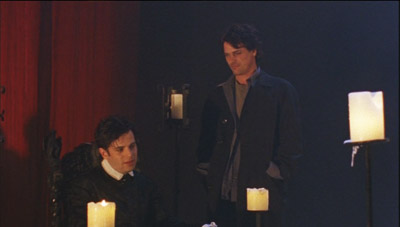
As Jack utters the speech, Geoffrey starts to see the play take shape (with the usual musical cue the show uses to render the theater as a magical place), and he and the ghostly Oliver walk through the fantasy. Geoffrey's image of scene has the spies behind a red curtain, steeped in blood as they are, and Hamlet surrounded by candles, a symbol of spiritual illumination, or perhaps an image of mortal life's brevity and snuffability. As the sequence ends, we return to reality and Hamlet stands up to face his Ophelia, a look of marked disappointment in himself on his face. The regret is palpable.
During the play in episode 6, we briefly alight on the sequence again. Budget cuts have made the fantasy version of the play impossible, but the show must go on. Jack's new Hamlet costume is a simple hoodie out of his own wardrobe. The jewelry, including the appropriate skull ring, is also his, part of the osmosis between role and actor that is part and parcel of Slings & Arrows.

Wednesday, October 19, 2011

III.i. To Be or Not to Be - Tennant (2009)

One thing the restructured Hamlets make clear is that putting "To be or not to be" before the Players arrive, rather than after, works better if Hamlet is not spied upon or at least doesn't know he's being spied upon. A Hamlet so structured has yet to see a glimmer of hope and may thus be more sincere in his mediation on self-oblivion. And so it is here, and though spies lie in wait, the moment is so intimate, and actually outside the room, so we may infer that the spies do not hear him. The speech is played around the corner of a wall, in near-darkness, with Hamlet progressively revealed. The way he is initially framed and backlit makes him skeletal (something supported by his t-shirt print), an image of mortality and vulnerability, and of revealing something to the audience that is under the surface.

Tennant has a fresh approach to almost every line in the speech, something that's very much not obvious with "To be or not to be". He uses long, pregnant pauses to make us feel like he's thinking those words up for the first time. One of Tennant's best qualities in the role is that he doesn't seem to know what he'll say next, even though he's speaking some of the best known words in all of English literature. The best example of this "freshness" is that though "To be or not to be" is the question, he asks another, putting a question mark on the end of "by opposing, end them?" Hamlet is filled with anguish, which slowly builds towards bitterness. His eyes are closed in pain until he finally looks at us on "there's the rub". At "must give us pause", he swallows hard. Just as his "gorge rises at it" in the graveyard scene later, Hamlet is here physically repulsed by what lies waiting in the afterlife, by extension, his own father's ghost. Bringing a measure of fear to this speech makes perfect sense in the context of having met an undead parent earlier. The physical signs of that repulsion continue through to "sicklied o'er", manifesting what is in the text merely a mental image. It continues the image of sickliness that is background for most of the play, one that covers the whole of Denmark, and is caused by the depraved behavior of its King, and possibly the madness of its Prince as well.

"Soft you now" comes hard and fast on the heels of "lose the name of action", springing TO action even as one gives up hope that any action can occur. Ophelia's appearance thus surprises Hamlet and his audience, taking us out of the meditation and back to more earthly matters.

Friday, October 14, 2011

III.i. To Be or Not to Be - Fodor (2007)

Fodor's Hamlet places the speech very early in the story, as Hamlet sits at his reel-to-reel and speaks into a microphone just after a musical montage representing his first encounter with Ophelia (unseen but described in the play). It is then followed by Polonia's scene with her spy Reynaldo (or here, Reynalda). In effect, the speech is now part of Hamlet's initial set of reactions to meeting his father's ghost. At that point in his emotional journey, Hamlet is actively thinking about revenge, cutting off ties to loved ones, setting up his cover as a madman, and in this repurposed sequence, leaving a record of his thoughts for posterity. It's a suicide note on audio, except he doesn't go through with it. Hamlet's pace suggests he's been composing it in his head. He rattles off the speech rather quickly, especially the list of ills we must bear here on Earth.
The speech intercuts between the first frame shown and the one above, Hamlet's half-face (an image of ambivalence?). The camera in that shot gets ever closer to him as we delve deeper into his consciousness. These shots are further intercut with Hamlet Sr.'s funeral, as various characters kiss his dead mouth goodbye. We see Polonia in particular, intimating a relationship between her and the former King and a possible role in his betrayal. At "To die, to sleep, perchance to dream", those flashbacks begin, with a frame of various characters all fated to die, lined up in a row. At the very end, as Hamlet himself kisses his father's cadaver, we hear the sounds of bells and sea birds, disturbing elements taking us further into the memory. Those flashbacks are blown out even more than the present day's film treatment, adding a greenish tinge to the proceedings that evoke both a sickliness and perhaps the "pale cast of thought" itself.

A notable cut: The speech is largely intact but omits "For in that sleep of death what dreams may come". Why? I am unable to come up with an answer. Perhaps Fodor felt it was too pretty and precious a line for his horror story. Perhaps the actor skipped over it. Theories?

Saturday, October 8, 2011

III.i. To Be or Not to Be - Hamlet 2000

Hamlet 2000 has a unique placement for the speech: Just after the spies make their plans, and before Hamlet meets up with Rosencrantz & Guildenstern. It's a scene completely divorced from the rest of the characters. No one sees or hears Hamlet (who goes in and out of voice-over anyway), nor does the Nunnery scene (still to come) weigh on him. The staging is, I must admit, a little precious for my tastes.

The scene takes place in a Blockbuster, specifically its Action section (to go with "lose the name of action"). Hamlet is a film buff and amateur filmmaker, which makes the setting fairly natural for him. The screens behind him show fiery explosions of the same kind seen during Hamlet's meeting with the Ghost, where they evoked the hell the latter had escaped from. Here, it is the "undiscovered country" Hamlet fears. Though chronologically before Hamlet's meditation on the Player in the film, we at Hyperion to a Satyr can remember that scene's use of James Dean as the nominal actor. When we discover at the end of the "To be or not to be" speech that the explosive film behind Hamlet is The Crow, a link is made between Dean and The Crow's star, Brandon Lee (who gives a kind of salute to camera). Hamlet seems to be fascinated by actors who tragically died young, his own death prefigured in those of his idols.

As for the performance, Ethan Hawke makes his walk as nonchalant as possible, whispering the words when they aren't coming from voice-over, running through.lines at a quick, pause-free pace. This is a jaded Hamlet, one who is either verbalizing things he's already thought about, or repeating words he's written for one of his short films. It takes away from the power of the speech, but is legitimate in the context of the film.

Sunday, October 2, 2011

III.i. To Be or Not to Be - Kline '90

Kline's Hamlet comes into the room and stays at the doorway. We, the camera's point of view, close in slowly until we'll be on his face. There is no indication here that Hamlet knows he's being spied upon, but the staging infers that the speech isn't overheard. Hamlet has yet to step into the trap, his moment of hesitation at the door stopping the action figuratively as well as literally.

Kline's delivery is what you'd expect from his Hamlet, all sighs and tears, but it does get more interesting at the end when he weeps and laughs at the same time, finding it laughable that people bear the burden of all those evils.Hamlet's native irony is revealed much as it was in "What a piece of work is a man", and he mocks humanity (himself included) for being the butt of a cosmic joke, and existential cowards to boot. The tail end of the speech becomes an attack on conscience itself, the immutable thing that is preventing him from acting. A flash of anger at the word "thought" confirms this. He is angry at the morality that is delaying his revenge, in effect cursing God himself. The speech is in fact quite religious without ever mentioning faith. Hamlet's morality is highly Christian (Puritanical compared to the people around him), and those teachings and the fear of the afterlife reserved for suicides in that cosmogony are what stay his hand against his will.

He hears Ophelia coming, with a half-smile imbued with gentleness, but also dread. He has avoided this meeting, just like he has avoided doing anything with meaning. The play tips on the edge of that knife's point.

Wednesday, September 28, 2011

III.i. To Be or Not to Be - Zeffirelli '90

Zeffirelli places the speech between the Nunnery scene and his meeting with Rosencrantz & Guildenstern, and then the Players' arrival. He has just violently rejected Ophelia, and has yet to have his spirits lifted by the newcomers. Mel Gibson plays it as Hamlet at his lowest. He enters his ancestors' crypt, and surrounded by tombs and skeletons, he intones the speech. There is no question that he is alone and unheard. This is his depression talking as he faces death itself.

At first, I felt the intent of the speech was muddled by this staging. Shots of dead royals in their tombs as Hamlet talks about ending one's own life seemed jarring. Surely, those kings and queens didn't all commit suicide? And Hamlet praying to two different tombs surely took away from what would otherwise be a visit to his father's. But time and again, Zeffirelli has created meaning from imagery, replacing or supplementing the text. Looking at it with a more open mind, a new interpretation emanates from the scene. Zeffirelli's Hamlet isn't just facing suicide, but mortality itself. And opening this speech up to other ways of dying reminds us of a simple fact: There are more ways to commit suicide than the sudden stab of a dagger, or fall from a great height. By simply choosing to go against his uncle, Hamlet spells his own doom. It's not that he would commit suicide rather than commit regicide, it's that regicide is its own suicide. Not many men come out of such a mission unscathed or alive. We know this is a tragedy, so we know too that by choosing to act, Hamlet in effect commits suicide. He goes to his own death willingly. (Or does "the water come to him"? We must surely compare this speech to the gravedigger's later in the play.)

So though Zeffirelli changes the structure of the play to render moot the problem of Hamlet's backpeddling in Act III AFTER "the play's the thing", his staging here still evokes a justification for it. As written, Hamlet may well feign a speech about suicide to confuse the spies, but at the same time may sincerely discuss doubts about going through with his planned action. For such action will likely result in his death, and such an outcome naturally creates doubt, the nature of which he mentions.

Hamlet's anger rises through the speech - nothing new for Gibson's visceral performance - but ends in rhetorical defeat as the prince admits that great enterprises turn awry when they are over-thought, as they are here. His voice cracks, his shoulders stoop, and he goes back up to the world. In the next (previously discussed) scenes, he'll find his second wind.

Sunday, September 25, 2011

III.i. To Be or Not to Be - BBC '80

From the anguish on Hamlet's face, Jacobi does not allow him to suspect he's being watched. He speaks directly to camera as Ophelia is sometimes seen walking in the background, unseen and oblivious. Once again, I'm entranced by Derek Jacobi's performance. He always manages to surprise me. His line readings convey perfectly the inner turbulence of the character, shifting tone as the character actually THINKS about what he's saying, rather than recites it. For example, here's an emotional reading of the opening lines of the speech: To be, [Bitterness verging on anger:] or not to be, [softer, a revelation to his audience:] that is the question. And later: [Anger:] To die, [sudden realization that pacifies him:] to sleep, no more. [...] [joy:] 'tis a consummation devoutly to be wish'd. To die, to sleep; to sleep: [another realization, this one inspiring dread:] perchance to dream. And so on, keeping the speech fresh at every turn. This is not something Hamlet has rehearsed in his mind, it is the true outpouring of thought as it occurs. The list of hardships is just that, a list, until he gets to "pangs of despised love" when the items suddenly become personal, and Jacobi lets us know what is rhetoric and what Hamlet truly cares about.
When he takes his dagger out, it's to insouciantly mime a suicide. He does not really consider it, except as a day dream. Behind him, painted boards showing a hellish plain, the undiscovered country as background to this scene. What else can this decor be? Surely it has nothing to do with Denmark's topography. It adds to the reflective and dream-like quality given to the end of the speech. As Hamlet speaks of travelers not returning, he fingers his father's medallion. Does he wonder, as we do, at the Ghost's true identity? At the supposed finality of death? "Puzzles the will" almost takes on another meaning here. By this subtle action, Jacobi manages to connect this speech with the previous one (O what a rogue and peasant slave am I). Hyperion to a Satyr has often questioned why and how Hamlet suffers a setback in Act 3 after having come up with a plan to reveal the King's guilt, but there's a double proof to be sought at the end of Act 2. Hamlet must prove Claudius a murderer, lest he prove the Ghost (another King) a false harbinger. This adaptation of the play reconciles the apparent incongruity by more overtly turning thoughts of the Ghost's honesty to those of mortality. One thought evolves into another, for they are well linked.

Saturday, September 17, 2011

III.i. To Be or Not to Be - Olivier '48

Having placed this speech between the Nunnery scene and "The play's the thing", far from prying eyes, Olivier gives Hamlet a reason to sincerely deliver the speech. Hamlet has just hurt Ophelia deeply and learned he can trust no one. Without the Players in the mix, he hasn't had the opportunity to think the Mouse-Trap either. As we leave the previous sequence in one of those vertiginous camera moves, we move away from Ophelia's reaching hand (is she seeing the Ghost whose point-of-view Olivier's camera evokes? is this the onset of her madness?) and up, up, up, through walls and dizzying staircases until we land on the back of Hamlet's head, looking down from the highest parapet into the crashing waves below. The camera moves further in, zooming into his head itself - we even see his brain - until we're looking out through his eyes. Whatever spirit the camera represents and whose point of view we share, it can even go into a person's thoughts. It is a four-dimensional experience, with shifting perspectives and superimposed images. Hamlet's forehead with the foaming sea laid on top of it. Shifting back and forth between interior (voice-over) and exterior monologue. His "sea of troubles" in made manifest in the ocean itself, or indeed suggests the metaphor, and becomes a means to achieve the suicide he longs for. The cadence of internal/external monologue moves as the waves do, there is an ebb and flow to it. Say what you will of Olivier's choices (especially regarding some important cuts and restructuring), but he has a visual flair that adds meaning to the words.
He takes out a dagger, reclining on the castle spire, closes his eyes, and almost falls asleep. The camera slowly creeps towards him until a musical sting brings him out of his reverie, pushing the camera back to a more objective POV as he cries "perchance to dream!". Hamlet's lassitude makes him accidentally drop his dagger into the sea, an image of the very inaction the soliloquy uncovers. Not only could that dagger be used to commit suicide, but also to commit murder. Hamlet loses his resolve for either, and again, Olivier visually enhances the idea.

He does so again at the end of the speech. When Hamlet talks about "enterprises of great pith and moment", he stands on the platform, facing outward to his country, its past, his father's deeds, the missing Fortinbras. When they "turn awry" in the speech, he turns back inward, to Elsinore, his problems and his lonely fate. The irony of these lines is revealed. Hamlet's greatness (and Denmark's) is turned awry by his fatal flaw, that of inaction. He leaves with a now complete loss of motivation, his passions waiting to be reignited by the arrival of the Players.

Sunday, September 11, 2011

III.i. To Be or Not to Be - Branagh '96

Hamlet has been called to the Hall of Mirrors, but no one's there. He enters trepidatiously and ends up facing himself in a mirror, triggering a meditation on self-slaughter. Each of those mirrors is also a door, and at least some of those doors have a special feature that allows you to look through the mirror. It's a wonderful cinematic conceit that allows Hamlet to say the speech directly to Claudius and Polonius, giving it an additional layer of irony and meaning. Suddenly, the "sea of troubles" is right behind the door and Hamlet talks about taking arms against his uncle.He simultaneously would take arms against himself, as he is talking to his own reflection. In this one mise en scène, everything Hamlet is facing is represented. The enemies both without and within (for what if his madness is making him believe all this?). The scene's central ambiguity remains. Does Hamlet know he's being seen? We've seen him navigate Elsinore's various secret passages and priest holes, so it's possible he knows (or at least suspects) spies are on the other side of the mirror. We can't know if ALL the mirrors are two-way, or if Hamlet specifically chose one that was. The irony works whether Hamlet is aware of it or not, of course.

Taken as an address to Claudius, the words take on a different bent, in particular the enumeration of this world's evils one (he) must bear. The oppressor's wrong is most on the nose, but there's also law's delay (justice for his father's murder subverted) and insolence of office. Hamlet must also deal with despised love and at least one proud man. Reverse the idea and make Hamlet address himself. How much of what he says can apply to him? In the next sequence, he will admit to being proud, for example. If his talk of suicide is sincere, how much of it is motivated by an unwillingness to become the monster he knows he must become to enact his revenge? How much is to protect his loved ones from himself? Hamlet knows he's about to get a confession from Claudius, knows events are about to speed towards a dreadful resolution. One answer to why he would contemplate suicide at the turning point of the play is that it's his last chance to prevent the evils that must surely befall Elsinore if he goes through with his plan.
At the end of a slow advance towards the mirror, Hamlet pulls out a dagger (the "bare bodkin"), eliciting a startled reaction from the men watching on the other side. Claudius almost seems to grab at Polonius to make sure the man doesn't cry out or attempt to stop Hamlet. The frame (above) quotes an earlier moment in which Hamlet kisses the sword and swears revenge. The death of a father, the promised murder of a stepfather, the idea of self-annihilation. These ideas are interconnected. As Hamlet speaks the "safe words", making his plans "lose the name of action", he taps the point of the dagger on the mirror. The image is ambiguous, but full of possibilities. Hamlet might be killing himself symbolically, or at least his past self, finally shedding the man who would never commit murder, finally erasing the books in his mind as promised at the end of Act I. He points the dagger at Claudius, but really sees himself, so might the mirror create an osmosis between murderers past and future? He might be attacking unreality itself, the world of thoughts but not of deeds. Or it could be an interesting way to stage the impossibility of suicide, as the blade hits a barrier of self-preservation before it can ever reach Hamlet's self.

In this most astute piece of staging, Branagh manages to open the speech up to new and interesting interpretation.

Saturday, September 3, 2011

III.i. To Be or Not to Be


The most famous words in the English language and almost the dead center of the play, this speech is reputedly the bane of every actor who is ever to play Hamlet. After all, your audience is likely to know it by rote, may well have seen other actors do it, and remember those performances clearly. What do you bring to it that is your own and yet true to the character? How do you re-interpret and make fresh a speech that is so famous as to slip into cliché? And devoid of context, as multiple pop culture quotations of it have been, that may be true. Within the context of the play itself, it continues to fascinate. First of all, what is it about? The easy answer is suicide, but why would Hamlet consider such an act now? He's just been revitalized by the arrival of the Players and hopes to catch his uncle in a trap. Some stagings have chosen to restructure the play so that the speech comes in Act II instead as a way to resolve (or cheat) this issue. (I attempt my own answer in the body of the text, below.) The director and actor must also decide if Hamlet's words are heard by anyone else, and if Hamlet knows that he's being spied upon. What we might forget is that not only are Claudius and Polonius standing behind an arras, but Ophelia has never exited the stage. The conventions of theater still allow Hamlet to pronounce his soliloquy to the audience alone, but what if the other characters hear his meditation on death and afterlife? And if Hamlet DOES know he's being watched, how much of the speech can still be sincere and how much is performance? Shakespeare's words in italics.

Enter HAMLET
HAMLET: To be, or not to be: that is the question:


That is the question indeed. There is something implied in the choice of verb here that is more profound than "to live or not to live" or "to die or not to die" or "to commit suicide or not to commit suicide". The question is about existence itself. Critic Harold Bloom likes to say - and I like to believe it true - that Hamlet is one of two characters that got away from Shakespeare (the other is Falstaff). So complex, deep and ALIVE, that he delays the play's action rather than allow events to proceed towards his inevitable death. Hamlet approaches meta-fiction in this sense, as if instinctively aware that he is a character in someone else's story (he calls her Fortune), and he refuses to let that story play out as scripted. Because if he is, as he suspects, in a tragedy, it will inevitably end with his death. And even if it didn't, the end of the story would signal the end of all its characters anyway. It is Hamlet who forces the story to last as long as it does (problematically long). And though he does die at the end, he is ready to do, as if aware that he did enough during the length of the story to achieve a certain literary immortality (indisputable in hindsight). Compare to Falstaff who has a false death scene in his first appearance, goes on to star in a play that has nothing to do with Prince Hal, and then dies off-stage rather than on it. Hamlet may dress it up in ideas of suicide, possibly for the benefit of the spies, but he's sincerely talking about oblivion. And would the murder of his uncle not send him to the same hellish place suicide would?

Whether 'tis nobler in the mind to suffer
The slings and arrows of outrageous fortune,
Or to take arms against a sea of troubles,
And by opposing end them? To die: to sleep;
No more; and by a sleep to say we end
The heart-ache and the thousand natural shocks
That flesh is heir to, 'tis a consummation
Devoutly to be wish'd. To die, to sleep;
To sleep: perchance to dream: ay, there's the rub;


The speech sits in the middle of the play so should act as a turning point. Structurally, it would seem that a better turning point is "The play's the thing" or even Claudius' "Give me light", but "there's the rub" is a strong contender. Before this line, Hamlet is dour and would rather die than complete his mission. After it, he rejects suicide. He rejects Ophelia, sending her into madness. And Claudius, hearing all this, confirms his order to send him to England where he'll have him killed. Hamlet's choice is "to be" and it is made at this point in the speech. And since he "is", he completes his mission and fulfills the promise of the tragedy.

For in that sleep of death what dreams may come
When we have shuffled off this mortal coil,
Must give us pause: there's the respect
That makes calamity of so long life;
For who would bear the whips and scorns of time,
The oppressor's wrong, the proud man's contumely,
The pangs of despised love, the law's delay,
The insolence of office and the spurns
That patient merit of the unworthy takes,
When he himself might his quietus make
With a bare bodkin? who would fardels bear,
To grunt and sweat under a weary life,


Hamlet's vision is grim indeed. The only reason we don't kill ourselves is from fear of what lay beyond. Could the after-life be worse than the mortal world itself? But such is life in the unweeded garden.

But that the dread of something after death,
The undiscover'd country from whose bourn
No traveller returns, puzzles the will


In the play, we have Denmark, Norway, Poland and England, but Death is the fifth country and perhaps the most important one. Hamlet Sr. went to Norway, but eventually had to go to that "undiscovered country" too, as will most of the characters. There is also a hint her that Hamlet may be putting on a show for his observers: He says no traveller returns from there, but clearly, he's met at least one - his father's ghost - who has told him a little something about the horrors of that other world. He does not reveal this fact here. Because he doesn't want to let his secret mission slip from his lips? Or is it because he has more or less forgotten what started the ball rolling, "blunting his purpose"?

And makes us rather bear those ills we have
Than fly to others that we know not of?
Thus conscience does make cowards of us all;
And thus the native hue of resolution
Is sicklied o'er with the pale cast of thought,
And enterprises of great pith and moment
With this regard their currents turn awry,
And lose the name of action.--Soft you now!
The fair Ophelia! Nymph, in thy orisons
Be all my sins remember'd.


As the speech ends, Hamlet finally notices Ophelia...

Saturday, August 27, 2011

III.i. Briefings - Classics Illustrated

The original
The sequence does not appear in the 1952 comic. Rosencrantz & Guildenstern are given a mission, but we never see them on it, nor report back to the King. As for the set-up to Ophelia's encounter with Hamlet, space considerations leave it to the plan being first mentioned in Act II.

The Berkley versionTom Mandrake's adaptation, however, gives the sequence a full - and unusually sunny - page. Space is still a concern, with cuts both in dialog and images changing the "staging" of the sequence. R&G's report, for example, now amounts to a single line ("He does confess himself...") and does not include the invitation to the play. This omission actually highlights an irony in the play. In the play, Claudius makes a show of happiness to hear Hamlet has found joy in the Players. He then goes on to spy on the prince and set things in motion for his exile. Here, there is no false show of emotion, and that's perhaps because Gertrude has been cut entirely from the scene.

Compressing so much dialog into so few panels has a powerful effect. It rushes things. There is greater momentum to the story, but it also changes how we might perceive any given exchange. For example, it here looks like Claudius is informing R&G of his plans for Ophelia. While most stagings of the play have made Polonius say his "We are oft to blame in this" speech to Claudius (sharing the "we"), here he says it to Ophelia, a rare apology from the character. Needs must. There is no space, nor any compositional advantage, to craft panels with the correct expressions and facing characters to properly interpret each exchange and nuance. Reading these comics, it is clear that Hamlet is a drama meant to be ACTED.

Friday, August 26, 2011

III.i. Briefings - Tennant (2009)

The sequence sits right on top of the film's structural change. Rosencrantz & Guildenstern's debriefing acts as preamble to Claudius' reaction to the nunnery scene, and so as a way to get back to the timeline as written. Ophelia's instructions, precursor as ever to "To be or not to be" and the nunnery scene occurs long before, at the tail end of the sequence this blog called "Brevity" (just before the fishmonger scene).

Part I - Rosencrantz & GuildensternThe restructuring means that by the time R&G get to Claudius, the King has already seen Hamlet throwing Ophelia about and playing games with Polonius. As in the original text, being aware of all this means he's primed and ready to send his stepson to England. He's made up his mind. While R&G make their report, the King and Queen simply use each consecutive argument to justify their opinions. When there is talk of crafty madness, Claudius wags his finger in an "I told you so" motion at Gertrude. She, in turn, asks leading questions that have an unspoken yet audible "yes but" behind them. Yes but... did he receive you well? She's building a defense for her son, and is happy when the retorts go her way, discomfited when the other twin puts a different spin on the same answer.

The staging reveals why R&G each take a side. In the story, one is sucking up to the Queen and the other to the King. In the drama, the Royals are enacting their argument THROUGH the sycophants. By their reactions, the King and Queen are suggesting answers to two people who only really want to say what the Royals want to hear, and so they do.

Part 2 - Ophelia
Here too, there is innovation from the cast and director Gregory Doran. It seems that in this version, Gertrude doesn't know Ophelia at all! She's unsure about the girl's name and says it with a question mark attached, and lets out a surprised, little "oh" when Ophelia takes her hand. There is no doubt her heart is warmed by the gesture, and that her words are sincere, but they are not borne of long-standing affection. What does it mean? Well, she doesn't know her son as well as she thinks she does, for one thing. For another, it lends weight to Polonius and Laertes warning Ophelia away from Hamlet at the start of the play. Was he perhaps a bit of a lad (at least before Ophelia)? His mother doesn't seem to keep up with who the latest girlfriend is. And what will be the impact of this choice on Gertrude's description of Ophelia's suicide?

"To both your honors." As it's often played - for I had not considered another possibility - this seems to refer to the honors of both Ophelia and Hamlet. That if love is the cause of Hamlet's madness, then the truth of it would heal both he and Ophelia. This Gertrude is more direct in addressing the line to Polonius, which makes more sense. It would be to Ophelia's honor that she be the object of this love/madness, and to Polonius' that his theory be correct.

As Gertrude is dismissed and the scene turns to instructions for Ophelia, we see Hamlet coming down an adjacent corridor, the words echoing quite clearly. He's heard it all and definitely knows he'll be watched in the nunnery scene (however, "To be or not to be" is still spoken quietly enough to register as unseen by the spies). A word on Hamlet's t-shirt as it's its first chronological appearance even if we've seen it before in these articles:
Apparently an old t-shirt of Tennant's, it's a bit flashy for the dark, brooding Hamlet, but takes on an ironic meaning. The muscled chest depicted relates to Hamlet's earlier comparison between himself and Hercules. We are invited to compare the mythic demigod with the thin, disturbed boy in front of us.

One final thing: There's a hilarious bit when Polonius takes the book Ophelia is to read from a large folder. In this hyper-surveillance world, did Polonius catalog, index and file all of Hamlet's mementos to Ophelia? It's as ludicrous and self-important as the First Minister himself.