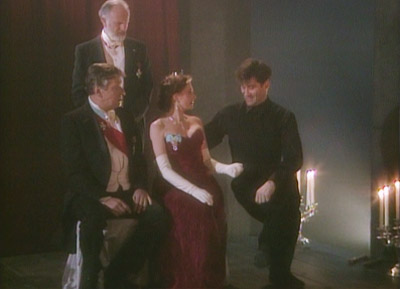
Saturday, June 30, 2012

III.ii. Critical Reception - Hamlet 2000

In Hamlet 2000, we don't stay in the theater long. Horatio and Marcella noted Claudius' blenching at the movie screen (as did we), but seems more confused than certain. Still, in cases where the actor playing the King isn't ambiguous in his reaction, there's no real need to dwell on Horatio's. Hamlet races off into night as we hear the song's words in voice-over. It takes an entirely different bent spoken as internal monologue. In the play as written, the lines are a manifestation of Hamlet's exultant victory. Here, it becomes commentary on the evening's events. Some must watch, some must sleep and so it goes. He is saying that only a few, like him, are vigilant, and the world outside is still oblivious to Claudius' crimes. There is still much work to be done, and the melancholy of Hamlet's tone shows him weary still, despite his small victory.

He hails a cab and jumps in, and that's where Rosencrantz & Guildenstern catch up to him, box him in. As the cab drives off, we hear words on the radio, but not from the play, a commercial for buckling up about cats having nine lives. It informs the scene only in the smallest degree. It's about danger and safety, something all the participants are ignoring. They're all playing a dangerous game. The difference between R&G and Hamlet is that the twins don't know it. In fact, Hamlet will survive his deadly encounter with them (he's the cat) and they will not. But here, the Prince is caught and though he tries to remain aloof, he does wipe at his wet eyes from time to time. In the absence of recorders - this version frequently does away with lines about anachronistic props - their conversation ends at "my wit's diseased". He cannot give an answer and that is that. He's not playing coy as other Hamlets do, he's frankly telling they are unlikely to get anything from him.
When he gets off, part of the "witching hour" speech is done in voice-over. It's all about mood. Heavy metal leaks out of a revolving door (the Ghost's passageway to and from the undiscovered country?), steam blows out of sewer grates, and in a few moments, as we cut to Claudius heading out of Elsinore, he crosses paths with a child dressed as a ghost who boos at him.
It's Halloween in New York, apparently, and it's a nice ironic image that a dead child would haunt the King at this point, he who has killed his brother, someone he grew up with, was a child with. It comes after a mysterious scene in which Hamlet is seen bothering a limo driver, but as we'll see, it is merely set-up for the confessional scene.

Thursday, June 21, 2012

III.ii. Critical Reception - Kline '90

In a small ironic twist, Hamlet runs around with a dagger at the beginning of this sequence - false fire indeed! And euphoric, he lets himself fall into Horatio's arms from off the stage, a foreshadowing piece of staging, as well as a call back to his feeling faint after meeting the Ghost. This is the midpoint between getting the mission and seeing it done, the turning point, and each one a blind fall backwards. Does Horatio believe Claudius showed his hand? Or does he just play along with the Prince dangerously swinging that knife around? There's simply no room to play the ambiguity as Hamlet jumps right back onto the stage and starts playing the recorder.

Rosencrantz & Guildenstern come running, and spin out their speeches while Hamlet pipes through them. The recorder is his weapon, used either to drown out their words, or swung as a dueling sword. Rosencrantz seems particularly earnest in trying to reason with him, honestly trying to save him from this reckless path he's set himself on. The old friendship appears more tangible in this adaptation. Consequently, Hamlet is less manic, though there are still moments of mad energy, such as on the "pickets and stealers" line, pulling handkerchiefs out their pockets like a stage magician. Regardless, Hamlet is more in control of his words. For example, "I lack advancement" is said with a smile, like he's pulling unconvincing reasons out of the air just to see how they'll respond.

A moment that made me stop and think is Guildenstern's contention that "if [his] duty be too bold, [his] love is too unmannerly" met with a real pause from Hamlet before answering that he doesn't understand that. He pauses, so we do as well. What surprises him in that line, or alternately, what makes him point out Guildenstern's delusion or hypocrisy? To paraphrase, Guildenstern's lack of manners are attributable to being oh so worried about Hamlet. Oh really! The Prince goes on to attack his credibility, so he clearly doesn't believe a word, that somehow these former friends care about him more than they do themselves. And he's very serious and calm throughout the sequence, adding to the earnestness. The scene is usually played with Hamlet being "idle", playing up his madness, and R&G as panicking hypocrites. In this adaptation, it is closer to an honest portrayal of a friendship breaking down. Or any relationship, in fact, because Hamlet is much the same with Polonius.
Of course, Hamlet's claims about imaginary clouds seems like madness no matter the tone. At least, Polonius thinks it so, looking sideways at R&G, trying to get a sign from them about the Prince's state of mind. He awkwardly agrees with everything, trying not to wake the beast, so to speak. Hamlet, too, is giving meaningful looks. Polonius IS the weasel that inspires the cloud simply for accepting the initial premise. A white lie, but one told by a liar nonetheless.

The soliloquy has a trigger: Midnight bells, rung at the "witching hour", giving the whole of the speech a funereal air, and giving the dagger, pulled back out, a fatal and dread resonance.

Thursday, June 14, 2012

III.ii. Critical Reception - Zeffirelli '90

An important difference with this adaptation is that the revels continue even after members of the Court scurry for the exits. It's an odd choice, one that devalues the King's power, though it does better match Hamlet's state of mind. His own song and dance is even more over the top than elsewhere, and he clearly sends such words as "wounded deer" in the King's direction so that it might be heard. This entire performance is witnessed by Gertrude who stands shocked and amazed before finally leaving. Hamlet doesn't have much of a conversation with Horatio before running off, so his friend's reaction remains ambiguous, though Claudius was pretty obvious in HIS reaction. And in the wake of all this, we keep finding fragments of the Nunnery scene - Hamlet tells Ophelia to leave one more time, kisses her, and gives a matter-of-fact farewell. You can practically see her mind breaking.

A change of venue, and we're on a parapet somewhere else, though not too long later since Hamlet has a drum around his neck and a recorder in his hand. He is accosted by Rosencrantz & Guildenstern, but he's obviously had time to settle down and is relatively serious and friendly with them. The better to take a darker turn in the middle of a line, specifically at "It is as easy as lying". Guildenstern is particularly sarcastic with his "I have not the skill", which sets Hamlet off to violence and to choking him with the pipe. The true irony is, in fact, that they really DON'T have the skill, neither in music, lying or getting information from Hamlet. One could probably write a dissertation on this idea. People in the play are consistently required to do things for which they "have not the skill", whether it's R&G's undercover work, Polonius' counsel, Claudius' confession, or indeed, Hamlet's bloody revenge. What is easy, on the surface, may not be so simple, and I am constantly reminded of "to thine own self be true" as the key to to the play. Polonius does not feature in this sequence, so no mysterious clouds, etc. Instead, R&G get some of his lines and are left to "easily" transmit the Prince's message. Of course, "easy" has so far been beyond their grasp.
Hamlet runs down the stairs, away from them, for his brief soliloquy, which is even briefer, ending the scene on "Now to my mother". In other words, he places no conditions on that visit, and after speaking of drinking hot blood and doing bitter business, the lack of such makes us believe he's off to murder Gertrude. It's an omission that creates tension, certainly, but thrown on top of the change of venue, it beggars the question of why Claudius is not more in his thoughts. The guilt of the King spreading to the Queen is a central ambiguity of the play (I could, in fact, have switched King and Queen and still been correct), but by forgetting the King entirely, that ambiguity is not well served. Once again, I find myself frowning at Zeffirelli's cuts.

Friday, June 8, 2012

III.ii. Critical Reception - BBC '80

Like Olivier's before him, Jacobi's Hamlet sings the opening lines of this sequence, and like Branagh's after him, he infuses the word "friends" with sarcasm and has similar, almost violent mannerisms (for example mock-punching Rosencrantz at "pickers and feelers", and almost jamming the recorder into Guildenstern's teeth). However, there's something very different being done with the staging, something that inspires a new reading of the text. There looks to be a very definite play, on Jacobi's part, on class/position. Hamlet starts out standing on a chair, then comes down eye level to R&G, falls on his knees before them, and finally kisses their feet. From prince to slave over the course of a conversation. This is intriguing because it's a conversation in which Hamlet also claims to lack advancement. He's being incredibly ironic, not only mocking the rise of R&G as sycophants seeking just such advancement, and warning them that the grass is indeed also growing for them. All gardening metaphors are suspect in the play ever since Hamlet called Denmark a rank and unweeded garden, and here, the grass proverb is "musty". Things grow in corrupted form in Hamlet's Denmark, and R&G are liable to choke on the weeds (and in a way, do).

In the text, there is also a play on class in regards to Horatio, but those few lines are some of the rare cuts in this adaptation ("You might have rhymed" and so on). This Horatio is less brazen than other interpretations of the character, and less able to speak truth to power. There is obvious fear of Hamlet in his performance, and a sense that when he says "I did very well note him", he rather means "I did very well note YOU". In this version, remember, Claudius did not really give himself away. There was a stand-off, but the slick politician seems to have come out of it unblemished, while Hamlet appeared completely out of his mind. As usual, Hamlet will dismiss those he doesn't agree with before he hears what he doesn't want to hear.
When Polonius comes in, Hamlet seems to notice the camel-shaped cloud for the first time, and appears genuinely distracted, but the bitterness that ensues reveals it's probably an act. The cloud exists in this version, on a fresco that acts as backdrop to the play-within-the-play. Not that any of its clouds look like particular animals. It's against this background of gods in the heavens that Hamlet's hellish soliloquy is ironically spoken, his hands full of weapons, yet promising not to use them on his mother. As the staging piles on the ironies, so too does the text's ironies become more noticeable. Think of it: Hamlet has just (in his mind) exposed the King's guilt, and is ready to finally do violence, and yet it's to his mother's closet he now goes. Upon her invitation, of course, but if he is so ready to act, why not go directly to the King and murder him? It's because he finds her guilty as well, and indeed makes her the priority over the King. This inner battle has been going on since the start of the play when, in fact, the Queen started out guiltier than the King. Before the revelation of a murder, there was only the betrayal of a husband. It's a fact that continues to blunt Hamlet's purpose.

Sunday, June 3, 2012

III.ii. Critical Reception - Olivier '48

As the Court leaves the "theater", Hamlet sings his lines, throwing his torch in the air jubilantly. He becomes so manic, in fact, that Horatio can hardly keep up and isn't given enough time to confirm or deny the King's reaction (although it was pretty dramatic and clear). Olivier compressed a lot of the action, so there are a number of cuts, including (sadly) the pipe metaphor. This is, after all, a version of the play without Rosencrantz & Guildenstern. A few of their lines are given to Polonius instead, which tends to make him less scatterbrained for the start of the sequence and then seems to make him press the issue as he repeats the summons in his own voice.

Instead of focusing on Hamlet's madness in this moment, Olivier makes lines like "My wit's diseased" as level-headed as any. There's a solid confidence in his treatment of Polonius, and when he points to clouds out in a dark corner of the castle, never even looking in that direction, he is serious and cruel. He's not acting crazy, not seeing things, or even feigning hallucinations. He is testing how far Polonius' sycophancy goes. He never takes his eyes off the old man, implicitly telling him that he owns him: "I am the master here and you'd do well to know your place, you who would command me to go to my mother's closet." A brilliant representation of what is going on under the surface of the cloud exchange.

"By and by is easily said" isn't spoken to Polonius, but as a thoughtful aside. Olivier takes a verbal dagger and points it at Hamlet himself. "By and by" means "in a moment", and implies a delay, so of course we're reminded of his forever-delayed revenge. Easily sworn, but the deadline is something that lacks definition, and the doing is much more difficult. It is somewhat moving that the camera lingers on Horatio after he is dismissed. He wasn't really consulted and sees that he cannot truly help his friend, especially since he strikes me as someone who would never counsel going through with a murder.
The following soliloquy starts with Hamlet his back to us, so that you can't initially tell if he's speaking the words or using voice-over. He is facing utter darkness. When he turns, we see he was indeed speaking the lines, but the original confusion has put you in the right frame of mind - we are hearing a man's inner thoughts. He then starts to go up some stairs towards his mother's closet, looking up at a god-like beam of light. Olivier has crafted an image here that shows Hamlet going from dark to light, from doubt to decision, and at the same time, relates to the King's own dilemma, as in the next scene we will see his words going up, but his thoughts remaining below. Hamlet's own pledge here will be as empty as the King's own prayers.

Sunday, May 27, 2012

III.ii. Critical Reception - Branagh '96

In the whirlwind of words and black comedy that follows, I had never really noticed before that Nick Farrell's Horatio doesn't actually confirm the King's guilt in Branagh's version. He looks for the right words before coming up with "I did very well note him" and is not particularly enthusiastic. Hamlet has a moment of doubt where he goes "ahhh" before other characters walk in. Not doubt that the King is guilty, but doubt in the trust he placed in his friend. But what should he expect? At the top of the sequence (which will be another one of those whirling one-shots), Horatio is calling him out on his bad poetry as if they relationship was always one where Horatio brought the prince down to earth with a dose of acerbic wit.

But the moment quickly passes as Rosencrantz & Guildenstern arrive and Branagh uses the line "Some music" to herald that arrival. Yes, he's about to be handed a recorder, but Hamlet is really announcing the music of words that's about to ensue. Their lies and his vicious mockeries - the music of repartee. Hamlet is still giddy from his perceived victory and continues to giggle, impishly overact, sing-song lines in a parody of meter, and openly mock their every word, speaking to them as if they were deaf or dumb, and making grandly theatrical gestures. He's still at the theater. For their part, R&G have grown bold enough to show their anger towards him. They know Hamlet has gone too far and fully throw their support to the King. This is a mistake, and as if to foreshadow their eventual fate, Hamlet becomes violent with them. The prince handles that pipe like a weapon, here choking Guildenstern, there slashing the air with it as if it were a rapier.
There is another sudden change of attitude in Hamlet when Polonius walks in, another fool who now thinks nothing of showing angry impatience at the mad prince. Hamlet basically gives the same performance twice here. He's impish and overly theatrical, and turns to bitterness and anger. He just does it all much more quickly. It's really a reaction to Polonius' tedious redundancy, repeating behavior more efficaciously. For once, Polonius doesn't want to drag things out either, so he agrees to every fantastical cloud in the ceiling just to get it over with. The sequence ends with Hamlet asking his "friends" to leave him, the word dripping with sarcasm.
One of the few changes made to the play's structure in Branagh's integral adaptation occurs here as we cut to Act III Scene 3 before the short soliloquy that usually ends Scene 2. In Scene 3, R&G play sycophants to Claudius, Polonius tells the King he'll hide behind an arras in the Queen's closet, and the King heads for the chapel. The function of the edit is to get Hamlet's "I'm now ready to do anything" speech closer to Claudius' confession. In fact, the soliloquy is dropped in just before the confession, and its last lines even juxtaposed to Claudius entering the confessional, so that "my soul, consent!" precedes Claudius' prayer, highlighting the thematic connection between the two. In both cases, what is done falls short of what is said. Hamlet will not kill Claudius, and Claudius does not repent. Neither man's conscience manages to become more like the other's, a failed osmosis.

Friday, May 18, 2012

III.ii. Critical Reception

The scene's final sequence concerns reactions less to the play than about everyone's reactions about the play. Hamlet wants to know if Horatio saw Claudius' reaction. Guildenstern & Rosencrantz react to Hamlet's wildness and bring a message that the Queen wants to speak with her son. Polonius arrives to do much the same, ever the tedious, redundant cog in the works. Shakespeare never fails to entertain when his genius confronts his fools, but after the laughs, he puts a button on the scene, a short soliloquy that allows Hamlet to react to himself, what he has seen, and what he now means to do. As usual, we'll be looking at the text first, Shakespeare is in italics.

HAMLET: "Why, let the stricken deer go weep,
The hart ungalled play;
For some must watch, while some must sleep:
So runs the world away."
Would not this, sir, and a forest of feathers-- if the rest of my fortunes turn Turk with me--with two Provincial roses on my razed shoes, get me a fellowship in a cry of players, sir?
HORATIO: Half a share.
HAMLET: A whole one, I.
"For thou dost know, O Damon dear,
This realm dismantled was
Of Jove himself; and now reigns here
A very, very--pajock."
HORATIO: You might have rhymed.


The closeness between the two characters is well represented here, with Horatio teasing his friend in spite of the class difference. For directors who want to make Claudius' guilt ambiguous could use it to their advantage - Horatio is very critical of Hamlet's prowess as a player (he undervalues the first ballad and critiques the second), and may be critical of Hamlet's conclusions regarding his uncle. Even if the director doesn't go that route, the lines still have an ironic bent. Hamlet is here representing himself as a Player, but he broke character during the play with some outrageous behavior that undermines his entire experiment. Damon, by the way, is a character from Greek myth reputed to be a trusted friend. The realm dismantled of Jove is Denmark, as Hamlet Sr. is compared to Jove in the play. And a "pajock" is a peacock, which I've often heard directly substituted into the text for modern clarity.

HAMLET: O good Horatio, I'll take the ghost's word for a thousand pound. Didst perceive?
HORATIO: Very well, my lord.
HAMLET: Upon the talk of the poisoning?
HORATIO: I did very well note him.


The text seems clear that Horatio saw the same thing as Hamlet and agrees with him about Claudius' guilt. And indeed it will soon become clear to the audience as well when we hear the King's confession. Depending on the staging, it may still be prudent to have Horatio unsure at this point, which does make him a less sincere character, albeit a more skeptical one.

HAMLET: Ah, ha! Come, some music! come, the recorders!
For if the king like not the comedy,
Why then, belike, he likes it not, perdy.
Come, some music!

Re-enter ROSENCRANTZ and GUILDENSTERN

GUILDENSTERN: Good my lord, vouchsafe me a word with you.
HAMLET: Sir, a whole history.
GUILDENSTERN: The king, sir,--
HAMLET: Ay, sir, what of him?
GUILDENSTERN: Is in his retirement marvellous distempered.
HAMLET: With drink, sir?


Hamlet is mocking R&G and the King, but since we know drink to be one of Claudius' weaknesses, the line may be taken as a stage direction to have the King drink during the play, perhaps as an explanation for his extreme reaction.

GUILDENSTERN: No, my lord, rather with choler.
HAMLET: Your wisdom should show itself more richer to signify this to his doctor; for, for me to put him to his purgation would perhaps plunge him into far more choler.
GUILDENSTERN: Good my lord, put your discourse into some frame and start not so wildly from my affair.
HAMLET: I am tame, sir: pronounce.
GUILDENSTERN: The queen, your mother, in most great affliction of spirit, hath sent me to you.
HAMLET: You are welcome.
GUILDENSTERN: Nay, good my lord, this courtesy is not of the right breed. If it shall please you to make me a wholesome answer, I will do your mother's commandment: if not, your pardon and my return shall be the end of my business.


A word like "breed" always alerts Hamlet's reader, since breeding, succession and yes, sex, are important themes. Hamlet is answering them with the wrong breed of courtesy, answering their own insincere breed of friendship, coming as they do from the wrong breed of King.

HAMLET: Sir, I cannot.
GUILDENSTERN: What, my lord?
HAMLET: Make you a wholesome answer; my wit's diseased: but, sir, such answer as I can make, you shall command; or, rather, as you say, my mother: therefore no more, but to the matter: my mother, you say,--


Hamlet's hatred for the various members of the Court guilty of his father's murder/disrespect is spreading, and lines like this one, where Gertrude and R&G are osmotically linked and interchangeable are a poetic reflection of that. When Polonius comes in later with the same news and request, he becomes interchangeable with R&G and thus the Queen. Later, Hamlet will play word games to make father and mother equivalent, including Claudius in this guilty ensemble. And despite the Ghost's return to try and reign Hamlet in, the psychic damage is done, and the play will have each of those characters die, sharing punishment along with guilt.

ROSENCRANTZ: Then thus she says; your behavior hath struck her into amazement and admiration.
HAMLET: O wonderful son, that can so astonish a mother! But is there no sequel at the heels of this mother's admiration? Impart.
ROSENCRANTZ: She desires to speak with you in her closet, ere you go to bed.
HAMLET: We shall obey, were she ten times our mother. Have you any further trade with us?
ROSENCRANTZ: My lord, you once did love me.
HAMLET: So I do still, by these pickers and stealers.
ROSENCRANTZ: Good my lord, what is your cause of distemper? you do, surely, bar the door upon your own liberty, if you deny your griefs to your friend.
HAMLET: Sir, I lack advancement.
ROSENCRANTZ: How can that be, when you have the voice of the king himself for your succession in Denmark?
HAMLET: Ay, but sir, 'While the grass grows,'--the proverb is something musty.


For a more careerist vision of Hamlet who is driven not just filial duty, but by ambition, this line becomes important. Claudius may have said in open Court that Hamlet will succeed him, he nevertheless cut in line, as it were, by marrying Gertrude. What else is he capable of? Hamlet's exile to England has already been planned after all. As time goes by, Claudius may change the arrangement, have Hamlet killed, or even have another son. Claudius must die in order for Hamlet to become King. An entirely political reading of Hamlet would see it this way.

Re-enter Players with recorders

O, the recorders! let me see one. To withdraw with you:--why do you go about to recover the wind of me, as if you would drive me into a toil?
GUILDENSTERN: O, my lord, if my duty be too bold, my love is too unmannerly.
HAMLET: I do not well understand that. Will you play upon this pipe?
GUILDENSTERN: My lord, I cannot.
HAMLET: I pray you.
GUILDENSTERN: Believe me, I cannot.
HAMLET: I do beseech you.
GUILDENSTERN: I know no touch of it, my lord.
HAMLET: 'Tis as easy as lying: govern these ventages with your fingers and thumb, give it breath with your mouth, and it will discourse most eloquent music. Look you, these are the stops.
GUILDENSTERN: But these cannot I command to any utterance of harmony; I have not the skill.
HAMLET: Why, look you now, how unworthy a thing you make of me! You would play upon me; you would seem to know my stops; you would pluck out the heart of my mystery; you would sound me from my lowest note to the top of my compass: and there is much music, excellent voice, in this little organ; yet cannot you make it speak. 'Sblood, do you think I am easier to be played on than a pipe? Call me what instrument you will, though you can fret me, yet you cannot play upon me.


One of my favorite exchanges in the play, just for the wit of it, even if Hamlet does use a mixed metaphor (pipes and strings). But then, the pluck and fret puns are too good to pass up or criticize.

Enter POLONIUS

God bless you, sir!
LORD POLONIUS: My lord, the queen would speak with you, and presently.
HAMLET: Do you see yonder cloud that's almost in shape of a camel?
LORD POLONIUS: By the mass, and 'tis like a camel, indeed.
HAMLET: Methinks it is like a weasel.
LORD POLONIUS: It is backed like a weasel.
HAMLET: Or like a whale?
LORD POLONIUS: Very like a whale.
HAMLET: Then I will come to my mother by and by. They fool me to the top of my bent. I will come by and by.
LORD POLONIUS: I will say so.
HAMLET: By and by is easily said.


The whole exchange about the clouds have posed problems for modern stagings of the play. In Shakespeare's day, the play would have been performed under an open roof, and I imagine crowds looking up and trying to spot that cloud, or actors changing the animals perceived based on the clouds that day. But for Hamlet, who is in Elsinore... are they outside? Do they have access to a skylight or window? Or is it all just a feigned hallucination Polonius buys into as an obsessive yes-man? Each director must answer that question for him or herself.

Exit POLONIUS

Leave me, friends.

Exeunt all but HAMLET

Tis now the very witching time of night,
When churchyards yawn and hell itself breathes out
Contagion to this world: now could I drink hot blood,


Hamlet foreshadows here the return of the Ghost.

And do such bitter business as the day
Would quake to look on. Soft! now to my mother.
O heart, lose not thy nature; let not ever
The soul of Nero enter this firm bosom:
Let me be cruel, not unnatural:
I will speak daggers to her, but use none;
My tongue and soul in this be hypocrites;
How in my words soever she be shent,
To give them seals never, my soul, consent!

Exit


Hamlet promises to hurt his mother with words, probably by revealing the truth of his father's death and accusing her of "damned incest". What he WANTS to do is hurt her physically, so the closet scene will have that tug of war between his violent impulse and a more reasoned approach. Eruptions expected.

Thursday, May 10, 2012

III.ii. The Mouse-Trap - French Rock Opera

Un trône sans roi/Throne Without a King is a transitional piece of music on Johnny Hallyday's album, but if you use your imagination, you might see how it would have underscored action in the staged rock opera. It is placed where the Mouse-Trap would be, and through the repetition of the dirge motif Le vieux roi est mort/The Old King Is Dead already used twice before, has a similar recap function. Here is the text and a quick translation.

Un trône sans roi
Le vieux roi et mort
Depuis moins d'un mois
L'herbe sur sa tombe
Ne pousse encore pas

Le vieux roi est mort
Le temps d'une messe
Il est notre roi
Il cale ses fesses

Throne Without a King
The old king is dead
For less than a month
The grass on his tomb
Still does not grow

The old king is dead
The span of a [church] service
He is our king
He sinks his ass

It is telling that the chorus sings here and not Hamlet, though as we know from the play, he has written their words. This is the murder as presented by the Players. We could well imagine the processional music underscoring the arrival of the Court to the playhouse. Then, suspenseful stings over the dumb show, probably dance-like. Finally, we end with the result of a king's death, and the familiar Dead Old King theme. The first two lines are the same, but reiterate, as Hamlet does in the text, the temporal collapse caused by his grief. Using the chorus/Players translates that collapse to the People, foreshadowing their later rebellion. In fact, the lines here go further, from "less than a month" to "the span of a church service". The King has been forgotten by the time his funeral service is over.

And then time is collapsed even further when a new King shows up in the next line, so Hamlet Sr. has been forgotten in the breath between two lines. Those final lines do play on an ambiguity, as the "king" is actually two separate characters in the play. On the one hand, there is a resistance to a new leadership, the dead king being that of the people, even as his descent into the ground is mocked with colorful language. On the other, the new king is now that of the people - speaking to an ironic interchangeability as far as commoners are concerned - and a mockery of his sitting on that empty throne, now filled. That is the story of The Mouse-Trap.

Saturday, May 5, 2012

III.ii. The Mouse-Trap - Classics Illustrated

The original
Surprisingly, the old "boys' adventure" comics version includes both the dumb show and the speaking play, though it makes huge cuts through the use of captions to fit them in. In other words, they both "happen", but are not necessarily seen. The pantomime that precedes the play is visual, of course, so becomes the backbone of the comics version.There are number of interesting touches, as if the artist, freed from the Classics Illustrated constraint of heavy work balloons, has finally been allowed to show his quality. As the Player Queen leaves the sleeping king, for example, there's an odd expression on her face. Is she worried she might wake him? Or is she colluding with the murderer, but already feeling guilty? I also like the purely graphic juxtaposition of crown and poison separating the two bottom panels, showing how one can act as a gateway to the other. The sequence continues on the next page, where the Queen is offered jewels, but she seems to refuse from her body language. So it's not always clear what she's thinking.

A puzzled Ophelia asks about the argument of the play - the only live commentary made in this heavily edited version - but Hamlet leaves it to the Prologue. There is no cruelty towards Ophelia or the Royals, the play being the only possible impetus for Claudius to lose it. Hamlet's antics do not play a part or muddy the waters. On purpose perhaps, the Player Queen is a dead ringer for Ophelia, wearing the same kinds of clothes as well.
After a few words from the Prologue, the action cuts to Claudius' fit. We've seen the play's action through the pantomime, and we know the story because it's a mirror of Hamlet Sr.'s murder, so this is quite economical, while respecting the events of the play. Needlessly? If Claudius had reacted to the dumb show, it would have made more structural sense. As is, even though we know everything we do, there still seems to be a scene missing. It makes you want to see the trigger.

The Berkley version
Hamlet is likewise more pleasant to Ophelia in Tom Mandrake's version, his smiles turning cruelties into mere teasing. His art makes good use of shadows throughout the sequence, often keeping the Royals hidden, even when they speak lines. The darkness of their sins and their initial ambiguity make justify it, but it is starting to feel like they are shadows, ciphers or otherwise non-characters. Even the "protests too much" line is given to Ophelia instead of Gertrude. One place where shadows are better used is in Hamlet's face. The darkness of Ophelia's lap plays across it when he turns more serious and thinks of his father, ironically while entering a motherly womb.
Mandrake does away with the dumb show in favor of the spoken play, his painted Players in various cultural costumes separating the heightened reality of the Mouse-Trap with the Medieval trappings of the play outside the play, though I'll never get used to Claudius' Santa Claus outfit.
In the absence of a preceding panto, Claudius now sees the accusation for the first time, and reacts. Again, there are few public antics from Hamlet, so his idleness is not what distracts or affects the King. Both comics versions have chosen to make the King unambiguously guilty.

Thursday, April 26, 2012

III.ii. The Mouse-Trap - A Midwinter's Dream

It's likely this version of Hamlet, if actually staged, would be exhausting to both audience and actors. Because it is presented as a quick-paced montage, its energy level is consequently very high. It drives the montage well however. Maloney's Hamlet is always moving around with a barely contained fury. Every line is an attack that justifies a more defensive tone from the Royals.

This short sequence takes us from "Madam, how like you this play" to "The Mouse-Trap", the latter spoken in the direction of the audience, played as an important reveal. In the montage, it plays the role of "the play's the thing" and tells us how those early scenes with the players could be removed from a particular staging, hiding from the audience Hamlet's true purpose until Act 3 Scene 2.

Wednesday, April 25, 2012

III.ii. The Mouse-Trap - Slings & Arrows

The very brief part of this scene used in Slings & Arrows amounts to Hamlet's opening insults to Ophelia, but there are still lessons to be gleaned from it. On staging, you'll note that Ophelia and Hamlet are sitting/crouching near the ground, which fits the low-brow humor of the "country matters" line. Hamlet is in full madcap mode, rubbing his hands with devilish glee as Ophelia is continually hurt.

Hamlet turns to the audience to say "That's a fair thought to lie between maids' legs" and gets a laugh without need for Ophelia's questioning retort. The audience gets it because the punchline precedes the joke. In the text, the fact that Ophelia asks for the joke to be explained isn't strictly necessary, though it does inform her traumatized character and works within the rhythm of the scene. By making Hamlet's line an aside, Ophelia does not have to react to it and comes off as even more wounded, unable to properly interact. An aside at this point, and once that elicits a laugh at that, makes the audience share in Hamlet's cruelty. Because he shares his lewd thought with us, we empathize with him, which makes us his accomplices. Subtle, but subversive stuff.

Sunday, April 22, 2012

III.ii. The Mouse-Trap - The Banquet

Set in China, The Banquet of course presents the play-within-a-play as Chinese opera. The full court is in attendance, but the Royals are quite far from the stage. It's all dumb show, with masked acrobats, but interestingly, the Hamlet character is sitting on the stage, masked, facing his parents and keeping the beat on a drum. A ghost clad in white (the color of death) comes to kill a ref-faced king and already, even before a puff of scorpion venom is blown into the figure's ear, the King recognizes something. As the opera makes its points, close-ups of the King and Queen reveal unease, while those of Hamlet rather show a cold fury, thought it's difficult to divine the expression behind the mask. These are intercut with close-ups of the previous King's armor, shedding tears of blood. In this way, this version of the play includes the Ghost.
In fact, the Ghost is quite prominent, not only in the cuts to the armor that has come to represent it, but in the garb of the people on stage. There are two white figures, including Hamlet whose facelessness turns him into a ghost himself. This osmosis presents characters doing the Ghost's bidding, as if he were the one putting on the play and observing well the guilty party.

At the end of the dumb show, the murdered Player King keels over, a shot that is played over and over again, lending it psychological weight. The Royals gets up from their thrones and walk over to the stage where the King examines the dead body. Cool and collected, smiling even, he starts a slow clap filled with sarcasm, though the court doesn't take any chances and starts to applaud as well. In this mockery, he hides his own guilt. He then turns to confront the Prince in what seems a mirror of the Prince's first scene of the play. "Hamlet" is asked to remove his mask (i.e put an end to his mourning) and in seeming madness, doesn't want to be touched by the King lest the black scorpion venom get on him. In response, the King sends him on a mission to the North because it is time he resume his service to the country. This combines the ideas of Hamlet's first scene and the exile forced on him after he has killed Polonius, making the Mouse-Trap reason enough for the Prince's exile, one during which he will suffer an assassination attempt.

This being a Chinese martial arts epic, Rosencrantz & Guildenstern will however be replaced by snow-tunneling ninjas...

Sunday, April 15, 2012

III.ii. The Mouse-Trap - Tennant (2009)

Tennant's Hamlet is a petulant and mischievious child in this scene. The audience's entrance is scored with the Danish national anthem, as a barefoot Hamlet insolently whistles along. They ignore him, and we get the sense that his parents are already tired of his shenanigans. They do not appear to be particularly excited at the prospect of a night at the theater with him, and indeed, the audience is rather small. This is an intimate affair, not the public one other versions have created. We are definitely in the wake of Hamlet's attack on Ophelia. She comes in with her head down. Her father looks ever so puzzled. No one trusts Hamlet's mood. As if to give them reason, his giddy idleness is immediately disrespectful, throwing in an army salute with the chameleon's dish line, mocking the normal obedience one should show a father and a king.

In the early part of the scene, everything is more intimate. Hamlet asks Polonius about his acting days in private conversation, and only Polonius laughs at the prince's pun. It's interesting however to see Polonius so confounded by the fact he had to be killed in the play, a precursor to his actual senseless death in THIS play. Hamlet runs off with Ophelia, grabbing her out of her seat and to a position from where he can better observe the Royals. At this, Polonius breaks the fourth wall to ask us if we "mark that". Again, the scene's intimacy prevents him from being more public about his thoughts. Hamlet drags Ophelia down to the floor and wraps her arms around himself, mockingly bites her arm. It is a parody of a normal romantic relationship, and in a sense, perhaps a disguise. Sitting across from his parents, he appears to be getting back together with his girlfriend, but his cruel, unheard words tell another story. Tennant underlines the dirty pun in "country matters" (cunt-ry matters) to make it harsh indeed. And yet, his "as woman's love" later is a private statement, sounding more sorry than mean.

These private moments contrast with the moment when Hamlet actually flings an accusation his parents' way, as he shows more and more difficulty reigning himself in. At the jig-maker line, he gets up and dances humorously on the rug that will serve as a stage, making his mother laugh, which is the moment he chooses to begin his open cruelties. His very bitter delivery of "die two months ago, and not forgotten yet" gives it a strong ironic bent. For Hamlet, two months is no more appropriate than two hours, recalling the Hamlet from earlier in the play who was told to stop his grieving.
The dumb show is a most depraved affair meant to shock perhaps more than amuse. A tiny king with giant ears comes out of bald, fat queen's skirts and speaks unintelligibly (I was reminded of Pingu) until he is poisoned by a glam murderer with a heart over his crotch which, when removed, reveals an uncoiled slinky. The dead king's shroud becomes a ghostly sheet that runs off to let them have sex. Through this ridiculous piece of bawdry, Claudius laughs not at all, holding his temper in check. We do see his reaction to he mock poisoning, which makes this Claudius quite aware of the insinuation from early on. He stews in his own guilt longer as a result. As the dumb show starts, Hamlet takes out his camera and starts filming it, or really, the Royals' reactions to it. In this way, the film keeps the energy up by layering in Hamlet's point of view. When does he look at the characters and at what gestures or words do he focus in on his mother or stepfather?
The play itself features rather extreme Elizabethan costumes, and a staging that mirrors that of the Royals (king-left, queen-right). Gertrude is bitter and impatient at the text. She knows very well what she is being accused of and finds it insulting. With great poise, she questions whether the Player Queen protests too much, and gets a laugh from the audience. It's a show of power against Hamlet, and the audience seems to be on the Queen's side in this. As for Claudius, the cracks start to show. Silent up to this point, he asks if there's offense in it, in fact proposing there is, at which Polonius makes an odd gesture as if to stop him from speaking out. Have they decided prior to the play to let Hamlet have his fun and show no reaction? Reacting, even with a smaller audience, is dangerous at this point because Hamlet is filming them. The (Mouse-)trap is theirs to get caught in.

After mouthing many of the lines himself, it's time for the murder, and Hamlet can't help but get up and spoil the ending, just to force the reaction he's looking for, triumphant even has he ruins his own device. Does he succeed? The king rises, but walks calmly to a stagehand and requests light. He then brings the lantern over and shines it on Hamlet, as if revealing the prince's madness for all to see. He shakes his head as if to say "You won't get me so easily". To the assembly, this may instead mean that he pities and softly chides Hamlet, but we know better, and the slightest of smiles from Patrick Stewart speaks volumes. That Hamlet thinks he's found a chink in the King's armor may be wishful thinking on his part however.

Sunday, April 8, 2012

III.ii. The Mouse-Trap - Fodor (2007)

The Mouse-Trap is translated into a German experimental film in Fodor's vision. It was made very quickly, although the play does allow for temporal anomalies like this, as we've often discussed. In the film, we first see a hammer and a screwdriver, the murder weapons, as it turns out. Then the murderer, thinking, plotting. The Queen getting her picture taken, an image of the people's adulation. At this point, we cut to Hamlet in the audience, nodding along. Even in the text as written, the Queen hammers her point a bit stridently - Gertrude's evaluation is not far off - so this might indicate that her dialog was manipulated by Hamlet. A similar idea is used here to "get" Gertrude as well as Claudius. In the text, it makes her a betrayer of her word. In this version's film, she is a co-conspirator whose motivation seems to be greater fame and power.

The film continues... The Queen is having dinner and flirting (insincerely) with the King. In the audience, there are uncomfortable shots of Claudius and Polonia - in this version, his new mistress. Does she see herself onscreen? Is she actually the Queen character who seduces the King to slip him poison? We assume it's the Player Queen, because that's what it is in the text. Fodor's gender-switching game may give a different interpretation where the character is both women. On screen, drinks are brought to the table, and in the audience, it sparks Ophelia's "You are merry", but as with most of the dialog that should intercut the Mouse-Trap, it is done in voice-over, making it very ambiguous as to when these words were actually spoken. Usually, we can assume they were said before the start of the film. In others, such as Getrude's "The lady doth protest too much", that wouldn't make sense. Are these words just the imaginings of Hamlet, taking the place of memories? Or since we never see her "protest", are we hearing something said in an earlier part of the projection?

Back in the film, the King drinks and topples over (Polonia and Claudius share a look, and again we wonder if she's the woman). Horribly, the poison is just a knock-out drug and the murderer must stab the King in the ear, driving the screwdriver down with his hammer. At the first stab, we hear a horse neighing, perhaps an image imposed by Hamlet to represent his noble father.
Claudius starts getting hot under the collar, and at the murder, Fodor flash cuts to every character's reaction. Shock is registered on almost all faces, even on Rosencrantz/Guildenstern's, though he soon starts to laugh at how cool the violence is like the sociopath he is. Children's laughter is heard on the soundtrack at this point. The King rises and distraught, goes to stand before everyone, the movie projection flickering on his face. He's lost it completely and he stands revealed, the projection putting the murder on him, like blood on his hands. Everyone then leaves behind him, and only a judgmental Gertrude stays a moment to give her son a stern look (setting up the next scene), before leaving Hamlet and smiling Horatio alone in the dark to enjoy their victory.

Sunday, April 1, 2012

III.ii. The Mouse-Trap - Hamlet 2000

Hamlet 2000 features some important cuts, including the entirety of the play within the play, replaced by a dialogless art film of Hamlet's creation. While it serves the same function as the play, by showing images designed to perturb the King and Queen, it does mean a lot of commentary on the play had to be cut as well ("'Tis brief", "doth protest too much" and "is there no offense", for example). Still, staging the scene in a movie theater does have its uses. There's a depth to such a room that allows the entire audience to be seen at different levels in the same shot, and the director keeps the Royals in the background kissing until Claudius finally pulls focus by speaking. Hamlet's words are for Ophelia alone, keeping up the barrage of insulting words started in their previous scene together, playful but highly sardonic. What comes across is that Ophelia really doesn't understand him. Everything she says in this section is wrong, either a misunderstanding or really Hamlet switching things on her. Hamlet seems angry with her for not understanding him, though it's also his fault for behaving differently.

Only at the end of his diatribe about people forgetting his father does he raise his voice enough for Claudius to notice him and ask "How fairs my cousin Hamlet?" The answer is cut down to a simple "excellent" after a pregnant pause that dismisses the King and let's it be known he really has nothing to say to his stepfather. Polonius, meanwhile, is absent from this scene entirely, and after all, there's no reason for him to have the Brutus lines seeing as there are no Players or talk of acting.
The film starts with white on red title cards that plays on Hamlet (the play)'s own title: "The Mouse-Trap, a Tragedy by Hamlet, Prince of Denmark", a visual reminder, perhaps of his aborted rise to the throne. The images shown include time-lapse photography, clips from old movies and Monty-Python-style animation. In order, we see a flower opening, clips of a happy childhood with a father and his son, the world turning, a bottle of poison, animation showing the poison going into the ear, scenes of murder and death, athletes falling like dominoes, the flower wilting, a child comes down the stairs, Mark Anthony and Cleopatra (a reference to another adulterous relationship in Shakespeare), some pornographic material, a crowd applauding and a king crowning himself before the mirror.
At the sight of the poison, Claudius starts to sweat, catching the obvious accusation. For Gertrude, the difficult part of the film is the pornography, and given her innate lasciviousness, it must be because she gets the inference. She is the pornographic Cleopatra on the screen, and it's her son (there are no other authors of this drama, no "Murder of Gonzago" template) who has represented her this way. Claudius will walk out of the theater at the end, fighting with his demons, while Gertrude attempts to follow, speechless as she turns towards her son.

By virtue of the many cuts, this Hamlet is less active than the text's, but he needs to prod the King and Queen much less because he made the film, whereas in the text, The Mouse-Trap is meant to be a play he ordered from the Players' repertoire. The message is more direct, and Hamlet need not jump on stage to make his own intent clear.

Saturday, March 24, 2012

III.ii. The Mouse-Trap - Kline '90

In Kline's adaptation, the Royals sit on the stage, facing the audience, and the Players perform their play midway between the Royals and the audience, using profiles to play to both. This is an ingenious use of stage space that in the theater, would allow the real audience (us) to see both The Mouse-Trap and the characters' reactions. While Hamlet doesn't sit on stage, he and Ophelia are off to the side, still facing us in ¾ view. This staging also works thematically, enhancing the mirror effect between the Royals and the Players.

Ironically, though Hamlet has dramatized his parents, both by rewriting the play and placing them on the stage for all to observe, he's the star of the show. As the Court enters, he is draped in a red curtain, Christ-like. He initiates applause that an already impatient Claudius stops with a look and a gesture. He falls off the stage as if it were a cliff, making his voice recede, an echo of the fate Horatio feared he would meet by following the Ghost some days prior. Indeed, while we'll soon find out the Ghost wasn't lying about the murder, the play is the moment that truly embarks him on his doom. It will lead to Polonius' murder, his exile, subsequent return, and "all we mourn for". His falling off a cliff here makes that point. Kline also makes good use of his mime skills by sitting next to his mother on an invisible chair, as absent as their relationship.
Hamlet also makes Polonius squirm by letting him go on about his university days, a brilliant comic delivery from Josef Sommer as Polonius, adding information haltingly to cover the lack of reaction. The crowd does laugh at Hamlet's punchline, as it does at some of his early cracks at Ophelia. Her humiliation feels all the more public, and her quick look at her father when Hamlet makes an obscene remark may indicate she's hiding a sexual relationship (older-looking Ophelias, and those from more modern settings, give this impression rather easily). And of course, Hamlet flings accusatory comments in his parents' direction, which displease, but do not seem to embarrass.

Claudius is a character to watch in this sequence, and not just because Hamlet has asked us to observe him. Brian Murray plays him fresh off the Nunnery scene, wary of what might happen, rather than, as it is sometimes played, seeing a turn for the better in Hamlet's passion for the theater. As the play begins, rather suddenly and without Prologue or dumb show (and yes, that means the brevity of woman's love isn't mentioned), Claudius gets somewhat lost in the story. The visual mirror makes Gertrude see herself in the Queen, of course, but mistakenly see Claudius in the King. In the background, she tenderly pets her husband, not seeing her forgotten former lord. Claudius is no less affectionate, though he does look in Hamlet's direction whenever the prince blurts out a line, trying to figure him out.

His other hand is on a drink, one we see him refill during the sequence (as Hamlet mentions poison, another visual irony). Playing on Claudius' weakness for alcohol goes a long way in showing how such a practiced politician could give himself away during this scene. He's had too much too drink and loses control. It's also interesting to see him puzzled at the title of the play, for indeed, why is it called that unless it ends with a Player Prince catching the murderer? Claudius might even think Hamlet has made changes to the play, and a clue exists in Lucianus switching from dagger to poison as he enters. One of the changes Hamlet has made? As the veiled accusation is UNveiled, Claudius drops his glass and stands, a gesture that shocks the assembly. Here, Kline creates a motivation for the otherwise redundant line "The King rises". The audience must be prompted to stand (as they must) because they've forgotten their manners in the wake of this incident. Chaos ensues as Claudius disentangles himself from Gertrude's kind ministrations, as she is part and parcel of the guilt he's suddenly experiencing.

Saturday, March 17, 2012

III.ii. The Mouse-Trap - Zeffirelli '90

Despite his adaptation's many cuts, Zeffirelli acknowledges this scene's importance by not only showing a good part of the play-within-a-play as written, but by collapsing parts of various other scenes into it. For example, Polonius is here part of the show, gives a cue to the musicians and introduces the players on stage with the "pastoral-historical" speech from Act II Scene 2. He makes a meal of it too, enjoying the laughter he gets from the audience, sincere in his praise but also over-egging the pudding to get a reaction. Hamlet then has good reason to ask about Polonius' university days, coming around with a cup of wine and an inebriated step. Claudius, already in high spirits, laughs at Hamlet's Brutus pun (which is ironic given that like Julius Caesar, he's to be murdered by an adopted son - I'm surprised I never saw the connection before), but is puzzled by the "promise-crammed" comment. He's still trying to figure Hamlet out.

Ophelia is at once impatient and hurt by Hamlet's words and actions, rolling wet eyes at the ceiling. It's a small moment, but one of Bonham-Carter's best. Before the play, we're offered acrobats, clowns and jugglers, during which time Hamlet and Ophelia have part of the Nunnery scene (as already described in a previous article; Zeffirelli is also a juggler, of scenes). It's their one private moment in the scene, as otherwise, Hamlet lets the King and Queen overhear things just to make them squirm, treating them as if they weren't there. In fact, during the play, Ophelia is mostly forgotten and some of her lines are given to others. The Queen says of the Prologue "T'is brief, my son" so Hamlet an direct his barb straight at her. Later, Claudius gets "You are as good as a chorus, cousin" as the director wants this to be a duel between the two men.
After the Prologue, rather big and clownish because Hamlet never instructs the Players in this version, the play starts without the dumb show and cut down to essential lines. The important lines are intact, but this collapse does hammer the point home aggressively, giving Gertrude, all forced smiles and gritted teeth, reason to opine that the lady doth protest too much. The Royals immediately feel targeted, and a satisfied Hamlet, grins eagerly at their reaction. His plan is working and he can't help but participate by mouthing words he apparently wrote, or talking out of turn, mischievously pushing a patron back so he can slip the King a comment or two. Claudius can't be sure Hamlet knows the truth and the way he pitches his question about whether or not he knows the argument, you can tell he finds it strange Hamlet already knows the story. By this point, Claudius is avoiding Hamlet's eyes, sweating, gulping down wine nervously. This Hamlet may be hyperactive, but he doesn't shout his less-than-veiled accusations at the whole assembly, he takes the Royals into his confidence, in a hushed voice, manically pulling at threads on his clothes as the story and Claudius' composure unravel. He doesn't tell "Gonzago" what to do, though that player does lose his lines and simply enacts the murder (an echo of the dumb show). We instead focus (as Hamlet does) on Claudius' reaction.
At first he leans in, then rises, holds his head in pain and drops his cup. On stage, the Player King has dropped down hard enough to dislodge his crown, a nice piece of stagecraft and mirror to Claudius' own loss of control. Hamlet steps all over the audience to follow the advancing Claudius, fixed on his expression. Claudius points at the murderer who looks positively dumbstruck, then begins to laugh insanely, turning towards the audience. No one seems to know how to take this, least of all the Players, and he runs out of the castle to get some air, chaos in his wake. The verdict definitely points to Guilty.

Sunday, March 11, 2012

III.ii. The Mouse-Trap - BBC '80

Hamlet begins the scene in a cloak and skull mask which makes Claudius laugh and Gertrude smile. The staging, in which Claudius immediately recognizes Hamlet under the mask is ironic. What Claudius actually recognizes is that Hamlet will be the death of him. In fact, everyone who interacts with Hamlet-as-Death will be dead by the end of the play.

Hamlet's initial interaction with Ophelia shocks and grieves her, so he corrects his intent and puts the shame on her, acting disgusted that she thought of "country matters". To him - because of her recent betrayal, or possibly simply because of her gender - she is a whore and a deviant. He reiterates the idea when he says woman's love is brief, pointing it at her rather than his mother. Is there a difference in his mind, or does he paint all women with the same brush?
The play is well-realized through stagecraft that creates an optical illusion of depth in the set, and a lot of time is spent on the mime show. As it plays out, the clown versions of the King, Queen and murderer make the real King, Queen and murderer laugh. Hamlet acts like he's evaluating the events the play is based on for the first time, but also seems disturbed at how much fun Claudius is having with it. The King doesn't clue in that the murder is an image of the one he committed, and roars with laughter. The mime show ends with the murderer quelling the Player Queen's grief with a rich gift of jewels. She's essentially being bought, another reference to her being a whore in Hamlet's eyes.

The play itself appears in slightly abridged form, but nothing major is lost and it moves along quite nicely. It's only at "wormwood" that Hamlet finally attracts the attention of the Royals - all previous accusations were made in Ophelia's confidence alone - and it is perhaps only then that the King and Queen realize the play might be about them. Up to that point, they were fresh teenagers on a date, but now there are more silence and squirming. After the first scene, Gertrude is so caught up in her own thoughts, she almost forgets to applaud, and does only awkwardly, with too much enthusiasm. She's the one who "protests too much". Hamlet puts the accent on "her" in "She'll keep HER word", a veiled accusation, and by this point, though Claudius is far less easy to read, he's lost all of his cheer.

With the Player King confused by Hamlet's interruption and attempt to spoil the play's ending, the prince waves the murderer onto stage. Jacobi shows Hamlet's impatience quite well here, losing his temper when the player doesn't immediately start speaking the lines. And finally, Hamlet loses it altogether, in a rush to see Claudius' reaction, interjecting just as the Player King is poisoned and wracked with pain. He makes sure to mention the garden, so that no detail of the accusation is lost. He over-eggs the pudding. This adaptation makes us realize that though the play is designed to catch the conscience of the King, Hamlet never lets it do that. He wants to rumble Claudius himself. Does he succeed? From the staging, it's really not clear he does. It's not even clear he's guilty of the crime he's accused of.
Though he accuses Claudius of being "frighted", the King's reaction is really to stand and approach Hamlet, bringing a torch too close to his eyes. It's a stand-off. He asked for light not because he struggled with his own darkness, but because he wants to expose Hamlet's. Violence almost breaks out before the King catches himself. Hamlet starts to giggle insanely, giving Claudius the chance he needs to turn around and smile at the assembly. He sends everyone home and it's understood that this evening's diversion has been just another of mad Hamlet's shenanigans. We're left wondering if anyone really did catch the King's conscience or even if there was anything to catch in the first place.

Sunday, March 4, 2012

III.ii. The Mouse-Trap - Olivier '48

Trumpets sound, everyone enters, Hamlet in darkness in the center. First, courtiers and players, showing deference, and only then do the Royals come down the stairs. Hamlet goes up to help his mother come down. Is he lulling her into a false sense of security? That would be coherent with the whole idea of putting on a show (the play and his high spirits). His first shot at her, choosing to sit by Ophelia instead of her, seems even more mercurial from her point of view, and calculated cruelty from ours. The courtiers gasp at this slight. The idea that this sequence scandalously upends Denmark's hierarchy is something today's audiences might not at first get. Not that Ophelia is kindly treated. Hamlet grabs her by the wrist and pushes her down into a chair. Though this is a violent gesture, her father Polonius is rather pleased that it seems to confirm his still-held theory. The poor man is completely oblivious in this version, the only one to laugh when Hamlet publicly humiliates him. Ophelia's own humiliation in this scene is more private. Gertrude and Claudius don't even hear Hamlet's loud accusations before the play starts, so as if we were watching it as a play, the actors are projecting their voices, but intimacy is nevertheless retained. This Ophelia is an innocent, naive girl, so the references to her lap do shock her.
Of The Mouse-Trap, only the Prologue and mime show are in the film. The Prologue seems almost embarrassed at how short the text is, though he may just be intimidated by the royal audience. Did Hamlet write this? Since there's no dialog, where are the lines he inserted? If he did write the prologue, we might believe he set himself up for his "As woman's love" line. The "mischief" is definitely Hamlet's. On stage, the orchard is represented by a sickly-looking cactus-like tree and the camera stays mobile as if to show a shared point of view. With no words spoken, we're allowed to focus on the audience's reactions. Ophelia catches Hamlet looking at the King. Horatio is also looking in that direction. And there's something to look at. Even Polonius notices the King having difficulty, though he assumed Claudius to have taken ill. The play continues regardless, with the Player Queen finding her dead husband and being comforted by the murderer. There's a lot of gossip in the crowd, but it looks strange without Hamlet's more public accusations, as is the fact the King is moved in such a fashion.
Though he melodramatically asks for light, he acts as if blinded by the images in his mind. Hamlet brings a torch much too close to his face and he flinches and runs off. Olivier follows this up with utter chaos. The Queen looks at Hamlet with a "what have you done" kind of look, while everyone else runs in every possible direction, as in a scene from a monster movie. The natural order has been completely destroyed. As the King loses all control, so does the populace, and though Olivier doesn't explore every aspect of that idea, in the text it does thematically lead to, first, the peasants proclaiming Laertes potential king, and second, the invasion of Denmark by Norway. In a sense, Olivier covers the cut of those plot elements with this scene which does something similar through visuals.