Friday, October 5, 2012

III.iii. The Confessional - French Rock Opera

With Tue-le/Kill Him, Johnny Hallyday does away with the King's confession to the audience and his plight in facing his maker, incapable of remorse. It only deals with Hamlet's own feelings coming upon Claudius a-praying, and uses the chorus as a kind of angel/devil on his shoulder, pushing him to kill with whispers and full-on opera, but also warning him that to do so now could result in Claudius going to Heaven. Here are the lyrics and my usual doggerel translation.

Tue-le
Tue-le ! Tue-le ! Tue-le !

Quand des sept capitaux
Il choisit un péché
Quand il a un pied en enfer

Quand il manque une marche
Qu’il jure le « nom de Dieu »
Quand il a un pied en enfer

Tue-le ! Tue-le ! Tue-le !

Quand ces doigts sont crochus
Qu’il recompte ses sous
Quand il a un pied en enfer

Quand il se fait plaisir
En rêvant de seins doux
Quand il a un pied en enfer

Mais ne le tue pas quand il prie
Avec Dieu on ne sait jamais
Ne l’envoie pas au paradis

Tue-le ! Tue-le ! Tue-le !

Quand pour tourner la page
Il compte sur le vent
Quand il a un pied en enfer

Quand il boit comm’un trou
Et qu’il pisse à côté
Quand il a un pied en enfer

Tue-le ! Tue-le ! Tue-le !

Quand sa tête est gonflé
Quand il se prend pour un Dieu
Quand il a un pied en enfer

Quand des sept capitaux
Il envie les péchés
Quand il a les pieds en enfer

Mais ne le tue pas quand il prie
Avec Dieu on ne sait jamais
Ne l’envoie pas au paradis

Mais ne le tue pas quand il prie
Avec Dieu on ne sait jamais
Ne l’envoie pas au paradis

Tue-le !

Kill Him
Kill him! Kill him! Kill him!

When of the seven deadly
He chooses a sin
When he has a foot in hell

When he misses a step
When he curses "My God"
When he has a foot in hell

Kill him! Kill him! Kill him!

When his fingers are crooked
When he counts his money again
When he has a foot in hell

When he pleases himself
By dreaming of soft breasts
When he has a foot in hell

But don't kill him while he prays
With God we never know
Don't send him to paradise

Kill him! Kill him! Kill him!

When, to turn the page
He counts on the wind
When he has a foot in hell

When he drinks like a hole
And he pisses on the side
When he has a foot in hell

Kill him! Kill him! Kill him!

When his head is swollen
When he thinks he's God
When he has a foot in hell

When of the seven deadly
He envies the sins
When he has a foot in hell

But don't kill him while he prays
With God we never know
Don't send him to paradise

But don't kill him while he prays
With God we never know
Don't send him to paradise

Kill him!

As you can see, while his impulses (to kill or not to kill) are handled by voices sung in his ear, his own lyrics are all to do with planning the better moment to murder Claudius. Just like in the play, the Prince lists the various occasions when Claudius already as "a foot in hell", and would thus be easy to "trip up". Hallyday's song creates its own imagery, including a rather subtle image of combined lazyness and vindictiveness (When, to turn the page / He counts on the wind), which is also a play on the word "count" used in the image of greed. The Seven Deadly Sins are in fact all represented, the most ironic being Pride, a line which creates the image of God in Hell. The last lyric sung by Hamlet is a strange one about the King envying one of the deadly sins, which I'm still not sure how to interpret, though it seems to me it could be the only element of Claudius' dilemma left in this highly edited version of the play. His sin is so great, that he envies the other sins their relative unimportance. But that's a reading based on knowing what's been omitted quite well, and in the structure of this adaptation, it is probably just an image of sin plucking on sin.

Also of interest, at least if we understand the chorus to stem from Hamlet as much as his own words, is "With God we never know", which makes God a less trustworthy agent than He is in the play. It's a valid interpretation, seeing as Fortune's evils are often invoked, and Hamlet Sr.'s fate is (presumably) an unfair one. God is as uncertain as the "undiscovered country" that lies beyond death. In other words, the song makes it plain that Hamlet can't be sure killing Claudius at this point will result in a heavenly ascension, but he's taking no chances, or it's just another excuse to delay the action. The image of a mistrusted God highlights the fact that though Hamlet has a strict morally Christian world view, he is not an agent of the Divine. Indeed, his mission was given him by a creature from Hell.

Sunday, September 30, 2012

III.iii. The Confessional - Classics Illustrated

The original
This page is preceded by two brief panels whose sole function is to keep the plot alive. In the first, Claudius dispatches Rosencrantz & Guildenstern to take Hamlet to England. In the second, Polonius describes his plan to hide in the Queen's closet, to which Claudius merely says "thanks". Such brevity is in complete contrast to the page above, which forces the characters to let out an entire speech fixed in a single pose. That's a weakness of the comics medium, but does it inform our reading of the play anyway? Claudius says his speech with an obvious headache and because he doesn't actually kneel before the next panel, he seems to decide that prayer, which he believed impossible, remains the only avenue left open to him. Hamlet, in the second, never approaches the King, and so likely does not hear the coda in the last panel, but note that in that panel, the King does not stop praying. In this version then, Claudius' attempts at prayer may go on longer, and might even succeed off-panel. These words become part of the same self-doubt he shows in the preceding speech. Can he overcome it and find salvation?

That large candle in front of him reminds us that he asked for "light" in the previous scene, and that this light may be physical or spiritual. He needs to shed light on his darkened soul. Should have caught that link earlier, but see how a simple (and fairly primitive) image can, uhm, shed light on Shakespeare's text.

The Berkley version
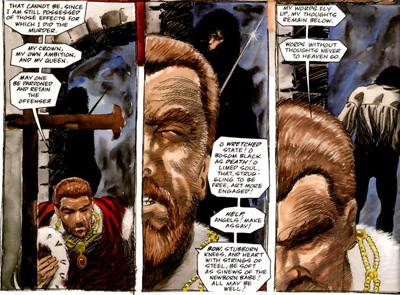
Tom Mandrake's adaptation omits Polonius (keeping his appearance in the closet scene as something of a surprise), but keeps Claudius' orders to R&G. As in the previous adaptation, they don't get to say their lines, and Claudius, his face in constant, unreadable shadow, dismisses them with his back turned. This is a man who cannot bear to let anyone see him in this state and he might even run from a mirror at this point. Before they've even left, his voice goes to a whisper (smaller lettering) as he starts on his speech. Finally, we're allowed to see his eyes, but he's hiding his face from the reader with his metaphorically blood-soaked hand. Mandrake, as always, is very strong at representing anxiety, and we won't see the King's eyes again in the scene, as he can't bear to look at any part of himself.
Behind his, a shadow with sword drawn. Is that pity in Hamlet's glittering eye? Or regret to find such a pioous Claudius? It does seem like he overhears the prayer if not the admission of murder, and yet, is powerless to act on that confirmation. He turns away and likely misses Claudius' final lines, but you'll note that his own speech is completely omitted. Mandrake is well aware that his reader has probably read or seen the play before, and allows us to fill in that blank. For the uninitiated however, he avoids the theological discussion and lets them assume... what? That Hamlet is satisfied with the King asking for forgiveness? That his mother is the greater target and that this is a result of his "blunted purpose"? It's a rather more ambiguous representation of the scene.

Wednesday, September 26, 2012

III.iii. The Confessional - Slings & Arrows

Though we hear Hamlet's speech, we don't see it. Instead, the camera pans across the reactions of the characters backstage, watching from the side. First is Richard Smith-Jones (Mark McKinney), the putative "Claudius" in the meta story (S&A's plots always take a great deal of inspiration from the play the characters are staging... the play outside the play, if you will), and though he would have "sold out" and turned the festival into an American-style theme park with a strong focus on mainstream musicals, the play has really grabbed him by this point. The moment is well-chosen, with the play's Claudius experiencing a crisis of faith on stage.

But it's the group pictured above that is most touching. Nahum (Rothaford Gray) is an African immigrant who works as the theater's custodian who sees the play for the first time, with fresh eyes. He comments that "fate plays with our Prince", which confuses the other actors. His explanation (that Hamlet cannot kill the king while he prays) is what we've always known. Like those actors, we know the play left and right. There are no surprises on this order anymore. Except there must be. At one point, we must have seen the play for the first time (unless we were told about it, which I'm afraid happens a lot in this universe of Cliffs Notes and Wikis and popular media referencing everything). At one point, we must have been like Nahum, experiencing the play's twists and turns for a first, joyous time. It makes Kate (Rachel McAdams) smile broadly, and in that moment, we're all seeing Hamlet as if for the first time.

I always discover new things in Hamlet, but by now, they're small things. Lines, images, new ways of reading or staging a moment, or inferences. Nahum's reaction is each of those moments writ large. And since Slings & Arrows is about the actorly work of discovering a play and its characters so that you may inhabit them, it's that as well.

Sunday, September 23, 2012

III.iii. The Confessional - Tennant (2009)

Though he kept his cool during the Hamlet's play, Claudius now seems slightly more agitated. Still, he deals with Rosencrantz & Guildenstern with calm and diplomacy, giving them orders to ferry his dangerous stepson to England. While the scripted fawning can make the audience grow as impatient as Claudius in this scene, this version's R&G keep the moment alive with comedy. Guildenstern is, as usual, in deadly earnest and prompts the less resolute Rosencrantz to fawn along with him. So Rosencrantz looks at Guildenstern, not Claudius, while he searches for the right metaphor, then realizes almost too late that he's gone on too long, that the King is looking at him, so he gulps down the last words. Might this "wheel" metaphor also betray a lower birth, which is doubly embarrassing for Rosencrantz? I'm thinking specifically of Polonius' line about keeping a farm and carters, and something as mundane as a wheel not being a fit symbol for a King. R&G's gauche imagery could stem from their essentially being posers, men whose ambitions outpace their place in the hierarchy (contrast with Horatio's humility). As for Polonius, he is still deluded, and laughs through his lines as if all will be well as soon as the Queen speaks to her son. Not only is he wrong about Hamlet's motivations, but he completely misgauges Claudius' mood.

As soon as he's alone, Claudius' guilt - or perhaps his fear of being caught - catches up to him and makes him retch in a handkerchief. Patrick Stewart gives reality to the rank smell mentioned in the lines. It's a very physical performance, one that betters 1980's version by a mile. The act of prayer is denied him, his hands acting as polar opposites and refusing to make contact. He laughs at the absurdity of praying with bloody hands, linking the pious position to the metaphysical state of prayer. At the end of the speech, when he is finally able to touch his palms together, that seems enough to give him the hope that "all may yet be well". If it's all about the physical with Claudius, it's in direct opposition to Hamlet who is all thought and no action, and it also relates well to his carnal motivations. Claudius is a man of this Earth, a man of flesh, not one of Heavenly spirituality.
Enter Hamlet with a switchblade, his crooked theater crown still on his head, a visual link to the killer king who murdered his father. In the theater, this was a cliffhanger where their put the intermission. Clever to put it in the middle of a scene rather than at the end of an Act, even if today's audiences know very well the scene ends in anti-climax. The energy of the scene is all and insures patrons will return promptly to their seats. On DVD, of course, there is no such break, and the action continues with Hamlet standing right over the kneeling Claudius who is putting his whole body into a semblance of prayer. Hamlet switches to voice-over for realism's sake, but soon runs off behind a pillar, breathless, to speak more directly to the audience.

An ambiguity: At the very end, Claudius wakes from his useless prayer and smiles, turning his eyes on us. It's slightly creepy, and through the self-disgust, you might wonder if there's a also a sense of satisfaction at having tricked Hamlet. Did he feel him there? Did he intensify his physicality to MAKE Hamlet come to that conclusion? In the midst of prayer, did Claudius suddenly let go of his guilt and self-servingly feigned piousness to selfishly save his own life? Whatever the case may be, he then rips his jacket open in anger, defeated and frustrated by that "physic" (and a well-chosen pun it is, in the wake of this discussion).

Saturday, September 15, 2012

III.iii. The Confessional - Fodor (2007)

Fodor cut into this scene substantially, but his spareness works. The penitent Claudius is first seen in shadow (above) and says one line from his talk with Rosencrantz & Guildenstern (absent), inserting it in the soliloquy admitting his guilt. The line: "I like him not, nor stands it safe with us / To let his madness range". His guilt for past sins is prefaced by the promise of future sins. So it is in the play, but by removing all intervening text, Fodor brings the irony forward. Even as Claudius is praying for forgiveness, he has put into motion more evil. In this version, the speech can't even really be called a prayer, since it avoids his wish for forgiveness. This is a darker world where divine intervention isn't an option, and where it would not be believable for any of the characters to actually be pious. In part because of the modern setting, but also because their interpretation is so much more corrupt than in the classic text.

Mid-prayer (as it were), the lights come up and Polonia enters. Or has she been there all along? She is, in this version, fully aware of Claudius' misdeeds, and often a willing participant. She's there to explain her plan to Claudius (substituting the word "arras" for "mirror" to match the later location), and despite their romantic relationship, seems afraid of him. Or perhaps FOR him. Claudius seems to be in shock, and zombie-like, shuffles off after Polonia when she stops speaking.
Holding his arm, she brings him back to his room before heading for Gertrude's, and they share a light kiss at the end of the hall. Still, Claudius barely responds to it, though he does turn back towards her as she leaves. She is, after all, a part of his sins, which are amply on his mind in this moment.

Earlier in the hall sequence, Hamlet creeps up behind them, sees them together, might even guess at Polonia's destination, but he does not, as in the play, attempt to kill Claudius. We know he has a gun and that he has said he could do "bitter business" this night, so the implication is that he might have shot them both in the back right then and there, but chose not to. Why is not revealed. He certainly has no cause to think Claudius is seeking redemption, nor that a praying man would go to Heaven even if he'd seen Claudius praying (which he has not). There's not even the sense that Hamlet feels sorry for his stepfather. He just ducks out of sight after a short moment, and only Polonia feels that perhaps she was being watched. It's possible her presence protected Claudius as Hamlet could not be sure he could perpetrate a double murder successfully.

Saturday, September 8, 2012

III.iii. The Confessional - Hamlet 2000

The staging in the modern-era Hamlet 2000 is cleverly done. Hamlet takes the place of Claudius' chauffeur, and so is able to hear the confession from the front seat. The confession, and the conversation with Rosencrantz & Guildenstern over the car phone. This is how he learns of his impending trip to England, and gets confirmation that Claudius is guilty. And yet, he fails to pull the trigger. Aside from the modern trappings, there is an important deviation from the play in the way this is handled. As written, it is unlikely that Hamlet is meant to hear the confession. He comes upon Claudius praying for salvation, and based on that and his reaction at the play, concludes he is guilty. He does not kill him just then on religious grounds. In this film, Hamlet hears the confession, but has no soliloquy to express why he leave the car without carrying on the execution. It looks like he's just unable to commit murder at this point, and that he might actually feel sorry for Claudius. After all, if he's unable to kill, he sees in Claudius his future self, a man having trouble living with the guilt of such an act. It may also be that the religious nature of Hamlet's delay would ring false in a contemporary, so much more secular, setting. However, a shade of this idea is retained for the viewer who would like to think Hamlet's reasons are the same in any era: Claudius' lines which are specifically about his inability to be forgiven are the ones said in voice-over, the implication being that Hamlet cannot know Claudius' prayers are null and void, or else he would have shot his uncle.

The staging also allows for some dynamic elements. Hamlet gives the steering wheel a turn during the confession, further destabilizing the King. His royal hand lands on the limo's television, where backlit, it triggers his lines about his bloody hand. Some of the images on that screen may or may not inform the scene. While he talks on the phone, for example, he switches channels from an ad saying "Stop living paycheck to paycheck" to a crude animated skeleton reading the newspaper, to news footage of Bill Clinton. Images of desperation, death and kingship. When his hand lands on the monitor, it is showing a vaguely volcanic cliff on the sea. The undiscovered country? The real Denmark? An image of precariousness? Director Michael Almereyda uses a lot of images on television screens throughout the film, most to simply evoke a feeling and theme, not to necessarily comment on particular lines.

Soon, Claudius is at the stock exchange, and it's business as usual, his doubts and guilt a momentary thing.

Saturday, September 1, 2012

III.iii. The Confessional - Kline '90

Leaving Rosencrantz, Guildenstern and Polonius out of it, we jump straight into Claudius' confession. The staging is quite well done. A funeral bell is hard, Claudius is in shadow, his collar undone. He is a man unmade by his own grief. At the word "above", the camera angle changes to a divine point of view above him, tracking back, repulsed by his inability to be redeemed. He will choose a square of light in which to kneel and pray in, crossing himself before doing so. In all this, he comes across as sympathetic. His guilt is real and makes him tear up, and he puts emphasis on his queen more than his crown. This Claudius did it for love, not just for ambition's sake.
Hamlet comes upon him, and it's no surprise since the staging is based on a theatrical performance that the prince can run around Claudius, shout and scream and not be noticed. The words are an aside, but so are the gestures, and meant to exist for the audience, but not for the characters. Symbolically, Hamlet aims for Claudius' ear before taking his swing, and in realizing that this is the wrong time for his revenge, he swings the dagger around Claudius madly with each mentioned sin. It reinforces the illusion that we're in a frozen moment in time, and must be quite a feat for the actor playing Claudius to remain so still while Hamlet whirls around him. Hamlet leaves, and Claudius is jolted out of that moment, not by a physical cue, but by an inner realization that he cannot and should not be forgiven his murder.

Throughout, Hamlet appears to be mad and dangerous, and Claudius so much more human and relatable. Indeed, is Hamlet so extreme an intellect that we might be more inclined to side with the villain, or at least better empathize with his venal motivations?

Thursday, August 23, 2012

III.iii. The Confessional - Zeffirelli '90

As frequently happens, Zeffirelli chooses to infer a lot of what's being said rather than use the dialog, but the net effect is to deny the audience insight into Claudius' character. Rosencrantz & Guildenstern's role in the sequence is entirely, cut as is Polonius announcing his plan, but this is par for the course for a trimmer Hamlet. Where we lose the most is in Claudius' confession. He finds himself in the chapel, crossing himself before a tapestry of the crucifixion, directly(?) from his emotional outburst at the play. The scene picks up at "My offenses rank" and doesn't get much farther than "a brother's murder" before he kneels and prays silently. It's enough to show his guilt, but not enough make us empathize with his situation. There is no internal debate about the impossibility of his redemption, and most egregious of all, the final line about words without thoughts has been excised. As Hamlet does his thing from the doorway, Claudius at times sobs loudly, and croaks out parts of his speech in prayer ("wretched state" etc.), so this King feels very guilty indeed. However, we're left believing he might yet be redeemed, or that he at least thinks he can be. So Hamlet is right to stay his hand, and the scene's irony is completely lost.

A great disappointment.

Sunday, August 19, 2012

III.iii. The Confessional - BBC '80

Claudius is a man upset by Hamlet's play, and struggling to keep his emotions in check. He's not just enraged, but guilt-ridden as well, making for a scene with Rosencrantz & Guildenstern that's more emotional and intimate than most. Here, Rosencrantz's speech about the realm empathizing with its King becomes a way of consoling Claudius, and he even feigns(?) being moved, makes his voice tremble, etc. The sycophancy works and Rosencrantz gets a manly embrace from the King. Often painted as irrelevant cogs in the courtly machine, the R&G of this version seem to be in better graces, at least at the moment. This fits within its theme of Claudius preferring (and showing fatherly affection) to every young man BUT Hamlet, though he may simply be in a sort of daze, acting automatically. Indeed, when Polonius comes in, he gets no reaction. By the time the King breaks with his daydream and answers, Polonius has already rushed off. And then there is a sudden explosion of emotion, a sneeze as much as a sob, and though alone, Claudius still tries to maintain his facade.

Patrick Stewart gives his lines a strong measure of sarcasm to make Claudius reject his own capacity to be forgiven, and this is something that's quite important to the Medieval point of view - the idea that the King is the voice of God, the head of the stately body and true origin of the realm's welfare. We've seen how this is true of Hamlet's Denmark, a weakened and corrupted country, and it's in his role as God of Denmark that Claudius rejects his own salvation. His damned state is of his own making, and at the very end, his final line is a full acceptance of his evil and damned state. It doesn't matter what he does to repent, his fate has been sealed, and so he may give in to evil since once damned is thrice damned. It's not that he rejects divinity, quite the opposite, it's that he sees himself as forever unworthy of divine grace. His later "sin will pluck on sin" is less an observation than justification for his wrong-doing.
From his desk, Claudius forces himself to a small altar to pray, every move an effort, and Hamlet comes upon this scene by accident. Unlike the close calls of other adaptations where Hamlet gets quite close to Claudius, here he never even crosses the threshold. The soliloquy is spoken directly to the camera, which gives Jacobi's Hamlet an opportunity to explain himself. It's the audience that doesn't understand this particular delay when Hamlet has just vowed to finally act, and he feels compelled to justify his non-action. It's no harder to reconcile than his apparent relish at describing the compromising positions he might catch the King in, including everything he hates about him, such as his "incestuous bed". Regardless of how it is played, the text itself is contradictory in this. Hamlet at once WANTS to catch his stepfather in bed with his mother, and then expressly FORBIDS his mother from sleeping with him. But that's Hamlet's own wretched state, balanced between putting a stop to Elsinore's evils and maintaining them to fuel his self-pity. He knows who he is now, but who will he be when it's all been said and done?

Sunday, August 12, 2012

III.iii. The Confessional - Olivier '48

As usual, Olivier tells us more with his staging than he does with his actors' performances, which makes up for his large cuts to Shakespeare's lines. Obviously, the largest cut where this sequence is concerned is the elimination of Rosencrantz & Guildenstern, but their scene here is easy to excise. Instead, Polonius runs to Claudius directly with his plan. He has to seek him out because the King has been sitting alone in darkness since the Mouse-Trap, and strangely for him, crownless. As we discover him, his face is completely in darkness, an image of his sin, yes, but also of a man devoured by guilt. He does not face us out of shame. This Claudius seems more repentant than others, in tears, kneeling without his words prompting him to do so. The camera focuses on his hand for a long time, another clue that it is very much the Ghost's eye-view in this adaptation. A Ghost fixating on the hand that murdered it in life.

Hamlet stumbles upon this scene, walking behind Claudius and only barely noticing him there. His speech is in voice-over to avoid the theatricality of words spoken and unheard. In many adaptations, Hamlet's presence in this room feels deliberate. A crime of opportunity to be sure, but it ties into his last speech. He is ready to do anything, and welcomes this chance (until he thinks about it some more). In the way Olivier stages it, Hamlet is taken by surprise by this opportunity, and feels a sudden rush to avenge his father, but it's all going too fast. It makes his decision not to go through with it more realistic, where a slow or thoughtful approach would infer more time to think about acting to counter the time to think about NOT acting.
The statue of Jesus in this scene is no casual set dressing. Olivier uses it in his staging to give Hamlet pause. It's in seeing it that Hamlet makes the realization that Claudius should not be killed a-praying, and Jesus becomes a character in the room, silently looking at the characters, his eye line able to meet theirs, and a voiceless conversation does occur! In this praying scene, prayers are answered, not by some divine mechanic, but by characters hearing themselves speak and reacting to it (Shakespeare's great gift to literary characters, according to critic Harold Bloom). Divine inspiration and wisdom coming from inside the characters. As Claudius' words "don't rise up", the imagery and this more secular reading tell us different, and that - a double irony - Christ does forgive him, but he cannot forgive himself. The last line sees the camera drop down, obscuring Jesus' face and moving down a dark slab towards a sobbing Claudius.

Saturday, August 4, 2012

III.iii. The Confessional - Branagh '96

There's some small shuffling of scenes in this section, as the first part of the scene - Claudius and his various sycophants - is placed before Hamlet's short soliloquy technically part of the previous scene, before resuming with the Claudius' confession, an edit that creates more tension by putting Hamlet's "I'm ready" speech right up close to his opportunity to show he is. In the sequence preceding, Claudius is seething from Hamlet's affront at the play, and is putting into motion Hamlet's exile to England. Rosencrantz & Guildenstern are also assigned to this voyage, which immediately makes them worry that they're sharing in the punishment. This is the scene where they try to understand if they've fallen out of favor or not. At least, that's how it's played in this adaptation. As Claudius ignores the two gnats, R&G give each other looks and try to glean some kind of response from the King. There's a sense that they realize they are a "noyance", but can't get out of this conversation. When Claudius, lost in murderous thought, snaps back to reality, it's like they never said a thing. He's back on the question of the exile. Had he listened, he might have heard a warning about the relationship between King and State, his Denmark about to fall because he has. That general groan is merely delayed, the King and corrupted State's days prolonged while Hamlet and Fortinbras are made to wait in the wings a bit longer.

When Polonius walks in, Claudius is activated. He rises, enters a secret door, and walks to the chapel, his adviser in tow. This is where Polonius gave his advice to Laertes, a possible source of irony since Claudius is to himself true (unrepentant) which ultimately dooms him. It's also fiercely ironic that a dishonest plan to spy on Hamlet and his mother is laid out on the way to a church. The rapid fire sequence makes it seem like Claudius is getting all his sins out of the way before he goes to confession.
Jacobi's Claudius is clearly haunted by his fratricide, which is what makes him more sympathetic. While he cannot repent, he does feel guilty, and he doesn't ask the angels to forgive him, only for the strength to make amends and do what he must so he can be forgiven. He asks for a conscience. Repentance is a process with many steps, and in Hamlet's world, it seems much easier to go to Hell than it is to Heaven. Something to think about when we get to the ending. Time seems a great enemy in the play. Not only is it fluid and "out of joint", but it's a corrupting influence. The more Hamlet delays, the more death he causes. In Claudius' prayer, he asks to be given the supple knees of a new born babe, an image of innocence that translates not just to the physical. He wishes to return to a time when there was no taint on his soul. Alas, age breeds corruption as sins accumulate. The speech also highlights a certain futility in the plot. Claudius WILL be punished, and the punishment will fit the crime. He knows he's headed for Hell, which is "just" because that is the fate that greeted his victim. So the question is, does Hamlet have to kill him? God will sort it out, and in a sense, that's what Hamlet's delay tells us. Killing Claudius is just another regicide, one that may doom Hamlet's own soul. In Hamlet's highly religious world view, however, Claudius must be killed before he can be forgiven for his sins through confession or final rites. Of course, the fact that Claudius doesn't believe he can be forgiven means only the audience is aware of revenge's innate futility here.
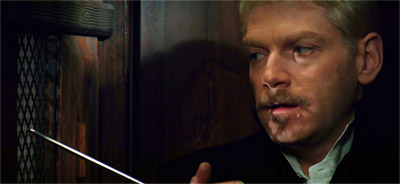
Once Claudius takes on a praying position, Hamlet appears on the priest's side of the confessional, in a position to forgive or to dole out punishment. He dictates morality in the play. He slides his dagger through the window, his words heard in voice-over as to make the scene less theatrical, and the blade goes right into Claudius' ear, shockingly. It's a fantasy. The next shot shows the blade not quite there yet as Hamlet hesitates. We're on Hamlet's eyes, thinking, realizing, and remembering. Quick flashbacks take us to various points in the film where Claudius was a-sinning, which includes a shot of the King and Polonius getting behind an arras. A clue that Hamlet very much knew that they were behind the mirror during "To be or not to be"? Or an imagined moment based on what he later learned? Choosing to wait for a better moment, the blade passes before Hamlet's eyes and he is gone. Claudius' ironic last line is also in voice-over. A strange feeling comes over him and he looks to the priest's side, but there's no one there. I wonder, could there be a staging where Hamlet isn't there at all, but is instead Claudius' imagined Hamlet, first punishing him, then not, then resolving to do so at a different moment, fueling Claudius' paranoia and justifying the exile? Hamlet as guilt manifest.

Saturday, July 28, 2012

III.iii. The Confessional

At the top of Scene 3, Claudius' sycophants report in, Rosencrantz & Guildenstern desperate to ingratiate themselves despite their failures (this is often cut from productions as there is something necessarily tedious about it), and Polonius to inform him of his plan to hide in the Queen's closet. We then get to the heart of the matter as Claudius confesses his crime in a prayer/soliloquy. This is where Shakespeare lets go of any ambiguity concerning the crime, but to better forge a cruel irony. Hamlet walks in, sees an opportunity to kill Claudius, but stays his hand because the King is at prayer and his soul thus likely to rise to heaven, whereas his father's is trapped in hell. Or it is just another excuse not to commit to his action, regardless of his previous soliloquy. Hamlet is yet a man of words, not of action. Before we look at the play's various featured productions, and how they staged this very theatrical double-aside, let's look at Shakespeare's text (in italics) and shine some light on some of the lines.

SCENE III. A room in the castle.
Enter KING CLAUDIUS, ROSENCRANTZ, and GUILDENSTERN

KING CLAUDIUS: I like him not, nor stands it safe with us
To let his madness range. Therefore prepare you;
I your commission will forthwith dispatch,
And he to England shall along with you:
The terms of our estate may not endure
Hazard so dangerous as doth hourly grow
Out of his lunacies.


The hazard, at this point, is that Hamlet gives Claudius away and reveals his guilt more plainly to Court and Country. After the next scene, he'll be better able to justify the exile as a different "hazard" is realized violently on Polonius.

GUILDENSTERN: We will ourselves provide:
Most holy and religious fear it is
To keep those many many bodies safe
That live and feed upon your majesty.


As if knowing the punishment (exile) doesn't fit the crime (putting on an outrageous play), R&G immediately jump to Claudius' defense, justifying his order for him and making sure he knows they are absolutely on his side. Without meaning to, Guildenstern creates a Hamletian image of a rotting King on which maggot-subjects feed. Words and kingly diets will turn up again soon.

ROSENCRANTZ: The single and peculiar life is bound,
With all the strength and armour of the mind,
To keep itself from noyance; but much more
That spirit upon whose weal depend and rest
The lives of many. The cease of majesty
Dies not alone; but, like a gulf, doth draw
What's near it with it: it is a massy wheel,


In Rosencrantz' wheel metaphor, one might see the Wheel of Fortune, Hamlet's strumpet, and an again-accidental warning that what goes around, comes around, proclaiming another king's death in the future. He should do well to heed his own prophecy, because he's one of the lesser things annexed to that royal wheel, and will share its fate. The King will sigh (his last), and he will groan.

Fix'd on the summit of the highest mount,
To whose huge spokes ten thousand lesser things
Are mortised and adjoin'd; which, when it falls,
Each small annexment, petty consequence,
Attends the boisterous ruin. Never alone
Did the king sigh, but with a general groan.
KING CLAUDIUS: Arm you, I pray you, to this speedy voyage;


Small ironies: Claudius "prays" them, and in a few more lines will pray God. From the lowest to the highest, but with no change in intensity or value.

For we will fetters put upon this fear,
Which now goes too free-footed.
ROSENCRANTZ GUILDENSTERN: We will haste us.

Exeunt ROSENCRANTZ and GUILDENSTERN
Enter POLONIUS

LORD POLONIUS: My lord, he's going to his mother's closet:
Behind the arras I'll convey myself,
To hear the process; and warrant she'll tax him home:
And, as you said, and wisely was it said,
'Tis meet that some more audience than a mother,
Since nature makes them partial, should o'erhear


The idea here is that Claudius does not trust Gertrude, and believes she will always be biased in Hamlet's favor. This is a variation on the first arras scene, in which Gertrude was sent away.

The speech, of vantage. Fare you well, my liege:
I'll call upon you ere you go to bed,
And tell you what I know.
KING CLAUDIUS: Thanks, dear my lord.

Exit POLONIUS


Here begins Claudius' confession, and one might compare it to "To be or not to be", in that it is a strong example of something losing "the name of action". If Hamlet refuses to commit murder (or self-murder, if you believe he's really talking about suicide), Claudius refuses to repent. Both men have this moment of weakness where they cannot do what they should. In both cases, we can invoke pride. These men follow "To thine own self be true" to the letter and are doomed by it. Though they can reflect on the possibility of change, change is actually beyond them (at least, at this point in the play). We will discover over the next few weeks if directors have acknowledge this parallel between the two characters and the two scenes.

O, my offence is rank it smells to heaven;
It hath the primal eldest curse upon't,
A brother's murder. Pray can I not,
Though inclination be as sharp as will:
My stronger guilt defeats my strong intent;
And, like a man to double business bound,
I stand in pause where I shall first begin,
And both neglect. What if this cursed hand
Were thicker than itself with brother's blood,
Is there not rain enough in the sweet heavens
To wash it white as snow? Whereto serves mercy


The same idea is explored more fully in MacBeth, in which a similar image of unwashable blood represents guilt tempered by ambition. There as here, the true villain's ambition triumphs over his guilt and he resolves not to repent, but to commit further murders to hide the first. MacBeth is, in truth, an anti-Hamlet that may deserve its own entry one day, a Hamlet told from Claudius' perspective and where rashness replaces delay.

But to confront the visage of offence?
And what's in prayer but this two-fold force,
To be forestalled ere we come to fall,
Or pardon'd being down? Then I'll look up;
My fault is past. But, O, what form of prayer
Can serve my turn? 'Forgive me my foul murder'?
That cannot be; since I am still possess'd
Of those effects for which I did the murder,
My crown, mine own ambition and my queen.
May one be pardon'd and retain the offence?


If Denmark is a moral universe, now corrupted, then it could be that once Hamlet has done his own murders and set the country's moral compass a-right, he has to die. Hamlet will not retain the advantages of the deaths he has caused, and Denmark passes into the hands of an entirely different monarch.

In the corrupted currents of this world
Offence's gilded hand may shove by justice,
And oft 'tis seen the wicked prize itself
Buys out the law: but 'tis not so above;
There is no shuffling, there the action lies
In his true nature; and we ourselves compell'd,
Even to the teeth and forehead of our faults,
To give in evidence. What then? what rests?


In another mirrored moment from "To be or not to be", Claudius wonders at the undiscovered country himself, and he too sees it as a place to fear, a place where he cannot hide from justice as he has done in our own corrupt world.

Try what repentance can: what can it not?
Yet what can it when one can not repent?
O wretched state! O bosom black as death!
O limed soul, that, struggling to be free,
Art more engaged! Help, angels! Make assay!
Bow, stubborn knees; and, heart with strings of steel,
Be soft as sinews of the newborn babe!
All may be well. [Retires and kneels]

Enter HAMLET


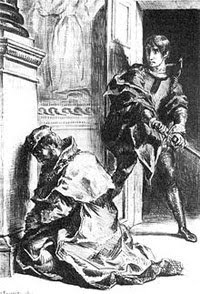
Note that Shakespeare makes it clear Hamlet only comes in after the speech and once Claudius is on his knees. He does not hear what is said, though of course, Claudius does not hear the following words. On stage, this is often played with Hamlet standing right over him with a blade. As we'll see, films have attempted many different stagings to make this moment less theatrical and more realistic.

HAMLET: Now might I do it pat, now he is praying;
And now I'll do't. And so he goes to heaven;
And so am I revenged. That would be scann'd:
A villain kills my father; and for that,
I, his sole son, do this same villain send
To heaven.
O, this is hire and salary, not revenge.
He took my father grossly, full of bread;
With all his crimes broad blown, as flush as May;
And how his audit stands who knows save heaven?
But in our circumstance and course of thought,
'Tis heavy with him: and am I then revenged,
To take him in the purging of his soul,
When he is fit and season'd for his passage?
No!
Up, sword; and know thou a more horrid hent:
When he is drunk asleep, or in his rage,
Or in the incestuous pleasure of his bed;
At gaming, swearing, or about some act
That has no relish of salvation in't;
Then trip him, that his heels may kick at heaven,
And that his soul may be as damn'd and black


Readers today may not realize how violent and even blasphemous this passage is. Hamlet is not just contemplating the murder of his king and uncle, but also of making sure Claudius' soul isn't saved so that is doomed to hell. Christian doctrine, which Hamlet adheres to, often showing a Puritanical vein, would have him allow his uncle to repent before his death/execution. Hamlet's choice puts him on the path of evil, which possibly adds an ironic layer to Horatio's invocation of angels upon his death. What undiscovered country will Hamlet go to?

As hell, whereto it goes. My mother stays:
This physic but prolongs thy sickly days.

Exit

KING CLAUDIUS: [Rising] My words fly up, my thoughts remain below:
Words without thoughts never to heaven go.

Exit


And there's the punch line. The irony is that Claudius' prayers are empty and that he was basically communicating his refusal to repent. Hamlet could have killed him then after all. Hamlet's words are truer than he realizes. It is indeed a "physic", i.e. purely physical state. that prolongs Claudius' days. Of course, different stagings and performances may change how we perceive this scene. Is Hamlet convinced by the prayer, or just looking for yet another excuse to delay his action? Does the setting, both physical and temporal, change how we interpret these Christian ideas? The next articles will address these issues and more.

Saturday, July 21, 2012

III.ii. Critical Reception - Classics Illustrated

The original
The black comedy of the recorder exchange between Hamlet and Rosencrantz & Guildenstern cannot be easily reproduced on the comics page, not with the page count inherent to the format, so I'm sad to report the sequence was cut from both version of Classics Illustrated. R&G still show up to deliver the Queen's message, but it acts merely as prologue to Hamlet's soliloquy. This is especially true of the original comic, which has Hamlet spare his cruelties, unless one considers an abrupt answer "cruel".Note also how the bloodier language was excised from the speech, pitching it to its younger audience.

The Berkley version
Tom Mandrake's adaptation uses an entire page, but is still very economical. Hamlet's delirious rhymes are kept, but spoken over the panel in which the King runs off, showing more clearly that he is the "stricken deer" of Hamlet's song. Mandrake's gloomy Hamlet has a very different expression from the original Classics Illustrated too, replacing joy with anguish. Gone is the euphoria, and in its place is the realization that now he must carry out a bloody revenge. For this Hamlet, it's made things worse and it seems he'd rather have been told that the Ghost was lying, tormenting him.
R&G's arrival restores a lot of dialog lost in the original comic, but still no recorder business (which would probably have been bitter and violent rather than manic). In fact, Hamlet's response, cutting to a later line in the scene, is almost a non sequitur. "By and by is easily said" seems strange here, but it is basically Hamlet telling them what answer to go, without the prompt of it being their own, plain answer. The comics form shows another of its weaknesses at adaptation when Hamlet starts his speech in the same panel he dismisses his friends, making it look like they'll hear that part of it. However, it does kind of work, and makes the witching hour the reason for their dismissal. Instead of saying it's late, Hamlet goes into poetic detail the likens night to evil. I could see this used in a proper staging of the play as a way to give Hamlet another "madness" moment in front of the traitors, putting a mirror up to their own evil or acting as a veiled threat.
The rest is the speech is as written and performed alone, either with Hamlet in close-up, or walking towards his mother's closet.

Wednesday, July 18, 2012

III.ii. Critical Reception - Slings & Arrows

The only part of the sequence that makes it into the performance montage is the soliloquy, but we don't see it. Instead, we're with the play's director, Geoffrey Tennant (Paul Gross), mouthing the words backstage, praying to the Shakespearean gods for a good outcome. In the show, he was a much-praised Hamlet until he cracked on stage, and the "witching hour" in terms of that story is when he must redeem himself and walk back from that disaster (through a proxy). As the soliloquy ends, he signals the number of soliloquies to the actress playing Gertrude, a countdown that refers to the five key moments an actor must nail as he gets through the play, something he told "Jack Crew" to reassure him that this performance was possible. In relating it to the play, it refers to Hamlet's delay of the action, a self-imposed countdown that creates the tension in the play. Hamlet is a time-bomb, each soliloquy counted down a means to talk himself into taking action. By the end, when all soliloquies are done, words turn to action, and the dialog shrinks until the rest is, indeed, silence.

Thursday, July 12, 2012

III.ii. Critical Reception - Tennant (2009)

The sequence doesn't start with the usual rhymes in this version, but instead with Horatio trying to tell Hamlet that was he noted most definitely was NOT conclusive proof of Claudius' guilt. Hamlet won't listen, of course, an almost violent euphoria overtaking him. He asks for music, but also grabs a silver tray from a servant, banging it in the man's face like a gong. Horatio attends him and laughs at his jests, but he doesn't speak or try to broach the subject of the King again. The focus changes, in any case, to Rosencrantz & Guildenstern, surely Horatio's rivals in the friendship department, so perhaps there's a psychological, personal reason why he falls in with Hamlet again despite the unspoken disagreement.

David Tennant's Hamlet is at his funniest in this scene. His "with drink?" is impish and a confidential "he's drunk again eh? yeah, that happens a lot", traitor's talk that makes R&G co-conspirators if anyone were listening. As they continue, Hamlet more or less ignores them, putting the Player's crown on his head, using the silver tray as a mirror, hiding his face from them. He's their mock King, the King that should have been if only they (and the rest of the Court) would follow the right man, the true heir. He's also mocking Claudius, sitting on the throne misunderstanding everything they say on purpose. It is a sly condemnation of Claudius' decisions to date, prefiguring Denmark's downfall at the hands of Fortinbras. When they demand an answer from him, he raises his hand excitedly, like a school boy, only to reveal he can't make a wholesome one. It's with mock pride that he says the "oh wonderful son" line. It's all a caricature of his false King/Father.

And he does the same with the friendship he bears these men. At "pickers and feelers", he gets up to tickle Rosencrantz, freaking him out. And he should. They are failing at their appointed task, and that will have consequences. For this Rosencrantz, it's really about getting it over with so he can leave this hellish place before the axe falls on him. He tries to keep back, he's rather sincere when he asks Hamlet to stop what he's doing before it ruins them all. Guildenstern is the more political, albeit gauche, animal. He tries to find the right words and hopes to get favor from the King. But of course, neither of them are aware that Claudius may be a murderer and usurper. They just don't get it, perhaps because they can't. It's shown, for example, when Rosencrantz gives Hamlet a blank stare at "While the grass grows". There's a funny beat before the next line, and Hamlet obnoxiously slaps him, but doesn't awaken him to the very real danger of trusting Claudius.
The recorders arrive, and the production plays on the plural in that line to make Hamlet throw one to Horatio, which will come into play later. The interplay between Hamlet and Guildenstern is sweeter and less violent than usual, initially, Hamlet acting all innocent, not understanding why Guildenstern won't play and laughing at the irony. Guil, for his part, tries to understand what is being said and takes the Prince's explanations with a measure of respect, as if he agrees he's been rumbled. Then BAM! A rare musical sting accompanies Hamlet attacking Guildenstern with the pipe, trying to choke him, even as Rosencrantz tries to gently separate them. What actually does it is Polonius' arrival.

Coming into a violent moment, Polonius gets a loud pipeful in the face, followed by Hamlet and Horatio playing a tune together over his words. By having the old councilor mouth words at R&G with a certain degree of ire, the production motivates his presence. Thematically, I've said that Polonius is entirely redundant in the scene because he always makes the wrong choices, and that Hamlet feels he's irrelevant all the time. Here, he comes because R&G are taking too long. We have to remember he plans to hide in the Queen's closet (even if he hasn't said so yet), so his impatience stems from that. He's been kept waiting as much as the Queen has. Showing impatience and even anger is rare for him, so perhaps his head too, is on the chopping block. When the King is angry, chaos reigns in Elsinore. And it's because he's impatient and in a hurry that Hamlet chooses to play the game of clouds with him, pushing him to show disrespect. Polonius catches himself each time, but his composure does break.
The soliloquy is done straight into Hamlet's movie camera, a point of view we get to see. Sitting askew on the throne while he speaks of being cruel to his mother creates a visual inversion of what is natural, and may put the lie to his words. Hamlet looks quite demented here. His successive victories over Claudius, R&G, and Polonius have pushed him over the line of what may be reasonable or acceptable.

Wednesday, July 4, 2012

III.ii. Critical Reception - Fodor (2007)

After the King leaves, Hamlet's insane clapping draws a hateful look from Polonia, who in this universe, is Claudius' lover. Polonius's change of gender has several effects, but one of them is creating a dynamic that makes attacks on Claudius that much more personal for his councilor (and chief accomplice?). The King obviously "blenched", and Horatio really did note him and shares in Hamlet's joy. There is no bitterness in them, Fodor treats this as a victory as yet untinged by what must come after. When Hamlet calls for the recorders, it's in a gently mocking, celebratory tone, a way of smoothing over the fact that it's a clarinet and not a medieval recorder he finds. It's amazing how an actor can simply put a little humor or sarcasm into a single word and modernize it immediately. Rosencrantz & Guildenstern, dangerous bullies in this world, are really angry and do a lot of shouting out of their frustration. They're at the end of their ropes. In fact, their reaction is so strong that Hamlet's "I am tame" shames them into a quieter stance. They're the ones who seem crazy, not him. Instead of the aggressive, threatening madness most Hamlet put on in this sequence, this one instead goes for innocent playfulness, as a man-boy who doesn't understand why people are angry at him. Ever his partner in this affair, Horatio quietly smiles next to him, somehow acting as Hamlet's irony. It's how R&G know they're being laughed at. No matter how much they threaten him with body language and tone, Hamlet doesn't lose his composure. On "as easy as lying", he makes it a discovery, an answer inspired by looking at them. And there's no violence in the business with the recorders. He just gives them the clarinet and begs them to play it, more a petulant child than a dangerous man in his own right. They hesitate before admitting to not knowing how and roughly disassembling the instrument before giving it back, again an implied threat. By the time Hamlet gets to "you cannot play upon me", Polonia is standing behind R&G and the remark is addressed to her as much as to them, if not more. Through the innocent act, he lets slip that he knows they're all in league with each other. The imaginary cloud in the ceiling plays out as a power struggle, Polonia refusing to be intimidated, her responses dripping with sarcasm to let him know she's quite aware of what he's doing. There is further osmosis between the conspirators at the end of the sequence when "by and by is easily said" is spoken to R&G instead of Polonia, but they put a further twist on it. R&G each get one "by" thrown in their direction, making it "bye" and "bye", a pun on their quick dismissal directly following. Horatio then leads him out of the room by the hand, a gesture that could be interpreted as either romantic or childish, but a tense sound stops him. Does he feel the Ghost? A gun left on a chair - it might have fallen out of R&G's pockets - draws his attention, and he fondles it as he says his speech, a prayer to the gods of violence. These choices are informed by the modern staging of the play in the film. Hamlet does not carry a weapon, so much procure one. And the "witching hour" cannot be heralded by bells or some such, so a strange feeling comes upon the Prince instead. It's a supernatural occurrence, this weapon suddenly materializing when Hamlet needs to kill the King, and supernatural forces may well be at work.

Saturday, June 30, 2012

III.ii. Critical Reception - Hamlet 2000

In Hamlet 2000, we don't stay in the theater long. Horatio and Marcella noted Claudius' blenching at the movie screen (as did we), but seems more confused than certain. Still, in cases where the actor playing the King isn't ambiguous in his reaction, there's no real need to dwell on Horatio's. Hamlet races off into night as we hear the song's words in voice-over. It takes an entirely different bent spoken as internal monologue. In the play as written, the lines are a manifestation of Hamlet's exultant victory. Here, it becomes commentary on the evening's events. Some must watch, some must sleep and so it goes. He is saying that only a few, like him, are vigilant, and the world outside is still oblivious to Claudius' crimes. There is still much work to be done, and the melancholy of Hamlet's tone shows him weary still, despite his small victory.

He hails a cab and jumps in, and that's where Rosencrantz & Guildenstern catch up to him, box him in. As the cab drives off, we hear words on the radio, but not from the play, a commercial for buckling up about cats having nine lives. It informs the scene only in the smallest degree. It's about danger and safety, something all the participants are ignoring. They're all playing a dangerous game. The difference between R&G and Hamlet is that the twins don't know it. In fact, Hamlet will survive his deadly encounter with them (he's the cat) and they will not. But here, the Prince is caught and though he tries to remain aloof, he does wipe at his wet eyes from time to time. In the absence of recorders - this version frequently does away with lines about anachronistic props - their conversation ends at "my wit's diseased". He cannot give an answer and that is that. He's not playing coy as other Hamlets do, he's frankly telling they are unlikely to get anything from him.
When he gets off, part of the "witching hour" speech is done in voice-over. It's all about mood. Heavy metal leaks out of a revolving door (the Ghost's passageway to and from the undiscovered country?), steam blows out of sewer grates, and in a few moments, as we cut to Claudius heading out of Elsinore, he crosses paths with a child dressed as a ghost who boos at him.
It's Halloween in New York, apparently, and it's a nice ironic image that a dead child would haunt the King at this point, he who has killed his brother, someone he grew up with, was a child with. It comes after a mysterious scene in which Hamlet is seen bothering a limo driver, but as we'll see, it is merely set-up for the confessional scene.

Thursday, June 21, 2012

III.ii. Critical Reception - Kline '90

In a small ironic twist, Hamlet runs around with a dagger at the beginning of this sequence - false fire indeed! And euphoric, he lets himself fall into Horatio's arms from off the stage, a foreshadowing piece of staging, as well as a call back to his feeling faint after meeting the Ghost. This is the midpoint between getting the mission and seeing it done, the turning point, and each one a blind fall backwards. Does Horatio believe Claudius showed his hand? Or does he just play along with the Prince dangerously swinging that knife around? There's simply no room to play the ambiguity as Hamlet jumps right back onto the stage and starts playing the recorder.

Rosencrantz & Guildenstern come running, and spin out their speeches while Hamlet pipes through them. The recorder is his weapon, used either to drown out their words, or swung as a dueling sword. Rosencrantz seems particularly earnest in trying to reason with him, honestly trying to save him from this reckless path he's set himself on. The old friendship appears more tangible in this adaptation. Consequently, Hamlet is less manic, though there are still moments of mad energy, such as on the "pickets and stealers" line, pulling handkerchiefs out their pockets like a stage magician. Regardless, Hamlet is more in control of his words. For example, "I lack advancement" is said with a smile, like he's pulling unconvincing reasons out of the air just to see how they'll respond.

A moment that made me stop and think is Guildenstern's contention that "if [his] duty be too bold, [his] love is too unmannerly" met with a real pause from Hamlet before answering that he doesn't understand that. He pauses, so we do as well. What surprises him in that line, or alternately, what makes him point out Guildenstern's delusion or hypocrisy? To paraphrase, Guildenstern's lack of manners are attributable to being oh so worried about Hamlet. Oh really! The Prince goes on to attack his credibility, so he clearly doesn't believe a word, that somehow these former friends care about him more than they do themselves. And he's very serious and calm throughout the sequence, adding to the earnestness. The scene is usually played with Hamlet being "idle", playing up his madness, and R&G as panicking hypocrites. In this adaptation, it is closer to an honest portrayal of a friendship breaking down. Or any relationship, in fact, because Hamlet is much the same with Polonius.
Of course, Hamlet's claims about imaginary clouds seems like madness no matter the tone. At least, Polonius thinks it so, looking sideways at R&G, trying to get a sign from them about the Prince's state of mind. He awkwardly agrees with everything, trying not to wake the beast, so to speak. Hamlet, too, is giving meaningful looks. Polonius IS the weasel that inspires the cloud simply for accepting the initial premise. A white lie, but one told by a liar nonetheless.

The soliloquy has a trigger: Midnight bells, rung at the "witching hour", giving the whole of the speech a funereal air, and giving the dagger, pulled back out, a fatal and dread resonance.

Thursday, June 14, 2012

III.ii. Critical Reception - Zeffirelli '90

An important difference with this adaptation is that the revels continue even after members of the Court scurry for the exits. It's an odd choice, one that devalues the King's power, though it does better match Hamlet's state of mind. His own song and dance is even more over the top than elsewhere, and he clearly sends such words as "wounded deer" in the King's direction so that it might be heard. This entire performance is witnessed by Gertrude who stands shocked and amazed before finally leaving. Hamlet doesn't have much of a conversation with Horatio before running off, so his friend's reaction remains ambiguous, though Claudius was pretty obvious in HIS reaction. And in the wake of all this, we keep finding fragments of the Nunnery scene - Hamlet tells Ophelia to leave one more time, kisses her, and gives a matter-of-fact farewell. You can practically see her mind breaking.

A change of venue, and we're on a parapet somewhere else, though not too long later since Hamlet has a drum around his neck and a recorder in his hand. He is accosted by Rosencrantz & Guildenstern, but he's obviously had time to settle down and is relatively serious and friendly with them. The better to take a darker turn in the middle of a line, specifically at "It is as easy as lying". Guildenstern is particularly sarcastic with his "I have not the skill", which sets Hamlet off to violence and to choking him with the pipe. The true irony is, in fact, that they really DON'T have the skill, neither in music, lying or getting information from Hamlet. One could probably write a dissertation on this idea. People in the play are consistently required to do things for which they "have not the skill", whether it's R&G's undercover work, Polonius' counsel, Claudius' confession, or indeed, Hamlet's bloody revenge. What is easy, on the surface, may not be so simple, and I am constantly reminded of "to thine own self be true" as the key to to the play. Polonius does not feature in this sequence, so no mysterious clouds, etc. Instead, R&G get some of his lines and are left to "easily" transmit the Prince's message. Of course, "easy" has so far been beyond their grasp.
Hamlet runs down the stairs, away from them, for his brief soliloquy, which is even briefer, ending the scene on "Now to my mother". In other words, he places no conditions on that visit, and after speaking of drinking hot blood and doing bitter business, the lack of such makes us believe he's off to murder Gertrude. It's an omission that creates tension, certainly, but thrown on top of the change of venue, it beggars the question of why Claudius is not more in his thoughts. The guilt of the King spreading to the Queen is a central ambiguity of the play (I could, in fact, have switched King and Queen and still been correct), but by forgetting the King entirely, that ambiguity is not well served. Once again, I find myself frowning at Zeffirelli's cuts.

Friday, June 8, 2012

III.ii. Critical Reception - BBC '80

Like Olivier's before him, Jacobi's Hamlet sings the opening lines of this sequence, and like Branagh's after him, he infuses the word "friends" with sarcasm and has similar, almost violent mannerisms (for example mock-punching Rosencrantz at "pickers and feelers", and almost jamming the recorder into Guildenstern's teeth). However, there's something very different being done with the staging, something that inspires a new reading of the text. There looks to be a very definite play, on Jacobi's part, on class/position. Hamlet starts out standing on a chair, then comes down eye level to R&G, falls on his knees before them, and finally kisses their feet. From prince to slave over the course of a conversation. This is intriguing because it's a conversation in which Hamlet also claims to lack advancement. He's being incredibly ironic, not only mocking the rise of R&G as sycophants seeking just such advancement, and warning them that the grass is indeed also growing for them. All gardening metaphors are suspect in the play ever since Hamlet called Denmark a rank and unweeded garden, and here, the grass proverb is "musty". Things grow in corrupted form in Hamlet's Denmark, and R&G are liable to choke on the weeds (and in a way, do).

In the text, there is also a play on class in regards to Horatio, but those few lines are some of the rare cuts in this adaptation ("You might have rhymed" and so on). This Horatio is less brazen than other interpretations of the character, and less able to speak truth to power. There is obvious fear of Hamlet in his performance, and a sense that when he says "I did very well note him", he rather means "I did very well note YOU". In this version, remember, Claudius did not really give himself away. There was a stand-off, but the slick politician seems to have come out of it unblemished, while Hamlet appeared completely out of his mind. As usual, Hamlet will dismiss those he doesn't agree with before he hears what he doesn't want to hear.
When Polonius comes in, Hamlet seems to notice the camel-shaped cloud for the first time, and appears genuinely distracted, but the bitterness that ensues reveals it's probably an act. The cloud exists in this version, on a fresco that acts as backdrop to the play-within-the-play. Not that any of its clouds look like particular animals. It's against this background of gods in the heavens that Hamlet's hellish soliloquy is ironically spoken, his hands full of weapons, yet promising not to use them on his mother. As the staging piles on the ironies, so too does the text's ironies become more noticeable. Think of it: Hamlet has just (in his mind) exposed the King's guilt, and is ready to finally do violence, and yet it's to his mother's closet he now goes. Upon her invitation, of course, but if he is so ready to act, why not go directly to the King and murder him? It's because he finds her guilty as well, and indeed makes her the priority over the King. This inner battle has been going on since the start of the play when, in fact, the Queen started out guiltier than the King. Before the revelation of a murder, there was only the betrayal of a husband. It's a fact that continues to blunt Hamlet's purpose.