


Sunday, October 6, 2013
IV.v. Laertes Returns - A Midwinter's Tale

Sunday, September 29, 2013
IV.v. Laertes Returns - Tennant (2009)

And the danger is very real here. Laertes comes in brandishing a handgun, pushes the Queen down to the ground, and waves the pistol in Claudius' face. It could go off at any time, without much effort, if he thinks he's being juggled with. Claudius is completely calm throughout, and by keeping the Gentleman who comes in with the news of the rebellion in the room, a nice contrast is created between two sorts of men. At one point, Laertes waves the gun in HIS face and the Gentleman falls down in terror, trying to squirm away from imagined bullets. He's the common man, Claudius is something else - a King protected by divine favor. He can even afford to walk towards the gun.

Usually, Claudius then crassly approaches the stunned Laertes and continues his appeal as if nothing happened. In this case, Laertes takes his gun out again, giving the King a lot more justification for the continued appeal. I love to watch Downie's performance here. Gertrude is riveted by Claudius' speech, and I can't decide if it's because she's fascinated by his charisma, impressed/alarmed that he would give up everything if found wanting by Laertes, or in the final seconds of the scene, shocked at how Claudius just threw Hamlet under a bus.
Sunday, September 22, 2013
IV.v. Laertes Returns - Fodor (2007)

At the beach, this Laertes proves too gross in nature to keep to the Shakespeare's lines, dropping a number of F-bombs into his speech that emphasizes his beastliness. Of course, the text was going to suffer a lot of changes anyway, since he's not asking after his father's death, but his sister's, Polonia being this adaptation's other feminized character. The sexual politics that come into play actually give Claudius a better motive for Polonia's death, and Laertes more justification to come after the King. After all, Polonia had been Claudius' lover, so both Royals would have had reason to want her killed. Their discussion becomes a shouting match, which is perhaps the only way one can communicate with this brutish Laertes. While present, Horatio of course has no lines during this scene, but that can easily be attributed to a bruised throat. Gertrude is also largely taken out of it as the King's pleas for her to let Laertes ("Let him go, Getrude") become "Let her go, Laertes", in reference to the captive Horatio.

The the sound drops back in, the colors return to normal, and the scene regains a sense of normalcy (such as it is) as the girl frenetically looks through her brother's pockets, likely looking for heroin, though she finds nothing. Remember, Polonia was supplying her with it, and a large part of Ophelia's breakdown in this version is attributed to withdrawal. Angry and bitter, and holding back tears, she then proceeds to distributing her flowers before walking off, her final words completely cut as we move back to Claudius' seduction of Laertes. She does tweak some the lines she IS afforded to interesting effect, in particular "You must sing a-down a-down, / An you call him a-down-a" pronounced "a-down-er", a clue to the drugs that are on her mind, as well as a less-than-stellar appreciation for her cruel, manipulative sister.
Saturday, September 14, 2013
IV.v. Laertes Returns - Hamlet 2000

One note about the room: It somehow doesn't appear to be on the same floor as the balcony it seemed adjacent to. The street outside makes this no more than the second or third floor, while the balcony was high indeed. It gives the sense that the reception hall is a pit dug into the ground, a funnel into hell itself.

"Where the offense is let the great axe fall" is now part of the next scene, not spoken to Laertes, but to Claudius himself, in the broken mirror up in his bedroom, just before he manipulates Laertes into helping him kill Hamlet. It takes on another meaning. Rather than trying to sound sincere for Laertes, he's rather psyching himself up for the task of "turning" an antagonistic "Laertes". The moment may imply that Claudius is ready to take his lumps if he can't work his magic, and that success in this instance is a sign from above that he shall prevail against Hamlet as well. The things we tell ourselves in the mirror to convince ourselves we're on the correct course.
Sunday, September 8, 2013
IV.v. Laertes Returns - Kline '90

In a white dress with a long train, Ophelia looks like she's come from her own demented wedding, and perhaps she has. She hold a paper flower made of what might very well be Hamlet's letters to her, unraveling them like the life she believed she would lead, and letting them fall on the floor, parallel to her tears. It takes a beat before she recognizes her brother and embraces him, though in her confusion, she almost kisses him full on the mouth, hiccuping her line about remembrance to stop herself. That's Hamlet represented. As for her father, she speaks her lines about him ("he made a good end" and so on) in a tone that parodies the platitudes one might hear at a loved one's funeral. Like Hamlet before her, she keeps changing character. Mocking and sincere, impish - stuffing a paper petal down Gertrude's cleavage, for example - and overwhelmed with grief. At the end of the sequence, she struggles with her brother and positively screams her prayers for God to have mercy on them all, finally collapsing in his grip, spent. And she'll walk out the same way she walked in, confused and deaf to the world.
Sunday, September 1, 2013
IV.v. Laertes Returns - Zeffirelli '90


Sunday, August 25, 2013
IV.v. Laertes Returns - BBC '80


Notably, Ophelia's scene doesn't completely deflate Laertes' anger. As Claudius finishes his speech to him, Laertes is overwhelmed with emotion. Still red-faced, he's now visibly shaking, almost like he's about to go mad himself. And that's proper given how Ophelia just treated the King. If he's guiltless, why would his sister be so disrespectful to him?
Saturday, August 17, 2013
IV.v. Laertes Returns - Olivier '48

After Laertes' initial reaction, we stay with Ophelia, she walks out of the room, speaks lines to herself, leaves rosemary on Hamlet's chair (asking him to remember), returns to the hall. And they don't follow her. They're stunned. She might as well be walking through walls. Ophelia is isolated - by choice, in a sense - and impossible to communicate with. The three onlookers don't even try. She gives them flowers (appropriate to their sins), and Gertrude is made to break down and cry, but they don't respond verbally. Even Laertes' running commentary is mostly removed. In the end, Ophelia walks away, crumples by an archway, crosses herself, looks back (though we never do), and seems to make her decision to commit suicide. What she imagines or reasons at that moment is a mystery. Does she imagine her brother will now avenge her father, and that her work is done? Does she realize she's lost any connection she might have had to the people behind her? We don't know. But Olivier certainly shows us that crucial moment of decision. The camera hangs back (and still no reaction shots), watches her leave the room, then follows her, but she's gone. And the image dissolves into that of the brook as Gertrude's telling of Ophelia's final moments begins. It's obvious Olivier draws a straight line from this moment to that fatal one, and in a way that could only really be done on film.
Saturday, August 10, 2013
IV.v. Laertes Returns - Branagh '96

And then Ophelia runs in and saps the rage out of Laertes.

The gift of flowers seems not to follow the Elizabethan symbolism. She gives remembrance and thoughtfulness to Laertes, which is standard, and similarly, flattery, male adultery and ingratitude to the Royals. However, "adultery and genuine repentance of all transgressions for women and everlasting suffering" (rue), she gives to Laertes. In her songs, "stole the master's daughter" takes on a special meaning, because she looks towards the Royals and acts like it's a secret not to be repeated, but I'm unable to decipher that meaning, if any. The master can only be the King, and he has no daughter unless Claudius somehow bedded Ophelia's mother. If so, it gives the accusations of adultery a whole other bent, and makes Ophelia Hamlet's cousin. But while you could stage the play with this over-complication, Branagh's doesn't do attempt it. But it's a thought.
Ophelia's last song is heart-breaking, devastatingly beautiful, and imbued with a finality that's absent from the rest of her performance. Before this, there's rebellion in Ophelia. She's stubborn, inappropriately disrespectful to the Royals, and seeking escape. But in this last and prettiest of melodies, she seems more at peace, more accepting of her father's death. She accepts her fate, perhaps having transferred the responsibilities of her grief to Laertes, and emotionally spent (the energy at the top of the sequence moves from Laertes to her and runs itself out there), walks into her padded cell and just stands there, a figure haunting her brother through the rest of the scene.

Saturday, August 3, 2013
IV.v. Laertes Returns

A noise within
QUEEN GERTRUDE: Alack, what noise is this?
KING CLAUDIUS: Where are my Switzers? Let them guard the door.
Enter another Gentleman
What is the matter?
GENTLEMAN: Save yourself, my lord:
The ocean, overpeering of his list,
Eats not the flats with more impetuous haste
Another link to Hamlet is this ocean metaphor. When Hamlet returns, it'll be by sea, whereas Laertes surely comes from France by land. Perhaps the audience would think, for a brief moment, that Hamlet has returned in force.
Than young Laertes, in a riotous head,
O'erbears your officers. The rabble call him lord;
And, as the world were now but to begin,
Antiquity forgot, custom not known,
The ratifiers and props of every word,
They cry 'Choose we: Laertes shall be king:'
Caps, hands, and tongues, applaud it to the clouds:
'Laertes shall be king, Laertes king!'
QUEEN GERTRUDE: How cheerfully on the false trail they cry!
O, this is counter, you false Danish dogs!
It's notable that Gertrude is angry at this rebellion and could indicate that she's thrown in with Claudius after all, but one should remember that Claudius only became King through his alliance with her. Deposing Claudius means deposing Gertrude, and ultimately, Hamlet. No matter Claudius' worth, no Monarch is going to welcome the actions of rebels.
KING CLAUDIUS: The doors are broke.
Noise within
Enter LAERTES, armed; Danes following
LAERTES: Where is this king? Sirs, stand you all without.
DANES: No, let's come in.
LAERTES: I pray you, give me leave.
DANES: We will, we will.
They retire without the door
Though Laertes has many men, he's not really there to stage a coup. His quest is a personal one, and he leaves his troops behind to confront and accuse the King. Again, this mirrors Hamlet's actions as a prince not particularly interested in claiming the usurped throne for himself. Revenge is more important that reparation.
LAERTES: I thank you: keep the door. O thou vile king,
Give me my father!
QUEEN GERTRUDE: Calmly, good Laertes.
LAERTES: That drop of blood that's calm proclaims me bastard,
Cries cuckold to my father, brands the harlot
Even here, between the chaste unsmirched brow
Of my true mother.
A lot like Hamlet's own vows, Laertes says calming down, inaction and reflection in this case, are anathema to his very being. And in a later scene, he'll assure Claudius that he would eat Hamlet's heart in the church so constant is his need for revenge. And yet, in both cases, he does calm himself, his mood is changed (twice by Ophelia, and ultimately by Hamlet himself).
KING CLAUDIUS: What is the cause, Laertes,
That thy rebellion looks so giant-like?
Let him go, Gertrude; do not fear our person:
There's such divinity doth hedge a king,
That treason can but peep to what it would,
Acts little of his will. Tell me, Laertes,
Why thou art thus incensed. Let him go, Gertrude.
Speak, man.
LAERTES: Where is my father?
KING CLAUDIUS: Dead.
QUEEN GERTRUDE: But not by him.
This, more than her anger at the rebels, puts Gertrude on Claudius' side. She's only saying the truth when she says he didn't kill Polonius, but is seen physically restraining Laertes as he tries to reach the King. Again, this may be a question of preventing the crown from falling into a commoner's hands, but it's hard to see anything other than a wife protecting her husband here. It does depend on staging and performance, and I hope to see some fruitful variety among the adaptations.
KING CLAUDIUS: Let him demand his fill.
LAERTES: How came he dead? I'll not be juggled with:
To hell, allegiance! vows, to the blackest devil!
Conscience and grace, to the profoundest pit!
I dare damnation. To this point I stand,
That both the worlds I give to negligence,
Let come what comes; only I'll be revenged
Most thoroughly for my father.
KING CLAUDIUS: Who shall stay you?
LAERTES: My will, not all the world:
And for my means, I'll husband them so well,
They shall go far with little.
KING CLAUDIUS: Good Laertes,
If you desire to know the certainty
Of your dear father's death, is't writ in your revenge,
That, swoopstake, you will draw both friend and foe,
Winner and loser?
LAERTES: None but his enemies.
KING CLAUDIUS: Will you know them then?
LAERTES: To his good friends thus wide I'll ope my arms;
And like the kind life-rendering pelican,
Repast them with my blood.
KING CLAUDIUS: Why, now you speak
Like a good child and a true gentleman.
That I am guiltless of your father's death,
And am most sensible in grief for it,
It shall as level to your judgment pierce
As day does to your eye.
Claudius gives a lesson in persuasion throughout the sequence, asking questions to Laertes whose answers open the door to the way out, all the while playing the innocent and valorous man. The political animal is out.
DANES: [Within] Let her come in.
LAERTES: How now! what noise is that?
Re-enter OPHELIA
O heat, dry up my brains! tears seven times salt,
Burn out the sense and virtue of mine eye!
By heaven, thy madness shall be paid by weight,
Till our scale turn the beam. O rose of May!
Dear maid, kind sister, sweet Ophelia!
O heavens! is't possible, a young maid's wits
Should be as mortal as an old man's life?
Hamlet proved far more than those two things mortal with his single blow, as we can find it responsible for all the deaths at the end of the play, as well as Denmark falling to Fortinbras with the entire line of succession dead.
Nature is fine in love, and where 'tis fine,
It sends some precious instance of itself
After the thing it loves.
OPHELIA: [Sings] They bore him barefaced on the bier;
Hey non nonny, nonny, hey nonny;
And in his grave rain'd many a tear:--
Fare you well, my dove!
LAERTES: Hadst thou thy wits, and didst persuade revenge,
It could not move thus.
OPHELIA: [Sings] You must sing a-down a-down,
An you call him a-down-a.
O, how the wheel becomes it! It is the false steward, that stole his master's daughter.
LAERTES: This nothing's more than matter.
While Ophelia's speech is laced with that the other characters consider complete non sequiturs, neither does Laertes respond directly to anything she says. Both are entirely disconnected from their sibling, both are holding parallel conversations. This is emotionally true of their situation, but more importantly, it continues the pattern of Ophelia being defined by men. What Laertes does here is the same he's always done, which is describe Ophelia as she is or as he thinks she should be. His sadness in part stems from the idea that he can no longer control her, though it would be unkind of anyone but his critics to say so.
OPHELIA: There's rosemary, that's for remembrance; pray, love, remember: and there is pansies. That's for thoughts.
LAERTES: A document in madness, thoughts and remembrance fitted.
OPHELIA: There's fennel for you, and columbines: there's rue for you; and here's some for me: we may call it herb-grace o' Sundays: O you must wear your rue with a difference. There's a daisy: I would give you some violets, but they withered all when my father died: they say he made a good end,--
Each flower has a meaning in local English lore, of course, and Ophelia is intimately tied to flowers in the manner of her death (she too withers). So rosemary is remembrance, pansies are thoughtfulness (in French, we call them pensées, which literally means thoughts), fennel for flattery, columbine for male adultery and ingratitude, rue for adultery and genuine repentance of all transgressions for women and everlasting suffering, daisies for innocence, and violets for fidelity. Note how it isn't always clear from the text who she gives each flower to, allowing the director and actors to modulate Ophelia's message, though of course, modern audiences will not get the hidden meanings unless Ophelia reveals them (which she sometimes does). Laertes obviously gets remembrance and thoughts, as is asked to remember her and their family as it used to be. This is in many ways her suicide note. Fennel might well go to Claudius, the flatterer, and the same character receives columbines, the sign of male adultery. So rue must go to Gertrude, though she takes some too, both women linked by suffering and the crimes of men. Proponents of the theory that Ophelia was pregnant should be aware that rue was used in abortions. The daisy (innocence) doesn't seem to go anywhere, it's been lost. As for violets, fidelity and loyalty have died along with her father. As we've seen already, she blames the Royals for her hardships.
[Sings] For bonny sweet Robin is all my joy.
LAERTES: Thought and affliction, passion, hell itself,
She turns to favour and to prettiness.
OPHELIA: [Sings] And will he not come again?
And will he not come again?
No, no, he is dead:
Go to thy death-bed:
He never will come again.
His beard was as white as snow,
All flaxen was his poll:
He is gone, he is gone,
And we cast away moan:
God ha' mercy on his soul!
And of all Christian souls, I pray God. God be wi' ye.
Exit
LAERTES: Do you see this, O God?
KING CLAUDIUS: Laertes, I must commune with your grief,
Or you deny me right. Go but apart,
Make choice of whom your wisest friends you will.
And they shall hear and judge 'twixt you and me:
If by direct or by collateral hand
They find us touch'd, we will our kingdom give,
Our crown, our life, and all that we can ours,
To you in satisfaction; but if not,
Be you content to lend your patience to us,
And we shall jointly labour with your soul
To give it due content.
LAERTES: Let this be so;
His means of death, his obscure funeral--
No trophy, sword, nor hatchment o'er his bones,
No noble rite nor formal ostentation--
Cry to be heard, as 'twere from heaven to earth,
That I must call't in question.
KING CLAUDIUS: So you shall;
And where the offence is let the great axe fall.
I pray you, go with me.
Exeunt
Ophelia exits and Claudius ruthlessly exploits Laertes' vulnerability by returning to arguments of his innocence. And yet, Ophelia just delivered a coded message about the Royals' improprieties. But Laertes doesn't have all the information that would link his father's death to a sequence of events that go back at least to Hamlet Sr.'s. Not as worthy as Hamlet, Laertes will not try things further or uncover the truth until it's too late.
Friday, July 26, 2013
IV.v. Ophelia's Madness - Classics Illustrated
The original
 Probably because there was too much sexual subtext in the sequence, the original Classics Illustrated adaptation chose to explain Ophelia's madness in no uncertain terms in a caption (Claudius will repeat some of this information in verse in his short speech), and reduced the scene to two mostly harmless snatches of song (though "cockle" survived as a rude pun, as did "maid" which is implicitly sexual). In fact, it's all about Hamlet. Nothing about Polonius' death, despite what the caption might say. Note also Ophelia's flowers which will play a part in her next (and last) appearance.
Gotta love the royals' comic take in the first panel. They're also given a panel (not shown) in which to despair, again in mirroring poses that would suggest these versions of Claudius and Gertrude are still a solid couple. The adaptation sadly doesn't do a lot to flesh out the characters, so the underwritten Gertrude is more underwritten (underdrawn?) still, often just an ornament on Claudius' arm, placidly receiving dialog more than she ever doles it out. We can't really know what she thinks of the King, if anything.
The Berkley version
 The Grant/Mandrake version has also been sanitized, cutting everything that relates to Hamlet, so Claudius is right to invoke her father's death as the reason for her madness. In this adaptation too the royal couple seems as solid as ever. Look at the staging: It's Gertrude who brings Ophelia to the King, placing the Queen in a servile position. As for the art, I wondered what those pill-like shapes on the edge of the first panel were and decided they were hinges. Unstuck from the second panel, they're an image of the "unhinged". A clever little piece. I've looked and it's not a recurring motif. A clue that Ophelia's madness is real, whereas Hamlet's was not?
 Claudius gets to say his piece on the next page, and you'll note the bloody wash that frames the panel, the same kind of wash that framed Polonius' murder. It gives Claudius' speech about "murd'ring" an ironic bent, showing how selfish he is to moan about his woes when those of others are much greater (and indeed, stem from his own misdeeds). Ophelia in this panel becomes a dark figure, disappearing into the walls of Elsinore. She has become a truth-speaking ghost, not unlike Hamlet Sr. though less intelligible. Of course, the Ghost was an enigmatic figure until Hamlet came. This time, Hamlet will come too late to wring any meaning out of Elsinore's resident ghost.
Gotta love the royals' comic take in the first panel. They're also given a panel (not shown) in which to despair, again in mirroring poses that would suggest these versions of Claudius and Gertrude are still a solid couple. The adaptation sadly doesn't do a lot to flesh out the characters, so the underwritten Gertrude is more underwritten (underdrawn?) still, often just an ornament on Claudius' arm, placidly receiving dialog more than she ever doles it out. We can't really know what she thinks of the King, if anything.
The Berkley version
Sunday, July 21, 2013
IV.v. Ophelia's Madness - Tennant (2009)

Ophelia begins with a sad song, but as soon as either of the royals try to touch her - as Claudius walks in with papers that later prove to be news of Laertes' rebellion - she grows manic, screams "PRAY MARK" and starts whirling about the room. She's a dangerous creature to the realm and that sense is given by sudden moves, like her jumping at the Queen's hair, or ripping off the King's jacket. Director Greg Doran apparently rehearsed Ophelia separately from the other actors at first, so that their reactions would be truthful and the mad girl's antics all the more surprising. As she moves to the mirror and goes to touch a sharp shard of glass, they fear she might do a desperate outrage to herself (and she will, through something else that gives a reflection). Some of her madness is real, as in the moment where she looks vacantly into the distance reliving her father's burial, but sometimes she feigns madness to terrorize the royals. The story about the owl, for example, is accompanied by an epileptic fit to mime the transmogrification. This ties her more solidly with Hamlet. She's his mirror, but perhaps in more realistic psychological terms, her imitator. Note also the hilarious reading of the line "I hope all will be well" as a mockery of Patrick Stewart's mannerisms and voice. As such, it means Ophelia does not hope all will be well, and indeed wishes doom on this entire family at her brother's vengeful hands.
The production does not shy away from the more sexual aspects of the scene. In her manic state, Ophelia quickly removes her dress and slip during the tumbling song and refuses the Queen's attempts to drape a shawl over her nakedness. Although Ophelia still has underwear, Claudius looks away embarrassed, contradicting Hamlet's portrait of him as a lust-filled beast. She runs off, clothes in hand, when she suddenly finds herself vulnerable with the thoughts she'd been avoiding all along, those touching her father's death. But make no mistake, this was a coded attack on the royal family.
Claudius, ever the unctuous politician, seems all too calm about the situation, his priority to cajole the distance Gertrude into his frame of mind. His smooth tones betray his intentions, this is a spin job, and he makes sure to blame Hamlet for their problems, an accusation she shrugs off angrily, as if it's been his mantra now for a while and she's tired of hearing it. But he's not exactly wrong.
Saturday, July 13, 2013
IV.v. Ophelia's Madness - Fodor (2007)
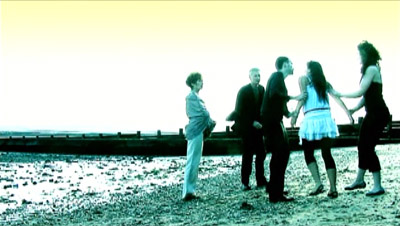
Oddly, the songs are not gender-translated like the rest of the play. "He is dead and gone" can now only mean Hamlet, because Ophelia has lost no father. Hamlet isn't dead, though they might have said that to comfort her. She might be talking about Hamlet Sr., as she is one of the people who seems able to see the Ghost when she's high on heroin. Fodor had a perfect excuse for Ophelia's madness even in his modern context, but he doesn't seem to use it here and the scene is the weaker for it. Polonia was Ophelia's pusher, and the girl could have been crashing hard at this point. However, the performance has none of that, and the way Ophelia recites the songs by rote, without inflection or inner discourse, doesn't work either as withdrawal OR madness.
Fodor suggests a number of dark happenings in both past and present, but they don't come together satisfyingly in this scene.
Tuesday, July 9, 2013
IV.v. Ophelia's Madness - Hamlet 2000

The King walks in with a bodyguard in tow and Ophelia gets more and more agitated. Not feeling like they're listening to her, she screams "Pray mark". Gertrude turns to the King for help, her smiles still trying to cover for the girl's antics. "When they ask you what it means", she tells the royals to convey not the original song, but an incredible scream that startles the guests (pictured above). The film translates her trauma differently than the play does, cutting out most of the "nonsense songs", replacing them with moments such as this, which we might call "nonsense sounds". What we lose in poetry we gain in visceral immediacy.
The rest of Ophelia's performance, including the warning about her brother, is given while being dragged away by the bodyguard, again keeping things moving. The scene's rather surprising punchline is that Laertes comes out of nowhere before the King can utter more than one line of the final speech, grabbing him by the throat. Ophelia's appearance was but the first volley in this "rebellion", played rather more personally in this version of the play, as we'll discuss when we tackle the next scene.
Saturday, July 6, 2013
IV.v. Ophelia's Madness - Kline '90

Venora really presents two Ophelias. The child who dreams of being Queen, who sees imaginary ladies-in-waiting (in lines which, on the stage, might well be directed at audience members), sings and dances and passes notes (what is the significance of the crumpled piece of paper she gives Gertrude? An old love letter? Is this a corruption of the scene in which Polonius reads on to the royals?). The other Ophelia is the traumatized, grieving daughter who scratches at the floorboards (where the audience knows ghosts live), rhymes rather than sings, moans and beats her chest. They don't co-exist. When she moves from orphan to child at one point, she realizes her face is wet with tears and starts wiping it, as puzzled as she is ashamed. Ophelia is out of joint.
Sunday, June 30, 2013
IV.v. Ophelia's Madness - Zeffirelli '90

Here they meet on the giant steps, where Ophelia's songs are more about her father's death. They come off as accusations and always end dissonantly, prettiness turning to hardness as she comes upon the Queen. A chase ensues as Gertrude tries to escape the girl, but Ophelia is quicker and manages to catch up to her, fingers the crucifix the Queen was piously fingering earlier. In fact, she chases the Queen right into Claudius' arms. The baker's daughter comment is clearly leveled at Gertrude, a warning to the King that his wife may not be what she seems. Is Ophelia then siding the the murderous King? Why wouldn't she? Her father was slain in the company of the Queen and Hamlet. She seems to suspect Gertrude had a hand in it. Strictly speaking, she's wrong about that, but the warning should not have fallen on such deaf ears regardless. Without knowing it, Ophelia has warned Claudius that Gertrude's allegiance is now with Hamlet, though that remains in dispute. Gertrude running for Claudius' protection in this scene would seem to say she's too weak a person to reject her King. She may well land wherever her position is strongest. We don't know what she may be either.
Believe it or not, these are her moments of lucidity. Ophelia's words are interrupted by painful memories that bring her to the ground. Horatio and some sad guardsman surround her, ready to take her into custody. The sudden realization that her brother will know of it makes her smile and grow manic. This is a departure from other performances of the role we've looked at, but completely justified. Though the occasion is tragic, Laertes is all she has left and his return is to be celebrated. She kisses the Queen's hands, offers the King her own to kiss, and off she goes through the castle. With the dilated timeline (rebels are not at the gates), Elsinore is still full of people, there to witness Ophelia's madness. The "sweet ladies" actually exist, and some nuns do run off after her to help, along with Horatio who finds her wailing and clutching at a wall, and who takes her up in his arms. Gertrude walks off sobbing, leaving Claudius to his thoughts.
Time lapses still, with cutaways to Hamlet at sea (we'll return to this in due course), before Laertes' arrival at some later point.
Sunday, June 23, 2013
IV.v. Ophelia's Madness - BBC '80

Enter Claudius, and here Ophelia's attitude is much different, taking the Queen's role by caressing his beard, singing the Valentine's Day song seductively, and grinding the uncomfortable King. Again, there's emotional transference at work, with Claudius becoming Hamlet for those few seconds. A past Hamlet, when the lovers were together. A future Hamlet who would have become King. Ophelia is trapped in a jealous love triangle from a projected (and now aborted) future. The identities of Claudius as Hamlet, and the Queen as rival are delusions just like the invisible coach and ladies. When Ophelia breaks from this fantasy, it's to weep, or to rage. "My brother shall know of it" is particularly fierce and a violent announcement of what is to come.
In Claudius' ensuing speech, he explains why Gertrude should fear just as he does, a deft manipulation to make her hold on to him harder. We know not what she may be, this baker's daughter, true to her husband, or true to her son? Like Ophelia, her changeability is tied to the men who dominate her.
Sunday, June 16, 2013
IV.v. Ophelia's Madness - Olivier '48


More insolence: She won't endure the Queen's consoling. Every time Gertrude attempts it, Ophelia starts on a song (and Simmons has a beautiful singing voice), even moves away. This is even more true once Claudius happens on the scene. She won't let him touch her. There's a sense that, consciously or not, she knows who's responsible for all their sorrows. She moves between smiles and tears, silliness and wisdom, girl and woman, and though the dirtiest song isn't used, there is a moment of sexuality as yet unseen in the character when she lets Horatio help her up. She notices him as a young woman would a handsome gallant, flushed by his touch.
Gertrude flees Claudius' touch too, mind. Hamlet's parting words have had an effect on her, though she hides it in distracted sadness. Claudius, sensing she's slipping out of his control, embraces her from behind and visibly frustrated, lays a manipulative speech on her. He talks about OUR son and threats to OUR own person, physically showing they are, as Hamlet had said, "one flesh". In other words, "we're in this together, baby". If his regime falls, she falls with it, and better behave like the Queen he needs her to be, obedient at his side. It's not often discussed, but one of the great evils perpetrated by this corrupt Denmark is how it uses women for its own ends. It has broken Ophelia and will undo Gertrude, the puppet queen as well.
Sunday, June 9, 2013
IV.v. Ophelia's Madness - Branagh '96

The better to prepare us for the next shot: Ophelia in a padded cell, being observed through a grate from above, straight-jacketed and wearing a gray cap, a creature more like the Tempest's Caliban than the lovely girl we met earlier in the play. She's ramming into each wall like a trapped animal. Gertrude's attitude then isn't annoyance, but fear. Caught between Horatio and the doctor (a black, female doctor, in line with Branagh's other anachronistic casting choices) who share the unnamed Gentleman's lines, she eventually relents and agrees to see Ophelia. Cut to the shot above, Ophelia all trussed up on her stomach, an inch worm asking to see the Queen. It's at once funny and pathetic, but also harks back to Hamlet's worm metaphor and to the abuse historically suffered by the mentally ill. In other versions and other Shakespeare plays, mad characters seem to have free reign of the locations, enjoying a sort of immunity to reprisal, perhaps through the mystical notion that madmen speak poetic truth. Often, these characters are allowed to rant and speak to power with insolence, without interruption (the mad queen in Richard III is another example). Madness makes people uncomfortable, unsure of what to say. We should note how differently mad Ophelia is being treated compared to mad Hamlet. Is this the effect of class or gender? Probably both.
The cell, you'll notice, is right adjacent to the throne room. As it's unlikely this is a normal feature of Elsinore, we might see it as a sign of changing times. Used to be the King and Queen were constantly attended, the Hall of Mirrors full of courtiers, but with Hamlet in exile, rumors abound and revolution brews. Claudius' Elsinore, like his Denmark, is changing. It's probably not safe to let the Prime Minister's mad daughter leave the castle, or even let it be known she's gone insane (it's a surprise to Laertes later). So a makeshift padded cell has been built into one of the secret compartments so she can be treated at home. This is an isolated Elsinore where visitors are no longer welcome. Halls made to look big and empty in wide shots. The Royals are small and vulnerable in their marble cocoon.
Before Ophelia can rant, she must be free, and Gertrude does her this kindness, untying her sleeves in an effort to comfort her. The rant takes the form of songs (many of them ribald), but that's probably the only things she knows. A young girl in a royal court wouldn't be trained in any useful skill. Her life would be songs and the meaning of flowers, skills to charm and impress a father and husband. That's all she has to try and express the inexpressible. Claudius comes in during one of the songs and tries to help her up, and the dynamic changes. Not that Ophelia can tell he's responsible (though she does throw the owl line at him), but he's a man, and men have been her undoing. At the mention of her father, she screams and stumbles off, and even the camera is kept at bay, suddenly uncertain and shaky. From Ophelia's point of view too, other characters seem far away. A distance in understanding. When she approaches them again, it's to rudely bump Claudius on the word "cock", and to disturbingly reenact her "tumbling" on the floor (with unnecessary but pointed flashbacks of Hamlet in bed with her).
In the middle of this, a moment of lucidity (from "I hope all will be well") and a realization that her brother will be coming. This moment is covered in a close-up of Ophelia, for the moment coming into focus, her cheeks and eyes ruined by too many tears. Her mind is broken, but she's still in there, and through those lines that are not "nonsense songs", we discover a certain self-awareness, one that she's trying to escape from. The metaphor echoes into reality as she struggles not to be tied up again, refusing Claudius' touch, avoiding him as she defiantly calls for her coach and runs off with Horatio and the doctor after her.
Saturday, June 1, 2013
IV.v. Ophelia's Madness - Slings & Arrows

One of the subplots of the show around the play focuses on the character of Claire (Sabrina Grdevich), a talentless brown-noser the play's director, Geoffrey Tennant (Paul Gross), has inherited. In rehearsals, she's going on sense memory to simulate Ophelia's madness, reenacting what it's like to be stoned because she surmises that it's the same thing. So it's a whole lot of staggering about, mouth open, twirling... After all, there's nothing Claire can take from the text. Ophelia is just singing nonsense songs.

"Ophelia is a child. She has been dominated by powerful men all of her life and suddenly they all disappear. Her brother goes to France. Her father is murdered by her boyfriend. And he is shipped off to England. She is alone for the first time, grieving and heartbroken and guilty because, as far as she's concerned, it's all her fault. She ignored her brother's advice and fell in love with Hamlet and now, her father is dead, all because of her. And the pain, and the loss, and the shame, and the guilt, all of this is gnawing away inside that little child's mind, and it comes out as little... songs. 'And will he not come again? And will he not come again? No, no, he is dead.' My father is dead and I killed him."
This is dead on, and hearing the quote he uses spoken by a man, reveals how the songs also relate to Hamlet's own situation. He too has gone mad from losing a father (or three, if we count surrogate Yorrick and stay-at-home uncle who betrayed his trust Claudius), and Geoffrey makes us feel that loss and how guilt played a part in his own bout of madness. We almost intuit what his own legendary Hamlet was like.
Thankfully, something happens to Claire and understudy Kate (Rachel McAdams) must take over for her. Her performance as Ophelia, make-up dripping, voice shaking and breaking, even gets to Claire, who bitterly wipes a tear away in the audience. Ellen (Martha Burns) playing Gertrude is also visibly affected, another case of seeing the actress behind the role, not expecting that level of emotion. It makes me realize how important Gertrude's reaction to Ophelia is in this scene. In the text, she isn't particularly kind to her. She doesn't even want to deal with her at the moment. But if she lets herself be touched by this moment, or if she visibly doesn't, it changes how we might understand Gertrude's later narration of Ophelia's final moments. On one end of the scale, deep empathy, on the other, the sense she might have played a sinister. part in those events.
Subscribe to:
Posts (Atom)