Saturday, May 25, 2013

IV.v. Ophelia's Madness

Scene 5 can be split into two sequences, Ophelia's descent into madness and Laertes' return (though the latter eventually dovetails into the former), so we'll take them separately. Scene 5 is the scene by which we judge all Ophelias and indeed, it is her last. She thereafter only appears in the story of her suicide as told by Gertrude, though of course, films often show us something of that action. Though the difficulty for the actress is obvious, there's also a difficulty for the director because Ophelia's madness manifests as snippets of old folk tunes. What melodies does one use, and how do these change the way we understand and interpret the songs? Before addressing the relevant performances, let's look at the text itself. As usual, the Bard is in italics, and my comments break through unitalicized.

SCENE V. Elsinore. A room in the castle.
Enter QUEEN GERTRUDE, HORATIO, and a Gentleman

QUEEN GERTRUDE: I will not speak with her.


Some time has passed since Polonius' death and Hamlet's exile, enough that the Queen doesn't want to deal with Ophelia anymore. This line is often forgotten because Gertrude does indeed go on to see Ophelia, but it is nonetheless there. Is the Queen annoyed, tired or afraid? That's up to each actress, but there is cause for any or all those feelings.

GENTLEMAN: She is importunate, indeed distract:
Her mood will needs be pitied.
QUEEN GERTRUDE: What would she have?
GENTLEMAN: She speaks much of her father; says she hears
There's tricks i' the world; and hems, and beats her heart;
Spurns enviously at straws; speaks things in doubt,
That carry but half sense: her speech is nothing,
Yet the unshaped use of it doth move
The hearers to collection; they aim at it,
And botch the words up fit to their own thoughts;
Which, as her winks, and nods, and gestures yield them,
Indeed would make one think there might be thought,
Though nothing sure, yet much unhappily.


There is, in the Gentleman's speech, the mirror of how an audience can, should and does infer meaning in poetry (and in Shakespeare's plays themselves). Ophelia's speech is "nothing", meaningless, and yet the human mind cannot but try to give meaning to it. This is a wonderful preamble to a scene where the audience (and the characters in the scene) are asked to do just that. We will look for poetical meaning, what Ophelia feels about her lover killing her father, but the King and Queen may be looking for something else - Ophelia leaking the very information they tried to keep quiet by sending Hamlet away, or else implying the Royals had something to do with it (something gets back to Laertes, who has that distinct impression when he returns to Elsinore). In fact, Horatio seems to be of the same bent.

HORATIO: 'Twere good she were spoken with; for she may strew
Dangerous conjectures in ill-breeding minds.


Now, I find Horatio's presence very odd. Hamlet is off and away, but he has stayed at Elsinore. Furthermore, he's here thinking about the Royals' PR. That's behavior you'd expect from Rosencrantz&Guildenstern! Since he later receives word from Hamlet, the simplest explanation is that he's under orders from the Prince to stick around, perhaps to take care of Ophelia, certainly to keep an eye on Claudius. Still, ingratiating himself into the Court might speak to a more self-serving agenda, one that finds its fullest expression at the very end when he is left to tell the story. His interest in "spin" in this very line might very well mean he'll embellish or change some details...

QUEEN GERTRUDE: Let her come in.

Exit HORATIO

To my sick soul, as sin's true nature is,
Each toy seems prologue to some great amiss:
So full of artless jealousy is guilt,
It spills itself in fearing to be spilt.

Re-enter HORATIO, with OPHELIA

OPHELIA: Where is the beauteous majesty of Denmark?
QUEEN GERTRUDE: How now, Ophelia!

OPHELIA [Sings]: How should I your true love know
From another one?
By his cockle hat and staff,
And his sandal shoon.


Knowing true love from false seems a pretty obvious reference to Hamlet's betrayal. Gertrude's a bit dense, in denial, or looking for confirmation in her next line:

QUEEN GERTRUDE: Alas, sweet lady, what imports this song?
OPHELIA: Say you? nay, pray you, mark.
[Sings] He is dead and gone, lady,
He is dead and gone;
At his head a grass-green turf,
At his heels a stone.


This one is about her father, clearly, and in the next interrupted line from the song, she sees him in a white shroud. It's a symbol of purity that implies her father wasn't guilty of anything, nor deserving of his fate. It seems the fault all lies on Hamlet's shoulders.

QUEEN GERTRUDE: Nay, but, Ophelia,--
OPHELIA: Pray you, mark.
[Sings] White his shroud as the mountain snow,--

Enter KING CLAUDIUS

QUEEN GERTRUDE: Alas, look here, my lord.
OPHELIA: [Sings] Larded with sweet flowers
Which bewept to the grave did go
With true-love showers.


Note the connection made between the flowers on her father's grave and those she will hand out in the next sequence, and the garlands that are part of her death scene.

KING CLAUDIUS: How do you, pretty lady?
OPHELIA: Well, God 'ild you! They say the owl was a baker's daughter. Lord, we know what we are, but know not what we may be. God be at your table!


There is a strange legend about a baker's daughter who was transformed into an owl after being stingy to Jesus Christ, which is what Ophelia refers to. It's possible Ophelia blames herself for her father's death (after all, it was his theory that she was the cause of Hamlet's madness), so this allusion of transformation is appropriate. Tragic or extreme events can unlock our true form, just as these have unlocked her madness. More dangerously, she might be implying the King has yet to show his true colors.

KING CLAUDIUS: Conceit upon her father.
OPHELIA: Pray you, let's have no words of this; but when they ask you what it means, say you this:
[Sings] To-morrow is Saint Valentine's day,
All in the morning betime,
And I a maid at your window,
To be your Valentine.
Then up he rose, and donn'd his clothes,
And dupp'd the chamber-door;
Let in the maid, that out a maid
Never departed more.


An indication that Hamlet took her maidenhead. She's a maid (a virgin) in the first half of the song, and in the second, her lover is rising from the bed and putting his clothes on, and she leaves, no longer a maid. If staging it so that Ophelia and Hamlet never consummated their relationship, Ophelia could instead be referring to a loss of innocence caused by her father's murder, or else visualizing a reality that might have been had the events of the play not occurred. The next song, however, pretty much seals the deal.

KING CLAUDIUS: Pretty Ophelia!
OPHELIA: Indeed, la, without an oath, I'll make an end on't:
[Sings] By Gis and by Saint Charity,
Alack, and fie for shame!
Young men will do't, if they come to't;
By cock, they are to blame.
Quoth she, before you tumbled me,
You promised me to wed.
So would I ha' done, by yonder sun,
An thou hadst not come to my bed.


The meaning is fairly clear. Hamlet has already made love to her on the pretext that he would marry her later anyway. Events prevented the latter from happening, so Ophelia is doubly betrayed, both as a daughter and as a (potential) wife.

KING CLAUDIUS: How long hath she been thus?
OPHELIA: I hope all will be well. We must be patient: but I cannot choose but weep, to think they should lay him i' the cold ground. My brother shall know of it: and so I thank you for your good counsel. Come, my coach! Good night, ladies; good night, sweet ladies; good night, good night.

Exit

KING CLAUDIUS: Follow her close; give her good watch,
I pray you.

Exit HORATIO

O, this is the poison of deep grief; it springs
All from her father's death. O Gertrude, Gertrude,


There are too many references to Hamlet in Ophelia's songs for her father's death to be the only cause of her distress. It's actually quite amusing that Polonius spent the better part of the play insisting Hamlet's madness was due to neglected love, while in truth, it was his father's murder that pushed him over the edge. Now, Ophelia's mad and it's Claudius insisting the complete opposite. He thinks her father's murder is to blame, but it may well be that neglected love is the more potent reason behind Ophelia's tears.

When sorrows come, they come not single spies
But in battalions. First, her father slain:


Foreshadowing Fortinbras' attack, possibly? While the King is distracted by single threats like Hamlet (still a threat because his exile has caused the populace to whisper rumors) and Laertes (whose ear these rumors have reached), he misses the bigger danger completely.

Next, your son gone; and he most violent author
Of his own just remove: the people muddied,
Thick and unwholesome in their thoughts and whispers,
For good Polonius' death; and we have done but greenly,
In hugger-mugger to inter him: poor Ophelia
Divided from herself and her fair judgment,
Without the which we are pictures, or mere beasts:
Last, and as much containing as all these,
Her brother is in secret come from France;
Feeds on his wonder, keeps himself in clouds,
And wants not buzzers to infect his ear
With pestilent speeches of his father's death;
Wherein necessity, of matter beggar'd,
Will nothing stick our person to arraign
In ear and ear. O my dear Gertrude, this,
Like to a murdering-piece, in many places
Gives me superfluous death.


Here we should address the idea of putting poison in one's ear, which was Claudius' method for murdering Hamlet Sr., and the poetic justice of the King being threatened by metaphorical poison poured in Danish ears. Because the truth of Polonius' death could not be revealed, Claudius fears the rumors (poison) has reached Laertes and may fuel a rebellion. Claudius uses the word "ear" again and again as his anxiety mounts, a sort of veiled confession only we can decode.

Sunday, May 19, 2013

Other Hamlets: Kill Shakespeare

What happened to Hamlet on his way to England? The play tells us through a letter to Horatio, but writers Conor McCreery and Anthony Del Col, along with artist Andy Belanger, have a different idea. In the 12-issue comics series Kill Shakespeare, they basically use Hamlet's exile as a launching pad for a story in which Hamlet finds his way to the shores of a fable-land where all of Shakespeare's creations co-exist. A prophecy proclaims him the "shadow king" that must one day find the lost creator, William Shakespeare, and two factions try to lay claim to him. On one side, Richard III, Lady MacBeth and Iago, on the other, Falstaff, Juliet and Othello. The first wants to kill Shakespeare and steal his power over creation, the other to convince Will to rid the land of evil.

It's a fun exercise, more approachable than League of Extraordinary Gentlemen, though more contained than Fables, its two most obvious antecedents. McCreery and Del Col make a lot of references to the Shakespearean canon, not just with the characters, but in tropes (there's a play, cross-dressing, a tempest on the horizon), details (place names are in-jokes, Hamlet and Juliet speak through a chink in a wall, some of the action takes place on Twelfth Night), and dialog (many lines are referenced). It certainly keeps readers who know their Shakespeare interested. But they also don't mind fiddling with the stories so they can interact regardless of their fates in the original plays.

Of course, we're here to talk about Hamlet specifically, and there are some interesting changes made to his particular tale that can inform a new staging of the play. Elsinore is translated as Helsingor, and its king dies a month ago. Since then, Hamlet's mother has wed the king's brother and events have quickly spun out of control. Hamlet, believing he is killing Claudius on behalf of his ghostly father, accidentally murders Polonius...
The writers make certain choices that change the tenor of the play. For one thing, it takes three days for Hamlet to admit his crime and return the body to Polonius' family. You shall indeed "nose him". Second, this weighs far more heavily on Hamlet than in the play, and his exile is more or less voluntary. Though Claudius officially sends him away and decrees he shall never return on pain of death, Hamlet's guilt is a major motivator. As he prepares to leave, he says goodbye to his father's tomb and feels as if he's been set free. This is not the Hamlet whose thoughts are bloody, so the comic becomes his journey to his eventual return, changed and ready, to Denmark's shores. In fact, when he is visited by other spirits (attempting to draw him to the land of Shakespeare), he protests again and again that he is no killer.

An important difference in the comic is that Rosencrantz & Guildenstern are Hamlet's true friends.
They expose Claudius' plot and suggest Hamlet raise an army to regain his throne. But Hamlet accepts his punishment for the murder of Polonius and finds himself unworthy of the Danish crown. If there is a parallel with Act IV Scene 4, it's that Rosencrantz shows Hamlet how to make a difficult choice by betraying Claudius. But fate (or rather, the forces who want to control the "shadow king") intervene and leads pirates to Hamlet's ship. His friends are killed in the melee and he is cast away on alien shores. This is all part of issue 1's introduction, and from there the story proceeds apace.

Issue 7 is another important issue for Hamlet scholars. A dark troupe of players throw Hamlet on the stage in an effort to manipulate him and force him to play a part in The Murder of Gonzago. It's not clear if he also had the play presented before the Royal couple before killing Polonius, but he presumably did. He plays the role of the assassin, forcing him to connect his own murder with that of Claudius. Up to this point, Hamlet has been unwilling to accept his destiny, a mirror of his reticence to do the same in Helsingor, so forces are pushing him to confront his demons. He runs into a Hall of Mirrors where he does just that.
There he confesses his murder to Juliet, a five-fold crime in his eyes because it struck more than just Polonius. Ophelia and Laertes lost a father, Gertrude lost a son (he believes Gertrude now sees him as an abomination), and Hamlet is the last victim, having forsaken his own self as penance. He also explores his feeling towards his father, a cold and distance man of violence who was so paranoid as to wage war on all his neighbors until only internal threats were left, a man suspicious of his brother, yes, but also of his own son. Hamlet Sr. is painted as a Richard III, someone who might well have done away with Claudius and Hamlet if he feared, rightly or wrongly, they coveted the throne. Did Claudius only kill his brother in preventative self defense? Or is Hamlet only justifying, once again, why he hasn't killed Claudius in his father's name? Hamlet comes out of the experience ready to be a hero, but no to go back home.

The idea that Hamlet is the only character that can find Shakespeare is a perfectly legitimate one, even an obvious one. He is the character that perhaps most escaped his author's control. Hamlet's delays in the play are an overt attempt to stymie the play's inevitable tragedy. Hamlet does not want to die and forces his author to keep him alive and interesting. When we finally encounter Will in the final act, he admits to having given his characters free will, a Judeo-Christian allegory sure, but also commentary on how alive his characters seem. After his first few plays, imitating the "cartoons" of Christopher Marlowe, Shakespeare found a way to make his characters truly life-like, able to hear themselves speak and change in response to their own thoughts. In the world of Kill Shakespeare, it's caused a civil war, strife in the land at the hands of the more evil characters, but also the chance for redemption.

Though the series ends at issue 12, Hamlet does not return to Helsingor. Not yet. A new series, subtitled The Tide of Blood, has since begun publishing, continuing Hamlet's story. We shall have to return to this book again one day...

Saturday, May 11, 2013

Act IV, Scene 4 - Classics Illustrated

The original adaptation omits this scene entirely, but the Berkley version doesn't, though by staging the action just as Hamlet's party leaves Elsinore does have a variety of effects.
First, it puts Fortinbras' army very close to the Danish throne, and reinforces the idea that Claudius is a fool to trust Norway. We're looking at a huge army within a stone's throw of what looks like a largely undefended castle, overgrown with weeds and surrounded by crumbling walls. Denmark is on the wane, and artist Tom Mandrake represents this visually. Another change is that the Captain's lines seem to have been given to one of Hamlet's guards, which justifies the cursory information given when you cut most of the Captain's lines.
Removing the Captain's lines about the futility of this particular battle means Hamlet's condemnation of it as a "trick of fame" is really a condemnation of all war. He doesn't need to know the details of the Norway-Poland engagement to know many men will die and for what? Their leader's glory and some patch of land? This tells us something about Hamlet's relationship to his father, reputedly a great warrior. He's an academic and as the play has made clear to date, a man more of words than actions. He sees something of his father in Fortinbras, and that compels him to finally act, but he's also critical of the type of action. Even in a speech about finally committing to action, there is still a resistance, an attempt to justify why HE might act when others' violence is so distasteful to him. To become one's father, or to forge one's own way, is in many ways Hamlet's dilemma.

Mandrake's active pose in the last panel does a good job of visually representing that leap into a new mode of being for our Prince.

Sunday, May 5, 2013

Act IV, Scene 4 - The Banquet

The Banquet (sold in America as Legend of the Black Scorpion) must be the only version of Hamlet that includes snow ninjas. While the story is often very different from the play's, the Prince's exile definitely evokes Hamlet's own, as he is escorted on horseback through a snowy plain. As in the play, he spies an army from afar, and it is a mirror of himself on that other road. No Fortinbras, but a fake Prince who will act as tribute to the country standing in for England while he is assassinated by his own escort, here, now. In other words, what if Claudius, Rosencrantz & Guildenstern were far more treacherous than they appeared? The Prince is rescued by the timely intervention of, yes, snow ninjas burrowing from beneath and killing the murderous escort with their crossbows. It is a wuxia film, after all.

The rescue party is led by the Laertes figure working on the orders of the Queen who, more villainous in this story than in the play, is holding his sister hostage. He is also ordered to then tell the King that the entire party was silenced, escort and all. This "Laertes" has no real love for "Hamlet" and in a scene that takes the place of the IV.4 soliloquy, he dares tell the Prince his course for revenge will cost many lives before it is over, and that he puts "Ophelia", "Polonius", everyone in danger so long as political machinations continue to center upon him. Better everyone believe he is dead. For the Prince, this acts as a wake-up call, that his readiness to die should not be his readiness that the people he loves die. When he returns, in spite of Laertes' admonitions, it will be to end it once and for all, but it will be too late for many of the characters.

What I find very interesting about these important changes made to the story is that they don't in any way diminish the drama, but rather give viable alternatives to the events and motivations found in the play. When one isn't tied down to the text (and a Chinese version - or any translation - wouldn't be), one can better experiment with the Bard's structure. It may even be possible to do it within the confines of the text as written. Imagine a Laertes who colludes with Hamlet during his exile. A Laertes that returns to Denmark to cause trouble and prepare the way for Hamlet, possibly depose Claudius in his name. One who believes Claudius responsible for Polonius' death (has Hamlet lied to him?). But it all goes wrong when Claudius denies the charges, when Ophelia walks in completely mad, and when finally, she commits suicide. Hamlet returns to find Ophelia dead and Laertes a surprise enemy. It could give the Hamlet/Laertes relationship an additional layer of complexity.

Saturday, May 4, 2013

Act IV, Scene 4 - Slings & Arrows

In the play inside the show, Luke Kirby's Jack Crew is getting into the "home stretch", as this is the last of six soliloquies. What we see of it in the montage is a simple close-up, but it shows how Jack, an insecure Hollywood actor, has become much more confident by this point in the performance, which can also be said of Hamlet. Meta-textually, one might very well see how the actor on stage would get an energy boost from knowing his exile (long-over due break) was coming next. The story structure must play into the mood of the actor.

But that's not the only meta-textual trick Slings & Arrows plays on its audience. As Jack/Hamlet speaks his words, his director Geoffrey is reminded to get his mentor's skull for the Yorick scene, and has to make a mad dash for it. As he does, we stay in touch with Hamlet through the backstage P.A. system, and the mention of a "delicate and tender prince" seems to give Geoffrey that association. If Fortinbras is a mirror held up to Hamlet, and Hamlet is an actor/director, taking on various roles and instructing the Players on how to act, can Fortinbras be any different? And in that context, the futile enterprise, the "egg shell", of his war with Poland IS, in a sense, the act of putting on a play. So much goes into the endeavor, and yet, each performance is ephemeral.

The juxtaposition made here makes Hamlet chide himself for not giving his all when the actor who plays him obviously is. He is himself the First Player, able to conjure emotions out of thin air for a world imaginary. Hamlet keeps breaking the fourth wall and running into itself.

Sunday, April 28, 2013

Act IV, Scene 4 - Hamlet 2000

You'd think this modern adaptation, with countries represented as corporations, would cut Fortinbras' "powers" and this scene altogether. You'd be wrong. Instead of a snowy plain, we're on an airplane. Rosencrantz & Guildenstern are sniggering, reading Wired and eating peanuts in the aisle opposite Hamlet who is watching in-flight television and looking at postcards that symbolically represent his exile. A plane taking off, a nude painting, a stone mask. We're heading back in time, to parts unknown, to Hamlet's reptile brain, and away from the civilization and intellectualism that has plagued him to date. On the television is Fortinbras, or so a flight attendant says when Hamlet asks. At least, he looks like a flight attendant, until he puts the drink he's holding to his mouth. Is he then just an officer of some kind? In the play, it's Fortinbras' captain, but here, is he the plane's captain? If so, he shouldn't drinking or walking around the craft. It's an odd moment. If I were to give it purpose, I'd say it's a representation of Norway usurping Hamlet's Danish power. A steward approaches with a drink, but then doesn't give it to the passenger and drinks it himself. It foreshadows' Fortinbras' corporate takeover. Not that this is is any way clear.

One thing that is missing from the exchange is the idea that soldiers are about to die for a useless cause in Poland. Because we know the play, we might infer it ourselves. Fortinbras dismantles a Polish company for no other reason "than the name", costing untold numbers their jobs. But there's no way to show this with Shakespeare's text, so Hamlet's exhorting examples don't have anything to do with Fortinbras' war. This Hamlet lives in the modern world and is surrounded by "examples gross in nature", many of which he's used in his art films. We accept his growing determination without it needing a trigger. The staging is crucial. Hamlet heads for the bathroom at the other end of the plane, speaking his soliloquy as he walks down the aisle, an echo of "To be or not to be" in Blockbuster's aisles. This forces him to walk through economy class - largely empty, a sign of severe class divide? - and sees a woman holding a baby. The examples before him, though different than in the play, may still cause his personal call to arms. Seeing other children and other parents only reinforces the unnaturalness his own family relationships.
The plane seems incredibly long, and the dramatic vanishing point behind Hamlet makes him akin to a bullet in a cannon, about to be fired. In the bathroom, he speaks to himself in the mirror, gives himself a mission. Has he become the Ghost himself? He dares himself to act, nose to nose with his reflection, and he will take that dare.

Sunday, April 21, 2013

Act IV, Scene 4 - Kline '90

Three things distinguish Kevin Kline's staging/acting of the scene from the other performances studied at Hyperion to a Satyr. First, proximity. This sticking quite close to the way they did it on stage, Hamlet is only a few few away from a young, dashing Fortinbras who has just walked off-screen/stage after giving his orders. Norway's army might be only 40 feet before Hamlet, and the drumbeat to which it walks is heard through the entire scene, practical music that spurs Hamlet on. In a sense, he becomes the army, though his cause is his alone.

The second difference is the sense of suspicion surrounding Hamlet. The Captain makes a face when Hamlet asks him about the army, as if deciding what exactly he will tell him. Is this a sign that the entire Polish campaign is a lie? Doubtful, as he gives too many details. Or perhaps it's all part of a cover story, since obviously, people (including Claudius) might question why Norway attacks this useless piece of land. And the Captain isn't just an officer, he's an ambassador, trusted to deliver a message to the Danish King. He could be skilled in the art of diplomatic deception. If Hamlet is lied to, it creates a layer of irony. Fortinbras, doubling back to attack Elsinore, is at once on the same mission he is - dethroning/killing Claudius - and mimicking Claudius' own actions - usurping Hamlet's rightful place on the throne. Claudius is the alternative to Hamlet Sr., and Fortinbras the alternative for Hamlet Jr. Rosencrantz & Guildenstern also treat Hamlet with suspicion, taking a long time to go "a little before", as if fearing Hamlet might escape their custody. This possibility is made entirely more possible by the army's proximity. He might easily lose himself in the crowd. But as usual, they get it wrong.

The third major difference in the performance is that tears stream down Hamlet's face during his speech. Kline's Hamlet is a rather weepy one, but why here? The scene is done mostly in tight close-up with a bitter Hamlet, getting louder only later as his anger and determination grow. But is he crying for the men who will lose their lives, for the Ghost of his father still trapped in limbo, or because he's disappointed in himself?

Saturday, April 13, 2013

Act IV, Scene 4 - BBC '80

Though the studio-bound production is spare in its scope - the white plain a set, and Fortinbras' army a small collection of extras, reproducing the feel of a staged play - the scene is still well set, with flags and sound effects that evoke an army on a war-footing. A fairly soft war-footing, as it turns out. As part of the staging, Fortinbras' last line, "Go softly on", isn't spoken to the Captain, but to another soldier staying with the main of the army as if to evoke a sense of stealthy movement to Fortinbras' troops. They're asking for permission, but perhaps Claudius doesn't know exactly where the army is going, or how many men it represents. Fortinbras is hiding something.

The conversation between Hamlet and the Captain features some of the rare cuts in this adaptation of the play. The Danish Prince doesn't ask as many questions and doesn't react out loud to the futility of this war. Sending Rosencrantz & Guildenstern ahead, he turns to the camera/audience, as usual, to speak his soliloquy in quiet and intimate terms. The contrast with Branagh's bombastic call to arms is striking. Jacobi's Hamlet is bitter and rueful, at once angry and sad that he hasn't yet been able to take revenge and lay his father's ghost to rest. Where Branagh motivated his army of one, Jacobi explains and reasons, until only one conclusion can be drawn from it. His thoughts are now "bloody" as he looks over to R&G, an implied threat, and one the camera lingers on. We are slow to exit the scene and are meant to understand that these two men, Hamlet's untrustworthy escort, are to become his first victims. And there's a certain sadness in Hamlet that it must be so.

Sunday, April 7, 2013

Act IV, Scene 4 - Branagh '96

The frozen lake near Elsinore dissolves into a frozen waste between Denmark's mountains, where figures on horseback appear from out of the mist. This is Fortinbras, followed by his Captain, on their way to Poland. Fortinbras, the so-called "tender and delicate prince" seems more like a jaded sociopath, with his cold, insincere eyes, and his Captain is so curt in his line deliveries, we might well believe he does not like his Prince, just as he does not like his plans. If Fortinbras notices, he does not care. Wide shots reveal a large marching army, and it's from a certain vantage point that Hamlet will meet the Captain and be able to survey the military force walking through his country. The way these shots are designed already evoke Hamlet's exile, small figures in panoramic, white landscapes, and the image will be taken to its extreme in the end.

Hamlet isn't grilling the Captain in this version, rather more puzzled than irate (except with Rosencrantz & Guildenstern, flies buzzing at his ears), and he introspectively realizes that wealth and peace breed war by making men like Fortinbras restless to the point of launching capricious forays into other nations in search of glory. When we compare the two princes, we might see Hamlet as a man so preoccupied that he cannot choose the right course of action, whereas Fortinbras lacks any kind of preoccupation, and so must spring into action, ANY action, to chase the doldrums away.
In a presentational twist, Hamlet speaks softly with the Captain, but as the music swells behind him and the camera tracks back and back and back, he operatically shouts his soliloquy as if delivering it to an army. And he is, an army of one. Himself. He is, at this moment, convincing himself to finally commit to action. There's an interesting discussion between Branagh and his producer in the director's commentary about why so many adaptations cut this speech, that many directors see it as redundant. Branagh makes the case that unlike Hamlet's other calls to action, this one is a cooler, more intellectual, assessment of why he must do what he must do, and that as such, it is a more auto-convincing argument. It's one thing to feel something, but another to understand the logic of it.

And of course, the dramatic presentation of the speech makes for a better act break - leading to an intermission/disc change in bloody red letters - than a more intimate moment might otherwise have been. The music is big, the words are large, but the man himself is rendered small in the shot, a single individual defiant before his destiny, affairs of state, and a hostile world, the backdrop against which this drama is played. It is Hamlet in scale with the universe of the play, so to speak, and in being smaller becomes bigger.

Sunday, March 31, 2013

Act IV, Scene 4

Despite its containing one of Hamlet's soliloquies, it's not uncommon to see this scene excised from any given adaptation. Obviously, those that remove Fortinbras entirely won't be able to justify Hamlet crossing paths with his army on his way to exile in England. And a director might legitimately ask if their adaptation needs another moment where Hamlet decides that NOW he must act. In many ways, this is a mirror of "O, what a rogue and peasant slave am I" (Act II, scene 2). There, he was shamed by the First Player whose ability to express a false passion was greater than his to express a true ambition. Here, Hamlet is shamed by Norway and Poland, who attack or defend a worthless patch of soil with more conviction and willful action than he went after his revenge. Fortinbras is, after all, Hamlet's opposite number, a princely man of action, perhaps far more like Hamlet Sr. than his scholarly son. In him, Hamlet finds a role model, and perhaps enough of the qualities he would like to see in himself to give the Norwegian prince his vote of confidence at the play's conclusion. But let's look at Shakespeare's text (in italics; my comments interrupting in normal script) before heading off into those adaptations that included the scene.

SCENE IV. A plain in Denmark.

Enter FORTINBRAS, a Captain, and Soldiers, marching
PRINCE FORTINBRAS: Go, captain, from me greet the Danish king;
Tell him that, by his licence, Fortinbras
Craves the conveyance of a promised march
Over his kingdom. You know the rendezvous.
If that his majesty would aught with us,
We shall express our duty in his eye;


There is perhaps an early clue to Fortinbras' treachery. Expressing his duty "in his eye" might be something done for appearances only, since his plan is to invade Denmark after the invasion of Poland. This is Fortinbras' first appearance on stage, and it doesn't tell us much, only recaps the deal he has with Claudius as per the wedding banquet scene. But that's the point. Fortinbras is a plain-spoken man who deals in facts and not abstractions. A doer, not a thinker. At least, not beyond the tactics of the day.

And let him know so.
CAPTAIN: I will do't, my lord.
PRINCE FORTINBRAS: Go softly on.

Exeunt FORTINBRAS and Soldiers
Enter HAMLET, ROSENCRANTZ, GUILDENSTERN, and others

HAMLET: Good sir, whose powers are these?
CAPTAIN: They are of Norway, sir.
HAMLET: How purposed, sir, I pray you?
CAPTAIN: Against some part of Poland.
HAMLET: Who commands them, sir?
CAPTAIN: The nephews to old Norway, Fortinbras.
HAMLET: Goes it against the main of Poland, sir,
Or for some frontier?


I'm not sure I've ever seen it played that way, but Hamlet's questions could indicate a certain suspicion as to Fortinbras' intent. After all, he's just discovered a foreign army on Danish soil. The Captain's candor and sincerity (he is like his master, just as Hamlet is a product of his own deceptive Court) relieve him of his suspicions, however, as Shakespeare offers a tidy satire on the absurdity of war from the soldiers' point of view.

CAPTAIN: Truly to speak, and with no addition,
We go to gain a little patch of ground
That hath in it no profit but the name.
To pay five ducats, five, I would not farm it;
Nor will it yield to Norway or the Pole
A ranker rate, should it be sold in fee.
HAMLET: Why, then the Polack never will defend it.
CAPTAIN: Yes, it is already garrison'd.
HAMLET: Two thousand souls and twenty thousand ducats
Will not debate the question of this straw:
This is the imposthume of much wealth and peace,
That inward breaks, and shows no cause without
Why the man dies. I humbly thank you, sir.
CAPTAIN: God be wi' you, sir.

Exit

ROSENCRANTZ: Wilt please you go, my lord?
HAMLET: I'll be with you straight go a little before.

Exeunt all except HAMLET

How all occasions do inform against me,
And spur my dull revenge! What is a man,
If his chief good and market of his time
Be but to sleep and feed? a beast, no more.


Hamlet invokes his earlier "quintessence of dust" speech, but where earlier he condemned humanity, here he condemns how men abuse other men and render their existence meaningless. He's turned a corner. Where before, he saw humanity as a futile state of being, now he accepts that humanity is not necessarily futile, but one must overthrow the chains of that futility. Relative to the cannon fodder before him, he has power enough to make his life (and death) count, and resolves to do so. He even admits God's gift of free will and thus rejects predestination and nihilism:

Sure, he that made us with such large discourse,
Looking before and after, gave us not
That capability and god-like reason
To fust in us unused. Now, whether it be
Bestial oblivion, or some craven scruple
Of thinking too precisely on the event,
A thought which, quarter'd, hath but one part wisdom
And ever three parts coward, I do not know
Why yet I live to say 'This thing's to do;'


Hamlet counts himself lucky to still be alive, but can't believe he still hasn't done what he set out to do. Hamlet looks into himself and does not know exactly why he's delayed. Blaming "bestial oblivion", i.e. having forgotten his mission and Claudius' deeds, may not seem possible on the surface of it, but his confusion between blaming Claudius and blaming Gertrude might be what he's referring to. The question he asks himself is whether emotion (the realm of the unthinking beast) or reason (thinking himself into inaction) was to blame, not that it makes a difference.

Sith I have cause and will and strength and means
To do't. Examples gross as earth exhort me:
Witness this army of such mass and charge
Led by a delicate and tender prince,
Whose spirit with divine ambition puff'd
Makes mouths at the invisible event,
Exposing what is mortal and unsure
To all that fortune, death and danger dare,
Even for an egg-shell. Rightly to be great
Is not to stir without great argument,
But greatly to find quarrel in a straw
When honour's at the stake. How stand I then,


His admiration for Fortinbras takes root here, admiration for his ability to take risks and action. He hasn't met Fortinbras, of course, so one might suspect Hamlet seeing a bit of himself in him. Certainly, he's the more tender and delicate prince. Psychologically, Hamlet is turning himself into a Fortinbras, readying himself for his eventual return.

That have a father kill'd, a mother stain'd,
Excitements of my reason and my blood,
And let all sleep? while, to my shame, I see
The imminent death of twenty thousand men,
That, for a fantasy and trick of fame,
Go to their graves like beds, fight for a plot
Whereon the numbers cannot try the cause,
Which is not tomb enough and continent
To hide the slain? O, from this time forth,
My thoughts be bloody, or be nothing worth!

Exit


Hamlet's tried to convince himself to take action before, but this is the one that takes. By the time we see him again, he'll have arranged two deaths and will be ready to kill more. There really is no going back, though ironically, he's leaving Denmark and will have to literally go back.

Sunday, March 24, 2013

Act IV, Scenes 1-3 - French Rock Opera

Strangely out of place on Disc 1 of the Johnny Hallyday's double-album, between Ophélie! Ô Folie! (Ophelia! Oh Madness!) and Je lis (I Read), is a song about the transmigration of kings through the guts of beggars. Its position seems to relate far more to Hamlet Sr. than it does Claudius, which isn't inappropriate, and resonates with the fishmonger and carrion references in the play as they relate to the song I Read, i.e. Hamlet's confrontation with Polonius. In any case, I held off discussing it until we reached the proper speech in the play. The tune itself is unremarkable, though as usual, Hallyday's songwriters have gone beyond Shakespeare's own metaphors and introduced their own images. We'll discuss them in due course, but first, the original French lyrics, and an ugly little English translation so we can all be on the same page. The song uses a lot of colloquial French, which, as a French-Canadian, aren't in my vernacular, so hopefully I did right by them.

L'asticot-roi
(Refrain:) Un roi tombe en asticot
La cause n’est pas entendue
L’asticot devient le roi
Et la danse continue

La charogne est bon fumier
Elle devient vite moissons
Et elle nourrit la nation
Les hommes, les veaux, les poissons
La charogne redevient roi

Le croquant, le va-nu-pieds
Le croqué claquant du bec
Qui fait des rêves de bifteck
Mais qui mange du pain sec
Fait pourtant festin de roi

(Refrain)

Quand le lion, roi des félins
Partage avec sa féline
Une gazelle, sa voisine
Pas un des deux n’imagine
Que le roi bouffe du roi

Quand un gros roi dit «j’ai faim»
Pas un cuisinier ne bouffe
Et le roi boit, le roi bouffe
Mais l’arête qui l’étouffe
Est aussi morceau de roi

(Refrain x2)

The Worm King
(Refrain:) A king becomes a worm
The cause is not heard
The worm becomes the king
And the dance continues

Carrion makes good compost
It soon becomes the harvest
And it feeds the nation
Men, calves, fish
The carrion becomes the king again

The yokel, the tramp
The chewed-up man with chattering teeth
Who dreams of beefsteaks
But eats dry bread
Still eats a king's feast

(Refrain)

When the lion, king of felines
Shares with its female
A gazelle, their neighbor
Neither of them imagines
That the king eats king

When a fat king says "I'm hungry"
Not a single cook eats
And the king drinks, the king eats
But the fishbone he chokes on
Is also a piece of king

(Refrain x2)

The song uses a number of eating-related words in some figurative sense, not all of which I was able to translate. For example, "yokel" is "croquant", which literally means "crunchy" or "biting". But you can see how the lyrics take the concept of a beggar eating the fish that ate the worm that fed of a king's rotting corpse and widens it. Hallyday links it to Denmark entire by having carrion enrich the soil that feeds the country and the next king. He also creates the image of a kingly lion devouring its "neighbor" (with its queen), unknowingly eating of its own kind. As with the image of the king's cooks going hungry while he chokes on food, we are presented with the king as parasite. Is this part of the original image? Not entirely, though the very idea of a nobleman (Hamlet) even mentioning his country's poor is a subtle indictment of the king's rule, a dramatic representation of the gap between Denmark's classes. Finally, we have the king choking on king, restoring the veiled threat Hamlet makes. Claudius will die because he committed regicide.

Thursday, March 14, 2013

Act IV, Scenes 1-3 - Classics Illustrated

The original
With no space to spare after that giant ghost visitation double-page splash, this three-scene sequence is reduced to a single panel, with a caption box explaining what happens and Claudius, finally alone, reveals his true agenda - the execution of Hamlet at England's hands. The original Classics Illustrated was nothing if not precipitous when it came to talking scenes. The single panel is more or less used as a punchline, a surprise twist that Hamlet has been sent to his death.

The Berkley version
In three panels, going from a claustrophobic close-up to an airy wide shot - perhaps representing how Claudius feels trapped by the situation, and freed by his decision - Tom Mandrake's Hamlet also reduces the sequence to a single moment. Once again, Hamlet has been caught offscreen, and no final confrontation between Prince and King is to be had on the page. Thrift, thrift, Horatio. Strangely, Rosencrantz & Guildenstern are allowed to stand there while Claudius pronounces his usually secret soliloquy. This makes them more obviously complicit in Hamlet's murder. They know the contents of the letters they carry and perhaps better deserve their deaths. Of course, part of this is the freeze-frame aspect of the comics form. A panel's action represents a single second, but the dialog takes far longer. Might R&G have left in between the two speech bubbles, and thus never heard the King's more private words? It's an ambiguity that wouldn't exist on the stage or on film.

Sunday, March 10, 2013

Act IV, Scenes 1-3 - Tennant (2009)

Scene 1
Patrick Stewart's Claudius is as ambiguous a figure as he is creepy in this sequence. Gertrude is startled out of her sobs by hands around her neck, a killer's hands, though it's of course meant to be a massage. Because we're experiencing the scene through her, the camera focused on showing us her reactions, everything Claudius says is does is imbued with a threatening quality, even though, on the surface, he shows her nothing but kindness. But is he asking her questions out of concern for her well-being, or sounding her to see if Hamlet revealed his murderous secret? She's very careful not to give too much away, weighs every word and scrutinizes his face, looking for a sign that he might do her or her son harm. Claudius too, weighs his words, but as a slick politician does, making cool choices to control others' perception of him. Though she is shocked at his assertion that his love (for her? for his adopted son?) was too much to stop this from happening, he eventually wins her over when he admits his soul is full of dismay, reacting to his pain and finally finding the man she loves and was evidently seeking for. We cut away before the embrace, though the director says they did indeed kiss at this moment when the scene was shot.

Gertrude may be desperate to cling to what she once had and resolve her mixed feelings, there's no denying Claudius' selfish streak here. Yes, his first reaction to Polonius' death is shock that he might have been the target of the assassination, but beyond that, there's the moment when he calls Rosencrantz & Guildenstern into the room, thoughtlessly exposing Gertrude to humiliation. She's in her night gown and has been crying and looks quite vulnerable. As R&G walk in, she goes running with a yelp, and sits her back to them, mortified. At no point does Claudius even notice. He's playing the part he wrote for himself, that of the concerned father, tiredly apologetic when asking Hamlet's two school chums to go and find the prince and the corpse. There's definitely a vein of black comedy in the matter-of-fact way it is played.

Scene 2
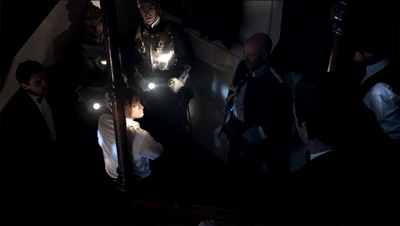
And then the comedy explodes with the apprehensive, not to say terrified, duo (and a host of guards) running around corridors and staircases, à la Marx Brothers, through Elsinore in search of the killer Prince. The music is humorous, and stops when they stop, so they can hear the body being dragged down stairs. Darkly funny. The Hamlet they find is Mad Hamlet, waiting for them, in complete control, and soon doing voices (pitching up on "squeeeeeeeeezed" for example, or giving the next few lines a swinging cadence as his body sways around a post, appropriately ape-like). The scene is lit by torches (or as we say in North America, flashlights), giving it an uneasy feeling, through which we well understand R&G's reaction. Hamlet is having fun, but no thinks it's funny. Not getting a reaction, he gives up and asks to be brought to the King... at which point he resumes running, jumping the balustrade and leading a merry chase once again.

Scene 3
At the bottom of a stairwell, a new venue, an ugly basement with mysterious stains on the concrete floor and a broken mirror over a dirty wash basin. A place where things are done in secret. Torture? Covert murder? People made to disappear. The cool and collected, even reasonable, Claudius is attended by lawyer types in suits, one of which will turn out to be a doctor. Again we have the push and pull of a reasoned leader protecting his family, who could also be about to kill Hamlet and have his body wash up somewhere innocuous (at least, for an audience who doesn't know the play). Enter Hamlet, taped to a chair on casters, a piece of tape on his mouth as well. It's an interrogation/torture scene. The threat to his life doesn't deter Hamlet from his mockeries. He makes his wild speeches and responds to Claudius' single loss of temper ("Where is Polonius?") with a silly shouting voice ("In heaven!"). The doctor in the room shoots him up with some drug, precursor to his exile, a way to smuggle him, sedate, out of the country. There's a nice moment when Hamlet looks straight into the camera at his mention of a cherub that sees Claudius' purposes, something that can easily be translated to the stage. The audience sees all, and it's true to say that soliloquies are a kind of compact between character and audience. It admits our existence in the world of the play, as observers... and judges. In the film, we're part of the paranoid hypersurveillance theme, but our function is the same.

And wheeeeeeeeeeeeeeeeeee, Hamlet is rolled out of the room, eager to get to England now that he's done with Claudius. Acting the child to the end. Claudius' brief soliloquy is told in the broken mirror, a match to the one upstairs in Gertrude's closet, and a reference to the mirror used in the stage production. This is an Elsinore that is falling apart, disjointed and fractured, just like its royal family unit. Like Ophelia's mind. And that's where Doran's Hamlet goes next.

Sunday, March 3, 2013

Act IV, Scenes 1-3 - Fodor (2007)

Fodor's Hamlet makes Ophelia much more of a participant in this sequence, starting on her and a visitation from the Hamlet ghost child. She follows him out into the hall, where a young Ophelia ghost is also running around. In this world, it seems your spirit can leave you early and remain in echoes of better times. Ophelia ignores her younger self and moves towards the end of the hall while intelligible shouts are heard resonating through Elsinore, likely people looking for Hamlet. Ophelia finds him first, having just stowed the body behind a folding screen, in a room dimly lit in red. She spies from one of the doors as Rosencrantz & Guildenstern find Hamlet. These are much more menacing, violent characters in Fodor's adaptation, so Rosencrantz is visibly holding back from attacking the Prince with great difficulty. Guildenstern's "A thing, my lord?" is said with outrage instead of the usual misunderstanding tone. Calling the King a thing is, it seems, a step too far, and the sponges wonder how much trouble Hamlet is willing to get himself into.

After they leave, Ophelia walks towards the folding screen where she finds her sister Polonia's body, hung in the closet, head down.
 She tries to take her down, to awaken her, and failing, throws an expletive-filled tantrum. Flashback images remind us of Polonia's role as her sister's drug pusher, sticking needles into her arm to manipulate her. The whole set-up creates an entirely new motivation for Ophelia's madness. She hasn't lost a beloved father at her lover's hand, she's lost her dealer. She's angry, not distraught, but soon she'll be feeling the pangs of withdrawal. What's most interesting is that Polonia has basically been placed "behind an arras", in death an image of the life she led.

Scene 3 is entirely omitted (as is Scene 1). It's an odd exclusion, and we may wonder where Hamlet has gone. The point is made later when he returns, so expediency may have been the order of the day. And since Ophelia discovers Polonia's body, there's less of a reason for Claudius to keep asking where it is.

Sunday, February 24, 2013

Act IV, Scenes 1-3 - Hamlet 2000

Skipping right to Scene 2, Rosencrantz & Guildenstern find Hamlet washing his bloody clothes in a laundromat. Cutting Scene 1 is an easily made cut since the audience can infer that the murder was found out and people sent to track the killer. We're only really missing Claudius' selfish reaction to it. In this modern day adaptation, the whole sequence (as Claudius walks in with bodyguards soon after being called by one of the twins) smacks of something out of a mob movie. The family never called the police, they're handling this themselves, quite possibly falsifying the details of Polonius' death to protect Hamlet from the authorities. And for that, they need the body. The laundromat is obviously redolent in meaning, a place where Hamlet attempts to wash his soul of his sin, and where indeed, we learn the King washed it from the public eye. We found out it was Halloween earlier (a child dressed as a ghost booed at the King), so there are two pumpkins on a table in the corner, and in an amusing piece of staging, Rosencrantz sits next to them during the scene, surely an attack on R&G's wits.

Unlike most interpretations, they let Claudius win the scene. He comes in with a disarming smile, and Hamlet gets through his lines with fear and apprehension in his voice. The prince even tries to bolt for the door, but is pinned to the wall by the King's bodyguards. Claudius vacillates between kindness and thuggery, punching Hamlet in the gut when he loses patience with him, but wiping the hair off his brow when he finally gives up the body's location. Among the many cuts is Hamlet's seeing a cherub that sees Claudius' purposes. So only in the final disquieting kiss to his mother/father does Hamlet score a point. The look on the bodyguard's face says it all - these people are crazy.
Cut to the airport, where Hamlet is given a rare farewell with a very drunk Gertrude, cold at first, then coming back for a warm embrace, an image of their last conversation in a way. Claudius stays in the limo to do his short soliloquy, and he has to get it out fast before Gertrude returns to the car. He's in his own world when she does and doesn't notice the way she looks at him, distrusting and wary. So though Scene 1 was cut, we still get a very good idea of which side she's really on thanks to her inclusion in this scene.

Sunday, February 17, 2013

Act IV, Scenes 1-3 - Kline '90

Scene 1
Brian Murray is one of the better Claudiuses, as evidenced by the sincerity he brings to his performance in this scene, a sincerity that draws attention to different words usually spoken quickly or with no particular emphasis, and enriching the text. His concern for Gertrude is heartfelt, and her focus on the murder of Polonius makes us believe she really does think her son mad. She has not gone over to his side. When Claudius says it would have been him killed had he been in Polonius' place, there is no shock or surprise in his voice, only assurance. This is Claudius at his most Kingly, deciding the truth of what has happened and moving from there. He is still a master politician, for example stressing the words "countenance and excuse" for Gertrude's sake, letting her know that while Hamlet is to be punished, the measures will be for his own good.

So what words does Mr. Murray illuminate? To begin with, there's the irony of the phrase "out of haunt", which had escaped me until now. Claudius means that Hamlet should have been kept locked away and not been allowed to walk (haunt) the halls of Elsinore at his leisure, but he doesn't know most of the current trouble is due to his brother's Ghost doing the same. Should we also see a pun in "The sun no sooner shall the mountains touch"? Shakespeare is notorious for playing on sun/son, and in this case, the phrase might have a double meaning akin to "before Hamlet can make his own escape", or even "before Hamlet can gain support and reach the top, i.e. kingship".
Scene 2
There were several cuts in Scene 1, the most important of which was Rosencrantz & Guildenstern's presence, but they're in this scene, obviously having been told to find Hamlet in between scenes. Kline's Hamlet is calmer and less obviously mad than most others in this sequence, bringing genuine outrage to the sponge speech. He even lets his anger come out when he says he's the son of a king, making this Hamlet more indignant about the subverted class system than most. And indeed, the same way Claudius has subverted the succession, R&G (at least, in Laertes' absence) have taken his place as the favored son of a king. A bloody rag in his hand, Hamlet uses the prop effectively AS a sponge, perhaps indicating that what they have soaked up is steeped in blood, fruits of a tree growing from a murder.
Scene 3
Instead of being brought to Claudius, the start of this scene is trimmed off and Claudius and his officers come to him. Both Kline and Murray play this scene calmly and reasonably, letting the words act as veiled threats or lunatic dissertations. Though underplayed, there is still a lot of invention on show. For example, though gesturing at Claudius when mentioning the "fat king" is par for the course, allowing the other hand to gesture at R&G on "lean beggar" is not. It becomes a reference to the sponge metaphor, and inverts the cannibalistic relationship between the characters. The King eats them like an apple, and they eat him like a fish. Who is using who?

Hamlet leaves his stepfather with a violent kiss on the cheek, which seems even more threatening than the words they've just exchanged, as if telling Claudius that kiss might well have been a dagger. He let him get too close. There's also some very effective staging - and excellent use of the text as written - as R&G are sent away. Claudius continues speaking after giving the order, and they turn around to, sponge-like, receive more of his words. It's an almost comical move that motivates the harsher "Pray you make haste" as Claudius seems to finally lose patience with his chief sycophants.

Sunday, February 10, 2013

Act IV, Scenes 1-3 - Zeffirelli '90

Before Claudius comes shouting in, Gertrude has a moment alone to herself, looking at the effigy of her late husband. She quickly hides it from the newer, more murderous model, and by this we know she's chosen a side. After this sequence, Zeffirelli restores the last few lines from Act IV to give Hamlet and Gertrude a proper farewell, "fixing" the anomaly of Hamlet knowing about his exile before he's actually told to go by the King. That's fine, give or take an inappropriate kiss, and it makes it even more clear the Queen is her son's accomplice. In the play as written, she has no contact with him after he is caught and sent away, letting ambiguity reign regarding her true feelings. In this restructuring of the play, she gives him hopeful smiles as he reassures her that he will keep a close eye on Rosencrantz & Guildenstern.

Claudius, for his part, suffers some cuts in the breakneck pace Zeffirelli has adopted. In Scene 1, his "it had been so with us had we been there" serves as a punchline, cutting from blood stains on the floor to his office, where he arrives in a hurry to give the order to apprehend Hamlet. We might wonder why he wasn't attended in the first part of the scene to avoid the location change, but it does create a more urgent rhythm as Elsinore wakes up and attempts to find the Prince and his victim. In fact, Scene 2 is reduced to a single shot of R&G and some guards with torches shouting out Hamlet's name.
Scene 3, as is usual, is more fully rendered, though Claudius still suffers an interruption when his political speech to his courtiers is shortened by R&G's arrival. By cutting the line of dialog about Hamlet being kept outside, the director achieves two things. First, he makes the action run faster by removing a planned delay. Second, by having Rosencrantz shake his head when asked "Where is he?" and giving Hamlet an entrance from the other side of the room, he stages it so the Prince is there willingly and was never caught. He whistles rudely, jumps on the table, kicks at some candles, mockingly wears Polonius' hat... This is a brazen attack on Claudius' authority and Hamlet brings the fight to him. It's a war of words, with both men making veiled but plain threats, but it's presumably all Hamlet can afford while surrounded by Claudius' men. Still, the danger to the King seems more palpable because Hamlet WAS never caught. He got all the way to Claudius' inner sanctum too.

Sunday, February 3, 2013

Act IV, Scenes 1-3 - BBC '80

Scene 1
Watch how masterful a politician Patrick Stewart's (first take as) Claudius is. In Scene 1, he's obviously angry at his wife and wants her to stop crying long enough to get the answers he needs from her. And he's visibly shaken when he investigates the site of Polonius' death by the sight of blood on his hands. This relates to his previous scene, the blood on his hands reminding him of his own murder. Indeed, we're reminded here that Polonius' death is ultimately his fault as well, since the old man wouldn't be skulking around Elsinore if he hadn't tasked him to, nor would Hamlet be so dangerous had his father not been killed. There's a dramatic reason why Hamlet Sr. was poisoned - it's a poison that courses through their entire family tree and the whole of Denmark. A murder that SPREADS. He wipes the blood off in a panic, as if trying to hide his own sins from the world, which is exactly what he will do politically. He's seen his way out of the situation and it's as a politician that he next addresses Gertrude. He'll exile Hamlet in such a way that even his mother can't argue. He makes a case that they're both in this together (no one is safe) and further that she shares in the blame for loving Hamlet too much and letting the situation get out of hand. She tries to argue Hamlet's case, but it won't work this time. Claudius is on more solid ground. But when he tells her to come away with him, she stays behind, the staging telling us their relationship has been split asunder.
Scene 2
Catching up to Hamlet, we find him "safely stowed" and not running, speaking to camera as he does, in the dark, waiting to be discovered. When he is, by Rosencrantz & Guildenstern's posse, he still doesn't run, but rather continues to undermine their authority over him as he did in the previous Act. However, Rosencrantz is done playing games, and sensing that he and his partner now have the King's favor over Hamlet, becomes very cold towards his former friend. He refuses to acknowledge any meaning in Hamlet's words. Derek Jacobi, as usual, puts enough of a spin on each and every line that *I* can't possibly take R&G's lead. He makes me want to find meaning in his mad dialog, and new meaning at that. For example, I'm now trying to read "The body is with the king, but the king is not with the body" with the "King" relating to Hamlet Sr. rather than Claudius. Certainly, the Ghost could be a "thing of nothing", but I still get lost in the verbal alchemy.

Scene 3
The text has Claudius "attended" in this third scene, but it's often staged with him starting on his speech alone. What a difference it makes when he's giving orders to Courtiers. Here we have the politician once again, explaining the situation, his plan, and most crucially, that "we're all in this together". By implying that the peasants love Hamlet, he threatens rebellion if they don't agree with his plan, making them all accomplices. Hamlet comes in, sits on the desk, inspects the sealed letters casually, and everything in the staging reveals the power shifting in Elsinore. Hamlet is sitting higher than the King, is far less anxious (does Claudius fear the Prince will expose him in front of everyone?), and having now killed, he is at least the "actor" Claudius is. The King must retake control of the situation and does, standing and once again playing the politician. The way he tells Hamlet of his exile, it's like he's helping him escape a worse fate. Again, it's a case of "being in this together", this time, as a family. It doesn't really work on Hamlet, but there are other people in the room. Hamlet actually leads them out, as if the trip was his idea, pointing at the attendants to fire them into action. We're left believing Hamlet won the scene. He leaves head held high, while Claudius, with tired sighs, asks England to do his dirty work for him.

Sunday, January 27, 2013

Act IV, Scenes 1-3 - Olivier '48

Olivier cuts scenes 1, 2 and indeed, 4, from Act IV, which does have a considerable impact on the play. By omitting Scene 1, Claudius' character is impoverished (the King is rather flat throughout the adaptation), and we can't evaluate whether Gertrude sides with her son or her husband (though the previous Act definitely leans towards the former). Scene 2's omission is unsurprising, given that Rosencrantz & Guildenstern have been excised from the play completely. So we start with Scene 3, a much calmer moment for lacking the chase through Elsinore. In fact, the King's sealing letters with Hamlet standing right there. Claudius' tone is restrained and ever the politician, he makes it sound like Hamlet's exile is for his own good, to avoid prosecution. The Prince is insolent, but Claudius' lack of reaction turns the words into curious/profound observation rather than insult.

Much more interesting is Hamlet's moment of madness when he calls Claudius his mother. He gets that far-away look in his eyes and his hands clench as if around someone's throat. By transforming his stepfather into his mother, or merging the two concepts, is he in a way giving Claudius a stay of execution? Olivier plays it as a realization. It's as if having decided not to harm his mother, he can now no longer harm her husband. Olivier is answering the question as to why Hamlet allows himself to go into exile rather than give in to his murderous impulse and kill the King instead. The exile saves all their lives, at least temporarily (aside from Ophelia, of course). With Scene 4 missing, THIS becomes the mid-play epiphany, the dramatic turning point. Not "my thoughts be bloody", quite the contrary. Hamlet apparently gives up his revenge, and we'll have to wonder why he returns to Denmark later. He can't even kill his two false friends on the voyage to England since they don't exist. Does Claudius' treachery (the letters requesting his death) reignite his desires? That's an analysis for another day.

As for Claudius, the staging has him go to the window to give his closing speech, speaking to England across the sea. A cool, collected delivery that speaks less to rage than it does to acceptance of one's situation. The role is underplayed here, but one might still praise it as an ideal form of Hamlet himself, i.e. a character who has already come to terms with "the readiness is all".

Sunday, January 20, 2013

Act IV, Scenes 1-3 - Branagh '96

Each of these three scenes is given its own unbroken shot, a technique Branagh says fostered a kind of anxiety in the actors that translated to their characters. It's a clever and subtle way to get across the instability and political (and personal!) upheaval caused by the Prince effectively killing the Prime Minister.

Scene 1
Most of Claudius' lines are played as an aside though Gertrude is present, usually off-screen, which creates the effect of her shock. She is obviously stunned, disconnected from the scene, their final embrace non-committal. Is she still clutching at him, wondering if she should betray him, or is he the one holding her close? Probably a bit of both. In this version, he does love her, and she is the principal reason for the murder he committed. All of which clashes with his feelings for Hamlet - fear and murderous anger - nevertheless Gertrude's reason for living. He's impatient with her contention that her son is somehow repentant, thinking her naive and foolish. Because no matter how important Gertrude is to him, Claudius can't ignore his own selfishness. On hearing of Polonius' murder, he thinks first of his own safety, and by the time the scene is resolved, he's put together a plan to make sure the Court knows who was really guilty of the crime lest the blame fall on him. During a crisis, Claudius falls to public relations mode.

Not content to believe Gertrude's interpretation, Claudius visits the crime scene himself, looks at the counterfeit presentment of two brothers on the bed, puts it all together. Between this scene and his next (Scene 3), not to mention the play within the play, there's every reason to believe he's understood what Hamlet is really on about. The Prince is gunning for him, possibly planning a coup, but at the very least trying to avenge his father's murder. He can no longer excuse the madness, nor does he particularly believe Hamlet's act.

Meanwhile, Rosencrantz & Guildenstern, asked to wait in the hall outside the rooms, and are often seen in frame, connecting them to Polonius, another conspirator listening in at a remove. Can their own deaths be far ahead?

Scene 2
Then, action. Soldiers running through Elsinore, searching Ophelia's bed. R&G find Hamlet first, creeping about as if in a comedy routine. They don't lay a finger on him, nor do the soldiers that join his train every time he turns a corner. It's a last hurrah for the madcap Hamlet, a version of the character that won' exist after Scene 3, and as if in an encore of a previous scene, he even takes Rosencrantz hostage (pipeless, this time). Branagh invents a bit here where an awakened Ophelia comes down the stairs, face to face with Hamlet. Confronted by the woman he's just orphaned, the Prince makes a run for it, going through room after room, jumping over tables (the courtiers seem to be having a late dinner after the play). It's notable that he tries to avoid his fate, or perhaps he's trying to find a weapon and get to Claudius before the guards get him. In the end, he reaches his library/study, but it's been compromised (as has the rest of Elsinore; note how none of the guards are those shown loyal to him in Act 1). A rifle is leveled at his head and we cut to Claudius.

Scene 3
Claudius is in his own study, sealing letters bound for England and explaining, in a soliloquy, the politics behind his next action. I wonder if Derek Jacobi muddled the pronunciation of "distracted multitude" on purpose, because it sounds like "destructive multitude" to me. Certainly, that's how he thinks of Denmark's population, as rabble not only stupid (distract), but dangerous as well. He's interrupted by R&G who bring Hamlet to him. Horatio is also dragged in, either as a co-conspirator or to bear witness to Hamlet's fair treatment. There are two reasons to have him present even if the text does not mention him. One is to keep him in play the same way Ophelia has been brought into these scenes. Neither character has appeared since the play, and neither gets a farewell scene with Hamlet before he is exiled. Branagh manages to give each of them a wordless farewell, both given meaning through performance. The other reason to have him there is to cement his role as an objective witness in the final scene. If he is telling us this story, he needs to be present as much as possible.

Hamlet continues to be insolent, and Claudius has had enough. He's drinking more and more (one of his sins), and back-hands Hamlet quite hard when the Prince refuses to give him a straight answer. And yet, Hamlet doesn't break character or even lose his sense of humor. In fact, the scene becomes a kind of duel, both characters knowing full well the other's secrets, but daring the other to reveal themselves in front of witnesses. Hamlet even goes so far as kissing Claudius on the mouth when he calls him his mother. Claudius finally breaks when Hamlet is carted off and he gives his "do it, England" speech, barely containing the rage and anguish he feels at the discord in his heart. His wish is to kill his stepson, but politically, he needs to exile him instead, either move sure to hurt the woman he loves. Because the exile means death, there's also a measure of guilt there. This is a man who only a few scenes ago was suffering from having committed one murder, and here he is ordering another.  It all plays out in Jacobi's voice.
Before being taken away, Hamlet goes to Horatio and almost talks to him, leaving it at a silent look passing between the two friends. Nothing so good for Ophelia, clutching at the chapel's doors as her father's found body is brought in, screaming her head off, her sanity already slipping away. Those screams echo over the water in an exterior shot, extending the mad scream right to the girl's very death, the brook where she will take her own life.