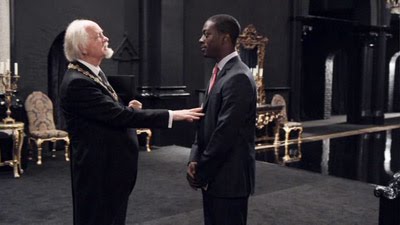
Tuesday, October 26, 2010

II.i. Ophelia Affrighted - BBC '80

Sadly, the BBC television production's version of this story shows off both the actress and the format's flaws. While from the distance afforded by the stage, Lalla Ward's performance would be acceptable, even the medium shot shows her tears to be absent in all but her voice. We're too close for such a performance. We could hear believe that Ophelia is faking it just as Hamlet is, except that Jacobi's Hamlet is well and truly mad (as he'll realize himself later), and Ophelia is meant to be sincerly distraught. But as I say, from a distance, Ward's performance is adequate. There's a fun moment when she is surprised by Reynaldo's exit and catches herself in time to cursorily curtsy. Polonius is kind to her, even when he makes the accusation, his fatherly love evident.
Even when the staging doesn't inspire much, I do try and pick up on a line I haven't examined before, and in this case, and perhaps because Ophelia herself has a fantastic hat, that line is "no hat upon his head". I just now realized that most, if not all, Hamlets I've seen feature a hatless Hamlet from start to finish. Could we infer that Shakespeare staged it differently? Hamlet might have started with a hat - like other courtly characters have - and signified his madness by taking it off and letting his hair flow wildly. Food for a future director's staging.

Saturday, October 23, 2010

II.i. Ophelia Affrighted - Olivier '48

Olivier removes Polonius from this scene entirely, and turns Ophelia's words into a soliloquy and flashback. Unlike most other directors, he chooses to show what Ophelia is describing. There is still a certain amount of subjectivity because the image are clearly coming from her mind (thanks to Olivier's often interesting camera and lighting tricks), but still seems to bleed some of the ambiguity out of it. Olivier's melancholy performance follows the text beat for beat, but by accentuating gestures over words, he brings some of the oddness to light. In particular, the shaking of Ophelia's arm and of his own head make you believe in his madness, rather than any planned cruelty. (Hamlet is such an ambiguous text, however, that we might still infer that causing Ophelia harm on purpose causes those physical symptoms. Perhaps Hamlet goes mad because he is forced to act against those he loves - lover and mother - and so feigned madness becomes real.)
As for Ophelia, she's far from frightened by these events. Instead of the rush to see her father, we have a quiet internal monologue. After Hamlet does a number on her, she simply sits down and resumes her sewing. Obviously, she'll go to her father later, because he talks to the King and Queen about it in the next scene, and the implication may be that the voice-over we hear is taken from that unseen meeting. As we don't hear Polonius' reactions, we cannot confirm that. She may have downplayed some elements or emphasized others. In any case, Polonius has been removed from Scene 1, eliminating much from his character.

All this is not to say Jean Simmons doesn't give an intriguing performance here. Her Ophelia is, as we've mentioned before, a child-like dreamer. Instead of panic, she instead gives us bemused reflection as she attempts to make sense of what has just happened. She peruses her own face, reenacting Hamlet's touch and smiling wistfully. The smile drops, perhaps an inner realization that her father must know of it - a natural assumption as we cut to the next scene at that point.

On a personal note, I can't say I'm a fan of Olivier's melancholy Hamlet, but I am a fan of Simmons' naive Ophelia. She brings something entirely different to the role.

Friday, October 22, 2010

II.i. Ophelia Affrighted - Branagh '96

Reynaldo's exit is Ophelia's entrance, out of breath and teary. Kate Winslet gives an intensely emotional performance that prefigures her later madness. One thing Branagh does not do here as director is show us flashbacks of Hamlet's visit. He leaves it to Winslet to mime Hamlet's actions. This is a notable choice in a film that makes wide use of flashbacks to generate interest in scenes described but impossible to stage in the theater. The scene not pictured thus continues to be something of a mystery. We only have Ophelia's highly emotional point of view and cannot know what Hamlet's true intentions were.
One line did resonate with me on this viewing: "He falls to such perusal of my face / As he would draw it." It's a line that harks back to Hamlet's oath to wipe away "all fond records" and erase the book of his memory. Hamlet isn't drawing, he's erasing. In the unseen scene, he almost draws her back into his "book", but as he's sworn to only his father's revenge written there, he cannot. Shakespeare chooses his words well. It's as if he would draw it, but "would" is not the same as actually doing it. Also note the ironic use of he word "fall" in the same line.

Watch Ophelia as Polonius starts responding to the story. When he mentions the ecstasy of love, she looks up, hopeful. Does Hamlet love her? She would rather it be that than some malady out of her control. Polonius then asks "What, have you given him any hard words of late?" as if it's all her fault. It's not fair to say Polonius refuses to take responsibility, because he does in his last few lines, but rather that he can't at first see that it's his own fault. Even when he does take responsibility here, Branagh has him say the lines in an aside, not directly at the sobbing Ophelia. She is left believing it was in a sense her fault, or at least that everyone else thinks it is.
Ophelia crawls into her father's bed, which some will want to label as Freudian, but I don't read any incest into it. Rather, it's more mirroring of characters (this is the Hamlet with the Hall of Mirrors, after all). Just as Ophelia was mirroring Hamlet's gestures earlier, here she takes the place of her father's whore in his bed. This merely emphasizes the old man's hypocrisy and corruption. A few moments ago, he had a girl the same age in his bed, and this staging reminds us of that. At the same time, we have Ophelia in bed with her father instead of Hamlet. She's lost one and now has only the other (which she is also destined to lose), and both men are mirrored through the scene. Both are manipulators, of each other ideally, but of Ophelia specifically.

Thursday, October 14, 2010

II.i. Ophelia Affrighted

On the heels of Reynaldo's departure comes Ophelia in the second half of Scene 1 (if, indeed, Reynaldo makes an appearance at all in any given version) with a story about Hamlet visiting her closet. Why is this scene told but not shown? Seeing as the actor playing Hamlet is about to come onstage for the longest continuous appearances in all of Shakespeare, was it done for practical reasons? More likely, but just as "practical", the picture painted by Shakespeare would have been considered scandalous on the Elizabethan stage, his pants around his ankles, as it were. In a scene that is already about the trustworthiness of any given point of view, we get a second hand account (a naive spy report from Ophelia) that propels the play exactly where Hamlet means to propel it. It is this account that involves Polonius, and Polonius who involves the King and Queen.

All part of Hamlet's plan? One question directors and actors must ask themselves is whether Ophelia's account is true. It's certainly true for her (though imagine a Hamlet where Ophelia is a willing accomplice, at least, until her father's death), but was Hamlet faking? Did he sacrifice Ophelia's love for his new cause? Is he using her, or was this a heartfelt goodbye? Or both? The text follows in italics, interspersed with my comments.

Enter OPHELIA

LORD POLONIUS: How now, Ophelia! what's the matter?
OPHELIA: O, my lord, my lord, I have been so affrighted!
LORD POLONIUS: With what, i' the name of God?
OPHELIA: My lord, as I was sewing in my closet,
Lord Hamlet, with his doublet all unbraced;
No hat upon his head; his stockings foul'd,
Ungarter'd, and down-gyved to his ancle;
Pale as his shirt; his knees knocking each other;
And with a look so piteous in purport
As if he had been loosed out of hell
To speak of horrors,--he comes before me.


Here is the portrait I was referring to. Hamlet is a man who very recently has been loosed out of hell, or from the nether realm in which the Ghost exists, placing this scene very soon after Act I. In fact, it is a reaction to Act I's revelations. There, we had Hamlet vow to erase the slate of his memory and here, his clothes and hair are undone, a graphic representation of an unmade man.

LORD POLONIUS: Mad for thy love?

Polonius immediately jumps to this conclusion. It is his first thought on the matter, and it remains the one he supports until his demise. We've already discussed how Polonius is the man who consistently gets it wrong, and here we see how. Rather than looking at all the evidence, he sticks with his first notion and keeps building upon it even when others suggest alternatives. Why IS it his first thought? Guilt about having given his daughter the interdiction may already have been on his mind.

OPHELIA: My lord, I do not know;
But truly, I do fear it.
LORD POLONIUS: What said he?
OPHELIA: He took me by the wrist and held me hard;
Then goes he to the length of all his arm;
And, with his other hand thus o'er his brow,
He falls to such perusal of my face
As he would draw it. Long stay'd he so;
At last, a little shaking of mine arm
And thrice his head thus waving up and down,


The use of "thus" encourages the actress playing Ophelia to mime Hamlet's actions, in effect merging with him now that he is ironically out of her grasp. It's a mirror between the two lovers, if you will. Both will suffer from madness, both will have their father slain, etc. This early mimic sets up that mirror.

He raised a sigh so piteous and profound
As it did seem to shatter all his bulk
And end his being: that done, he lets me go:


These lines, more than any others, point to Hamlet making his goodbyes and in effect putting to rest his old life. A more ruthless Hamlet could still fake this great sigh, of course, but the audience wants to believe Ophelia here, as she has a privileged relationship with Hamlet.

And, with his head over his shoulder turn'd,
He seem'd to find his way without his eyes;
For out o' doors he went without their helps,
And, to the last, bended their light on me.
LORD POLONIUS: Come, go with me: I will go seek the king.
This is the very ecstasy of love,
Whose violent property fordoes itself
And leads the will to desperate undertakings
As oft as any passion under heaven
That does afflict our natures. I am sorry.
What, have you given him any hard words of late?
OPHELIA: No, my good lord, but, as you did command,
I did repel his fetters and denied
His access to me.
LORD POLONIUS: That hath made him mad.


Polonius comes to that conclusion a second time.

I am sorry that with better heed and judgment
I had not quoted him: I fear'd he did but trifle,
And meant to wreck thee; but, beshrew my jealousy!
By heaven, it is as proper to our age
To cast beyond ourselves in our opinions
As it is common for the younger sort
To lack discretion. Come, go we to the king:


Polonius accuses himself of wrong-doing, but at the same time justifies those actions. He meddles, but his children lack discretion. It evens out. He must still do what he does. In fact, he'll next go to the King and Queen and meddle some more. The dramatic irony of Polonius is that while other characters in Shakespeare can overhear themselves speaking, he cannot. Other characters can realize things about themselves and adapt, he learns nothing of the truths he speaks.

This must be known; which, being kept close, might move
More grief to hide than hate to utter love.


Wrong again, Polonius.

Exeunt

Visual media can of course show us what here is merely told, through Ophelia's lens or a more objective third person point of view. We'll look at how that choice, among others, affects the various versions of the play under examination through the next few articles.

Wednesday, October 13, 2010

II.i. Reynaldo - Tennant (2009)

The 2009 Hamlet features an outwardly patient Reynaldo in the service of an aging and dottering Polonius. He smiles at jokes he doesn't really get and tries to walk away before the rather lengthy conversation starts again (the comedy exit is brilliant). This is a fair way to play since Polonius' long-windedness is Shakespeare's big joke. Just as he ironically has Polonius later go on and on about being brief, and in a later moment pointing out that a speech is too long, here he basically talks to himself, as the other character in the scene barely gets a word in edge-wise. It strikes me now that Polonius asks the questions he immediately answers ("Wherefore should you do this?").

There's irony in the language as well. Polonius uses words like "drift" more than once, as well as "slips". His own slip is an amusing, but disturbing one. Polonius loses the thread of his speech and, far from the 1996 version's test, appears to be losing his mind, and even realizing he's doing so.
It's an episode of Alzheimer's or dementia which puts in question Polonius' entire agenda. Why IS he sending a spy to follow his son? The genial Polonius in this version doesn't usually seem sinister. It's like the evil he does is almost accidental, casual and without reflection. It's just what he does because he's always done it. Does he even know there's been a change of kings? His mental competence is certainly in question. If he's obsessed with what the director calls hyper-surveillance, then what should we make of the shot of the conversation from the security camera?
Even as Polonius instructs his spy, he's the victim of surveillance. From whom? Claudius? Some unknown agency? The audience? Basically, he's under surveillance by dramatic irony. The shot is there to show us a man who has lost control of his own tools (whether that be spycraft or words). In general, whatever Polonius says in the play, the opposite has a better claim to the truth. He will be brief only by being long-winded. He will spy only by being spied upon. And he will never be right about anything - not Hamlet's madness, not his designs on his daughter, and not where to hide in Gertrude's closet. Everything he says is thus suspect, including his suspicions about Laertes' behavior, later to be refuted in everyone's dialogue (calling him a valiant youth, etc.).

In other words, Polonius' untrustworthiness gives Laertes' actor license to play him as the opposite of his descriptions.

Thursday, October 7, 2010

II.i. Reynaldo - Fodor (2007)

Or I should say Reynalda. Fodor's more experimental, horror-driven version has already changed Polonius and Horatio's genders, and now does the same with Polonia's agent. Now it should be said that this scene doesn't follow from the end of Act I anymore. Or rather does, but other things have been dropped before it, including a musical montage in which we see Hamlet and Ophelia's encounter (which we'll discuss in the next sequence) and the To Be Or Not To Be speech (again, a matter for another day). The Polonia-Reynalda scene is played as a seduction, with a definite sexual undertone throughout ("under"tone may be underselling it). Polonia feeds her agent black cherries and wine, while dressed in red silk evening wear. The Ghost bears silent witness to her decadence, and the occasional graininess of the film gives the impression that a third party is watching (perhaps it's the audience). At one point, the sound drops out and we hear a ghostly whisper, after which Polonia forgets her place. Polonia isn't old enough to be senile, but she could have played the line as sinister. Instead, we have a third option. She appears confused by the loss of her train of thought (or even memory?). Is she being haunted by the Ghost, who would then be acting supernaturally on characters other than Hamlet? Or is this part of Polonia's sadistic madness? What she does next is deranged at best. She slips her belt out of her evening gown, and having entranced Reynalda into closing her eyes in anticipation for some pleasure, is about to strangle her with it. Only Ophelia's entrance breaks the spell and prevents her from doing so. There is ambiguity here. It could be a sex game involving suffocation, or it could really be a "spell", putting Polonia under the Ghost's control. If it isn't, what are we to believe about someone who kills her own agent just after giving her orders? Again, the answer doesn't come easily. An unhinged and volatile Polonia could be mercurial enough to kill her own agent, forgetting the mission in that moment of passion. The mission itself could be a pretext for getting Reynalda into her quarters and/or make her disappear smoothly in the wake of the pleasure-driven murder. One clue: As Polonia discusses her brother Laertes - "He's very wild, addicted..." - we see a flash of him striking a woman. There's no need to sully his name when the character has already been shown to be all those things, which Polonia well knows. So is Reynalda's mission a fake from the start? Just a game she plays with her mistress? As usual, Fodor likes to keep us guessing.

Sunday, October 3, 2010

II.i. Reynaldo - BBC '80

This version of the scene makes me realize how much it hinges on Reynaldo's performance. In the Branagh adaptation, Reynaldo is a sinister figure, and thus the scene is played in a more sinister vein by Polonius. Here, he is a comedic sycophant, and it's hard to think of Polonius as much of a villain. Reynaldo is visibly shocked by Polonius' suggestion that he sully his son's name, but Polonius comes across as being naive and misguided, not sinister and manipulative. These are just very bad ideas he think are the right thing to do. The implication is that the King's chief counselor has no moral compass. He isn't choosing wrong like Claudius did; he is just unable to tell right from wrong.

The way Reynaldo is played as a smiling yes man mirrors Osric's role in Elsinore later, and even that of Rosencrantz and Guildenstern. Polonius seems to surround himself with aides who are excellent at singing praises, but not much else. There is no one in the Court who can tell truth to power, which will prove to be why Hamlet is so disruptive. Polonius is a fool who surrounds himself with clowns, and who is played with a distractedness bordering on senility. He really loses his place and seems confused even after Reynaldo's prompting in this scene.

I should also mention some fun bits of comic business in the scene. Reynaldo tries repeatedly to take the notes he's meant to deliver from Polonius' hands, but can never get at them through the older man's animated speaking. He also grabs the coins himself and doesn't wait for Polonius to remember to pay him. Though played for comic effect to keep the audience interested, this again goes to Polonius' failing faculties.

Friday, September 24, 2010

II.i. Reynaldo - Branagh '96

In Branagh's Hamlet, the small roles are played by major stars, and in this case, Polonius' spy Reynaldo is played by Gérard Depardieu. Unlike Jack Lemon's casting as Marcellus, Depardieu does he have anything resembling a substantial speech, but also unlike Lemon, he doesn't seem an ill fit for his character. Reynaldo is very much a "yes man" who smiles along at Polonius' instructions and is never seen beyond this one scene. Stunt casting like this serves a purpose, and that purpose is to give the part a lot more weight, by extension doing the same for the scene. Giving the role to such an iconic actor lends Reynaldo a richness he would not have had if played by an unknown. With Depardieu in charge of Polonius' mission, we might more easily imagine the Adventures of Reynaldo in Debauched France. There's also an implication here that he's the one who brought the whore in Polonius' bed with him, though only Depardieu's "importance" truly makes this inference possible. He's an important actor, so his character must be an important man. And how does that increase Polonius' own power that he is ordering Reynaldo around? Using a French actor here also adds something, since Laertes is in France. Polonius seems to have access to an international ring of spies, again, increasing his character's power.
We're so used to seeing Richard Briers play kindly old men that Polonius' sinister turn is shocking. We saw a dark side to him when he got angry at Ophelia, but there's a big difference between anger and the deliberate machiavellianism of this scene. Even his eyebrows are shaped for evil. Polonius is in his element here, so confident he barely comes across as tedious. He's proud of himself and is definitely testing Reynaldo when he appears to have lost his train of thought. There's no pause there to indicate a real loss of focus, and Reynaldo is mystified at the question. Polonius is sure his little trap is clever, but it just seems off to Reynaldo. Reynaldo feigns amusement at the older man's wit, but shows his true attitude - a sort of impatient weariness at Polonius' condescending instructions - when Polonius can't see him. Polonius remains a powerful and/or rich man it is worth making smiles at. Depardieu's performance truly infuses Reynaldo with a character that really doesn't appear on the page.
And what of the whore in Polonius' bed? From the look on her face, Polonius may be more dangerous than he seems. There is a huge contrast here between his (unseen but inferred) treatment of the prostitute and his fatherly kindness towards his daughter in the next sequence. But inferences aside, this addition to the scene shows Polonius to be a hypocrite. The text already tells us this (he takes a long time to tell us he'll be brief, for example), but it's easy to interpret such words not as hypocrisy, but as a lack of self-awareness. In painting Polonius as a villain perhaps worthy of his fate, Branagh goes farther. There's a nice visual punch when Polonius mentions drabbing (i.e. visiting brothels) as one of the "sullies" Reynaldo may lay on his son, and he sends the prostitute away through one of his room's secret doors (Ophelia will come in from another, completing the mirror image). He doesn't want his son to partake in various forms of vice, but here he is drabbing, smoking and drinking. Polonius doesn't listen to his own advice, nor does he hold himself to the same standard expected of his children, and this is a conscious thing in Branagh's Hamlet.

A fascinating scene between two great actors. I miss it every time it's cut and I know it's because of this version's power.

Saturday, September 18, 2010

II.i. Reynaldo

After more than a year of Hyperioneering, we finally slice into Act II. I never claimed this was going to be a short ride, did I? Act II's first scene I will divide in two parts. The first is Polonius' talk with his spy Reynaldo, a sequence that is often cut from dramatic presentations, and the second is Ophelia's description of Hamlet's mad visitation, which DOES generally make the cut. Why is Reynaldo so often left out? Well, for one thing, the play is excessively long and most directors want to pair it down. Reynaldo is a minor character who does not reappear in the play later, and his scene is basically there to show what Polonius is capable of (spying on his own son and even maligning him) and to increase the sense of paranoia in Elsinore.

Essentially, adaptations that feature this sequence create a more sinister Polonius than those that do not. That sinister Polonius is a better rounded character, a better match for Hamlet, and understandably in league with Claudius. The actor playing Polonius puts his own spin on it of course, and we'll see how the text lends itself to variable interpretations in the next few articles. Is his rambling calculated to test Reynaldo, or is he actually distracted? It varies. Let's have a look at the text itself (in italics):

SCENE I. A room in POLONIUS' house.
Enter POLONIUS and REYNALDO

LORD POLONIUS: Give him this money and these notes, Reynaldo.
REYNALDO: I will, my lord.
LORD POLONIUS: You shall do marvellous wisely, good Reynaldo,
Before you visit him, to make inquire
Of his behavior.
REYNALDO: My lord, I did intend it.
LORD POLONIUS: Marry, well said; very well said. Look you, sir,
Inquire me first what Danskers are in Paris;
And how, and who, what means, and where they keep,
What company, at what expense; and finding
By this encompassment and drift of question
That they do know my son, come you more nearer
Than your particular demands will touch it:
Take you, as 'twere, some distant knowledge of him;
As thus, 'I know his father and his friends,
And in part him: ' do you mark this, Reynaldo?


Though Reynaldo's actions in France will all occur off-stage and not be referenced again, we can compare the methods Polonius teaches here with his own in the case of Hamlet. Polonius is not direct. He attempts to get information by subterfuge, in a roundabout manner. In the same way that he has Reynaldo make inquiries for him, asking not pointed questions, but obfuscating ones, so will he try to find out the cause of Hamlet's madness with honey traps and interrogation masked in conversation. One should wonder if Hamlet would have been more forward with information is asked directly.

REYNALDO: Ay, very well, my lord.
LORD POLONIUS : 'And in part him; but' you may say 'not well:
But, if't be he I mean, he's very wild;
Addicted so and so:' and there put on him
What forgeries you please; marry, none so rank
As may dishonour him; take heed of that;
But, sir, such wanton, wild and usual slips
As are companions noted and most known
To youth and liberty.
REYNALDO: As gaming, my lord.
LORD POLONIUS: Ay, or drinking, fencing, swearing, quarrelling,
Drabbing: you may go so far.
REYNALDO: My lord, that would dishonour him.
LORD POLONIUS: 'Faith, no; as you may season it in the charge
You must not put another scandal on him,
That he is open to incontinency;
That's not my meaning: but breathe his faults so quaintly
That they may seem the taints of liberty,
The flash and outbreak of a fiery mind,
A savageness in unreclaimed blood,
Of general assault.
REYNALDO: But, my good lord,--
LORD POLONIUS: Wherefore should you do this?
REYNALDO: Ay, my lord,
I would know that.
LORD POLONIUS: Marry, sir, here's my drift;
And I believe, it is a fetch of wit:
You laying these slight sullies on my son,
As 'twere a thing a little soil'd i' the working, Mark you,


Something I've noticed throughout this speech is the frequent use of ellipses, as if Polonius talks so much that he must fit more words in the pentameter line. I wouldn't be surprised if it was done on purpose.

Your party in converse, him you would sound,
Having ever seen in the prenominate crimes
The youth you breathe of guilty, be assured
He closes with you in this consequence;
'Good sir,' or so, or 'friend,' or 'gentleman,'
According to the phrase or the addition
Of man and country.
REYNALDO: Very good, my lord.
LORD POLONIUS: And then, sir, does he this--he does--what was I
about to say? By the mass, I was about to say
something: where did I leave?


Here is a good example of giving the actors a choice as to interpretation. The exchange could read as Reynaldo being condescending to Polonius (in retaliation for that same treatment) and Polonius testing to see if he was really listening. Or it could be that Reynaldo is attentive and it's Polonius who gets distracted. The line between sinister and foolish can be drawn in different places depending on those choices.

REYNALDO: At 'closes in the consequence,' at 'friend or so,'
and 'gentleman.'
LORD POLONIUS: At 'closes in the consequence,' ay, marry;
He closes thus: 'I know the gentleman;
I saw him yesterday, or t' other day,
Or then, or then; with such, or such; and, as you say,
There was a' gaming; there o'ertook in's rouse;
There falling out at tennis:' or perchance,
'I saw him enter such a house of sale,'
Videlicet, a brothel, or so forth.


Whether a rambler or in love with his own voice, one thing we can say for Polonius is that he is tedious. The entire scene is replete with multiple examples to support each idea.

See you now;
Your bait of falsehood takes this carp of truth:


An interesting metaphor to resonates with that of the "worm that ate of a king" and Polonius later becoming worm food. If he becomes a worm eating at a king (similar to the sponge of another line, but better suited to a decaying realm), he can be thought of as this "bait of falsehood", a liar trying to catch the "carp of truth", which is Hamlet's true self. That truth will prove too elusive for him.

And thus do we of wisdom and of reach,
With windlasses and with assays of bias,
By indirections find directions out:
So by my former lecture and advice,
Shall you my son. You have me, have you not?
REYNALDO: My lord, I have.
LORD POLONIUS: God be wi' you; fare you well.
REYNALDO: Good my lord!
LORD POLONIUS: Observe his inclination in yourself.
REYNALDO: I shall, my lord.
LORD POLONIUS: And let him ply his music.
REYNALDO: Well, my lord.
LORD POLONIUS: Farewell!

Exit REYNALDO


Right to the end of the exchange, Polonius must have the last word. Though the play survives without this sequence in it, I find its revelations about Polonius extremely interesting. His hubris is palpable ("we of wisdom") and he suddenly seems like a threat to Hamlet. My first movie Hamlet was Zeffirelli's, where this sequence does not appear, and Ian Holm, for all his prowess, seems to me wasted in the two-dimensional role of the old fool. Had this been in the film, it would have changed his whole character and been much more fascinating.

Friday, September 10, 2010

Other Hamlets: Gilligan's Island

Left without comment

Because really, what can you say to this?

Saturday, September 4, 2010

I.v. Swearing Oaths - French Rock Opera

At around this point in the Hallyday's double album, the timeline gets a little tenuous. Songs are, by their nature, not as linearly narrative as drama is, and are closer cousins to the soliloquy. Interior voices, heightened reality. In Hallyday's Hamlet, where does the first Act end and the second begin? I believe the shift from one to the other is represented by the next two songs, Je suis fou (I Am Mad) and On a peur pour lui (We're Afraid for Him). The first is Hamlet's self-acknowledged switch from sanity to madness, the other the reaction his friends have to his change in behavior. As usual, expect a certain amount of doggerel in the translations:

Je suis fou
Je suis fou comm’une tomate
Je ne tiens plus sur mes pattes
Je marche et vais de travers
Je vois rouge et je suis vert

Refrain:
Pardonne-moi, fou du roi
Si je suis plus fou que toi

Je suis fou comme une ficelle
Je me déroule, je m’emmêle
Je me détache, je m’accroche
Je m’use et je m’affiloche

Je suis fou comm’un navire
Et je vogue sur le délire
Plus d’étoiles, une nuit d’encre
Je ne sais où jeter l’ancre

Je suis fou comm’un soleil
Que se soit par la bouteille
Que ce soit par Ophelie
Je couche avec la folie

I Am Mad
I am mad like a tomato
I can't stand on my own paws
I walk and go astray
I see red and I am green

Refrain:
Forgive me, king's jester
If I'm madder than you

I an mad like a string
I unfurl, I get tangled
I detach, I get snagged
I get used and I get frayed

I am mad like a ship
And I float on delirium
No more stars, an inky night
I don't know where to drop anchor

I am mad like a sun
Whether through the bottle
Whether through Ophelia
I sleep with madness

This lament pretty definitely tells us that Hallyday considers Hamlet's madness to be real. This is Hamlet's voice and he doesn't leave any room for ambiguity. He expresses sadness at what he has become, and in the closing parts of the song, starts laughing maniacally as the chorus throws high-pitched "He is mad!" at him and he repeats key lines from the song. Many of the similes used will seem strange in English, but that's because they were chosen for their rhyme schemes in French (a mad tomato?). On the other hand, those nonsense words invoke Hamlet's madness. The mention of madness in a bottle may, in fact, be more about Hallyday's own experiences with the rockstar lifestyle than Hamlet's, given his railing against the king's rouse.

Also note the foreshadowing of Ophelia's madness and Hamlet's relationship with poor Yorick. The latter creates an early link between Hamlet's madness and the king's jester who in part helped raise him. We'll have more cause to talk about Yorick as another father figure in Hamlet's life down the road.

That was Hamlet's interior monologue. Now comes the reaction.

On a peur pour lui
J'ai peur pour son coeur
J'ai peur pour sa tête
Et ses maux de coeur [not sure]
Il se monte la tête [not sure]

J'ai peur pour sa tête
J'ai peur pour son coeur
On a peur pour lui
On a peur de lui
On a peur pour lui
On a peur de lui
On a peur pour lui
On a peur de lui
etc.

We're Afraid for Him
I'm afraid for his heart
I'm afraid for his head
And his heartaches [not sure]
Something gets to his head [not sure]

I'm afraid for his head
I'm afraid for his heart
We're afraid for him
We're afraid of him
We're afraid for him
We're afraid of him
We're afraid for him
We're afraid of him
etc.

Half this track, about a minute, is just eerie driving music. If the Rock Opera were actually to be staged, we could well imagine some sort of action occurring here. It's noteworthy that while Hamlet's descent into madness is a relatively straightforward lament, Horatio's perception of the same even is creepy and strange. After that minute, the chorus shows up with an altogether too happy sing-along with a couple of undecipherable lines (I've been looking at various sources, but they either don't give lyrics for this track or else don't make any grammatical sense). The mix of concern and fear inspired by Hamlet's behavior takes us into the second Act, from Horatio and Marcellus to the whole of the Court.

Friday, August 27, 2010

I.v. Swearing Oaths - Classics Illustrated

The originalThat is all. It's actually surprising that the return of the Ghost isn't included given this adaptations fascination with that supernatural element. There is no conflict between the men that requires ghostly intervention, although the narration is almost oxymoronic. "I won't tell you anything, but I'll swear you to secrecy." And that's the interesting bit, I suppose. Summed up that way, it seems a little absurd, but we do have a scene here in which characters are forced to swear to reveal nothing while also being told nothing. While that's not strictly true, it's not entirely false either.

The Berkley version
The sequence gets the better part of a page, with Hamlet immediately asking his companions to swear. There is no room here for madcap zaniness, and Hamlet seems to remain his same old dour self through the entire first Act. We do not see him change, though he does tell Horatio that he'll affect a madness. In other words, this Hamlet isn't mad or even distraught. His actions will be well planned (presumably). The Ghost appears one last time:
Instead of other the earth, he's above ground. The relevant lines are of course cut. Strangely, though Hamlet proposes the oath, we do not hear the men swear to it. There is a disjointed quality to the comic book form, with things (especially speech) occurring in a single sustained moment within the same panel, and actions and words possibly lost in the space between panels. Sequences can read as a montage in which things must be inferred (mostly movement). As readers of Hamlet, we know the men swear even if that is not depicted here. This is an artifact of the medium (and the difficulties of adaptation) rather than a conscious disjointedness.
At the end, Hamlet and friends go back to Elsinore. As usual, artist Tom Mandrake gives us moody images, though I'm not always sure if they thematically match their scenes. This panel gives the impression of three heroes going boldly into the night. As we know, Hamlet really goes it alone from this point. We have the darkness and uncertainty, but where is Hamlet's isolation and doubt? Again, something may be lost in the frozen moment.

Tuesday, August 24, 2010

I.v. Swearing Oaths - Tennant '09

The camera work in this sequence is handheld, giddy, drunk and mad. The floor seems to tip like the deck of a ship. Hamlet comes towards his friends and walks away from them like the tide itself. This is an incredibly visual way to represent his state of mind. It pulsates with Hamlet's own sanity and with his alternating paranoia/trust with Horatio. There's good reason to believe Tennant's Hamlet has gone mad even beyond the way it is staged and shot. His characterization is very different from the grieving boy of the earlier scenes. He has just cut his hand, turning his oath into an even more serious affair. Is he asking the same from his friends? They never shed blood for their oaths, but they might well have thought Hamlet was going to require it of them. Even when he gets the idea of putting an antic disposition on, it doesn't look like he has far to go.
A good case could be made that this Hamlet is mad, but smart enough to know it. He justifies his present and future actions by turning uncontrollable behaviour into a conscious affectation. PR in Elsinore.

Insane or not, it's not all in his head. The Ghost returns, shaking the ground violently, bells ringing. In the stage play, they used sound effects to shake the seats, and mechanical effects to disturb chandeliers and lanterns. In the film version, simple use of shaky cam accomplishes the same trick, though it's not quite as visceral for the audience. Either way, it is quite clear that the director means for us to believe in the Ghost's reality. This is not anyone's point of view but our own. The two men accompanying Hamlet certainly believe in it and terrified, scream out their oath. Hamlet, for his part, is high on energy of the moment. He would hope Horatio could see things like he does and uses the more inclusive "our philosophy", but the sequence otherwise does little to bring Hamlet and Horatio closer together. They have contrasting attitudes, Hamlet's an alienating one. And once they've sworn, the men run out as Hamlet stays behind to say his final couplet to camera. The very last line is omitted. It would certainly have cemented Hamlet's madness for the audience.

A note on "There are more things..." from the director in the audio commentary: He rightly reminds us that this line also stands as an invitation to the audience to accept the weirdness of the play. There are politics and there is family drama, but there is also the supernatural and the more we dig into the play, problems and ambiguities. Shakespeare tells us, through this line, to trust him and go along with him on the journey. I accepted a long time ago.

Monday, August 23, 2010

I.v. Swearing Oaths - Fodor '07

In this version, Hamlet encounters the Ghost is a sort of waking dream. Horatio (the only one on guard duty with him) startles him out of it. He is confused and paranoid, as people sometimes are when awakened from an intense dream. The actor even fluffs his lines a little. It's important to remember that though she seems to accept the fact that the Ghost was communicating with Hamlet there, she didn't see it. So she really doesn't understand why he's so panicked, nor why he suddenly doesn't trust her to keep his secrets. In turn, this lack of understanding from his best friend makes him angry.

There is a nasty cut from "'faith heartily" to "this is wondrous strange", making it about his behavior rather than the Ghost. At which Hamlet lashes out. He snaps at her, using "YOUR philosophy" as an accusation. He's drawn a line in the sand and pushed her to the other side. Making Horatio a woman allows for a certain additional mirroring with Ophelia, which he also pushes away at the start of the next Act. What follows is an awkward moment. He visibly regrets what he's said, and she is hurt by the comment. There is definitely a certain degree of romantic tension between the two of them (which I won't claim ISN'T there when the characters are both male).
We then move on to the swearing, which he proposes as a sort of apology. He means to draw his friend back into his confidence, but gives his conditions, not just to show how important it is, but because he knows her. This is the first time I've gotten the sense that the description of "ambiguous giving out" refers specifically to Horatio (and Marcellus, if present). If Hamlet knows these men (and this woman, in this version) as well as it seems, wouldn't he use their own tics in that description? Horatio's characterization as a mistress of irony and sarcasm in this film could well come from these lines. Hamlet not only tells her not to cross her arms and shaking her head, he catches her doing it! The turns of phrase he forbids her may well be the ones she tends to use. This Horatio is so noncommittal, Hamlet must earnestly force her to commit.

At the end of the scene (which omits the rhyming couplet), the voice of the Ghost tells her to swear, she reacts, and we fade to black on that spooky moment. The ambiguity of the Ghost's reality is restored.

Sunday, August 22, 2010

I.v. Swearing Oaths - Hamlet 2000

Hamlet 2000 moves lines around frequently, and in this case, prefaces this section with its actual end lines. The rhyming couplet is spoken over a video montage (presumably one of Hamlet's art films) of people and the city, resolving into the "real" world of the play, the Denmark corporation logo (above). The Ghost is still present, out on a nearby balcony, smoking a cigarette.
As you can see, it's nowhere near morning, so the line about time being out of joint is used here as a preface to that strangeness. Hamlet's friends walk in and see the Ghost there, witnessing not Hamlet's madness, but the Ghost itself. This is an important cut. Hamlet does not appear mad, nor does he warn his friends that he might start acting strangely (at least, not yet). There is no swearing, possibly as his friends are unlikely to tattle on him, and the Ghost does not ask them to. Most of the sequence is thus cut and Horatio jumps right to "this is wondrous strange". Hamlet tells him to "give HIM welcome", a notable change (from "it") showing that he is more accepting of the Ghost's identity. This is his father and not some evil spirit. The character's tangibility goes in the same direction.

Speaking of single words, this Hamlet uses the more inclusive "our philosophy", being just as mystified as Horatio is that the supernatural is real. The cumulative effect of this scene is to create a world where the younger characters are loyal to each other without needing to swear oaths. It is an accepted principle that they won't be talking to Hamlet's parents, the adults who have sold themselves out for money and power. These are two distinct and never overlapping worlds. It will make the betrayal of Guildenstern and Rosencrantz all the more unforgivable.

With couplet come and gone, Hamlet ends the Act on another voice-over line, this one pulled from earlier in the scene (and in the previous sequence from the perspective of these articles): "My fate cries out." Instead of referring to the impulse to follow the Ghost, it now refers to his call to arms against his uncle. It works, as indeed, the original use of the line ultimately invokes that same mission, though Hamlet does not know it.

Saturday, August 21, 2010

I.v. Swearing Oaths - Kline '90

Kline's version is staged like a play, but that sometimes puts its staging closer to the theatre. At the end of the previous sequence, it is customary for Hamlet to collapse. Kline goes up on structures and lets himself fall back into the void... and into the arms of Horatio and the soldiers (yes, here too, both soldiers appear). A common drama class trust exercise used to good effect as Hamlet falls from the supernatural world of the Ghost and into the embrace of the living world.Kline gives an unironic reading to the word "wonderful" when Horatio asks what news. I'd never really thought about Hamlet's answer, perhaps because it was always thrown glibly and quickly as part of the prince's mad speeches. Here, Hamlet wakes up as if from a dream and answers more honestly. We know the news is pretty far from wonderful, unless he means "filled with wonder", which would be warranted from a brush with the afterlife. We might wonder ourselves if Hamlet actually sees the prospect of getting to kill his uncle as something positive, or if this emotional inversion is an early clue to his madness. In the early part of this sequence, Hamlet does indeed seem mad. His moods change, he sweats profusely and seems deranged. There's even a sense that his friends don't hear the Ghost's voice at first, though there is a reaction the next time it does.

Perhaps we should look at the concept of the Royal Body as an explanation. The King is dead and Denmark grows cold. The new King has broken rightful succession, which relates to time being out of joint and the temporal strangeness of the play. But if Hamlet is the rightful, bypassed, King, should he not also relate to the State? The solution to the problem of the Ghost and Hamlet's madness (is there a Ghost or is he mad?) may be that Hamlet's grief and madness are spreading a new reality in the land. He misses his father so strongly, that his grief manifests as an apparition others can see. In this scene as played, it's like this imposed reality (born of the King-State connection) catches up to the group slightly late. Hamlet imagines it and so it becomes real. But that's as maybe.

An interesting touch from Kline is to include the soldiers at least as much as Horatio. He speaks his lines to one, then the others, keeping up with the giddy energy of the scene. The swearing is done without a sword, upon the ground from which the voice sprang, invoking how the stage play should feel.
As the voice moves, they shift their ground to that place and swear again. On the stage, the audience would be aware of that movement under the floorboards and be caught up in the chase. This is lost on television, but stage directors should do well to remember to play this out if they can. As the oaths proceed, Hamlet gets more and more stable, though the men with him seem amply worried. When he breaks with them to speak his rhyming couplet, as if coming to a sudden and almost cosmic awareness of the state of reality, they hear it all and don't know how to respond. Sometimes he's with them, and sometimes he isn't, and perhaps it's fitting that he would specify they should go in together. In his current state, just being present does not always mean he is "with" them.

Friday, August 20, 2010

I.v. Swearing Oaths - Zeffirelli '90

Zeffirelli continues to frustrate with important cuts to the lines, which makes it at times difficult to glean some new understanding of the play from his version. As in the Olivier version, there are three men accompanying Hamlet on this journey into the supernatural, and the prince seems ready to tell them what's going on. The bird call seems an earnest invitation to learn the secret. Hamlet quickly changes his mind, fearing they will reveal it, though Gibson doesn't really play the next lines as obfuscation. He's matter of fact when he talks about the errant knave and it's only Horatio's frustration that turns it into a dodge. Hamlet makes sense to himself, but his words don't carry any meaning to his friends who are out of the loop.
Regarding the swearing, the Ghost's voice comes from above, as per its location in the previous sequence, motivating the cut of any line to the contrary. As day breaks, there's no reason it couldn't have returned to the ground, but in this version, the Ghost of woefully unambiguous. There is never any real indication that it might be an evil tempter or in any way dangerous. Making the voice from above makes it heavenly rather than hellish, and removing Hamlet's subsequent mockeries insures a son's respect. They run off to swear on more removed ground, leaving the walls of Elsinore and going outside where it is now light.
Hamlet is exhilarated by this point. The staging makes this new morning an entry into a new world, although one of light rather than darkness. It does not portentously foretell the tragedy to come. I'd call it ironic if it wasn't so wet and overcast. As is, the director's intent isn't clear. Horatio drops to his knees in fear, and the giddy Hamlet has cause to chide him about his philosophy ("your" is used). Gibson doesn't let us in on when he decided to act crazy, which is a shame. There's just not enough insanity in the sequence to warrant his getting the idea from his own behavior. The idea comes out of nowhere.

I feel the next cut most strongly. In this version, Hamlet ends the Act with the rhyming couplet, but does not preface or follow it with an invitation to go in. There's almost a sense that he speaks the couplet to the camera and that we are in a soliloquy-type space at that moment, but that's uncertain. I suppose Horatio and the soldiers hear him, though again, they have little context to make sense of it. By not looking to draw his friends back in - and perhaps he didn't ostracize them enough to warrant such a gesture, which is a problem in and of itself - he makes them unimportant. The cumulative effect of Act I's cuts is to turn these characters into ciphers. Zeffirelli might as well have cut them entirely from the film for all the importance they seem to have for Hamlet. Perhaps someone should stage a Hamlet where Horatio and Marcellus are ghosts themselves. Cut Scene I and it's rather doable. And then you have the whole of hell scheming against the prince of Denmark.

Sunday, August 15, 2010

I.v. Swearing Oaths - BBC '80

Jacobi's Hamlet puts that "antic disposition" on very early in the play, and one could easily say that this is a mad Hamlet, not a pretending Hamlet. However, Hamlet is self-aware enough to know that he is touched with insanity (or has consciously given in to it in order to rebuild himself for his mission), so he can say he'll act mad, knowing full well he IS mad. Characters who lie to each other breed ambiguity.

The sequence starts with Hamlet's "Hillo, ho, ho, boy! come, bird, come" played as an actual bird call, immediately setting the tone for the "wild and whirling" nature of his discourse through the rest of the scene. As usual for Jacobi, the character is mercurial and can change tone on a dime, making something different of each line. Though mostly manic through the scene, he comes close to tears when he invokes his "businesses and desires". His grief comes in waves (as I can confirm such things do), usually upon any reminder of his father's death. The Ghost's voice coming from the earth is another such moment. Though the words are mocking ("old mole", "truepenny", and all that), Hamlet is on the verge of breaking down while uttering them. This Hamlet has adopted a "mad speech", but some of his emotions cannot be hidden.

Though he seems lost in his own world, Hamlet shows he is nonetheless alert when he overhears Horatio's "This is wondrous strange" from afar. He says "in your philosophy" in this version, but there's enough tenderness between the two of them that we don't necessarily feel that Hamlet is ostracizing Horatio. Instead, the old school friend seems to be the only person Hamlet is close to (he makes an effort to include Marcellus in "scholars and soldiers", so Horation must already be included). Horatio is so astonished by his friend's turn that he may feel like a complete outsider. He is indeed a stranger to this, where Hamlet is not, and so there is a divide between the characters, though not one Hamlet consciously creates. There is a certain obliviousness to Hamlet in Jacobi's performance that makes us believe he really has gone crazy.
In the Act's final moments, Jacobi throws in an unscripted moment to motivate the "let's go together" repetition. After his rhyming couplet, and as the other men are walking away from him, they stop and look back, as if doubting his sanity. Hamlet looks to them then makes like he sees the Ghost again. They look in that direction and there is nothing, and Hamlet giggles wickedly at them, like a child who has just pranked his friends. "Nay" here becomes a "no, no, I'm just joking". He has shown them what he means by putting an antic disposition on, but has he convinced them that it IS a put-on? This Hamlet is so wild that Horatio and Marcellus may be more motivated by fear than trust.

Friday, August 13, 2010

I.v. Swearing Oaths - Olivier '48

There are a number of strange choices made here in the Olivier version, including cutting most of the Ghost's part under the floorboards. But I'm getting ahead of myself.

First, you'll note that Hamlet must force three men to swear, not just two. Horatio and Marcellus and joined by Bernardo who was, after all, present when they went to tell the Prince about the Ghost. Since Bernardo wasn't as trusted a confidant as the others (as infered from the text of Scene 2 itself), it means this Hamlet is even more careful about what he tells them. Olivier makes it very clear that Hamlet was about to tell them the whole story when he caught himself and went for "but he's an errant knave"). There's a long pause of realization there. Though he is distracted and evasive, I wouldn't go so far as to say Olivier's Hamlet becomes manic. The madness is definitely underplayed, leaving the crafting of an "antic disposition" for later. Which makes other choices a bit bizarre.

As the conversation progresses, the characters keep going down from platform to platform, a fine opportunity to signal a descent into madness. That Hamlet doesn't quite give in to it seems a missed opportunity. The move might also have helped motivate the Ghost's voice coming from the ground. Hamlet is initially too high up to do the whole "worthy mole" speech. However, in this version, the Ghost does not manifest itself before the incredulous men, so all of that is cut out. In this version, Horatio "this is wondrous strange" doesn't apply to the Ghost, but to Hamlet's insistence that they swear a second time. If reacting to Hamlet's madness, we're again left to wonder if Hamlet is acting strangely enough to warrant that reaction.
Only when they lay their hands on the sword does the Ghost let out the whisper of a "Swear!!!", accompanied by the trademark heartbeat sound effect. No reaction shot from the three men is edited in, so it might all be in Hamlet's head. If the trio hadn't seen the Ghost in Scenes 1 and 4, there would be no evidence of the spirit's reality and we'd have a completely mad Hamlet. We may still, and though a spirit walked the halls of Elsinore, perhaps their conversation was a fiction. And yet, Olivier is entirely too subtle about Hamlet's madness if indeed he suffers from it.

Time to bring Horatio closer as a confident. The twin lines about leaving the stage are used here to send the soldiers off first. Hamlet then has his asides in front of Horatio. He's including him more than the others into his secret (this despite earlier using "your philosophy", which distances him from Hamlet). When the final line says "let's go together" a second time, it's now for the loitering Horatio. Splitting the group off, though flying ignoring Shakespeare's stage directions, is well motivated by the text itself. Hamlet is last to leave, taking a look back at the tower where he met the Ghost, perhaps nostalgically looking back at the life he leaves behind.

Thursday, August 5, 2010

I.v. Swearing Oaths - Branagh '96

As soon as Horatio and Marcellus come running up, Hamlet goes from quiet to completely hysterical, voice almost comically breaking. Does this mean he's already feigning madness? Well, yes and no. Based on the performance alone, you might think so. Hamlet has just learned about a terrible betrayal from his uncle and mother. It's turned his world upside down, and in the opening moments of this sequence, would not know if he can trust his old friends anymore. Certainly, even if they're not working against him, he wonders if he can trust them with his secrets. The story is so extraordinary that it would be hard for almost anyone not to want to tell it. And so he tries to dismiss them by appearing a little crazy (Horatio did bring it up earlier as a possible effect of talking to the Ghost) and evading their questions. On the commentary track, Branagh describes Hamlet's state of mind as hysteria. He is trying to process the new information and just can't talk about it now. They can't know it's that much of a shocker, so they push him. So Hamlet's mind is rushing (with swirling camera shots of trees to help his POV come across) and he's acting crazy, genuinely, but it's not meant to be taken as if he's falling into madness.

Horatio is soon impatient with him. In their friendship, there's no call for such evasions. Again, he does not realize how big the revelation was. Hamlet's not trying to destroy his friendships, he just needs more time. Once he realizes that they won't let him off without an explanation, he does start giving hints that things aren't right, but as I noted in the last article, he does not reveal anything about the murder here. Horatio is in the know later, so we must assume he had the conversation offstage. At this point, he's trying desperately not to include them, both to make sure they don't blow his secret and to spare them the weight of it. When Horatio mentions offense, he can't hold it in anymore. He sincerely doesn't want to offend Horatio, but is also incredibly offended himself by what the Ghost has told him.

The cat's out of the bag. He doesn't tell all, but will (we just don't need another expository scene at this point). That's why we have the swearing. And neither Horatio nor Marcellus realize how serious it is (quickly sick of this swearing business) until the Ghost once more intervenes with its big, bellowy "SWEAR!", the earth cracking and exploding with smoke, fire and shaking trees. They get a little touch of hell, and if loyalty doesn't keep them silent, fear will.
Hamlet calms down when the Ghost finally leaves. Is there a link between the spirit's presence and Hamlet's mania? Is the swearing cathartic in some way? Is there comfort in the sharing of the secret or the knowledge that one is not mad because the vision has been shared? Or is it simply that once they've sworn, he can show his true face, with no added ambiguity?

Though Horatio planted the seed of feigning madness in Hamlet's mind in the previous scene, the plan to put on an "antic disposition" is probably born even as the prince says those very words. He has seen his friends' reaction to his temporary bout of mania and seen that he could use such behavior as a smokescreen for his revenge activities. Though he proposes to con all of Elsinore, he will have two allies who know the truth (one of which is not seen again). In the closing moments of the Act, Hamlet repairs his friendships with them. "Let's go together" evokes a partnership between the three holders of the secret. Note also the inclusiveness of Hamlet's "in OUR philosophy" where versions of the play use "in YOUR philosophy". In this adaptation, Hamlet and Horatio have a very tight bond, and in this line choice, are made closer still. They have the same kind of education, the same opinions and thought process. Hamlet chooses not to exclude his friends, and the most cynical of us could say he's trying to ensure loyalty, manipulating them. In this version of the play, at least, Hamlet genuinely cares for them and keeps them close without ulterior motives.