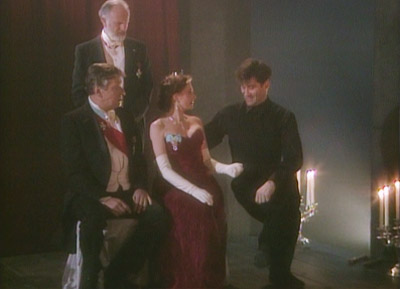
I've had my issues with Kline's adaptation, but have to admit the duel's choreography is to my liking, as it explicitly shows Laertes vacillating between murder and forgiveness all the way through. It begins with a sincere Hamlet apologizing and even embracing his wary "brother", which may well sow the seeds of doubt in Laertes' mind.
In the first exchange, Laertes knows he has a lethal weapon in his hand, and is timid in coming at Hamlet. This motivates the line "Come on, sir!" Laertes eventually does, and it's a good fight. An aggressive one too, and now wary of Laertes, Hamlet's attention really isn't on Claudius and his poison cup. The second exchange begins with a series of feints from both fencers, and at first, Hamlet seems to be having fun. It stops being enjoyable when he falls into a group of courtiers and while he's held in their hands, Laertes looks poised to skewer him in a rage. Obviously, this isn't one of the ways Hamlet can legally die here, so he stops himself, but from then on, the Prince is more careful. And it rattles Laertes too. The second exchange ends in a strange way, with Laertes letting his guard down on purpose and allowing Hamlet to get an easy hit. It's possible he now knows Hamlet is his better and he's trying to push him into drinking from the poison cup, but as events develop, it looks more like Claudius was right to doubt his drive for revenge.
After Gertrude naively drinks the poison, it looks like he's lost it completely. He heads for the weapons rack to get a non-poisonous sword, but Hamlet is too quick and begins the bout before he has a change to exchange one foil for another. As is usual, there's a moment where they hold each other and Osric must push them apart. In that moment, Hamlet - still oblivious to Claudius' shenanigans - almost takes a drink from the cup. The gesture makes Laertes turn again, and now wanting Hamlet to die by HIS hand, not Claudius', he stops Hamlet from drinking with the point of his sword, scratching him in the process. He then drops his sword and backs away, a gesture that recalls the modern "mike drop". There. Done.
Hamlet takes the dropped sword, and throws the other at Laertes. In the ensuing scuffle, Laertes grabes the blade in the middle, trying to keep the poison tip away from him. Hamlet slides the blade out of his grip, however, which slices his palms open. This ambivalence on Laertes' part makes his asking for Hamlet's forgiveness, and Hamlet giving it, more believable.
This Claudius clearly loves his wife, the fact of which we're reminded when he kisses her hand before even taking Hamlet's and Laertes'. His "Do not drink" comes off as a heartfelt warning, even a plea, which really should have given Gertrude pause. For the modern theater goer, the means by which he poisons the wine will seem highly unhygienic. He takes his ring off his finger and drops it in the cup, the pearl apparently set in it. I wouldn't drink out of that cup no matter how many fencing matches I won.
Gertrude dies in Hamlet's arms, which is a kinder way for her to go than is usually staged. He then moves to kill the King, scratching his ear, which we'll remember was where Hamlet Sr. was poisoned. He dies quickly; they don't make a meal of it. When Hamlet himself starts to feel the effects, he calls for Horatio who almost magically appears to catch him from behind. He clutches the Queen's hands for a moment more, the bodies more or less arranged in a chain on the floor, thematically representing their familial connections. Horatio would die with his friend, and there's a struggle for the cup, which Hamlet ends by throwing it away.
In the end, Kline's Hamlet doesn't struggle through his final lines the way other Hamlets sometimes have. The poison overcrows his spirit, not his vocal chords. If it means he dies more peacefully, so be it. At least the lines are strangled and hard to hear. Fortinbras next enters, and he seems a compassionate youth, surprisingly warm in his exclamations. Once again Hamlet is carried out in a Messianic position - this seems a favorite bit of staging - and as the soldiers slowly recede down a corridor, we hear a choir. These are the angels singing Hamlet to his rest, and in the notion of Horatio, a commoner, ordering royalty about, is expanded beyond even the mortal sphere. Horatio has commanded the very angels in Heaven. The world truly has been turned upside down by these events, an echo of Hamlet's parable of the worm and the king.
Showing posts with label Kline (1990). Show all posts
Saturday, February 14, 2015
Saturday, November 1, 2014
V.ii. The Readiness Is All - Kline '90
Kline keeps most of the sequence intact, give or take a line here and there (the mocking if Osric listing Laertes' twin weapons, for example, may be due to the duel's staging). As his Hamlet tells Horatio about his sea voyage, he seems steadier and far less weepy than before, and holds Horatio by the wrist as if he fears his friend would recoil hearing how their two school chums were murdered. He is shocked, but not too much, though Kline's performance did make me ponder if the scene could be staged where this speech is a veiled threat to Horatio's life. Cross me, and this is what happens. As it ends with Hamlet equating a man's life to a snap of the fingers, it could be quite effective and show a much changed Hamlet.
A line reading of interest: Hamlet stops on "cozenage", which means fraud (Claudius' specifically), and draws attention to its innate pun - it sounds like "cousinage", fusing this fraud with the false kinship the King has shown him, acting as false father, just as he was, in other ways, false brother to Hamlet Sr.
Osric then enters. He's played by Leo Burmester with an Irish accent, perhaps to show a rurality opposed to the other characters' noble births. He's a comic figure for Hamlet to toy with, but not particularly extreme compared to other performances. We see him searching for words as Hamlet gets off-script, and the Prince isn't particularly cruel to him. Once Hamlet has made his point about Claudius' yes men, he walks away. Several lines are cut, and one gets a sense that Osric is too tedious for Hamlet to bother with any longer. There is a strange, lingering moment on "yours, yours", which gives Osric pause. He has just basically send his services are at Hamlet's command, and though "yours" essentially means "thanks" in this context, it also reverses the order of things. Hamlet is at OSRIC's command, since he will be participating in a duel fated to end in tragedy at his behest. In a broken Denmark, a Prince might as well follow the orders of a powerless minion. They are as good as an illegitimate king's.
With the final speech, Hamlet once again grabs Horatio's wrist, this time to stop him from fussing. His defiance of augury is a grander pronouncement, as if spoken to Fortune herself, and Horatio looks spooked. And yet, Hamlet ends it with a resigned smile. Just behind him, a banner with a cross. Everything points to an ending in blood and sacrifice. Cue alarums...
A line reading of interest: Hamlet stops on "cozenage", which means fraud (Claudius' specifically), and draws attention to its innate pun - it sounds like "cousinage", fusing this fraud with the false kinship the King has shown him, acting as false father, just as he was, in other ways, false brother to Hamlet Sr.
Osric then enters. He's played by Leo Burmester with an Irish accent, perhaps to show a rurality opposed to the other characters' noble births. He's a comic figure for Hamlet to toy with, but not particularly extreme compared to other performances. We see him searching for words as Hamlet gets off-script, and the Prince isn't particularly cruel to him. Once Hamlet has made his point about Claudius' yes men, he walks away. Several lines are cut, and one gets a sense that Osric is too tedious for Hamlet to bother with any longer. There is a strange, lingering moment on "yours, yours", which gives Osric pause. He has just basically send his services are at Hamlet's command, and though "yours" essentially means "thanks" in this context, it also reverses the order of things. Hamlet is at OSRIC's command, since he will be participating in a duel fated to end in tragedy at his behest. In a broken Denmark, a Prince might as well follow the orders of a powerless minion. They are as good as an illegitimate king's.
With the final speech, Hamlet once again grabs Horatio's wrist, this time to stop him from fussing. His defiance of augury is a grander pronouncement, as if spoken to Fortune herself, and Horatio looks spooked. And yet, Hamlet ends it with a resigned smile. Just behind him, a banner with a cross. Everything points to an ending in blood and sacrifice. Cue alarums...
Sunday, August 10, 2014
V.i. Ophelia's Funeral - Kline '90
Kevin Kline does something very interesting in this scene, using Ophelia's body a character in its own right. Seconds into revealing himself, he's weeping and using that strange melodramatic voice he sometimes falls into over the course of the play; that's standard for him. Hamlet's emotion is strong enough, especially in comparison to the more steady (or perhaps less able to put things into words) Laertes, who is stunned by it. But then in a mirror of the other boy's interaction with Ophelia's corpse, Hamlet kneels down, caresses and even kisses the dead Ophelia. It's an intimate moment in which he tells her that the dog will have his day, a comforting promise. Deliciously ironic, because he killed her father and drove her to desperation, so he's also the dog that will be put down (a promise that is carried out). The moment comes right after he lets go of his anger and sadness at Laertes' own. There's a mental break there. And all the while, the other characters just let him go, just as they did when Ophelia made her mad speeches (I'm also reminded of Queen Margaret in Richard III; this is a Shakespearean tradition). In the throes of this madness, he then simply gets up and walks away without looking back.
Kline's adaptation is played as if on stage, and the planks are visible in this scene. There is no grave to put Ophelia or leap into. The sequence is played as a rest from the walk to the cemetery, and made to work. Claudius then has the rest of the short trek to remind a still shocked Laertes of their plans. Perhaps he senses the boy's reticence. This is not a particularly angry Laertes, and nothing, except Hamlet's presence, really inflames him. The priest is kind to him, answering his surprise at the slim rites kindly. His request to take Ophelia in his arms once more is dramatic, but shown by Hamlet's ranting to be somewhat insincere, like something he think he ought to do, not something he profoundly feels. Confronted by true emotion, he's no sure what to do. And perhaps are sewn the seeds of doubt, an empathy with the Prince.
Thursday, May 15, 2014
V.i. The Gravedigger Scene - Kline '90
Another adaptation that cuts the 2nd Clown and a few lines besides, the sequence begins with the Gravedigger singing for quite a long time as Hamlet and Horatio approach. Kline's Hamlet is filled with foreboding, as if returning to Denmark to find his grave there, which is in fact what IS happening. There is an interesting hesitation when he inquires if it is a woman's grave, fearing it might be his mother's or Ophelia's, though his worries are dispelled by the clown's amusing rhetoric. MacIntyre Dixon really plays the character as a classic fool, drinking, giggling and taking his time, he is somewhat dense and generally tedious, but can tell what any fool can. The joke goes on a bit too long for Hamlet.
Kline's interaction with Yorick's skull is far more sober than most, keeping it at a certain distance and only the very end smiling wistfully. He doesn't seem transported to a happier time, but rather forces himself to look at the thing Yorick has become, resentful and almost angry that life is rendered into dust in the end. When this Hamlet asks Yorick where his flashes of merriment have gone, their loss is keenly felt, and questions about the undiscovered country are once again raised.
Saturday, March 8, 2014
IV.vii. Ophelia's Death - Kline '90
As this production recreates the play as Kline crafted it on stage, the scene does not allow a flashback to the events Gertrude describes. It does, however, make sense of how wary Laertes is. His reaction to the news is to mistrust it, and his initial question (where?) drips with disbelief. Though he's just been "turned" by Claudius, the King has also shown him how devious and underhanded he could be (the convoluted murder conspiracy). Could Ophelia have been the victim of a similar plot, lest her madness reveal some hidden truths at Court? Because we don't see her suicide, we're allowed to be suspicious as well. Gertrude is certainly sincere, but did she actually witness those events (and thus is guilty of letting them happen), or was she told? And if told, how reliable was the witness? The problem with such an interpretation is that Claudius shouldn't be upset about this death affecting his plans for Hamlet (except with himself, but that's not the performance here).
Dana Ivey stresses the words "cold maid", which is an illuminating choice, as Ophelia is indeed the coldest of maids now. It's doubly interesting because this adaptation's Ophelia, Diane Venora, seems a little old for the part. Was she really a "maid", or is that part of Gertrude's tale to cushion the blow as much as the prettiness of the picture she paints?
Sunday, December 29, 2013
IV.vii. Claudius' Seduction - Kline '90
The scene suffers a number of cuts, starting slightly later, removing Lamond (as often happens), and any mention of the wick or snuff that could make Laertes hesitate. This Laertes is consequently all anger, and Claudius has no reason to challenge his commitment. One could almost believe Laertes had always held a certain malice against the prince who was wooing (if we're being tactful) his sister, who had more privileges than he did, who perhaps flaunted his wit and education around the castle. These events have just exacerbated an already tense relationship. One could also believe Laertes already has murder on his mind, and that he comes off thinking he's manipulated the King into giving him permission (which he does, in the sanctuary line). This might explain why his body language is so conspiratorial, giving Claudius a signal to keep quiet when a messenger comes in (after all, he has no reason to think Hamlet's already been sent to his death). Still, Claudius can't know the boy's mind, so does manipulate him a little bit, mostly by repeating the fact that Hamlet is returning, fueling that crucial anger.
This Claudius isn't as cold as some of the others, however, and Brian Murray lays fear into his performance. He's breathless, distracted, has to sit down. He almost shows his hand to the messenger, unwarrantably surprised and angry that the letter comes from Hamlet. It makes his plans sound more improvised and desperate. He's no mastermind, and we understand that it's all getting away from him. And Laertes is foolish to think it's a done deal, smiling like some psychopath and acting suspiciously when Gertrude comes in with some terrible news...
Thursday, November 7, 2013
IV.vi. Hamlet's Letter - Kline '90
In this extremely simple version of the scene, with a single silent sailor waiting behind Horatio, a mystery just as the contents of the letter, Kline cuts the lines about pirate ships, giving no real account of how Hamlet escaped his escort. The story works without this complication, of course, but makes the scene almost too simple to warrant an article about it. Perhaps that's our chance to discuss the text a little more, and how even a linking scene like this still has a poetry to it. Hamlet story (though here abridged) is about a reversal of fortune, an exile coming home rather than leaving it, and Shakespeare makes reversal a major theme of his short letter. Horatio is asked to COME to Hamlet speedily as if he was running away FROM death, the pursuer gaining the haste of the pursued. Hamlet's words will create silence. And so on. We should then see "these good fellows" as an ironic confirmation that the sailors are the pirates in the preceding story, and could even see a sly joke about Hamlet having much to say about two people who barely have enough content for a single character.
And of course, the greatest reversal of all is that this tiny scene is the pivot at the center of the play, turning the delaying Hamlet into the revenging Hamlet needed to bring the tragedy to a close.
Sunday, September 8, 2013
IV.v. Laertes Returns - Kline '90
Laertes' arrival in the Kevin Kline-directed version of Hamlet is pretty standard. While there's no rabble at his heels, the pseudo-military clothes give the feeling of mutiny, and Laertes' strong physical presence is threatening to the older, shorter Claudius, despite his cocksure smile. He's on guard. Laertes himself vacillates between anger and shock, as if he harbors a fear that he's misjudged the King, betrayed his country, and put his life and honor in danger. But before we can fully explore this, his mad sister enters.
In a white dress with a long train, Ophelia looks like she's come from her own demented wedding, and perhaps she has. She hold a paper flower made of what might very well be Hamlet's letters to her, unraveling them like the life she believed she would lead, and letting them fall on the floor, parallel to her tears. It takes a beat before she recognizes her brother and embraces him, though in her confusion, she almost kisses him full on the mouth, hiccuping her line about remembrance to stop herself. That's Hamlet represented. As for her father, she speaks her lines about him ("he made a good end" and so on) in a tone that parodies the platitudes one might hear at a loved one's funeral. Like Hamlet before her, she keeps changing character. Mocking and sincere, impish - stuffing a paper petal down Gertrude's cleavage, for example - and overwhelmed with grief. At the end of the sequence, she struggles with her brother and positively screams her prayers for God to have mercy on them all, finally collapsing in his grip, spent. And she'll walk out the same way she walked in, confused and deaf to the world.
Saturday, July 6, 2013
IV.v. Ophelia's Madness - Kline '90
Diane Venora has such a deep voice, it's hard to see her as anything but an adult version of Ophelia, but perhaps that's why her descent into madness as a kind of intermittent return to childhood, works. She's a woman acting like a little girl, dancing, clapping, singing and giggling in her night gown. It's a complex, mercurial, if sometimes over the top performance, with some interesting elements of mise en scène. First and foremost is her lack of animosity towards the royals. By removing the early sequence in which Gertrude doesn't want to see her, Kline makes the Queen more sympathetic, and Ophelia runs to her arms as if a mother. She puts on a brave face when the King arrives, but won't have anyone speak of her father's death. If there is a dark side to their relationship, it may be apprehended during the song about the two lovers. She plays director to the story, puts the King's hand into the Queen's and indicates how he's the boy in the story, and she the girl. Is she inferring something about the royal couple? That perhaps they'd been having an affair before Hamlet Sr.'s death? Or is it more likely she's throwing up a mirror for a future Hamlet & Ophelia that will now never come to pass?
Venora really presents two Ophelias. The child who dreams of being Queen, who sees imaginary ladies-in-waiting (in lines which, on the stage, might well be directed at audience members), sings and dances and passes notes (what is the significance of the crumpled piece of paper she gives Gertrude? An old love letter? Is this a corruption of the scene in which Polonius reads on to the royals?). The other Ophelia is the traumatized, grieving daughter who scratches at the floorboards (where the audience knows ghosts live), rhymes rather than sings, moans and beats her chest. They don't co-exist. When she moves from orphan to child at one point, she realizes her face is wet with tears and starts wiping it, as puzzled as she is ashamed. Ophelia is out of joint.
Sunday, April 21, 2013
Act IV, Scene 4 - Kline '90
Three things distinguish Kevin Kline's staging/acting of the scene from the other performances studied at Hyperion to a Satyr. First, proximity. This sticking quite close to the way they did it on stage, Hamlet is only a few few away from a young, dashing Fortinbras who has just walked off-screen/stage after giving his orders. Norway's army might be only 40 feet before Hamlet, and the drumbeat to which it walks is heard through the entire scene, practical music that spurs Hamlet on. In a sense, he becomes the army, though his cause is his alone.
The second difference is the sense of suspicion surrounding Hamlet. The Captain makes a face when Hamlet asks him about the army, as if deciding what exactly he will tell him. Is this a sign that the entire Polish campaign is a lie? Doubtful, as he gives too many details. Or perhaps it's all part of a cover story, since obviously, people (including Claudius) might question why Norway attacks this useless piece of land. And the Captain isn't just an officer, he's an ambassador, trusted to deliver a message to the Danish King. He could be skilled in the art of diplomatic deception. If Hamlet is lied to, it creates a layer of irony. Fortinbras, doubling back to attack Elsinore, is at once on the same mission he is - dethroning/killing Claudius - and mimicking Claudius' own actions - usurping Hamlet's rightful place on the throne. Claudius is the alternative to Hamlet Sr., and Fortinbras the alternative for Hamlet Jr. Rosencrantz & Guildenstern also treat Hamlet with suspicion, taking a long time to go "a little before", as if fearing Hamlet might escape their custody. This possibility is made entirely more possible by the army's proximity. He might easily lose himself in the crowd. But as usual, they get it wrong.
The third major difference in the performance is that tears stream down Hamlet's face during his speech. Kline's Hamlet is a rather weepy one, but why here? The scene is done mostly in tight close-up with a bitter Hamlet, getting louder only later as his anger and determination grow. But is he crying for the men who will lose their lives, for the Ghost of his father still trapped in limbo, or because he's disappointed in himself?
The second difference is the sense of suspicion surrounding Hamlet. The Captain makes a face when Hamlet asks him about the army, as if deciding what exactly he will tell him. Is this a sign that the entire Polish campaign is a lie? Doubtful, as he gives too many details. Or perhaps it's all part of a cover story, since obviously, people (including Claudius) might question why Norway attacks this useless piece of land. And the Captain isn't just an officer, he's an ambassador, trusted to deliver a message to the Danish King. He could be skilled in the art of diplomatic deception. If Hamlet is lied to, it creates a layer of irony. Fortinbras, doubling back to attack Elsinore, is at once on the same mission he is - dethroning/killing Claudius - and mimicking Claudius' own actions - usurping Hamlet's rightful place on the throne. Claudius is the alternative to Hamlet Sr., and Fortinbras the alternative for Hamlet Jr. Rosencrantz & Guildenstern also treat Hamlet with suspicion, taking a long time to go "a little before", as if fearing Hamlet might escape their custody. This possibility is made entirely more possible by the army's proximity. He might easily lose himself in the crowd. But as usual, they get it wrong.
The third major difference in the performance is that tears stream down Hamlet's face during his speech. Kline's Hamlet is a rather weepy one, but why here? The scene is done mostly in tight close-up with a bitter Hamlet, getting louder only later as his anger and determination grow. But is he crying for the men who will lose their lives, for the Ghost of his father still trapped in limbo, or because he's disappointed in himself?
Sunday, February 17, 2013
Act IV, Scenes 1-3 - Kline '90
Scene 1
Brian Murray is one of the better Claudiuses, as evidenced by the sincerity he brings to his performance in this scene, a sincerity that draws attention to different words usually spoken quickly or with no particular emphasis, and enriching the text. His concern for Gertrude is heartfelt, and her focus on the murder of Polonius makes us believe she really does think her son mad. She has not gone over to his side. When Claudius says it would have been him killed had he been in Polonius' place, there is no shock or surprise in his voice, only assurance. This is Claudius at his most Kingly, deciding the truth of what has happened and moving from there. He is still a master politician, for example stressing the words "countenance and excuse" for Gertrude's sake, letting her know that while Hamlet is to be punished, the measures will be for his own good.
So what words does Mr. Murray illuminate? To begin with, there's the irony of the phrase "out of haunt", which had escaped me until now. Claudius means that Hamlet should have been kept locked away and not been allowed to walk (haunt) the halls of Elsinore at his leisure, but he doesn't know most of the current trouble is due to his brother's Ghost doing the same. Should we also see a pun in "The sun no sooner shall the mountains touch"? Shakespeare is notorious for playing on sun/son, and in this case, the phrase might have a double meaning akin to "before Hamlet can make his own escape", or even "before Hamlet can gain support and reach the top, i.e. kingship".
Scene 2
There were several cuts in Scene 1, the most important of which was Rosencrantz & Guildenstern's presence, but they're in this scene, obviously having been told to find Hamlet in between scenes. Kline's Hamlet is calmer and less obviously mad than most others in this sequence, bringing genuine outrage to the sponge speech. He even lets his anger come out when he says he's the son of a king, making this Hamlet more indignant about the subverted class system than most. And indeed, the same way Claudius has subverted the succession, R&G (at least, in Laertes' absence) have taken his place as the favored son of a king. A bloody rag in his hand, Hamlet uses the prop effectively AS a sponge, perhaps indicating that what they have soaked up is steeped in blood, fruits of a tree growing from a murder.
Scene 3
Instead of being brought to Claudius, the start of this scene is trimmed off and Claudius and his officers come to him. Both Kline and Murray play this scene calmly and reasonably, letting the words act as veiled threats or lunatic dissertations. Though underplayed, there is still a lot of invention on show. For example, though gesturing at Claudius when mentioning the "fat king" is par for the course, allowing the other hand to gesture at R&G on "lean beggar" is not. It becomes a reference to the sponge metaphor, and inverts the cannibalistic relationship between the characters. The King eats them like an apple, and they eat him like a fish. Who is using who?
Hamlet leaves his stepfather with a violent kiss on the cheek, which seems even more threatening than the words they've just exchanged, as if telling Claudius that kiss might well have been a dagger. He let him get too close. There's also some very effective staging - and excellent use of the text as written - as R&G are sent away. Claudius continues speaking after giving the order, and they turn around to, sponge-like, receive more of his words. It's an almost comical move that motivates the harsher "Pray you make haste" as Claudius seems to finally lose patience with his chief sycophants.
Brian Murray is one of the better Claudiuses, as evidenced by the sincerity he brings to his performance in this scene, a sincerity that draws attention to different words usually spoken quickly or with no particular emphasis, and enriching the text. His concern for Gertrude is heartfelt, and her focus on the murder of Polonius makes us believe she really does think her son mad. She has not gone over to his side. When Claudius says it would have been him killed had he been in Polonius' place, there is no shock or surprise in his voice, only assurance. This is Claudius at his most Kingly, deciding the truth of what has happened and moving from there. He is still a master politician, for example stressing the words "countenance and excuse" for Gertrude's sake, letting her know that while Hamlet is to be punished, the measures will be for his own good.
So what words does Mr. Murray illuminate? To begin with, there's the irony of the phrase "out of haunt", which had escaped me until now. Claudius means that Hamlet should have been kept locked away and not been allowed to walk (haunt) the halls of Elsinore at his leisure, but he doesn't know most of the current trouble is due to his brother's Ghost doing the same. Should we also see a pun in "The sun no sooner shall the mountains touch"? Shakespeare is notorious for playing on sun/son, and in this case, the phrase might have a double meaning akin to "before Hamlet can make his own escape", or even "before Hamlet can gain support and reach the top, i.e. kingship".
Scene 2
There were several cuts in Scene 1, the most important of which was Rosencrantz & Guildenstern's presence, but they're in this scene, obviously having been told to find Hamlet in between scenes. Kline's Hamlet is calmer and less obviously mad than most others in this sequence, bringing genuine outrage to the sponge speech. He even lets his anger come out when he says he's the son of a king, making this Hamlet more indignant about the subverted class system than most. And indeed, the same way Claudius has subverted the succession, R&G (at least, in Laertes' absence) have taken his place as the favored son of a king. A bloody rag in his hand, Hamlet uses the prop effectively AS a sponge, perhaps indicating that what they have soaked up is steeped in blood, fruits of a tree growing from a murder.
Scene 3
Instead of being brought to Claudius, the start of this scene is trimmed off and Claudius and his officers come to him. Both Kline and Murray play this scene calmly and reasonably, letting the words act as veiled threats or lunatic dissertations. Though underplayed, there is still a lot of invention on show. For example, though gesturing at Claudius when mentioning the "fat king" is par for the course, allowing the other hand to gesture at R&G on "lean beggar" is not. It becomes a reference to the sponge metaphor, and inverts the cannibalistic relationship between the characters. The King eats them like an apple, and they eat him like a fish. Who is using who?
Hamlet leaves his stepfather with a violent kiss on the cheek, which seems even more threatening than the words they've just exchanged, as if telling Claudius that kiss might well have been a dagger. He let him get too close. There's also some very effective staging - and excellent use of the text as written - as R&G are sent away. Claudius continues speaking after giving the order, and they turn around to, sponge-like, receive more of his words. It's an almost comical move that motivates the harsher "Pray you make haste" as Claudius seems to finally lose patience with his chief sycophants.
Sunday, November 18, 2012
III.iv. The Closet Scene - Kline '90
No bed, no inappropriate mounting of one's mother, we seem well away from Zeffirelli's Oedipal staging, though by the end, Kline does give us a light kiss and a lot of hair and face stroking. Tender affection only brought on when Hamlet sees a hope for his mother's soul. But until then, the scene is set in a black room with red curtains, a red carpet and red chairs, foreshadowing the bloody deed that is to come and giving the entire scene, played mostly on the floor, a sense of violence.
Polonius goes out behind the arras earlier than in the text, at "I'll silence me, even here", which stressed this way, is rather like a suicide note. He'll come out again for one last line and bit of comic business before Gertrude asks him to withdraw. Dana Ivey as Gertrude is the one to watch here. Before Hamlet walks in, she's pacing, nervous, but once he enters, she becomes poised and regal, demanding answers as a Queen would. She puts on this character in part out of habit, and in part because it should work on a grown son who acts like a child. Queen/Mother, Country/Son - these concepts are connected, and when Hamlet asks her not to make things worse, he uses the rank weeds metaphor that we linked to Denmark as unweeded garden way back in Act I. From that angle, Hamlet is the rebellious country unhappy with its leaders' decisions, or rather that country's vocal discontents, as Laertes will actually lead the violent revolution. Should we then see Gertrude's mix of chiding and kindness as part of that allegory? A patronized Danish people who can get out of hand because of weakness at the top?
The scene plays out as more of a conversation than most adaptations allow. Gertrude genuinely wants answers and Hamlet is trying hard to convince her of the error of her ways. As the emotions reach a crescendo, the volume does go up, until Gertrude is screaming, through some very real anguish, for her son to stop. By showing her her two husbands, he seems to trigger her guilt and grief, but Gertrude always gets more agitated when he demands she stop sleeping with Claudius (and she gets a number of opportunities, he just won't let it go). Is the King violent? Does she fear political reprisal? Does she use sex as a weapon, and was planning to undo Hamlet's exile this very night with her feminine wiles? Does she truly love Claudius? Is she traumatized by the revelation that Claudius killed Hamlet Sr.? Any of these are possible and could make for interesting staging, though here it remains ambiguous.
The Ghost appears with a slight shift in lighting (no special effects, this was a theatrical production, after all), and it keeps to behind Gertrude, across from Hamlet, a most effective staging of the scene. The sense of worry Gertrude has for her son throughout returns to her here, and even Hamlet seems to be trying to convince himself of his mental health when he talks about his pulse keeping the time. Does it? Keeping time in this play is a most difficult enterprise. Kline's Hamlet doesn't appear to only be mad in craft, as evidenced by his murder of Polonius, and the way he speaks to the old man as if he were still alive. He drags him away, the red curtain getting caught on Polonius' foot and creating a sense of blood even though the scene is actually bloodless. His final good night is somber and macabre. The performance, as much as the text, puts Gertrude in an untenably ambiguous position. Madness and reason, violence and kindness, the men she loves both murderers, and this goodbye that does nothing to quiet her motherly concerns.
Polonius goes out behind the arras earlier than in the text, at "I'll silence me, even here", which stressed this way, is rather like a suicide note. He'll come out again for one last line and bit of comic business before Gertrude asks him to withdraw. Dana Ivey as Gertrude is the one to watch here. Before Hamlet walks in, she's pacing, nervous, but once he enters, she becomes poised and regal, demanding answers as a Queen would. She puts on this character in part out of habit, and in part because it should work on a grown son who acts like a child. Queen/Mother, Country/Son - these concepts are connected, and when Hamlet asks her not to make things worse, he uses the rank weeds metaphor that we linked to Denmark as unweeded garden way back in Act I. From that angle, Hamlet is the rebellious country unhappy with its leaders' decisions, or rather that country's vocal discontents, as Laertes will actually lead the violent revolution. Should we then see Gertrude's mix of chiding and kindness as part of that allegory? A patronized Danish people who can get out of hand because of weakness at the top?
The scene plays out as more of a conversation than most adaptations allow. Gertrude genuinely wants answers and Hamlet is trying hard to convince her of the error of her ways. As the emotions reach a crescendo, the volume does go up, until Gertrude is screaming, through some very real anguish, for her son to stop. By showing her her two husbands, he seems to trigger her guilt and grief, but Gertrude always gets more agitated when he demands she stop sleeping with Claudius (and she gets a number of opportunities, he just won't let it go). Is the King violent? Does she fear political reprisal? Does she use sex as a weapon, and was planning to undo Hamlet's exile this very night with her feminine wiles? Does she truly love Claudius? Is she traumatized by the revelation that Claudius killed Hamlet Sr.? Any of these are possible and could make for interesting staging, though here it remains ambiguous.
The Ghost appears with a slight shift in lighting (no special effects, this was a theatrical production, after all), and it keeps to behind Gertrude, across from Hamlet, a most effective staging of the scene. The sense of worry Gertrude has for her son throughout returns to her here, and even Hamlet seems to be trying to convince himself of his mental health when he talks about his pulse keeping the time. Does it? Keeping time in this play is a most difficult enterprise. Kline's Hamlet doesn't appear to only be mad in craft, as evidenced by his murder of Polonius, and the way he speaks to the old man as if he were still alive. He drags him away, the red curtain getting caught on Polonius' foot and creating a sense of blood even though the scene is actually bloodless. His final good night is somber and macabre. The performance, as much as the text, puts Gertrude in an untenably ambiguous position. Madness and reason, violence and kindness, the men she loves both murderers, and this goodbye that does nothing to quiet her motherly concerns.
Saturday, September 1, 2012
III.iii. The Confessional - Kline '90
Leaving Rosencrantz, Guildenstern and Polonius out of it, we jump straight into Claudius' confession. The staging is quite well done. A funeral bell is hard, Claudius is in shadow, his collar undone. He is a man unmade by his own grief. At the word "above", the camera angle changes to a divine point of view above him, tracking back, repulsed by his inability to be redeemed. He will choose a square of light in which to kneel and pray in, crossing himself before doing so. In all this, he comes across as sympathetic. His guilt is real and makes him tear up, and he puts emphasis on his queen more than his crown. This Claudius did it for love, not just for ambition's sake.
Hamlet comes upon him, and it's no surprise since the staging is based on a theatrical performance that the prince can run around Claudius, shout and scream and not be noticed. The words are an aside, but so are the gestures, and meant to exist for the audience, but not for the characters. Symbolically, Hamlet aims for Claudius' ear before taking his swing, and in realizing that this is the wrong time for his revenge, he swings the dagger around Claudius madly with each mentioned sin. It reinforces the illusion that we're in a frozen moment in time, and must be quite a feat for the actor playing Claudius to remain so still while Hamlet whirls around him. Hamlet leaves, and Claudius is jolted out of that moment, not by a physical cue, but by an inner realization that he cannot and should not be forgiven his murder.Throughout, Hamlet appears to be mad and dangerous, and Claudius so much more human and relatable. Indeed, is Hamlet so extreme an intellect that we might be more inclined to side with the villain, or at least better empathize with his venal motivations?
Thursday, June 21, 2012
III.ii. Critical Reception - Kline '90
In a small ironic twist, Hamlet runs around with a dagger at the beginning of this sequence - false fire indeed! And euphoric, he lets himself fall into Horatio's arms from off the stage, a foreshadowing piece of staging, as well as a call back to his feeling faint after meeting the Ghost. This is the midpoint between getting the mission and seeing it done, the turning point, and each one a blind fall backwards. Does Horatio believe Claudius showed his hand? Or does he just play along with the Prince dangerously swinging that knife around? There's simply no room to play the ambiguity as Hamlet jumps right back onto the stage and starts playing the recorder.Rosencrantz & Guildenstern come running, and spin out their speeches while Hamlet pipes through them. The recorder is his weapon, used either to drown out their words, or swung as a dueling sword. Rosencrantz seems particularly earnest in trying to reason with him, honestly trying to save him from this reckless path he's set himself on. The old friendship appears more tangible in this adaptation. Consequently, Hamlet is less manic, though there are still moments of mad energy, such as on the "pickets and stealers" line, pulling handkerchiefs out their pockets like a stage magician. Regardless, Hamlet is more in control of his words. For example, "I lack advancement" is said with a smile, like he's pulling unconvincing reasons out of the air just to see how they'll respond.
A moment that made me stop and think is Guildenstern's contention that "if [his] duty be too bold, [his] love is too unmannerly" met with a real pause from Hamlet before answering that he doesn't understand that. He pauses, so we do as well. What surprises him in that line, or alternately, what makes him point out Guildenstern's delusion or hypocrisy? To paraphrase, Guildenstern's lack of manners are attributable to being oh so worried about Hamlet. Oh really! The Prince goes on to attack his credibility, so he clearly doesn't believe a word, that somehow these former friends care about him more than they do themselves. And he's very serious and calm throughout the sequence, adding to the earnestness. The scene is usually played with Hamlet being "idle", playing up his madness, and R&G as panicking hypocrites. In this adaptation, it is closer to an honest portrayal of a friendship breaking down. Or any relationship, in fact, because Hamlet is much the same with Polonius.
Of course, Hamlet's claims about imaginary clouds seems like madness no matter the tone. At least, Polonius thinks it so, looking sideways at R&G, trying to get a sign from them about the Prince's state of mind. He awkwardly agrees with everything, trying not to wake the beast, so to speak. Hamlet, too, is giving meaningful looks. Polonius IS the weasel that inspires the cloud simply for accepting the initial premise. A white lie, but one told by a liar nonetheless.The soliloquy has a trigger: Midnight bells, rung at the "witching hour", giving the whole of the speech a funereal air, and giving the dagger, pulled back out, a fatal and dread resonance.
Saturday, March 24, 2012
III.ii. The Mouse-Trap - Kline '90
In Kline's adaptation, the Royals sit on the stage, facing the audience, and the Players perform their play midway between the Royals and the audience, using profiles to play to both. This is an ingenious use of stage space that in the theater, would allow the real audience (us) to see both The Mouse-Trap and the characters' reactions. While Hamlet doesn't sit on stage, he and Ophelia are off to the side, still facing us in ¾ view. This staging also works thematically, enhancing the mirror effect between the Royals and the Players.Ironically, though Hamlet has dramatized his parents, both by rewriting the play and placing them on the stage for all to observe, he's the star of the show. As the Court enters, he is draped in a red curtain, Christ-like. He initiates applause that an already impatient Claudius stops with a look and a gesture. He falls off the stage as if it were a cliff, making his voice recede, an echo of the fate Horatio feared he would meet by following the Ghost some days prior. Indeed, while we'll soon find out the Ghost wasn't lying about the murder, the play is the moment that truly embarks him on his doom. It will lead to Polonius' murder, his exile, subsequent return, and "all we mourn for". His falling off a cliff here makes that point. Kline also makes good use of his mime skills by sitting next to his mother on an invisible chair, as absent as their relationship.
Hamlet also makes Polonius squirm by letting him go on about his university days, a brilliant comic delivery from Josef Sommer as Polonius, adding information haltingly to cover the lack of reaction. The crowd does laugh at Hamlet's punchline, as it does at some of his early cracks at Ophelia. Her humiliation feels all the more public, and her quick look at her father when Hamlet makes an obscene remark may indicate she's hiding a sexual relationship (older-looking Ophelias, and those from more modern settings, give this impression rather easily). And of course, Hamlet flings accusatory comments in his parents' direction, which displease, but do not seem to embarrass.Claudius is a character to watch in this sequence, and not just because Hamlet has asked us to observe him. Brian Murray plays him fresh off the Nunnery scene, wary of what might happen, rather than, as it is sometimes played, seeing a turn for the better in Hamlet's passion for the theater. As the play begins, rather suddenly and without Prologue or dumb show (and yes, that means the brevity of woman's love isn't mentioned), Claudius gets somewhat lost in the story. The visual mirror makes Gertrude see herself in the Queen, of course, but mistakenly see Claudius in the King. In the background, she tenderly pets her husband, not seeing her forgotten former lord. Claudius is no less affectionate, though he does look in Hamlet's direction whenever the prince blurts out a line, trying to figure him out.
His other hand is on a drink, one we see him refill during the sequence (as Hamlet mentions poison, another visual irony). Playing on Claudius' weakness for alcohol goes a long way in showing how such a practiced politician could give himself away during this scene. He's had too much too drink and loses control. It's also interesting to see him puzzled at the title of the play, for indeed, why is it called that unless it ends with a Player Prince catching the murderer? Claudius might even think Hamlet has made changes to the play, and a clue exists in Lucianus switching from dagger to poison as he enters. One of the changes Hamlet has made? As the veiled accusation is UNveiled, Claudius drops his glass and stands, a gesture that shocks the assembly. Here, Kline creates a motivation for the otherwise redundant line "The King rises". The audience must be prompted to stand (as they must) because they've forgotten their manners in the wake of this incident. Chaos ensues as Claudius disentangles himself from Gertrude's kind ministrations, as she is part and parcel of the guilt he's suddenly experiencing.
Tuesday, January 24, 2012
III.ii. Instructing the Players - Kline '90
The scene is prefaced by a "Part II" title card, no doubt where Kline's stage play broke for intermission, and it's notable that Part II is when Hamlet actually starts to act in response to his father's murder. Not coincidentally, it's when people start to die. As the scene starts, candles and chairs a brought in to support what looks to be an intimate performance. On stage, that's what we'd always get, a few characters sitting around a small stage ON stage, though the play's audience may act as the play-within-a-play's audience as well. A filmed stage presentation omits this meta-audience and restores the image of small affair. Big film productions allow the Mouse-Trap to act as a scandalous reveal of Claudius' guilt (or at least Hamlet's attempt to publicly flush out the King's culpability), but the realities of the theater rarely allow for this take.Hamlet's directions are corrective ones, as he catches the Player sawing the air with his hands, for example. And as in the BBC version, the directions to the clowns are omitted. Is this common practice for Hamlets who are more on edge than others? The more clownish and mad Hamlet is, the less appropriate his warnings to the clown players become? It does rob the play of one of its ironies. While giving direction, the Prince sits on the stage, and so this is another performance, one in which the Players become the audience. It's a nice reflection of the royal audience that will be translated into the Players once the play begins. Hamlet directs both, and performs in both, and is audience to both. If the world's a stage, Hamlet is the one who plays all the parts, both on and off stage. He's even the usher, completing the mirror image of audience/Players by moving the "thrones" in the audience center to the stage, turning the Claudius and Gertrude's seats into the Player King and Queen's.
The portrayal of the Hamlet/Horatio relationship follows the usual conventions. Hamlet is sincere and calmer than normal, and Horatio is touched by his show of affection. In speaking to Horatio, Hamlet finds a stable rock to perch on, up and above his madness. The performance here highlighted one line I've usually glossed over, and that's "we will both our judgments join". Not only is Horatio considered an equal despite his lower birth, one whose opinion is equivalent to a Prince's, but it's also Hamlet's attempt at corroborating the information he got from the Ghost. Hamlet doesn't trust his father's spirit, but more importantly, he doesn't trust himself. If he's going mad, the accusations leveled at Claudius may be a product of his diseased mind, even if the Ghost is real. He trusts Horatio to confirm (as we, the audience, must) that he isn't imagining it. Horatio acts as the moral compass of the play, but also as a psychological gauge for Hamlet.
Friday, December 9, 2011
III.i. The Nunnery Scene - Kline '90
Now let's see how the scene comes across with an older, wiser Ophelia. At least, that's how I read Diane Venora's performance (and she was 38 at the time). Her age makes her less fearful of Hamlet or her father, and perhaps takes part in the scheme willingly, for her own reasons. She makes herself available to Hamlet with a smile and tries to cheer him up, acting like nothing's wrong. The gifts she bears, some letters and a dried flower, could be meant to refresh his memory or focus his wits. When he doesn't accept them, she lays them on the stage, and you'll note that "their perfume lost" is cut. We must then believe her motivation to be elsewhere. She still loves him and giving him back these things is not meant as an affront, reproach, or sign that she doesn't love him anymore. Her bright spirits are nonetheless mitigated by the demons she sees in his eyes and speech, and she eventually backs away from him. But still, she seems hopeful that he can come back from this madness, so she is visibly hurt by his denial of their love. When she says she was "the more deceived", it's with a bitter, but honest laugh. An older woman mocking herself for having acted like a schoolgirl.Kline does a good job with Hamlet as well. His version of "well, well, well" is robotic, a sample stuck on repeat as he ambles towards her, reaching for her hair. She stops his gesture and at the same time, his words. He peruses her face with his hands, gestures borrowed from the description of their first post-Ghost meeting, a smart use of the text in a different context. If these are Hamlet's mannerisms, why deny him those gestures in the rest of the play? And he eventually destroys the gifts, ripping up the letters, more of the erasure of the past he's been engaged in since he talked with his father's spirit. The nunnery speech is not unkind though. Hamlet has a thin smile, and advises more than accuses. She stops him with kisses, and this time, he's the one who pushes her away with a question about her father's whereabouts. He holds her tight during the next exchange, swinging her around in the parody of a newlywed dance. It gets more violent, he throws her down, hits her with a thrown book, tries to wipe away her make-up (her false face), moves her around as if she were a puppet (which she is - her father's)... Some of this is performance. He shouts at the air and looks around furtively. The kindnesses he does give Ophelia here are non-verbal and hidden in a flurry of strange, violent behavior.
After he leaves, Ophelia is left in the middle of a destroyed shared past, discarded like the trash around her. She grabs a piece of a poem, the "honey of his music vows", still clinging to past happiness, but her life is veritably in ruins. Is she picking up the pieces of her destroyed mind? Claudius seems more moved by these events than Polonius, her cold father who has his back to her and her distress. Ironically, he talks about neglected love as the cause of Hamlet's madness, not realizing he's neglecting his own (and soon to be mad) daughter. When she tries to speak, he stops her, refusing to empathize with her. Ophelia is often played as passive and listless in this moment, but Venora tries to actually say something. Who knows what that might be and what important piece of evidence or insight she might have imparted. She finally walks away, shell-shocked. Does her mind crack here? She'll be more keen in the next act, but it could be said that the first stone has been thrown at her fragile, glass-like mind.Kline uses a title card here: END PART I. It's where the break would have been at the theater. Perhaps it's a good place to make some set changes, prepare for the play within a play, etc., but evidently Kline also sees this as the mid-point in the play. And it is. From this point on, Hamlet stops doubting himself and proceeds with his plans, while for Claudius, the investigation is over and he is resolved to exile Hamlet as soon as possible. The shift to action, rather than inaction, characterizes the next act.
Sunday, October 2, 2011
III.i. To Be or Not to Be - Kline '90
Kline's Hamlet comes into the room and stays at the doorway. We, the camera's point of view, close in slowly until we'll be on his face. There is no indication here that Hamlet knows he's being spied upon, but the staging infers that the speech isn't overheard. Hamlet has yet to step into the trap, his moment of hesitation at the door stopping the action figuratively as well as literally.Kline's delivery is what you'd expect from his Hamlet, all sighs and tears, but it does get more interesting at the end when he weeps and laughs at the same time, finding it laughable that people bear the burden of all those evils.Hamlet's native irony is revealed much as it was in "What a piece of work is a man", and he mocks humanity (himself included) for being the butt of a cosmic joke, and existential cowards to boot. The tail end of the speech becomes an attack on conscience itself, the immutable thing that is preventing him from acting. A flash of anger at the word "thought" confirms this. He is angry at the morality that is delaying his revenge, in effect cursing God himself. The speech is in fact quite religious without ever mentioning faith. Hamlet's morality is highly Christian (Puritanical compared to the people around him), and those teachings and the fear of the afterlife reserved for suicides in that cosmogony are what stay his hand against his will.
He hears Ophelia coming, with a half-smile imbued with gentleness, but also dread. He has avoided this meeting, just like he has avoided doing anything with meaning. The play tips on the edge of that knife's point.
Thursday, August 11, 2011
III.i. Briefings - Kline '90
Rosencrantz & Guildenstern's appearance is cut from Act III Scene 1, leaving us to imagine them giving Claudius their meager findings off-stage. We instead start with Claudius asking Gertrude to leave so they can spy on Ophelia, the proper start of the second briefing. This Gertrude doesn't seem to mind and is content to obey her husband. Ophelia, for her part, is enthusiastic! She evidently believes this ploy will work and that her father's theory is likely the correct one. After the scene recounted by Ophelia earlier, who could blame her? His first show of madness, as far as Elsinore is concerned (Horatio and the soldiers were sworn to silence), was to Ophelia. Most actresses use how shaken Ophelia was in that first sequence to inform her meeting with Hamlet, apprehensive and hurt rather than hopeful, but playing the opposite is quite correct too. Hopefully, that choice will play out in interesting ways later in the scene.
Josef Sommer's Polonius remains as pedantic as ever, instructing his daughter on where and how to walk, as if talking to a child, which is all the more ridiculous given his Ophelia's apparent maturity.
Saturday, July 9, 2011
II.ii. O, what a rogue and peasant slave am I - Kline '90
Kline's Hamlet looks around, makes sure he is alone before saying so. He has a small stage to play with and makes good use of it, at first sitting amazed at the First Player's performance while also letting a certain measure of outrage build until the energy of it makes him jump up on it. Outage that the Player dared show more emotion than he has allowed himself to, outrage also directed inward for needing a reminder that he has lost his way. As his frenzy builds, he spins and gesticulates, miming the drowning of the stage with tears, for example. There is a pregnant pause after "Am I a coward?". Kline makes Hamlet really ask himself the question, not as rhetoric, but in such a way that it demands an answer. After thinking about it for a moment, he starts pointing to imaginary people, shadows that call him villain and such, before he finally collapses into a fetal position, overwhelmed.
We're reminded that we have seen this Hamlet snap in Act 1, and that he is not wholly feigning his madness. The guilt of not yet having avenged his father (perhaps compounded with that of not having prevented the murder in the first place and/or of having survived while a great man did not) translates into accusers only he can see, giving some reason behind the soliloquies. These are essentially a running conversation with Hamlet's demons (perhaps not so apart from those more "literal" devils he fears are trying to damn him). In a vision of the play where the Ghost is part and parcel of Hamlet's madness, his suspicious and ultimately murderous impulses are completely generated from within, psychologically. Only Horatio and the soldiers prevent us from taking this analytical route exclusively.
Subscribe to:
Posts (Atom)