The original
Probably because there was too much sexual subtext in the sequence, the original Classics Illustrated adaptation chose to explain Ophelia's madness in no uncertain terms in a caption (Claudius will repeat some of this information in verse in his short speech), and reduced the scene to two mostly harmless snatches of song (though "cockle" survived as a rude pun, as did "maid" which is implicitly sexual). In fact, it's all about Hamlet. Nothing about Polonius' death, despite what the caption might say. Note also Ophelia's flowers which will play a part in her next (and last) appearance.
Gotta love the royals' comic take in the first panel. They're also given a panel (not shown) in which to despair, again in mirroring poses that would suggest these versions of Claudius and Gertrude are still a solid couple. The adaptation sadly doesn't do a lot to flesh out the characters, so the underwritten Gertrude is more underwritten (underdrawn?) still, often just an ornament on Claudius' arm, placidly receiving dialog more than she ever doles it out. We can't really know what she thinks of the King, if anything.
The Berkley version
The Grant/Mandrake version has also been sanitized, cutting everything that relates to Hamlet, so Claudius is right to invoke her father's death as the reason for her madness. In this adaptation too the royal couple seems as solid as ever. Look at the staging: It's Gertrude who brings Ophelia to the King, placing the Queen in a servile position. As for the art, I wondered what those pill-like shapes on the edge of the first panel were and decided they were hinges. Unstuck from the second panel, they're an image of the "unhinged". A clever little piece. I've looked and it's not a recurring motif. A clue that Ophelia's madness is real, whereas Hamlet's was not?
Claudius gets to say his piece on the next page, and you'll note the bloody wash that frames the panel, the same kind of wash that framed Polonius' murder. It gives Claudius' speech about "murd'ring" an ironic bent, showing how selfish he is to moan about his woes when those of others are much greater (and indeed, stem from his own misdeeds). Ophelia in this panel becomes a dark figure, disappearing into the walls of Elsinore. She has become a truth-speaking ghost, not unlike Hamlet Sr. though less intelligible. Of course, the Ghost was an enigmatic figure until Hamlet came. This time, Hamlet will come too late to wring any meaning out of Elsinore's resident ghost.
Showing posts with label IV.v. Ophelia's Madness. Show all posts
Friday, July 26, 2013
Sunday, July 21, 2013
IV.v. Ophelia's Madness - Tennant (2009)
Starting in front of the broken mirror, a metaphor now for Ophelia's broken mind, Gertrude's broken spirit, and Claudius' broken Denmark, we see tensions run high in Elsinore. Only Horatio's calming influence makes Gertrude agree to see Ophelia. Left alone for an instant, Gertrude speaks her only soliloquy in the play, laughing bitterly at the irony of it all, but keeping it brief as if unwilling to look (and speak) into that mirror for too long. When Ophelia walks in disheveled, it's like the Queen sees her for the first time and is suddenly worried for her (rather than the realm). It's made real. But for the audience, it takes a moment longer before we're shown Ophelia directly. We initially remark on her madness only as it plays on Gertrude's face. Is this an image of the Queen's greatest fear about herself? Is one of the reasons the Queen doesn't want to see Ophelia that she feels herself slipping into madness and can't bear one more "spill"?
Ophelia begins with a sad song, but as soon as either of the royals try to touch her - as Claudius walks in with papers that later prove to be news of Laertes' rebellion - she grows manic, screams "PRAY MARK" and starts whirling about the room. She's a dangerous creature to the realm and that sense is given by sudden moves, like her jumping at the Queen's hair, or ripping off the King's jacket. Director Greg Doran apparently rehearsed Ophelia separately from the other actors at first, so that their reactions would be truthful and the mad girl's antics all the more surprising. As she moves to the mirror and goes to touch a sharp shard of glass, they fear she might do a desperate outrage to herself (and she will, through something else that gives a reflection). Some of her madness is real, as in the moment where she looks vacantly into the distance reliving her father's burial, but sometimes she feigns madness to terrorize the royals. The story about the owl, for example, is accompanied by an epileptic fit to mime the transmogrification. This ties her more solidly with Hamlet. She's his mirror, but perhaps in more realistic psychological terms, her imitator. Note also the hilarious reading of the line "I hope all will be well" as a mockery of Patrick Stewart's mannerisms and voice. As such, it means Ophelia does not hope all will be well, and indeed wishes doom on this entire family at her brother's vengeful hands.
The production does not shy away from the more sexual aspects of the scene. In her manic state, Ophelia quickly removes her dress and slip during the tumbling song and refuses the Queen's attempts to drape a shawl over her nakedness. Although Ophelia still has underwear, Claudius looks away embarrassed, contradicting Hamlet's portrait of him as a lust-filled beast. She runs off, clothes in hand, when she suddenly finds herself vulnerable with the thoughts she'd been avoiding all along, those touching her father's death. But make no mistake, this was a coded attack on the royal family.
Claudius, ever the unctuous politician, seems all too calm about the situation, his priority to cajole the distance Gertrude into his frame of mind. His smooth tones betray his intentions, this is a spin job, and he makes sure to blame Hamlet for their problems, an accusation she shrugs off angrily, as if it's been his mantra now for a while and she's tired of hearing it. But he's not exactly wrong.
Ophelia begins with a sad song, but as soon as either of the royals try to touch her - as Claudius walks in with papers that later prove to be news of Laertes' rebellion - she grows manic, screams "PRAY MARK" and starts whirling about the room. She's a dangerous creature to the realm and that sense is given by sudden moves, like her jumping at the Queen's hair, or ripping off the King's jacket. Director Greg Doran apparently rehearsed Ophelia separately from the other actors at first, so that their reactions would be truthful and the mad girl's antics all the more surprising. As she moves to the mirror and goes to touch a sharp shard of glass, they fear she might do a desperate outrage to herself (and she will, through something else that gives a reflection). Some of her madness is real, as in the moment where she looks vacantly into the distance reliving her father's burial, but sometimes she feigns madness to terrorize the royals. The story about the owl, for example, is accompanied by an epileptic fit to mime the transmogrification. This ties her more solidly with Hamlet. She's his mirror, but perhaps in more realistic psychological terms, her imitator. Note also the hilarious reading of the line "I hope all will be well" as a mockery of Patrick Stewart's mannerisms and voice. As such, it means Ophelia does not hope all will be well, and indeed wishes doom on this entire family at her brother's vengeful hands.
The production does not shy away from the more sexual aspects of the scene. In her manic state, Ophelia quickly removes her dress and slip during the tumbling song and refuses the Queen's attempts to drape a shawl over her nakedness. Although Ophelia still has underwear, Claudius looks away embarrassed, contradicting Hamlet's portrait of him as a lust-filled beast. She runs off, clothes in hand, when she suddenly finds herself vulnerable with the thoughts she'd been avoiding all along, those touching her father's death. But make no mistake, this was a coded attack on the royal family.
Claudius, ever the unctuous politician, seems all too calm about the situation, his priority to cajole the distance Gertrude into his frame of mind. His smooth tones betray his intentions, this is a spin job, and he makes sure to blame Hamlet for their problems, an accusation she shrugs off angrily, as if it's been his mantra now for a while and she's tired of hearing it. But he's not exactly wrong.
Saturday, July 13, 2013
IV.v. Ophelia's Madness - Fodor (2007)
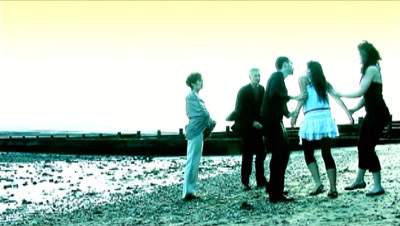
The more extreme relationships in this version of the play transform the meaning of almost every line in the scene (at least, those that survived the edit). It occurs under a quay on a muddy beach where Ophelia is brought to the Queen by Horatio and the Gentleman, where they exchange sarcastic barbs. It's a reversal. Instead of the Queen trying to avoid the mad young girl, she instead has the disruptive Ophelia brought to her for a scolding, either on her orders or by Horatio's initiative. Why is Gertrude so aloof? We have to remember that in this version, the slain Polonia was Ophelia's SISTER, a sister having an affair with Claudius. The Queen may be transferring resentment to the mistress' sister. The scene also suggests a similar adulterous relationship between Claudius and Ophelia, as the songs (here just shouted rhymes) about "tumbling" are thrown the King's way. And he seems particularly empathetic, though again, this may be transference as she was his lover's sister. Either way, the mistrust in the Queen's eyes is what creates the ambiguity.
Oddly, the songs are not gender-translated like the rest of the play. "He is dead and gone" can now only mean Hamlet, because Ophelia has lost no father. Hamlet isn't dead, though they might have said that to comfort her. She might be talking about Hamlet Sr., as she is one of the people who seems able to see the Ghost when she's high on heroin. Fodor had a perfect excuse for Ophelia's madness even in his modern context, but he doesn't seem to use it here and the scene is the weaker for it. Polonia was Ophelia's pusher, and the girl could have been crashing hard at this point. However, the performance has none of that, and the way Ophelia recites the songs by rote, without inflection or inner discourse, doesn't work either as withdrawal OR madness.
Fodor suggests a number of dark happenings in both past and present, but they don't come together satisfyingly in this scene.
Oddly, the songs are not gender-translated like the rest of the play. "He is dead and gone" can now only mean Hamlet, because Ophelia has lost no father. Hamlet isn't dead, though they might have said that to comfort her. She might be talking about Hamlet Sr., as she is one of the people who seems able to see the Ghost when she's high on heroin. Fodor had a perfect excuse for Ophelia's madness even in his modern context, but he doesn't seem to use it here and the scene is the weaker for it. Polonia was Ophelia's pusher, and the girl could have been crashing hard at this point. However, the performance has none of that, and the way Ophelia recites the songs by rote, without inflection or inner discourse, doesn't work either as withdrawal OR madness.
Fodor suggests a number of dark happenings in both past and present, but they don't come together satisfyingly in this scene.
Tuesday, July 9, 2013
IV.v. Ophelia's Madness - Hamlet 2000
Hamlet 2000 uses heavy cuts to ramp the scene's momentum up, focusing on Ophelia's disruptive influence at "court". The scene is set on an interior balcony overlooking a central atrium. On several levels, there appears to be a company function going on, some cocktail party attended by shareholders perhaps. Ophelia seeks the Queen, going round and round the concentric balconies, an image of her own mind spinning out of control. She finds Gertrude laughing, drink in hand, and seemingly untouched by the feeling expressed by her speech, done in voice-over. This is the face she shows the shareholders, a brave front to keep confidence in the company up, which makes Ophelia's intervention all the more destructive. She stumbles into guests and Gertrude naturally tries to smile over the incident and lead the girl away. With this more sinister Queen, it becomes possible for the song "How should I your true love know / From another one?" to be directed at her, the mother-in-law who has apparently spurned her and spurned her own son. One of Ophelia's transgressions is to question the love Gertrude bears her son (which she let the King exile), and her loyalty to Polonius' family (who died while theoretically under the Queen's protection).
The King walks in with a bodyguard in tow and Ophelia gets more and more agitated. Not feeling like they're listening to her, she screams "Pray mark". Gertrude turns to the King for help, her smiles still trying to cover for the girl's antics. "When they ask you what it means", she tells the royals to convey not the original song, but an incredible scream that startles the guests (pictured above). The film translates her trauma differently than the play does, cutting out most of the "nonsense songs", replacing them with moments such as this, which we might call "nonsense sounds". What we lose in poetry we gain in visceral immediacy.
The rest of Ophelia's performance, including the warning about her brother, is given while being dragged away by the bodyguard, again keeping things moving. The scene's rather surprising punchline is that Laertes comes out of nowhere before the King can utter more than one line of the final speech, grabbing him by the throat. Ophelia's appearance was but the first volley in this "rebellion", played rather more personally in this version of the play, as we'll discuss when we tackle the next scene.
The King walks in with a bodyguard in tow and Ophelia gets more and more agitated. Not feeling like they're listening to her, she screams "Pray mark". Gertrude turns to the King for help, her smiles still trying to cover for the girl's antics. "When they ask you what it means", she tells the royals to convey not the original song, but an incredible scream that startles the guests (pictured above). The film translates her trauma differently than the play does, cutting out most of the "nonsense songs", replacing them with moments such as this, which we might call "nonsense sounds". What we lose in poetry we gain in visceral immediacy.
The rest of Ophelia's performance, including the warning about her brother, is given while being dragged away by the bodyguard, again keeping things moving. The scene's rather surprising punchline is that Laertes comes out of nowhere before the King can utter more than one line of the final speech, grabbing him by the throat. Ophelia's appearance was but the first volley in this "rebellion", played rather more personally in this version of the play, as we'll discuss when we tackle the next scene.
Saturday, July 6, 2013
IV.v. Ophelia's Madness - Kline '90
Diane Venora has such a deep voice, it's hard to see her as anything but an adult version of Ophelia, but perhaps that's why her descent into madness as a kind of intermittent return to childhood, works. She's a woman acting like a little girl, dancing, clapping, singing and giggling in her night gown. It's a complex, mercurial, if sometimes over the top performance, with some interesting elements of mise en scène. First and foremost is her lack of animosity towards the royals. By removing the early sequence in which Gertrude doesn't want to see her, Kline makes the Queen more sympathetic, and Ophelia runs to her arms as if a mother. She puts on a brave face when the King arrives, but won't have anyone speak of her father's death. If there is a dark side to their relationship, it may be apprehended during the song about the two lovers. She plays director to the story, puts the King's hand into the Queen's and indicates how he's the boy in the story, and she the girl. Is she inferring something about the royal couple? That perhaps they'd been having an affair before Hamlet Sr.'s death? Or is it more likely she's throwing up a mirror for a future Hamlet & Ophelia that will now never come to pass?
Venora really presents two Ophelias. The child who dreams of being Queen, who sees imaginary ladies-in-waiting (in lines which, on the stage, might well be directed at audience members), sings and dances and passes notes (what is the significance of the crumpled piece of paper she gives Gertrude? An old love letter? Is this a corruption of the scene in which Polonius reads on to the royals?). The other Ophelia is the traumatized, grieving daughter who scratches at the floorboards (where the audience knows ghosts live), rhymes rather than sings, moans and beats her chest. They don't co-exist. When she moves from orphan to child at one point, she realizes her face is wet with tears and starts wiping it, as puzzled as she is ashamed. Ophelia is out of joint.
Sunday, June 30, 2013
IV.v. Ophelia's Madness - Zeffirelli '90
As usual, Zeffirelli plays fast and loose with the sequence of lines, but to good effect. Helena Bonham-Carter's waifish Ophelia is first seen sneaking around outside the castle, wet and dirty, but seemingly free to roam like Hamlet was. As Gertrude watches from the window, the girl approaches a guard at attention, rubs his face, his chest, and quite suggestively, his belt (reminiscent of Greek comedies and their leather phalli), singing the more sexual songs from her repertoire. The uncomfortable guard plays the role of a substitute Hamlet, the "true love she cannot know from another one". These songs she will repeat to herself at the end of the scene, confirming the main reason of her madness, loss of love (the reverse of Hamlet's condition). Someone soon comes to get her, but inside, she starts calling for the beauteous majesty of Denmark, Ophelia's actual entrance in the play, something that fills Gertrude with deep fear. Why is this madness more disturbing to her than her own son's? The truth of it may be that it isn't their first such meeting.
Here they meet on the giant steps, where Ophelia's songs are more about her father's death. They come off as accusations and always end dissonantly, prettiness turning to hardness as she comes upon the Queen. A chase ensues as Gertrude tries to escape the girl, but Ophelia is quicker and manages to catch up to her, fingers the crucifix the Queen was piously fingering earlier. In fact, she chases the Queen right into Claudius' arms. The baker's daughter comment is clearly leveled at Gertrude, a warning to the King that his wife may not be what she seems. Is Ophelia then siding the the murderous King? Why wouldn't she? Her father was slain in the company of the Queen and Hamlet. She seems to suspect Gertrude had a hand in it. Strictly speaking, she's wrong about that, but the warning should not have fallen on such deaf ears regardless. Without knowing it, Ophelia has warned Claudius that Gertrude's allegiance is now with Hamlet, though that remains in dispute. Gertrude running for Claudius' protection in this scene would seem to say she's too weak a person to reject her King. She may well land wherever her position is strongest. We don't know what she may be either.
Believe it or not, these are her moments of lucidity. Ophelia's words are interrupted by painful memories that bring her to the ground. Horatio and some sad guardsman surround her, ready to take her into custody. The sudden realization that her brother will know of it makes her smile and grow manic. This is a departure from other performances of the role we've looked at, but completely justified. Though the occasion is tragic, Laertes is all she has left and his return is to be celebrated. She kisses the Queen's hands, offers the King her own to kiss, and off she goes through the castle. With the dilated timeline (rebels are not at the gates), Elsinore is still full of people, there to witness Ophelia's madness. The "sweet ladies" actually exist, and some nuns do run off after her to help, along with Horatio who finds her wailing and clutching at a wall, and who takes her up in his arms. Gertrude walks off sobbing, leaving Claudius to his thoughts.
Time lapses still, with cutaways to Hamlet at sea (we'll return to this in due course), before Laertes' arrival at some later point.
Here they meet on the giant steps, where Ophelia's songs are more about her father's death. They come off as accusations and always end dissonantly, prettiness turning to hardness as she comes upon the Queen. A chase ensues as Gertrude tries to escape the girl, but Ophelia is quicker and manages to catch up to her, fingers the crucifix the Queen was piously fingering earlier. In fact, she chases the Queen right into Claudius' arms. The baker's daughter comment is clearly leveled at Gertrude, a warning to the King that his wife may not be what she seems. Is Ophelia then siding the the murderous King? Why wouldn't she? Her father was slain in the company of the Queen and Hamlet. She seems to suspect Gertrude had a hand in it. Strictly speaking, she's wrong about that, but the warning should not have fallen on such deaf ears regardless. Without knowing it, Ophelia has warned Claudius that Gertrude's allegiance is now with Hamlet, though that remains in dispute. Gertrude running for Claudius' protection in this scene would seem to say she's too weak a person to reject her King. She may well land wherever her position is strongest. We don't know what she may be either.
Believe it or not, these are her moments of lucidity. Ophelia's words are interrupted by painful memories that bring her to the ground. Horatio and some sad guardsman surround her, ready to take her into custody. The sudden realization that her brother will know of it makes her smile and grow manic. This is a departure from other performances of the role we've looked at, but completely justified. Though the occasion is tragic, Laertes is all she has left and his return is to be celebrated. She kisses the Queen's hands, offers the King her own to kiss, and off she goes through the castle. With the dilated timeline (rebels are not at the gates), Elsinore is still full of people, there to witness Ophelia's madness. The "sweet ladies" actually exist, and some nuns do run off after her to help, along with Horatio who finds her wailing and clutching at a wall, and who takes her up in his arms. Gertrude walks off sobbing, leaving Claudius to his thoughts.
Time lapses still, with cutaways to Hamlet at sea (we'll return to this in due course), before Laertes' arrival at some later point.
Sunday, June 23, 2013
IV.v. Ophelia's Madness - BBC '80
In this version, Gertrude clearly feels helpless to help Ophelia, which makes the girl's angry defiance even more shocking. Lalla Ward's Ophelia is angry at the Queen, her songs are vicious attacks, her eyes drill right through Gertrude. It's an Ophelia in the Olivier mold, but more extreme. It would seem she blames the Queen in some way, speaks of HER as the "baker's daughter", not what she seems, and is sarcastic when she wishes God at her table. There are several ways to justify such a performance. First, there's the fact that Polonius died in the Queen's closet, making Gertrude partly responsible. The second transfers Hamlet's guilt to the mother that bore him. Without Gertrude, there is no Hamlet (doubly so, as without her sin, there is no mad Hamlet). The overall effect creates a strange mirror of Hamlet's early attitude towards his mother, but even more unreasonable.
Enter Claudius, and here Ophelia's attitude is much different, taking the Queen's role by caressing his beard, singing the Valentine's Day song seductively, and grinding the uncomfortable King. Again, there's emotional transference at work, with Claudius becoming Hamlet for those few seconds. A past Hamlet, when the lovers were together. A future Hamlet who would have become King. Ophelia is trapped in a jealous love triangle from a projected (and now aborted) future. The identities of Claudius as Hamlet, and the Queen as rival are delusions just like the invisible coach and ladies. When Ophelia breaks from this fantasy, it's to weep, or to rage. "My brother shall know of it" is particularly fierce and a violent announcement of what is to come.
In Claudius' ensuing speech, he explains why Gertrude should fear just as he does, a deft manipulation to make her hold on to him harder. We know not what she may be, this baker's daughter, true to her husband, or true to her son? Like Ophelia, her changeability is tied to the men who dominate her.
Enter Claudius, and here Ophelia's attitude is much different, taking the Queen's role by caressing his beard, singing the Valentine's Day song seductively, and grinding the uncomfortable King. Again, there's emotional transference at work, with Claudius becoming Hamlet for those few seconds. A past Hamlet, when the lovers were together. A future Hamlet who would have become King. Ophelia is trapped in a jealous love triangle from a projected (and now aborted) future. The identities of Claudius as Hamlet, and the Queen as rival are delusions just like the invisible coach and ladies. When Ophelia breaks from this fantasy, it's to weep, or to rage. "My brother shall know of it" is particularly fierce and a violent announcement of what is to come.
In Claudius' ensuing speech, he explains why Gertrude should fear just as he does, a deft manipulation to make her hold on to him harder. We know not what she may be, this baker's daughter, true to her husband, or true to her son? Like Ophelia, her changeability is tied to the men who dominate her.
Sunday, June 16, 2013
IV.v. Ophelia's Madness - Olivier '48
The scene starts with foreshadowing of Ophelia's suicide as we see her reflection in the famous brook, taking a flower floating upon the water. As she plucks it, her image is naturally distorted, a metaphor for her broken mind. She screams, we see her on the river bank, her hair undone and tangled with bits and pieces of plants. She runs off, over a long that acts as a bridge over the brook, to and through the castle, only stopping after she crosses Horatio and the Queen, walking the halls.
There is something defiant about Jean Simmons' performance as Ophelia that gives a rebellious edge to some of her lines (she is, after all, a rebel's sister). Her back is turned when she asks where the "beauteous majesty of Denmark", but she's already seen the Queen. Is this mark of disrespect intentional? She is clearly not feigning madness, as Hamlet was, but that madness has dispelled her native inhibitions and given her permission to be insolent. The line could be read to mean she does not see the the Queen as "majesty", and indeed, her exit asking for her coach and giving her farewells to invisible attendants could be a fantasy in which SHE is Queen. Like Hamlet, her ambition has been aborted by the Royals' meddling and ultimately, Claudius' fratricide. Ophelia's ambitions are those of a child, aspiring to marriage in a naive way, but she still knows she's lost something, not just a father and a husband, but the future she believed was hers.
More insolence: She won't endure the Queen's consoling. Every time Gertrude attempts it, Ophelia starts on a song (and Simmons has a beautiful singing voice), even moves away. This is even more true once Claudius happens on the scene. She won't let him touch her. There's a sense that, consciously or not, she knows who's responsible for all their sorrows. She moves between smiles and tears, silliness and wisdom, girl and woman, and though the dirtiest song isn't used, there is a moment of sexuality as yet unseen in the character when she lets Horatio help her up. She notices him as a young woman would a handsome gallant, flushed by his touch.
Gertrude flees Claudius' touch too, mind. Hamlet's parting words have had an effect on her, though she hides it in distracted sadness. Claudius, sensing she's slipping out of his control, embraces her from behind and visibly frustrated, lays a manipulative speech on her. He talks about OUR son and threats to OUR own person, physically showing they are, as Hamlet had said, "one flesh". In other words, "we're in this together, baby". If his regime falls, she falls with it, and better behave like the Queen he needs her to be, obedient at his side. It's not often discussed, but one of the great evils perpetrated by this corrupt Denmark is how it uses women for its own ends. It has broken Ophelia and will undo Gertrude, the puppet queen as well.
There is something defiant about Jean Simmons' performance as Ophelia that gives a rebellious edge to some of her lines (she is, after all, a rebel's sister). Her back is turned when she asks where the "beauteous majesty of Denmark", but she's already seen the Queen. Is this mark of disrespect intentional? She is clearly not feigning madness, as Hamlet was, but that madness has dispelled her native inhibitions and given her permission to be insolent. The line could be read to mean she does not see the the Queen as "majesty", and indeed, her exit asking for her coach and giving her farewells to invisible attendants could be a fantasy in which SHE is Queen. Like Hamlet, her ambition has been aborted by the Royals' meddling and ultimately, Claudius' fratricide. Ophelia's ambitions are those of a child, aspiring to marriage in a naive way, but she still knows she's lost something, not just a father and a husband, but the future she believed was hers.
More insolence: She won't endure the Queen's consoling. Every time Gertrude attempts it, Ophelia starts on a song (and Simmons has a beautiful singing voice), even moves away. This is even more true once Claudius happens on the scene. She won't let him touch her. There's a sense that, consciously or not, she knows who's responsible for all their sorrows. She moves between smiles and tears, silliness and wisdom, girl and woman, and though the dirtiest song isn't used, there is a moment of sexuality as yet unseen in the character when she lets Horatio help her up. She notices him as a young woman would a handsome gallant, flushed by his touch.
Gertrude flees Claudius' touch too, mind. Hamlet's parting words have had an effect on her, though she hides it in distracted sadness. Claudius, sensing she's slipping out of his control, embraces her from behind and visibly frustrated, lays a manipulative speech on her. He talks about OUR son and threats to OUR own person, physically showing they are, as Hamlet had said, "one flesh". In other words, "we're in this together, baby". If his regime falls, she falls with it, and better behave like the Queen he needs her to be, obedient at his side. It's not often discussed, but one of the great evils perpetrated by this corrupt Denmark is how it uses women for its own ends. It has broken Ophelia and will undo Gertrude, the puppet queen as well.
Sunday, June 9, 2013
IV.v. Ophelia's Madness - Branagh '96
In one of Branagh's few changes to the text, he reorders Claudius' end speech (starting with "When sorrows come") in this sequence to serve as a recap of the action to date as we return from intermission. It's a clever change that, using voice-over and a montage of previously seen (and some repurposed) images, gives urgency to what would normally be repeated information. The voice-over starts on the gates of Elsinore, which foreshadows, along with the lines about single spies and battalions, Laertes' revolutionaries, Hamlet's skulking back into the country, and Fortinbras' invasion. The montage also reminds us of who Laertes is - we haven't seen him since the first Act - reveals how all of this is weighing on Claudius, here seen pacing in the chapel, and reveals slightly ahead of time that Ophelia has gone mad, reusing the shot of her screaming after her father's corpse.
The better to prepare us for the next shot: Ophelia in a padded cell, being observed through a grate from above, straight-jacketed and wearing a gray cap, a creature more like the Tempest's Caliban than the lovely girl we met earlier in the play. She's ramming into each wall like a trapped animal. Gertrude's attitude then isn't annoyance, but fear. Caught between Horatio and the doctor (a black, female doctor, in line with Branagh's other anachronistic casting choices) who share the unnamed Gentleman's lines, she eventually relents and agrees to see Ophelia. Cut to the shot above, Ophelia all trussed up on her stomach, an inch worm asking to see the Queen. It's at once funny and pathetic, but also harks back to Hamlet's worm metaphor and to the abuse historically suffered by the mentally ill. In other versions and other Shakespeare plays, mad characters seem to have free reign of the locations, enjoying a sort of immunity to reprisal, perhaps through the mystical notion that madmen speak poetic truth. Often, these characters are allowed to rant and speak to power with insolence, without interruption (the mad queen in Richard III is another example). Madness makes people uncomfortable, unsure of what to say. We should note how differently mad Ophelia is being treated compared to mad Hamlet. Is this the effect of class or gender? Probably both.
The cell, you'll notice, is right adjacent to the throne room. As it's unlikely this is a normal feature of Elsinore, we might see it as a sign of changing times. Used to be the King and Queen were constantly attended, the Hall of Mirrors full of courtiers, but with Hamlet in exile, rumors abound and revolution brews. Claudius' Elsinore, like his Denmark, is changing. It's probably not safe to let the Prime Minister's mad daughter leave the castle, or even let it be known she's gone insane (it's a surprise to Laertes later). So a makeshift padded cell has been built into one of the secret compartments so she can be treated at home. This is an isolated Elsinore where visitors are no longer welcome. Halls made to look big and empty in wide shots. The Royals are small and vulnerable in their marble cocoon.
Before Ophelia can rant, she must be free, and Gertrude does her this kindness, untying her sleeves in an effort to comfort her. The rant takes the form of songs (many of them ribald), but that's probably the only things she knows. A young girl in a royal court wouldn't be trained in any useful skill. Her life would be songs and the meaning of flowers, skills to charm and impress a father and husband. That's all she has to try and express the inexpressible. Claudius comes in during one of the songs and tries to help her up, and the dynamic changes. Not that Ophelia can tell he's responsible (though she does throw the owl line at him), but he's a man, and men have been her undoing. At the mention of her father, she screams and stumbles off, and even the camera is kept at bay, suddenly uncertain and shaky. From Ophelia's point of view too, other characters seem far away. A distance in understanding. When she approaches them again, it's to rudely bump Claudius on the word "cock", and to disturbingly reenact her "tumbling" on the floor (with unnecessary but pointed flashbacks of Hamlet in bed with her).
In the middle of this, a moment of lucidity (from "I hope all will be well") and a realization that her brother will be coming. This moment is covered in a close-up of Ophelia, for the moment coming into focus, her cheeks and eyes ruined by too many tears. Her mind is broken, but she's still in there, and through those lines that are not "nonsense songs", we discover a certain self-awareness, one that she's trying to escape from. The metaphor echoes into reality as she struggles not to be tied up again, refusing Claudius' touch, avoiding him as she defiantly calls for her coach and runs off with Horatio and the doctor after her.
The better to prepare us for the next shot: Ophelia in a padded cell, being observed through a grate from above, straight-jacketed and wearing a gray cap, a creature more like the Tempest's Caliban than the lovely girl we met earlier in the play. She's ramming into each wall like a trapped animal. Gertrude's attitude then isn't annoyance, but fear. Caught between Horatio and the doctor (a black, female doctor, in line with Branagh's other anachronistic casting choices) who share the unnamed Gentleman's lines, she eventually relents and agrees to see Ophelia. Cut to the shot above, Ophelia all trussed up on her stomach, an inch worm asking to see the Queen. It's at once funny and pathetic, but also harks back to Hamlet's worm metaphor and to the abuse historically suffered by the mentally ill. In other versions and other Shakespeare plays, mad characters seem to have free reign of the locations, enjoying a sort of immunity to reprisal, perhaps through the mystical notion that madmen speak poetic truth. Often, these characters are allowed to rant and speak to power with insolence, without interruption (the mad queen in Richard III is another example). Madness makes people uncomfortable, unsure of what to say. We should note how differently mad Ophelia is being treated compared to mad Hamlet. Is this the effect of class or gender? Probably both.
The cell, you'll notice, is right adjacent to the throne room. As it's unlikely this is a normal feature of Elsinore, we might see it as a sign of changing times. Used to be the King and Queen were constantly attended, the Hall of Mirrors full of courtiers, but with Hamlet in exile, rumors abound and revolution brews. Claudius' Elsinore, like his Denmark, is changing. It's probably not safe to let the Prime Minister's mad daughter leave the castle, or even let it be known she's gone insane (it's a surprise to Laertes later). So a makeshift padded cell has been built into one of the secret compartments so she can be treated at home. This is an isolated Elsinore where visitors are no longer welcome. Halls made to look big and empty in wide shots. The Royals are small and vulnerable in their marble cocoon.
Before Ophelia can rant, she must be free, and Gertrude does her this kindness, untying her sleeves in an effort to comfort her. The rant takes the form of songs (many of them ribald), but that's probably the only things she knows. A young girl in a royal court wouldn't be trained in any useful skill. Her life would be songs and the meaning of flowers, skills to charm and impress a father and husband. That's all she has to try and express the inexpressible. Claudius comes in during one of the songs and tries to help her up, and the dynamic changes. Not that Ophelia can tell he's responsible (though she does throw the owl line at him), but he's a man, and men have been her undoing. At the mention of her father, she screams and stumbles off, and even the camera is kept at bay, suddenly uncertain and shaky. From Ophelia's point of view too, other characters seem far away. A distance in understanding. When she approaches them again, it's to rudely bump Claudius on the word "cock", and to disturbingly reenact her "tumbling" on the floor (with unnecessary but pointed flashbacks of Hamlet in bed with her).
In the middle of this, a moment of lucidity (from "I hope all will be well") and a realization that her brother will be coming. This moment is covered in a close-up of Ophelia, for the moment coming into focus, her cheeks and eyes ruined by too many tears. Her mind is broken, but she's still in there, and through those lines that are not "nonsense songs", we discover a certain self-awareness, one that she's trying to escape from. The metaphor echoes into reality as she struggles not to be tied up again, refusing Claudius' touch, avoiding him as she defiantly calls for her coach and runs off with Horatio and the doctor after her.
Saturday, June 1, 2013
IV.v. Ophelia's Madness - Slings & Arrows
Allow me to upend the usual order by starting with Slings & Arrows, but while the scene is part of the onscreen performance (above), the show also features, in the season's penultimate episode, one of my favorite moments of dramatic criticism, and it relates to that scene and to this entire endeavor.
One of the subplots of the show around the play focuses on the character of Claire (Sabrina Grdevich), a talentless brown-noser the play's director, Geoffrey Tennant (Paul Gross), has inherited. In rehearsals, she's going on sense memory to simulate Ophelia's madness, reenacting what it's like to be stoned because she surmises that it's the same thing. So it's a whole lot of staggering about, mouth open, twirling... After all, there's nothing Claire can take from the text. Ophelia is just singing nonsense songs.
Geoffrey's intense piece of advice to Claire is wasted on her (hilariously, she's back to twirling in the background of the next scene), but I can't watch it without tearing up. Let me just reproduce it here in toto:
"Ophelia is a child. She has been dominated by powerful men all of her life and suddenly they all disappear. Her brother goes to France. Her father is murdered by her boyfriend. And he is shipped off to England. She is alone for the first time, grieving and heartbroken and guilty because, as far as she's concerned, it's all her fault. She ignored her brother's advice and fell in love with Hamlet and now, her father is dead, all because of her. And the pain, and the loss, and the shame, and the guilt, all of this is gnawing away inside that little child's mind, and it comes out as little... songs. 'And will he not come again? And will he not come again? No, no, he is dead.' My father is dead and I killed him."
This is dead on, and hearing the quote he uses spoken by a man, reveals how the songs also relate to Hamlet's own situation. He too has gone mad from losing a father (or three, if we count surrogate Yorrick and stay-at-home uncle who betrayed his trust Claudius), and Geoffrey makes us feel that loss and how guilt played a part in his own bout of madness. We almost intuit what his own legendary Hamlet was like.
Thankfully, something happens to Claire and understudy Kate (Rachel McAdams) must take over for her. Her performance as Ophelia, make-up dripping, voice shaking and breaking, even gets to Claire, who bitterly wipes a tear away in the audience. Ellen (Martha Burns) playing Gertrude is also visibly affected, another case of seeing the actress behind the role, not expecting that level of emotion. It makes me realize how important Gertrude's reaction to Ophelia is in this scene. In the text, she isn't particularly kind to her. She doesn't even want to deal with her at the moment. But if she lets herself be touched by this moment, or if she visibly doesn't, it changes how we might understand Gertrude's later narration of Ophelia's final moments. On one end of the scale, deep empathy, on the other, the sense she might have played a sinister. part in those events.
One of the subplots of the show around the play focuses on the character of Claire (Sabrina Grdevich), a talentless brown-noser the play's director, Geoffrey Tennant (Paul Gross), has inherited. In rehearsals, she's going on sense memory to simulate Ophelia's madness, reenacting what it's like to be stoned because she surmises that it's the same thing. So it's a whole lot of staggering about, mouth open, twirling... After all, there's nothing Claire can take from the text. Ophelia is just singing nonsense songs.
Geoffrey's intense piece of advice to Claire is wasted on her (hilariously, she's back to twirling in the background of the next scene), but I can't watch it without tearing up. Let me just reproduce it here in toto:
"Ophelia is a child. She has been dominated by powerful men all of her life and suddenly they all disappear. Her brother goes to France. Her father is murdered by her boyfriend. And he is shipped off to England. She is alone for the first time, grieving and heartbroken and guilty because, as far as she's concerned, it's all her fault. She ignored her brother's advice and fell in love with Hamlet and now, her father is dead, all because of her. And the pain, and the loss, and the shame, and the guilt, all of this is gnawing away inside that little child's mind, and it comes out as little... songs. 'And will he not come again? And will he not come again? No, no, he is dead.' My father is dead and I killed him."
This is dead on, and hearing the quote he uses spoken by a man, reveals how the songs also relate to Hamlet's own situation. He too has gone mad from losing a father (or three, if we count surrogate Yorrick and stay-at-home uncle who betrayed his trust Claudius), and Geoffrey makes us feel that loss and how guilt played a part in his own bout of madness. We almost intuit what his own legendary Hamlet was like.
Thankfully, something happens to Claire and understudy Kate (Rachel McAdams) must take over for her. Her performance as Ophelia, make-up dripping, voice shaking and breaking, even gets to Claire, who bitterly wipes a tear away in the audience. Ellen (Martha Burns) playing Gertrude is also visibly affected, another case of seeing the actress behind the role, not expecting that level of emotion. It makes me realize how important Gertrude's reaction to Ophelia is in this scene. In the text, she isn't particularly kind to her. She doesn't even want to deal with her at the moment. But if she lets herself be touched by this moment, or if she visibly doesn't, it changes how we might understand Gertrude's later narration of Ophelia's final moments. On one end of the scale, deep empathy, on the other, the sense she might have played a sinister. part in those events.
Saturday, May 25, 2013
IV.v. Ophelia's Madness
Scene 5 can be split into two sequences, Ophelia's descent into madness and Laertes' return (though the latter eventually dovetails into the former), so we'll take them separately. Scene 5 is the scene by which we judge all Ophelias and indeed, it is her last. She thereafter only appears in the story of her suicide as told by Gertrude, though of course, films often show us something of that action. Though the difficulty for the actress is obvious, there's also a difficulty for the director because Ophelia's madness manifests as snippets of old folk tunes. What melodies does one use, and how do these change the way we understand and interpret the songs? Before addressing the relevant performances, let's look at the text itself. As usual, the Bard is in italics, and my comments break through unitalicized.
SCENE V. Elsinore. A room in the castle.
Enter QUEEN GERTRUDE, HORATIO, and a Gentleman
QUEEN GERTRUDE: I will not speak with her.
Some time has passed since Polonius' death and Hamlet's exile, enough that the Queen doesn't want to deal with Ophelia anymore. This line is often forgotten because Gertrude does indeed go on to see Ophelia, but it is nonetheless there. Is the Queen annoyed, tired or afraid? That's up to each actress, but there is cause for any or all those feelings.
GENTLEMAN: She is importunate, indeed distract:
Her mood will needs be pitied.
QUEEN GERTRUDE: What would she have?
GENTLEMAN: She speaks much of her father; says she hears
There's tricks i' the world; and hems, and beats her heart;
Spurns enviously at straws; speaks things in doubt,
That carry but half sense: her speech is nothing,
Yet the unshaped use of it doth move
The hearers to collection; they aim at it,
And botch the words up fit to their own thoughts;
Which, as her winks, and nods, and gestures yield them,
Indeed would make one think there might be thought,
Though nothing sure, yet much unhappily.
There is, in the Gentleman's speech, the mirror of how an audience can, should and does infer meaning in poetry (and in Shakespeare's plays themselves). Ophelia's speech is "nothing", meaningless, and yet the human mind cannot but try to give meaning to it. This is a wonderful preamble to a scene where the audience (and the characters in the scene) are asked to do just that. We will look for poetical meaning, what Ophelia feels about her lover killing her father, but the King and Queen may be looking for something else - Ophelia leaking the very information they tried to keep quiet by sending Hamlet away, or else implying the Royals had something to do with it (something gets back to Laertes, who has that distinct impression when he returns to Elsinore). In fact, Horatio seems to be of the same bent.
HORATIO: 'Twere good she were spoken with; for she may strew
Dangerous conjectures in ill-breeding minds.
Now, I find Horatio's presence very odd. Hamlet is off and away, but he has stayed at Elsinore. Furthermore, he's here thinking about the Royals' PR. That's behavior you'd expect from Rosencrantz&Guildenstern! Since he later receives word from Hamlet, the simplest explanation is that he's under orders from the Prince to stick around, perhaps to take care of Ophelia, certainly to keep an eye on Claudius. Still, ingratiating himself into the Court might speak to a more self-serving agenda, one that finds its fullest expression at the very end when he is left to tell the story. His interest in "spin" in this very line might very well mean he'll embellish or change some details...
QUEEN GERTRUDE: Let her come in.
Exit HORATIO
To my sick soul, as sin's true nature is,
Each toy seems prologue to some great amiss:
So full of artless jealousy is guilt,
It spills itself in fearing to be spilt.
Re-enter HORATIO, with OPHELIA
OPHELIA: Where is the beauteous majesty of Denmark?
QUEEN GERTRUDE: How now, Ophelia!
OPHELIA [Sings]: How should I your true love know
From another one?
By his cockle hat and staff,
And his sandal shoon.
Knowing true love from false seems a pretty obvious reference to Hamlet's betrayal. Gertrude's a bit dense, in denial, or looking for confirmation in her next line:
QUEEN GERTRUDE: Alas, sweet lady, what imports this song?
OPHELIA: Say you? nay, pray you, mark.
[Sings] He is dead and gone, lady,
He is dead and gone;
At his head a grass-green turf,
At his heels a stone.
This one is about her father, clearly, and in the next interrupted line from the song, she sees him in a white shroud. It's a symbol of purity that implies her father wasn't guilty of anything, nor deserving of his fate. It seems the fault all lies on Hamlet's shoulders.
QUEEN GERTRUDE: Nay, but, Ophelia,--
OPHELIA: Pray you, mark.
[Sings] White his shroud as the mountain snow,--
Enter KING CLAUDIUS
QUEEN GERTRUDE: Alas, look here, my lord.
OPHELIA: [Sings] Larded with sweet flowers
Which bewept to the grave did go
With true-love showers.
Note the connection made between the flowers on her father's grave and those she will hand out in the next sequence, and the garlands that are part of her death scene.
KING CLAUDIUS: How do you, pretty lady?
OPHELIA: Well, God 'ild you! They say the owl was a baker's daughter. Lord, we know what we are, but know not what we may be. God be at your table!
There is a strange legend about a baker's daughter who was transformed into an owl after being stingy to Jesus Christ, which is what Ophelia refers to. It's possible Ophelia blames herself for her father's death (after all, it was his theory that she was the cause of Hamlet's madness), so this allusion of transformation is appropriate. Tragic or extreme events can unlock our true form, just as these have unlocked her madness. More dangerously, she might be implying the King has yet to show his true colors.
KING CLAUDIUS: Conceit upon her father.
OPHELIA: Pray you, let's have no words of this; but when they ask you what it means, say you this:
[Sings] To-morrow is Saint Valentine's day,
All in the morning betime,
And I a maid at your window,
To be your Valentine.
Then up he rose, and donn'd his clothes,
And dupp'd the chamber-door;
Let in the maid, that out a maid
Never departed more.
An indication that Hamlet took her maidenhead. She's a maid (a virgin) in the first half of the song, and in the second, her lover is rising from the bed and putting his clothes on, and she leaves, no longer a maid. If staging it so that Ophelia and Hamlet never consummated their relationship, Ophelia could instead be referring to a loss of innocence caused by her father's murder, or else visualizing a reality that might have been had the events of the play not occurred. The next song, however, pretty much seals the deal.
KING CLAUDIUS: Pretty Ophelia!
OPHELIA: Indeed, la, without an oath, I'll make an end on't:
[Sings] By Gis and by Saint Charity,
Alack, and fie for shame!
Young men will do't, if they come to't;
By cock, they are to blame.
Quoth she, before you tumbled me,
You promised me to wed.
So would I ha' done, by yonder sun,
An thou hadst not come to my bed.
The meaning is fairly clear. Hamlet has already made love to her on the pretext that he would marry her later anyway. Events prevented the latter from happening, so Ophelia is doubly betrayed, both as a daughter and as a (potential) wife.
KING CLAUDIUS: How long hath she been thus?
OPHELIA: I hope all will be well. We must be patient: but I cannot choose but weep, to think they should lay him i' the cold ground. My brother shall know of it: and so I thank you for your good counsel. Come, my coach! Good night, ladies; good night, sweet ladies; good night, good night.
Exit
KING CLAUDIUS: Follow her close; give her good watch,
I pray you.
Exit HORATIO
O, this is the poison of deep grief; it springs
All from her father's death. O Gertrude, Gertrude,
There are too many references to Hamlet in Ophelia's songs for her father's death to be the only cause of her distress. It's actually quite amusing that Polonius spent the better part of the play insisting Hamlet's madness was due to neglected love, while in truth, it was his father's murder that pushed him over the edge. Now, Ophelia's mad and it's Claudius insisting the complete opposite. He thinks her father's murder is to blame, but it may well be that neglected love is the more potent reason behind Ophelia's tears.
When sorrows come, they come not single spies
But in battalions. First, her father slain:
Foreshadowing Fortinbras' attack, possibly? While the King is distracted by single threats like Hamlet (still a threat because his exile has caused the populace to whisper rumors) and Laertes (whose ear these rumors have reached), he misses the bigger danger completely.
Next, your son gone; and he most violent author
Of his own just remove: the people muddied,
Thick and unwholesome in their thoughts and whispers,
For good Polonius' death; and we have done but greenly,
In hugger-mugger to inter him: poor Ophelia
Divided from herself and her fair judgment,
Without the which we are pictures, or mere beasts:
Last, and as much containing as all these,
Her brother is in secret come from France;
Feeds on his wonder, keeps himself in clouds,
And wants not buzzers to infect his ear
With pestilent speeches of his father's death;
Wherein necessity, of matter beggar'd,
Will nothing stick our person to arraign
In ear and ear. O my dear Gertrude, this,
Like to a murdering-piece, in many places
Gives me superfluous death.
Here we should address the idea of putting poison in one's ear, which was Claudius' method for murdering Hamlet Sr., and the poetic justice of the King being threatened by metaphorical poison poured in Danish ears. Because the truth of Polonius' death could not be revealed, Claudius fears the rumors (poison) has reached Laertes and may fuel a rebellion. Claudius uses the word "ear" again and again as his anxiety mounts, a sort of veiled confession only we can decode.
SCENE V. Elsinore. A room in the castle.
Enter QUEEN GERTRUDE, HORATIO, and a Gentleman
QUEEN GERTRUDE: I will not speak with her.
Some time has passed since Polonius' death and Hamlet's exile, enough that the Queen doesn't want to deal with Ophelia anymore. This line is often forgotten because Gertrude does indeed go on to see Ophelia, but it is nonetheless there. Is the Queen annoyed, tired or afraid? That's up to each actress, but there is cause for any or all those feelings.
GENTLEMAN: She is importunate, indeed distract:
Her mood will needs be pitied.
QUEEN GERTRUDE: What would she have?
GENTLEMAN: She speaks much of her father; says she hears
There's tricks i' the world; and hems, and beats her heart;
Spurns enviously at straws; speaks things in doubt,
That carry but half sense: her speech is nothing,
Yet the unshaped use of it doth move
The hearers to collection; they aim at it,
And botch the words up fit to their own thoughts;
Which, as her winks, and nods, and gestures yield them,
Indeed would make one think there might be thought,
Though nothing sure, yet much unhappily.
There is, in the Gentleman's speech, the mirror of how an audience can, should and does infer meaning in poetry (and in Shakespeare's plays themselves). Ophelia's speech is "nothing", meaningless, and yet the human mind cannot but try to give meaning to it. This is a wonderful preamble to a scene where the audience (and the characters in the scene) are asked to do just that. We will look for poetical meaning, what Ophelia feels about her lover killing her father, but the King and Queen may be looking for something else - Ophelia leaking the very information they tried to keep quiet by sending Hamlet away, or else implying the Royals had something to do with it (something gets back to Laertes, who has that distinct impression when he returns to Elsinore). In fact, Horatio seems to be of the same bent.
HORATIO: 'Twere good she were spoken with; for she may strew
Dangerous conjectures in ill-breeding minds.
Now, I find Horatio's presence very odd. Hamlet is off and away, but he has stayed at Elsinore. Furthermore, he's here thinking about the Royals' PR. That's behavior you'd expect from Rosencrantz&Guildenstern! Since he later receives word from Hamlet, the simplest explanation is that he's under orders from the Prince to stick around, perhaps to take care of Ophelia, certainly to keep an eye on Claudius. Still, ingratiating himself into the Court might speak to a more self-serving agenda, one that finds its fullest expression at the very end when he is left to tell the story. His interest in "spin" in this very line might very well mean he'll embellish or change some details...
QUEEN GERTRUDE: Let her come in.
Exit HORATIO
To my sick soul, as sin's true nature is,
Each toy seems prologue to some great amiss:
So full of artless jealousy is guilt,
It spills itself in fearing to be spilt.
Re-enter HORATIO, with OPHELIA
OPHELIA: Where is the beauteous majesty of Denmark?
QUEEN GERTRUDE: How now, Ophelia!
OPHELIA [Sings]: How should I your true love know
From another one?
By his cockle hat and staff,
And his sandal shoon.
Knowing true love from false seems a pretty obvious reference to Hamlet's betrayal. Gertrude's a bit dense, in denial, or looking for confirmation in her next line:
QUEEN GERTRUDE: Alas, sweet lady, what imports this song?
OPHELIA: Say you? nay, pray you, mark.
[Sings] He is dead and gone, lady,
He is dead and gone;
At his head a grass-green turf,
At his heels a stone.
This one is about her father, clearly, and in the next interrupted line from the song, she sees him in a white shroud. It's a symbol of purity that implies her father wasn't guilty of anything, nor deserving of his fate. It seems the fault all lies on Hamlet's shoulders.
QUEEN GERTRUDE: Nay, but, Ophelia,--
OPHELIA: Pray you, mark.
[Sings] White his shroud as the mountain snow,--
Enter KING CLAUDIUS
QUEEN GERTRUDE: Alas, look here, my lord.
OPHELIA: [Sings] Larded with sweet flowers
Which bewept to the grave did go
With true-love showers.
Note the connection made between the flowers on her father's grave and those she will hand out in the next sequence, and the garlands that are part of her death scene.
KING CLAUDIUS: How do you, pretty lady?
OPHELIA: Well, God 'ild you! They say the owl was a baker's daughter. Lord, we know what we are, but know not what we may be. God be at your table!
There is a strange legend about a baker's daughter who was transformed into an owl after being stingy to Jesus Christ, which is what Ophelia refers to. It's possible Ophelia blames herself for her father's death (after all, it was his theory that she was the cause of Hamlet's madness), so this allusion of transformation is appropriate. Tragic or extreme events can unlock our true form, just as these have unlocked her madness. More dangerously, she might be implying the King has yet to show his true colors.
KING CLAUDIUS: Conceit upon her father.
OPHELIA: Pray you, let's have no words of this; but when they ask you what it means, say you this:
[Sings] To-morrow is Saint Valentine's day,
All in the morning betime,
And I a maid at your window,
To be your Valentine.
Then up he rose, and donn'd his clothes,
And dupp'd the chamber-door;
Let in the maid, that out a maid
Never departed more.
An indication that Hamlet took her maidenhead. She's a maid (a virgin) in the first half of the song, and in the second, her lover is rising from the bed and putting his clothes on, and she leaves, no longer a maid. If staging it so that Ophelia and Hamlet never consummated their relationship, Ophelia could instead be referring to a loss of innocence caused by her father's murder, or else visualizing a reality that might have been had the events of the play not occurred. The next song, however, pretty much seals the deal.
KING CLAUDIUS: Pretty Ophelia!
OPHELIA: Indeed, la, without an oath, I'll make an end on't:
[Sings] By Gis and by Saint Charity,
Alack, and fie for shame!
Young men will do't, if they come to't;
By cock, they are to blame.
Quoth she, before you tumbled me,
You promised me to wed.
So would I ha' done, by yonder sun,
An thou hadst not come to my bed.
The meaning is fairly clear. Hamlet has already made love to her on the pretext that he would marry her later anyway. Events prevented the latter from happening, so Ophelia is doubly betrayed, both as a daughter and as a (potential) wife.
KING CLAUDIUS: How long hath she been thus?
OPHELIA: I hope all will be well. We must be patient: but I cannot choose but weep, to think they should lay him i' the cold ground. My brother shall know of it: and so I thank you for your good counsel. Come, my coach! Good night, ladies; good night, sweet ladies; good night, good night.
Exit
KING CLAUDIUS: Follow her close; give her good watch,
I pray you.
Exit HORATIO
O, this is the poison of deep grief; it springs
All from her father's death. O Gertrude, Gertrude,
There are too many references to Hamlet in Ophelia's songs for her father's death to be the only cause of her distress. It's actually quite amusing that Polonius spent the better part of the play insisting Hamlet's madness was due to neglected love, while in truth, it was his father's murder that pushed him over the edge. Now, Ophelia's mad and it's Claudius insisting the complete opposite. He thinks her father's murder is to blame, but it may well be that neglected love is the more potent reason behind Ophelia's tears.
When sorrows come, they come not single spies
But in battalions. First, her father slain:
Foreshadowing Fortinbras' attack, possibly? While the King is distracted by single threats like Hamlet (still a threat because his exile has caused the populace to whisper rumors) and Laertes (whose ear these rumors have reached), he misses the bigger danger completely.
Next, your son gone; and he most violent author
Of his own just remove: the people muddied,
Thick and unwholesome in their thoughts and whispers,
For good Polonius' death; and we have done but greenly,
In hugger-mugger to inter him: poor Ophelia
Divided from herself and her fair judgment,
Without the which we are pictures, or mere beasts:
Last, and as much containing as all these,
Her brother is in secret come from France;
Feeds on his wonder, keeps himself in clouds,
And wants not buzzers to infect his ear
With pestilent speeches of his father's death;
Wherein necessity, of matter beggar'd,
Will nothing stick our person to arraign
In ear and ear. O my dear Gertrude, this,
Like to a murdering-piece, in many places
Gives me superfluous death.
Here we should address the idea of putting poison in one's ear, which was Claudius' method for murdering Hamlet Sr., and the poetic justice of the King being threatened by metaphorical poison poured in Danish ears. Because the truth of Polonius' death could not be revealed, Claudius fears the rumors (poison) has reached Laertes and may fuel a rebellion. Claudius uses the word "ear" again and again as his anxiety mounts, a sort of veiled confession only we can decode.
Subscribe to:
Posts (Atom)