

From a later scene, John Trumbull shows this piece featuring Spider-Ham (the funny animal version of Spider-Man):


 With Tue-le/Kill Him, Johnny Hallyday does away with the King's confession to the audience and his plight in facing his maker, incapable of remorse. It only deals with Hamlet's own feelings coming upon Claudius a-praying, and uses the chorus as a kind of angel/devil on his shoulder, pushing him to kill with whispers and full-on opera, but also warning him that to do so now could result in Claudius going to Heaven. Here are the lyrics and my usual doggerel translation.

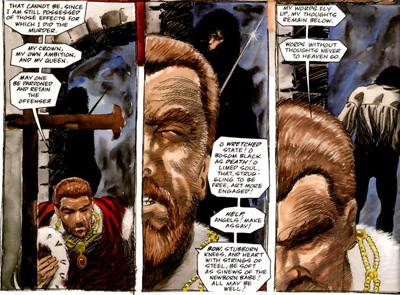


 Fodor cut into this scene substantially, but his spareness works. The penitent Claudius is first seen in shadow (above) and says one line from his talk with Rosencrantz & Guildenstern (absent), inserting it in the soliloquy admitting his guilt. The line: "I like him not, nor stands it safe with us / To let his madness range". His guilt for past sins is prefaced by the promise of future sins. So it is in the play, but by removing all intervening text, Fodor brings the irony forward. Even as Claudius is praying for forgiveness, he has put into motion more evil. In this version, the speech can't even really be called a prayer, since it avoids his wish for forgiveness. This is a darker world where divine intervention isn't an option, and where it would not be believable for any of the characters to actually be pious. In part because of the modern setting, but also because their interpretation is so much more corrupt than in the classic text.
 Holding his arm, she brings him back to his room before heading for Gertrude's, and they share a light kiss at the end of the hall. Still, Claudius barely responds to it, though he does turn back towards her as she leaves. She is, after all, a part of his sins, which are amply on his mind in this moment.
 The staging in the modern-era Hamlet 2000 is cleverly done. Hamlet takes the place of Claudius' chauffeur, and so is able to hear the confession from the front seat. The confession, and the conversation with Rosencrantz & Guildenstern over the car phone. This is how he learns of his impending trip to England, and gets confirmation that Claudius is guilty. And yet, he fails to pull the trigger. Aside from the modern trappings, there is an important deviation from the play in the way this is handled. As written, it is unlikely that Hamlet is meant to hear the confession. He comes upon Claudius praying for salvation, and based on that and his reaction at the play, concludes he is guilty. He does not kill him just then on religious grounds. In this film, Hamlet hears the confession, but has no soliloquy to express why he leave the car without carrying on the execution. It looks like he's just unable to commit murder at this point, and that he might actually feel sorry for Claudius. After all, if he's unable to kill, he sees in Claudius his future self, a man having trouble living with the guilt of such an act. It may also be that the religious nature of Hamlet's delay would ring false in a contemporary, so much more secular, setting. However, a shade of this idea is retained for the viewer who would like to think Hamlet's reasons are the same in any era: Claudius' lines which are specifically about his inability to be forgiven are the ones said in voice-over, the implication being that Hamlet cannot know Claudius' prayers are null and void, or else he would have shot his uncle.
 Leaving Rosencrantz, Guildenstern and Polonius out of it, we jump straight into Claudius' confession. The staging is quite well done. A funeral bell is hard, Claudius is in shadow, his collar undone. He is a man unmade by his own grief. At the word "above", the camera angle changes to a divine point of view above him, tracking back, repulsed by his inability to be redeemed. He will choose a square of light in which to kneel and pray in, crossing himself before doing so. In all this, he comes across as sympathetic. His guilt is real and makes him tear up, and he puts emphasis on his queen more than his crown. This Claudius did it for love, not just for ambition's sake.
 Hamlet comes upon him, and it's no surprise since the staging is based on a theatrical performance that the prince can run around Claudius, shout and scream and not be noticed. The words are an aside, but so are the gestures, and meant to exist for the audience, but not for the characters. Symbolically, Hamlet aims for Claudius' ear before taking his swing, and in realizing that this is the wrong time for his revenge, he swings the dagger around Claudius madly with each mentioned sin. It reinforces the illusion that we're in a frozen moment in time, and must be quite a feat for the actor playing Claudius to remain so still while Hamlet whirls around him. Hamlet leaves, and Claudius is jolted out of that moment, not by a physical cue, but by an inner realization that he cannot and should not be forgiven his murder.
 As frequently happens, Zeffirelli chooses to infer a lot of what's being said rather than use the dialog, but the net effect is to deny the audience insight into Claudius' character. Rosencrantz & Guildenstern's role in the sequence is entirely, cut as is Polonius announcing his plan, but this is par for the course for a trimmer Hamlet. Where we lose the most is in Claudius' confession. He finds himself in the chapel, crossing himself before a tapestry of the crucifixion, directly(?) from his emotional outburst at the play. The scene picks up at "My offenses rank" and doesn't get much farther than "a brother's murder" before he kneels and prays silently. It's enough to show his guilt, but not enough make us empathize with his situation. There is no internal debate about the impossibility of his redemption, and most egregious of all, the final line about words without thoughts has been excised. As Hamlet does his thing from the doorway, Claudius at times sobs loudly, and croaks out parts of his speech in prayer ("wretched state" etc.), so this King feels very guilty indeed. However, we're left believing he might yet be redeemed, or that he at least thinks he can be. So Hamlet is right to stay his hand, and the scene's irony is completely lost.
 Claudius is a man upset by Hamlet's play, and struggling to keep his emotions in check. He's not just enraged, but guilt-ridden as well, making for a scene with Rosencrantz & Guildenstern that's more emotional and intimate than most. Here, Rosencrantz's speech about the realm empathizing with its King becomes a way of consoling Claudius, and he even feigns(?) being moved, makes his voice tremble, etc. The sycophancy works and Rosencrantz gets a manly embrace from the King. Often painted as irrelevant cogs in the courtly machine, the R&G of this version seem to be in better graces, at least at the moment. This fits within its theme of Claudius preferring (and showing fatherly affection) to every young man BUT Hamlet, though he may simply be in a sort of daze, acting automatically. Indeed, when Polonius comes in, he gets no reaction. By the time the King breaks with his daydream and answers, Polonius has already rushed off. And then there is a sudden explosion of emotion, a sneeze as much as a sob, and though alone, Claudius still tries to maintain his facade.
 From his desk, Claudius forces himself to a small altar to pray, every move an effort, and Hamlet comes upon this scene by accident. Unlike the close calls of other adaptations where Hamlet gets quite close to Claudius, here he never even crosses the threshold. The soliloquy is spoken directly to the camera, which gives Jacobi's Hamlet an opportunity to explain himself. It's the audience that doesn't understand this particular delay when Hamlet has just vowed to finally act, and he feels compelled to justify his non-action. It's no harder to reconcile than his apparent relish at describing the compromising positions he might catch the King in, including everything he hates about him, such as his "incestuous bed". Regardless of how it is played, the text itself is contradictory in this. Hamlet at once WANTS to catch his stepfather in bed with his mother, and then expressly FORBIDS his mother from sleeping with him. But that's Hamlet's own wretched state, balanced between putting a stop to Elsinore's evils and maintaining them to fuel his self-pity. He knows who he is now, but who will he be when it's all been said and done?
 As usual, Olivier tells us more with his staging than he does with his actors' performances, which makes up for his large cuts to Shakespeare's lines. Obviously, the largest cut where this sequence is concerned is the elimination of Rosencrantz & Guildenstern, but their scene here is easy to excise. Instead, Polonius runs to Claudius directly with his plan. He has to seek him out because the King has been sitting alone in darkness since the Mouse-Trap, and strangely for him, crownless. As we discover him, his face is completely in darkness, an image of his sin, yes, but also of a man devoured by guilt. He does not face us out of shame. This Claudius seems more repentant than others, in tears, kneeling without his words prompting him to do so. The camera focuses on his hand for a long time, another clue that it is very much the Ghost's eye-view in this adaptation. A Ghost fixating on the hand that murdered it in life.
 The statue of Jesus in this scene is no casual set dressing. Olivier uses it in his staging to give Hamlet pause. It's in seeing it that Hamlet makes the realization that Claudius should not be killed a-praying, and Jesus becomes a character in the room, silently looking at the characters, his eye line able to meet theirs, and a voiceless conversation does occur! In this praying scene, prayers are answered, not by some divine mechanic, but by characters hearing themselves speak and reacting to it (Shakespeare's great gift to literary characters, according to critic Harold Bloom). Divine inspiration and wisdom coming from inside the characters. As Claudius' words "don't rise up", the imagery and this more secular reading tell us different, and that - a double irony - Christ does forgive him, but he cannot forgive himself. The last line sees the camera drop down, obscuring Jesus' face and moving down a dark slab towards a sobbing Claudius.
 There's some small shuffling of scenes in this section, as the first part of the scene - Claudius and his various sycophants - is placed before Hamlet's short soliloquy technically part of the previous scene, before resuming with the Claudius' confession, an edit that creates more tension by putting Hamlet's "I'm ready" speech right up close to his opportunity to show he is. In the sequence preceding, Claudius is seething from Hamlet's affront at the play, and is putting into motion Hamlet's exile to England. Rosencrantz & Guildenstern are also assigned to this voyage, which immediately makes them worry that they're sharing in the punishment. This is the scene where they try to understand if they've fallen out of favor or not. At least, that's how it's played in this adaptation. As Claudius ignores the two gnats, R&G give each other looks and try to glean some kind of response from the King. There's a sense that they realize they are a "noyance", but can't get out of this conversation. When Claudius, lost in murderous thought, snaps back to reality, it's like they never said a thing. He's back on the question of the exile. Had he listened, he might have heard a warning about the relationship between King and State, his Denmark about to fall because he has. That general groan is merely delayed, the King and corrupted State's days prolonged while Hamlet and Fortinbras are made to wait in the wings a bit longer.
 Jacobi's Claudius is clearly haunted by his fratricide, which is what makes him more sympathetic. While he cannot repent, he does feel guilty, and he doesn't ask the angels to forgive him, only for the strength to make amends and do what he must so he can be forgiven. He asks for a conscience. Repentance is a process with many steps, and in Hamlet's world, it seems much easier to go to Hell than it is to Heaven. Something to think about when we get to the ending. Time seems a great enemy in the play. Not only is it fluid and "out of joint", but it's a corrupting influence. The more Hamlet delays, the more death he causes. In Claudius' prayer, he asks to be given the supple knees of a new born babe, an image of innocence that translates not just to the physical. He wishes to return to a time when there was no taint on his soul. Alas, age breeds corruption as sins accumulate. The speech also highlights a certain futility in the plot. Claudius WILL be punished, and the punishment will fit the crime. He knows he's headed for Hell, which is "just" because that is the fate that greeted his victim. So the question is, does Hamlet have to kill him? God will sort it out, and in a sense, that's what Hamlet's delay tells us. Killing Claudius is just another regicide, one that may doom Hamlet's own soul. In Hamlet's highly religious world view, however, Claudius must be killed before he can be forgiven for his sins through confession or final rites. Of course, the fact that Claudius doesn't believe he can be forgiven means only the audience is aware of revenge's innate futility here.
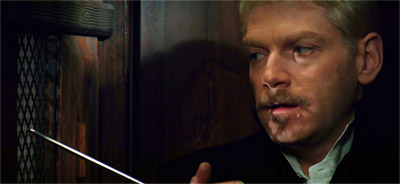 Once Claudius takes on a praying position, Hamlet appears on the priest's side of the confessional, in a position to forgive or to dole out punishment. He dictates morality in the play. He slides his dagger through the window, his words heard in voice-over as to make the scene less theatrical, and the blade goes right into Claudius' ear, shockingly. It's a fantasy. The next shot shows the blade not quite there yet as Hamlet hesitates. We're on Hamlet's eyes, thinking, realizing, and remembering. Quick flashbacks take us to various points in the film where Claudius was a-sinning, which includes a shot of the King and Polonius getting behind an arras. A clue that Hamlet very much knew that they were behind the mirror during "To be or not to be"? Or an imagined moment based on what he later learned? Choosing to wait for a better moment, the blade passes before Hamlet's eyes and he is gone. Claudius' ironic last line is also in voice-over. A strange feeling comes over him and he looks to the priest's side, but there's no one there. I wonder, could there be a staging where Hamlet isn't there at all, but is instead Claudius' imagined Hamlet, first punishing him, then not, then resolving to do so at a different moment, fueling Claudius' paranoia and justifying the exile? Hamlet as guilt manifest.
 At the top of Scene 3, Claudius' sycophants report in, Rosencrantz & Guildenstern desperate to ingratiate themselves despite their failures (this is often cut from productions as there is something necessarily tedious about it), and Polonius to inform him of his plan to hide in the Queen's closet. We then get to the heart of the matter as Claudius confesses his crime in a prayer/soliloquy. This is where Shakespeare lets go of any ambiguity concerning the crime, but to better forge a cruel irony. Hamlet walks in, sees an opportunity to kill Claudius, but stays his hand because the King is at prayer and his soul thus likely to rise to heaven, whereas his father's is trapped in hell. Or it is just another excuse not to commit to his action, regardless of his previous soliloquy. Hamlet is yet a man of words, not of action. Before we look at the play's various featured productions, and how they staged this very theatrical double-aside, let's look at Shakespeare's text (in italics) and shine some light on some of the lines.