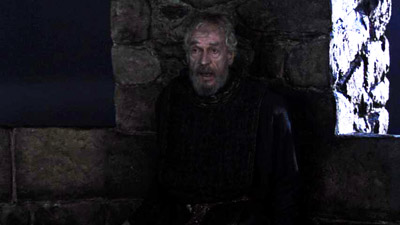
Johnny Hallyday covers this sequence with not one, but three entire songs.
Prière du spectre à Hamlet (The Ghost Prays Hamlet) has the Ghost asking Hamlet to avenge him.
Roi vivant (Living King) represents the bulk of the Ghost's story. And
J'effacerai de ma mémoire (I Will Erase From my Memory) deals with Hamlet swearing to avenge his father. Each title is linked to the song on you-tube for your listening pleasure. As usual, the full text of each song and its pedestrian translation (for clarity's and not art's sake) follow:
Prière du spectre à HamletUne ombre qui venait de l’ombreUne ombre noire, une ombre sombreUne ombre a crié, «oh, venge-moi»Une ombre qui apparaissait de l’ombreD’un roi du royaume des ombresUne ombre a crié «oh, venge-moi»Une ombre qui sortait de terreUne ombre en forme de mon pèreUne ombre a crié «oh, venge-moi»The Ghost Prays HamletA shadow that came out of shadowA black shadow, a somber shadowA shadow cried "O, avenge me!"A shadow that appeared from shadowOf a king of the realm of shadowsA shadow cried "O, avenge me!"A shadow that came out of the earthA shadow in the shape of my fatherA shadow cried "O, avenge me!"The song starts out as the "Le vieux roi est mort/The Old King Is Dead" dirge, but as soon as Hallyday starts singing, a blues-pop feel comes in to thwart expectations. The song describes the Ghost as a shadow, dark and hellish. Only in the last couples lines is it revealed to be the father of Hamlet, and even there, Hallyday doesn't let go of the Ghost's ambiguity. It is a shadow in the SHAPE of his father, which doesn't make it his actual father. As with Hamlet's questioning of Horatio's story in Scene 2, the Ghost is required to convince the doubting Hamlet. In the play, by giving the details of his murder; in the rock opera, with another song.
In fact, Roi vivant, though on a separate track with its own title, musically just continues straight from Prière, the last note of one covering the starting piano riffs. It sounds like another movement of the same piece, with backup singers coming in with their part, and indeed it is. It's all the same scene.
Roi vivantPars pas, il veut savoirPars pas, oui ton histoirePars pas, il veut te voir"Sur mon coeur de roi dormantIls ont posé un serpentDans ma vie de roi vivantIl a planté ses crocs blancEt mon coeur de roi dormantN’a plus été coeur battantRoi vivant, roi dormantRoi mourant, roi d'antanLiving KingDon't go, he wants to knowDon't go, yes your storyDon't go, he wants to see you"On my sleeping king's heartThey put a snakeIn my living king's lifeIt planted its white fangsAnd my sleeping king's heartWas no longer a beating heart"Living king, sleeping kingDying king, king of oldThe first tree lines are sung by the chorus, outside voices commenting on the action (where most songs are in Hamlet's voice). They ask the Ghost to stay and tell his story, a different take on "I will not go further" that turns it into Hamlet's first "test" of the Ghost's agenda. Hamlet takes noting at face value, and here doubts his father(?)'s words. He needs proof in the form of details. Do these details ring true? An interesting thing that's done in these opening lines is that "Pars pas" (Don't go) sounds a lot like "Papa", calling out to the father through the sounds of the words.
The section in quotation marks is spoken, rather than sung, in the Ghost's voice. The music evokes courtly medieval music, and so the past. It tells the story of the murder, but does not reveal the murderer's identity. Either the audience's knowledge of the play is taken for granted or it becomes more of a murder mystery (not that there are many suspects other than Claudius, seeing as the songs uniformly look down on him). Possibly, had the rock opera been successfully staged, the action on stage would have made it clear. The poison is represented by a snake, continuing the Garden of Eden metaphor from the play ("oh what a falling off was there"), with a strong play on the epithets, each one used as a punchy reveal (in French coming after the noun). The practice continues in the next section as acoustic guitar riffs and the chorus take over. Those last lines take Hamlet Sr. from living king to forgotten king in four short phrases, then repeat them in a fade, cycling towards an actual end and sending the Ghost back into shadow.
J'effacerai de ma mémoireJ’effacerai de ma mémoireTout mes souvenirs d’enfantDepuis couper le cordonJusqu’à ma première dentJ’effacerai de ma mémoireMes souvenirs de jeunesseDepuis mes derniers boutonsJusqu’à ma première caresseJ’effacerai de ma memoireDepuis mon premier jourJusqu’à la nuit qui vientEt dans le livre de mon histoireLes pages deviendront blanchesDu début jusqu’au mot finJ’effacerai de ma mémoireTous me souvenirs d’amourDepuis mon dernier « je t ‘aime »Jusqu’à mon premier « toujours »J’effacerai de ma mémoireTous mes souvenirs d’hierDepuis mon premier poêmeJusqu’à ma dernière guerreJ’effacerai de ma memoireMes souvenirs de demainEt ma tête se videraJe serai fou, enfinJ’effacerai même ma mémoireEt le néant s’ouvriraMais je ne t’oublierai pasJ’y plongerai avec toiI Will Erase From my MemoryI will erase from my memoryAll my memories of childhoodFrom the cutting of the cordTo my first toothI will erase from my memoryAll my memories of youthFrom my last pimplesTo my first caressI will erase from my memoryFrom my first dayTo the night that comesAnd in the book of my historyThe pages will become whiteFrom the beginning to the word endI will erase from my memoryAll my memories of loveFrom my last "I love you"To my first "always"I will erase from my memoryAll my memories of yesterdayFrom my first poemTo my last warI will erase from my memoryAll my memories of tomorrowAnd my head will empty itselfI will be mad, finallyI will erase from my memoryAnd the void will openBut I won't forget youI will dive into it with youHallyday takes the table of memory metaphor and runs with it. Though in the play, Hamlet enumerates what he erases from his memory to make room for his revenge, Hallyday gets more specific, in a way that only the ballad form can. He erases his childhood, then his youth, and so on, until he's actually erasing his future, dooming himself. He has no future except as an instrument of his father's revenge (of course, we know he's not able to respect that promise). In the last stanza, he jumps into the void to join with his father, making their "missions" one and the same by osmosis. This mirrors what is usually done in the play, with Hamlet collapsing at the end of the sequence. The empty space he has created in his mind is akin to the empty space under the earth where his father is doomed to walk (at the very least empty of God's love, in Christian cosmology). The next time we see Hamlet in the rock opera, he will have gone mad, as heralded here. Hallyday leaves little room for ambiguity on that point.


 That is all. It's actually surprising that the return of the Ghost isn't included given this adaptations fascination with that supernatural element. There is no conflict between the men that requires ghostly intervention, although the narration is almost oxymoronic. "I won't tell you anything, but I'll swear you to secrecy." And that's the interesting bit, I suppose. Summed up that way, it seems a little absurd, but we do have a scene here in which characters are forced to swear to reveal nothing while also being told nothing. While that's not strictly true, it's not entirely false either.
 Instead of other the earth, he's above ground. The relevant lines are of course cut. Strangely, though Hamlet proposes the oath, we do not hear the men swear to it. There is a disjointed quality to the comic book form, with things (especially speech) occurring in a single sustained moment within the same panel, and actions and words possibly lost in the space between panels. Sequences can read as a montage in which things must be inferred (mostly movement). As readers of Hamlet, we know the men swear even if that is not depicted here. This is an artifact of the medium (and the difficulties of adaptation) rather than a conscious disjointedness.
 At the end, Hamlet and friends go back to Elsinore. As usual, artist Tom Mandrake gives us moody images, though I'm not always sure if they thematically match their scenes. This panel gives the impression of three heroes going boldly into the night. As we know, Hamlet really goes it alone from this point. We have the darkness and uncertainty, but where is Hamlet's isolation and doubt? Again, something may be lost in the frozen moment.