Sunday, March 31, 2013

Act IV, Scene 4

Despite its containing one of Hamlet's soliloquies, it's not uncommon to see this scene excised from any given adaptation. Obviously, those that remove Fortinbras entirely won't be able to justify Hamlet crossing paths with his army on his way to exile in England. And a director might legitimately ask if their adaptation needs another moment where Hamlet decides that NOW he must act. In many ways, this is a mirror of "O, what a rogue and peasant slave am I" (Act II, scene 2). There, he was shamed by the First Player whose ability to express a false passion was greater than his to express a true ambition. Here, Hamlet is shamed by Norway and Poland, who attack or defend a worthless patch of soil with more conviction and willful action than he went after his revenge. Fortinbras is, after all, Hamlet's opposite number, a princely man of action, perhaps far more like Hamlet Sr. than his scholarly son. In him, Hamlet finds a role model, and perhaps enough of the qualities he would like to see in himself to give the Norwegian prince his vote of confidence at the play's conclusion. But let's look at Shakespeare's text (in italics; my comments interrupting in normal script) before heading off into those adaptations that included the scene.

SCENE IV. A plain in Denmark.

Enter FORTINBRAS, a Captain, and Soldiers, marching
PRINCE FORTINBRAS: Go, captain, from me greet the Danish king;
Tell him that, by his licence, Fortinbras
Craves the conveyance of a promised march
Over his kingdom. You know the rendezvous.
If that his majesty would aught with us,
We shall express our duty in his eye;


There is perhaps an early clue to Fortinbras' treachery. Expressing his duty "in his eye" might be something done for appearances only, since his plan is to invade Denmark after the invasion of Poland. This is Fortinbras' first appearance on stage, and it doesn't tell us much, only recaps the deal he has with Claudius as per the wedding banquet scene. But that's the point. Fortinbras is a plain-spoken man who deals in facts and not abstractions. A doer, not a thinker. At least, not beyond the tactics of the day.

And let him know so.
CAPTAIN: I will do't, my lord.
PRINCE FORTINBRAS: Go softly on.

Exeunt FORTINBRAS and Soldiers
Enter HAMLET, ROSENCRANTZ, GUILDENSTERN, and others

HAMLET: Good sir, whose powers are these?
CAPTAIN: They are of Norway, sir.
HAMLET: How purposed, sir, I pray you?
CAPTAIN: Against some part of Poland.
HAMLET: Who commands them, sir?
CAPTAIN: The nephews to old Norway, Fortinbras.
HAMLET: Goes it against the main of Poland, sir,
Or for some frontier?


I'm not sure I've ever seen it played that way, but Hamlet's questions could indicate a certain suspicion as to Fortinbras' intent. After all, he's just discovered a foreign army on Danish soil. The Captain's candor and sincerity (he is like his master, just as Hamlet is a product of his own deceptive Court) relieve him of his suspicions, however, as Shakespeare offers a tidy satire on the absurdity of war from the soldiers' point of view.

CAPTAIN: Truly to speak, and with no addition,
We go to gain a little patch of ground
That hath in it no profit but the name.
To pay five ducats, five, I would not farm it;
Nor will it yield to Norway or the Pole
A ranker rate, should it be sold in fee.
HAMLET: Why, then the Polack never will defend it.
CAPTAIN: Yes, it is already garrison'd.
HAMLET: Two thousand souls and twenty thousand ducats
Will not debate the question of this straw:
This is the imposthume of much wealth and peace,
That inward breaks, and shows no cause without
Why the man dies. I humbly thank you, sir.
CAPTAIN: God be wi' you, sir.

Exit

ROSENCRANTZ: Wilt please you go, my lord?
HAMLET: I'll be with you straight go a little before.

Exeunt all except HAMLET

How all occasions do inform against me,
And spur my dull revenge! What is a man,
If his chief good and market of his time
Be but to sleep and feed? a beast, no more.


Hamlet invokes his earlier "quintessence of dust" speech, but where earlier he condemned humanity, here he condemns how men abuse other men and render their existence meaningless. He's turned a corner. Where before, he saw humanity as a futile state of being, now he accepts that humanity is not necessarily futile, but one must overthrow the chains of that futility. Relative to the cannon fodder before him, he has power enough to make his life (and death) count, and resolves to do so. He even admits God's gift of free will and thus rejects predestination and nihilism:

Sure, he that made us with such large discourse,
Looking before and after, gave us not
That capability and god-like reason
To fust in us unused. Now, whether it be
Bestial oblivion, or some craven scruple
Of thinking too precisely on the event,
A thought which, quarter'd, hath but one part wisdom
And ever three parts coward, I do not know
Why yet I live to say 'This thing's to do;'


Hamlet counts himself lucky to still be alive, but can't believe he still hasn't done what he set out to do. Hamlet looks into himself and does not know exactly why he's delayed. Blaming "bestial oblivion", i.e. having forgotten his mission and Claudius' deeds, may not seem possible on the surface of it, but his confusion between blaming Claudius and blaming Gertrude might be what he's referring to. The question he asks himself is whether emotion (the realm of the unthinking beast) or reason (thinking himself into inaction) was to blame, not that it makes a difference.

Sith I have cause and will and strength and means
To do't. Examples gross as earth exhort me:
Witness this army of such mass and charge
Led by a delicate and tender prince,
Whose spirit with divine ambition puff'd
Makes mouths at the invisible event,
Exposing what is mortal and unsure
To all that fortune, death and danger dare,
Even for an egg-shell. Rightly to be great
Is not to stir without great argument,
But greatly to find quarrel in a straw
When honour's at the stake. How stand I then,


His admiration for Fortinbras takes root here, admiration for his ability to take risks and action. He hasn't met Fortinbras, of course, so one might suspect Hamlet seeing a bit of himself in him. Certainly, he's the more tender and delicate prince. Psychologically, Hamlet is turning himself into a Fortinbras, readying himself for his eventual return.

That have a father kill'd, a mother stain'd,
Excitements of my reason and my blood,
And let all sleep? while, to my shame, I see
The imminent death of twenty thousand men,
That, for a fantasy and trick of fame,
Go to their graves like beds, fight for a plot
Whereon the numbers cannot try the cause,
Which is not tomb enough and continent
To hide the slain? O, from this time forth,
My thoughts be bloody, or be nothing worth!

Exit


Hamlet's tried to convince himself to take action before, but this is the one that takes. By the time we see him again, he'll have arranged two deaths and will be ready to kill more. There really is no going back, though ironically, he's leaving Denmark and will have to literally go back.

Sunday, March 24, 2013

Act IV, Scenes 1-3 - French Rock Opera

Strangely out of place on Disc 1 of the Johnny Hallyday's double-album, between Ophélie! Ô Folie! (Ophelia! Oh Madness!) and Je lis (I Read), is a song about the transmigration of kings through the guts of beggars. Its position seems to relate far more to Hamlet Sr. than it does Claudius, which isn't inappropriate, and resonates with the fishmonger and carrion references in the play as they relate to the song I Read, i.e. Hamlet's confrontation with Polonius. In any case, I held off discussing it until we reached the proper speech in the play. The tune itself is unremarkable, though as usual, Hallyday's songwriters have gone beyond Shakespeare's own metaphors and introduced their own images. We'll discuss them in due course, but first, the original French lyrics, and an ugly little English translation so we can all be on the same page. The song uses a lot of colloquial French, which, as a French-Canadian, aren't in my vernacular, so hopefully I did right by them.

L'asticot-roi
(Refrain:) Un roi tombe en asticot
La cause n’est pas entendue
L’asticot devient le roi
Et la danse continue

La charogne est bon fumier
Elle devient vite moissons
Et elle nourrit la nation
Les hommes, les veaux, les poissons
La charogne redevient roi

Le croquant, le va-nu-pieds
Le croqué claquant du bec
Qui fait des rêves de bifteck
Mais qui mange du pain sec
Fait pourtant festin de roi

(Refrain)

Quand le lion, roi des félins
Partage avec sa féline
Une gazelle, sa voisine
Pas un des deux n’imagine
Que le roi bouffe du roi

Quand un gros roi dit «j’ai faim»
Pas un cuisinier ne bouffe
Et le roi boit, le roi bouffe
Mais l’arête qui l’étouffe
Est aussi morceau de roi

(Refrain x2)

The Worm King
(Refrain:) A king becomes a worm
The cause is not heard
The worm becomes the king
And the dance continues

Carrion makes good compost
It soon becomes the harvest
And it feeds the nation
Men, calves, fish
The carrion becomes the king again

The yokel, the tramp
The chewed-up man with chattering teeth
Who dreams of beefsteaks
But eats dry bread
Still eats a king's feast

(Refrain)

When the lion, king of felines
Shares with its female
A gazelle, their neighbor
Neither of them imagines
That the king eats king

When a fat king says "I'm hungry"
Not a single cook eats
And the king drinks, the king eats
But the fishbone he chokes on
Is also a piece of king

(Refrain x2)

The song uses a number of eating-related words in some figurative sense, not all of which I was able to translate. For example, "yokel" is "croquant", which literally means "crunchy" or "biting". But you can see how the lyrics take the concept of a beggar eating the fish that ate the worm that fed of a king's rotting corpse and widens it. Hallyday links it to Denmark entire by having carrion enrich the soil that feeds the country and the next king. He also creates the image of a kingly lion devouring its "neighbor" (with its queen), unknowingly eating of its own kind. As with the image of the king's cooks going hungry while he chokes on food, we are presented with the king as parasite. Is this part of the original image? Not entirely, though the very idea of a nobleman (Hamlet) even mentioning his country's poor is a subtle indictment of the king's rule, a dramatic representation of the gap between Denmark's classes. Finally, we have the king choking on king, restoring the veiled threat Hamlet makes. Claudius will die because he committed regicide.

Thursday, March 14, 2013

Act IV, Scenes 1-3 - Classics Illustrated

The original
With no space to spare after that giant ghost visitation double-page splash, this three-scene sequence is reduced to a single panel, with a caption box explaining what happens and Claudius, finally alone, reveals his true agenda - the execution of Hamlet at England's hands. The original Classics Illustrated was nothing if not precipitous when it came to talking scenes. The single panel is more or less used as a punchline, a surprise twist that Hamlet has been sent to his death.

The Berkley version
In three panels, going from a claustrophobic close-up to an airy wide shot - perhaps representing how Claudius feels trapped by the situation, and freed by his decision - Tom Mandrake's Hamlet also reduces the sequence to a single moment. Once again, Hamlet has been caught offscreen, and no final confrontation between Prince and King is to be had on the page. Thrift, thrift, Horatio. Strangely, Rosencrantz & Guildenstern are allowed to stand there while Claudius pronounces his usually secret soliloquy. This makes them more obviously complicit in Hamlet's murder. They know the contents of the letters they carry and perhaps better deserve their deaths. Of course, part of this is the freeze-frame aspect of the comics form. A panel's action represents a single second, but the dialog takes far longer. Might R&G have left in between the two speech bubbles, and thus never heard the King's more private words? It's an ambiguity that wouldn't exist on the stage or on film.

Sunday, March 10, 2013

Act IV, Scenes 1-3 - Tennant (2009)

Scene 1
Patrick Stewart's Claudius is as ambiguous a figure as he is creepy in this sequence. Gertrude is startled out of her sobs by hands around her neck, a killer's hands, though it's of course meant to be a massage. Because we're experiencing the scene through her, the camera focused on showing us her reactions, everything Claudius says is does is imbued with a threatening quality, even though, on the surface, he shows her nothing but kindness. But is he asking her questions out of concern for her well-being, or sounding her to see if Hamlet revealed his murderous secret? She's very careful not to give too much away, weighs every word and scrutinizes his face, looking for a sign that he might do her or her son harm. Claudius too, weighs his words, but as a slick politician does, making cool choices to control others' perception of him. Though she is shocked at his assertion that his love (for her? for his adopted son?) was too much to stop this from happening, he eventually wins her over when he admits his soul is full of dismay, reacting to his pain and finally finding the man she loves and was evidently seeking for. We cut away before the embrace, though the director says they did indeed kiss at this moment when the scene was shot.

Gertrude may be desperate to cling to what she once had and resolve her mixed feelings, there's no denying Claudius' selfish streak here. Yes, his first reaction to Polonius' death is shock that he might have been the target of the assassination, but beyond that, there's the moment when he calls Rosencrantz & Guildenstern into the room, thoughtlessly exposing Gertrude to humiliation. She's in her night gown and has been crying and looks quite vulnerable. As R&G walk in, she goes running with a yelp, and sits her back to them, mortified. At no point does Claudius even notice. He's playing the part he wrote for himself, that of the concerned father, tiredly apologetic when asking Hamlet's two school chums to go and find the prince and the corpse. There's definitely a vein of black comedy in the matter-of-fact way it is played.

Scene 2
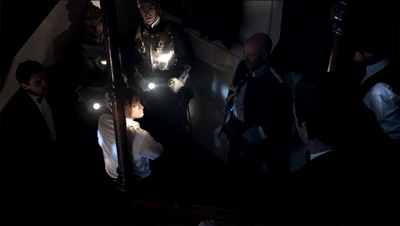
And then the comedy explodes with the apprehensive, not to say terrified, duo (and a host of guards) running around corridors and staircases, à la Marx Brothers, through Elsinore in search of the killer Prince. The music is humorous, and stops when they stop, so they can hear the body being dragged down stairs. Darkly funny. The Hamlet they find is Mad Hamlet, waiting for them, in complete control, and soon doing voices (pitching up on "squeeeeeeeeezed" for example, or giving the next few lines a swinging cadence as his body sways around a post, appropriately ape-like). The scene is lit by torches (or as we say in North America, flashlights), giving it an uneasy feeling, through which we well understand R&G's reaction. Hamlet is having fun, but no thinks it's funny. Not getting a reaction, he gives up and asks to be brought to the King... at which point he resumes running, jumping the balustrade and leading a merry chase once again.

Scene 3
At the bottom of a stairwell, a new venue, an ugly basement with mysterious stains on the concrete floor and a broken mirror over a dirty wash basin. A place where things are done in secret. Torture? Covert murder? People made to disappear. The cool and collected, even reasonable, Claudius is attended by lawyer types in suits, one of which will turn out to be a doctor. Again we have the push and pull of a reasoned leader protecting his family, who could also be about to kill Hamlet and have his body wash up somewhere innocuous (at least, for an audience who doesn't know the play). Enter Hamlet, taped to a chair on casters, a piece of tape on his mouth as well. It's an interrogation/torture scene. The threat to his life doesn't deter Hamlet from his mockeries. He makes his wild speeches and responds to Claudius' single loss of temper ("Where is Polonius?") with a silly shouting voice ("In heaven!"). The doctor in the room shoots him up with some drug, precursor to his exile, a way to smuggle him, sedate, out of the country. There's a nice moment when Hamlet looks straight into the camera at his mention of a cherub that sees Claudius' purposes, something that can easily be translated to the stage. The audience sees all, and it's true to say that soliloquies are a kind of compact between character and audience. It admits our existence in the world of the play, as observers... and judges. In the film, we're part of the paranoid hypersurveillance theme, but our function is the same.

And wheeeeeeeeeeeeeeeeeee, Hamlet is rolled out of the room, eager to get to England now that he's done with Claudius. Acting the child to the end. Claudius' brief soliloquy is told in the broken mirror, a match to the one upstairs in Gertrude's closet, and a reference to the mirror used in the stage production. This is an Elsinore that is falling apart, disjointed and fractured, just like its royal family unit. Like Ophelia's mind. And that's where Doran's Hamlet goes next.

Sunday, March 3, 2013

Act IV, Scenes 1-3 - Fodor (2007)

Fodor's Hamlet makes Ophelia much more of a participant in this sequence, starting on her and a visitation from the Hamlet ghost child. She follows him out into the hall, where a young Ophelia ghost is also running around. In this world, it seems your spirit can leave you early and remain in echoes of better times. Ophelia ignores her younger self and moves towards the end of the hall while intelligible shouts are heard resonating through Elsinore, likely people looking for Hamlet. Ophelia finds him first, having just stowed the body behind a folding screen, in a room dimly lit in red. She spies from one of the doors as Rosencrantz & Guildenstern find Hamlet. These are much more menacing, violent characters in Fodor's adaptation, so Rosencrantz is visibly holding back from attacking the Prince with great difficulty. Guildenstern's "A thing, my lord?" is said with outrage instead of the usual misunderstanding tone. Calling the King a thing is, it seems, a step too far, and the sponges wonder how much trouble Hamlet is willing to get himself into.

After they leave, Ophelia walks towards the folding screen where she finds her sister Polonia's body, hung in the closet, head down.
 She tries to take her down, to awaken her, and failing, throws an expletive-filled tantrum. Flashback images remind us of Polonia's role as her sister's drug pusher, sticking needles into her arm to manipulate her. The whole set-up creates an entirely new motivation for Ophelia's madness. She hasn't lost a beloved father at her lover's hand, she's lost her dealer. She's angry, not distraught, but soon she'll be feeling the pangs of withdrawal. What's most interesting is that Polonia has basically been placed "behind an arras", in death an image of the life she led.

Scene 3 is entirely omitted (as is Scene 1). It's an odd exclusion, and we may wonder where Hamlet has gone. The point is made later when he returns, so expediency may have been the order of the day. And since Ophelia discovers Polonia's body, there's less of a reason for Claudius to keep asking where it is.

Sunday, February 24, 2013

Act IV, Scenes 1-3 - Hamlet 2000

Skipping right to Scene 2, Rosencrantz & Guildenstern find Hamlet washing his bloody clothes in a laundromat. Cutting Scene 1 is an easily made cut since the audience can infer that the murder was found out and people sent to track the killer. We're only really missing Claudius' selfish reaction to it. In this modern day adaptation, the whole sequence (as Claudius walks in with bodyguards soon after being called by one of the twins) smacks of something out of a mob movie. The family never called the police, they're handling this themselves, quite possibly falsifying the details of Polonius' death to protect Hamlet from the authorities. And for that, they need the body. The laundromat is obviously redolent in meaning, a place where Hamlet attempts to wash his soul of his sin, and where indeed, we learn the King washed it from the public eye. We found out it was Halloween earlier (a child dressed as a ghost booed at the King), so there are two pumpkins on a table in the corner, and in an amusing piece of staging, Rosencrantz sits next to them during the scene, surely an attack on R&G's wits.

Unlike most interpretations, they let Claudius win the scene. He comes in with a disarming smile, and Hamlet gets through his lines with fear and apprehension in his voice. The prince even tries to bolt for the door, but is pinned to the wall by the King's bodyguards. Claudius vacillates between kindness and thuggery, punching Hamlet in the gut when he loses patience with him, but wiping the hair off his brow when he finally gives up the body's location. Among the many cuts is Hamlet's seeing a cherub that sees Claudius' purposes. So only in the final disquieting kiss to his mother/father does Hamlet score a point. The look on the bodyguard's face says it all - these people are crazy.
Cut to the airport, where Hamlet is given a rare farewell with a very drunk Gertrude, cold at first, then coming back for a warm embrace, an image of their last conversation in a way. Claudius stays in the limo to do his short soliloquy, and he has to get it out fast before Gertrude returns to the car. He's in his own world when she does and doesn't notice the way she looks at him, distrusting and wary. So though Scene 1 was cut, we still get a very good idea of which side she's really on thanks to her inclusion in this scene.

Sunday, February 17, 2013

Act IV, Scenes 1-3 - Kline '90

Scene 1
Brian Murray is one of the better Claudiuses, as evidenced by the sincerity he brings to his performance in this scene, a sincerity that draws attention to different words usually spoken quickly or with no particular emphasis, and enriching the text. His concern for Gertrude is heartfelt, and her focus on the murder of Polonius makes us believe she really does think her son mad. She has not gone over to his side. When Claudius says it would have been him killed had he been in Polonius' place, there is no shock or surprise in his voice, only assurance. This is Claudius at his most Kingly, deciding the truth of what has happened and moving from there. He is still a master politician, for example stressing the words "countenance and excuse" for Gertrude's sake, letting her know that while Hamlet is to be punished, the measures will be for his own good.

So what words does Mr. Murray illuminate? To begin with, there's the irony of the phrase "out of haunt", which had escaped me until now. Claudius means that Hamlet should have been kept locked away and not been allowed to walk (haunt) the halls of Elsinore at his leisure, but he doesn't know most of the current trouble is due to his brother's Ghost doing the same. Should we also see a pun in "The sun no sooner shall the mountains touch"? Shakespeare is notorious for playing on sun/son, and in this case, the phrase might have a double meaning akin to "before Hamlet can make his own escape", or even "before Hamlet can gain support and reach the top, i.e. kingship".
Scene 2
There were several cuts in Scene 1, the most important of which was Rosencrantz & Guildenstern's presence, but they're in this scene, obviously having been told to find Hamlet in between scenes. Kline's Hamlet is calmer and less obviously mad than most others in this sequence, bringing genuine outrage to the sponge speech. He even lets his anger come out when he says he's the son of a king, making this Hamlet more indignant about the subverted class system than most. And indeed, the same way Claudius has subverted the succession, R&G (at least, in Laertes' absence) have taken his place as the favored son of a king. A bloody rag in his hand, Hamlet uses the prop effectively AS a sponge, perhaps indicating that what they have soaked up is steeped in blood, fruits of a tree growing from a murder.
Scene 3
Instead of being brought to Claudius, the start of this scene is trimmed off and Claudius and his officers come to him. Both Kline and Murray play this scene calmly and reasonably, letting the words act as veiled threats or lunatic dissertations. Though underplayed, there is still a lot of invention on show. For example, though gesturing at Claudius when mentioning the "fat king" is par for the course, allowing the other hand to gesture at R&G on "lean beggar" is not. It becomes a reference to the sponge metaphor, and inverts the cannibalistic relationship between the characters. The King eats them like an apple, and they eat him like a fish. Who is using who?

Hamlet leaves his stepfather with a violent kiss on the cheek, which seems even more threatening than the words they've just exchanged, as if telling Claudius that kiss might well have been a dagger. He let him get too close. There's also some very effective staging - and excellent use of the text as written - as R&G are sent away. Claudius continues speaking after giving the order, and they turn around to, sponge-like, receive more of his words. It's an almost comical move that motivates the harsher "Pray you make haste" as Claudius seems to finally lose patience with his chief sycophants.

Sunday, February 10, 2013

Act IV, Scenes 1-3 - Zeffirelli '90

Before Claudius comes shouting in, Gertrude has a moment alone to herself, looking at the effigy of her late husband. She quickly hides it from the newer, more murderous model, and by this we know she's chosen a side. After this sequence, Zeffirelli restores the last few lines from Act IV to give Hamlet and Gertrude a proper farewell, "fixing" the anomaly of Hamlet knowing about his exile before he's actually told to go by the King. That's fine, give or take an inappropriate kiss, and it makes it even more clear the Queen is her son's accomplice. In the play as written, she has no contact with him after he is caught and sent away, letting ambiguity reign regarding her true feelings. In this restructuring of the play, she gives him hopeful smiles as he reassures her that he will keep a close eye on Rosencrantz & Guildenstern.

Claudius, for his part, suffers some cuts in the breakneck pace Zeffirelli has adopted. In Scene 1, his "it had been so with us had we been there" serves as a punchline, cutting from blood stains on the floor to his office, where he arrives in a hurry to give the order to apprehend Hamlet. We might wonder why he wasn't attended in the first part of the scene to avoid the location change, but it does create a more urgent rhythm as Elsinore wakes up and attempts to find the Prince and his victim. In fact, Scene 2 is reduced to a single shot of R&G and some guards with torches shouting out Hamlet's name.
Scene 3, as is usual, is more fully rendered, though Claudius still suffers an interruption when his political speech to his courtiers is shortened by R&G's arrival. By cutting the line of dialog about Hamlet being kept outside, the director achieves two things. First, he makes the action run faster by removing a planned delay. Second, by having Rosencrantz shake his head when asked "Where is he?" and giving Hamlet an entrance from the other side of the room, he stages it so the Prince is there willingly and was never caught. He whistles rudely, jumps on the table, kicks at some candles, mockingly wears Polonius' hat... This is a brazen attack on Claudius' authority and Hamlet brings the fight to him. It's a war of words, with both men making veiled but plain threats, but it's presumably all Hamlet can afford while surrounded by Claudius' men. Still, the danger to the King seems more palpable because Hamlet WAS never caught. He got all the way to Claudius' inner sanctum too.

Sunday, February 3, 2013

Act IV, Scenes 1-3 - BBC '80

Scene 1
Watch how masterful a politician Patrick Stewart's (first take as) Claudius is. In Scene 1, he's obviously angry at his wife and wants her to stop crying long enough to get the answers he needs from her. And he's visibly shaken when he investigates the site of Polonius' death by the sight of blood on his hands. This relates to his previous scene, the blood on his hands reminding him of his own murder. Indeed, we're reminded here that Polonius' death is ultimately his fault as well, since the old man wouldn't be skulking around Elsinore if he hadn't tasked him to, nor would Hamlet be so dangerous had his father not been killed. There's a dramatic reason why Hamlet Sr. was poisoned - it's a poison that courses through their entire family tree and the whole of Denmark. A murder that SPREADS. He wipes the blood off in a panic, as if trying to hide his own sins from the world, which is exactly what he will do politically. He's seen his way out of the situation and it's as a politician that he next addresses Gertrude. He'll exile Hamlet in such a way that even his mother can't argue. He makes a case that they're both in this together (no one is safe) and further that she shares in the blame for loving Hamlet too much and letting the situation get out of hand. She tries to argue Hamlet's case, but it won't work this time. Claudius is on more solid ground. But when he tells her to come away with him, she stays behind, the staging telling us their relationship has been split asunder.
Scene 2
Catching up to Hamlet, we find him "safely stowed" and not running, speaking to camera as he does, in the dark, waiting to be discovered. When he is, by Rosencrantz & Guildenstern's posse, he still doesn't run, but rather continues to undermine their authority over him as he did in the previous Act. However, Rosencrantz is done playing games, and sensing that he and his partner now have the King's favor over Hamlet, becomes very cold towards his former friend. He refuses to acknowledge any meaning in Hamlet's words. Derek Jacobi, as usual, puts enough of a spin on each and every line that *I* can't possibly take R&G's lead. He makes me want to find meaning in his mad dialog, and new meaning at that. For example, I'm now trying to read "The body is with the king, but the king is not with the body" with the "King" relating to Hamlet Sr. rather than Claudius. Certainly, the Ghost could be a "thing of nothing", but I still get lost in the verbal alchemy.

Scene 3
The text has Claudius "attended" in this third scene, but it's often staged with him starting on his speech alone. What a difference it makes when he's giving orders to Courtiers. Here we have the politician once again, explaining the situation, his plan, and most crucially, that "we're all in this together". By implying that the peasants love Hamlet, he threatens rebellion if they don't agree with his plan, making them all accomplices. Hamlet comes in, sits on the desk, inspects the sealed letters casually, and everything in the staging reveals the power shifting in Elsinore. Hamlet is sitting higher than the King, is far less anxious (does Claudius fear the Prince will expose him in front of everyone?), and having now killed, he is at least the "actor" Claudius is. The King must retake control of the situation and does, standing and once again playing the politician. The way he tells Hamlet of his exile, it's like he's helping him escape a worse fate. Again, it's a case of "being in this together", this time, as a family. It doesn't really work on Hamlet, but there are other people in the room. Hamlet actually leads them out, as if the trip was his idea, pointing at the attendants to fire them into action. We're left believing Hamlet won the scene. He leaves head held high, while Claudius, with tired sighs, asks England to do his dirty work for him.

Sunday, January 27, 2013

Act IV, Scenes 1-3 - Olivier '48

Olivier cuts scenes 1, 2 and indeed, 4, from Act IV, which does have a considerable impact on the play. By omitting Scene 1, Claudius' character is impoverished (the King is rather flat throughout the adaptation), and we can't evaluate whether Gertrude sides with her son or her husband (though the previous Act definitely leans towards the former). Scene 2's omission is unsurprising, given that Rosencrantz & Guildenstern have been excised from the play completely. So we start with Scene 3, a much calmer moment for lacking the chase through Elsinore. In fact, the King's sealing letters with Hamlet standing right there. Claudius' tone is restrained and ever the politician, he makes it sound like Hamlet's exile is for his own good, to avoid prosecution. The Prince is insolent, but Claudius' lack of reaction turns the words into curious/profound observation rather than insult.

Much more interesting is Hamlet's moment of madness when he calls Claudius his mother. He gets that far-away look in his eyes and his hands clench as if around someone's throat. By transforming his stepfather into his mother, or merging the two concepts, is he in a way giving Claudius a stay of execution? Olivier plays it as a realization. It's as if having decided not to harm his mother, he can now no longer harm her husband. Olivier is answering the question as to why Hamlet allows himself to go into exile rather than give in to his murderous impulse and kill the King instead. The exile saves all their lives, at least temporarily (aside from Ophelia, of course). With Scene 4 missing, THIS becomes the mid-play epiphany, the dramatic turning point. Not "my thoughts be bloody", quite the contrary. Hamlet apparently gives up his revenge, and we'll have to wonder why he returns to Denmark later. He can't even kill his two false friends on the voyage to England since they don't exist. Does Claudius' treachery (the letters requesting his death) reignite his desires? That's an analysis for another day.

As for Claudius, the staging has him go to the window to give his closing speech, speaking to England across the sea. A cool, collected delivery that speaks less to rage than it does to acceptance of one's situation. The role is underplayed here, but one might still praise it as an ideal form of Hamlet himself, i.e. a character who has already come to terms with "the readiness is all".

Sunday, January 20, 2013

Act IV, Scenes 1-3 - Branagh '96

Each of these three scenes is given its own unbroken shot, a technique Branagh says fostered a kind of anxiety in the actors that translated to their characters. It's a clever and subtle way to get across the instability and political (and personal!) upheaval caused by the Prince effectively killing the Prime Minister.

Scene 1
Most of Claudius' lines are played as an aside though Gertrude is present, usually off-screen, which creates the effect of her shock. She is obviously stunned, disconnected from the scene, their final embrace non-committal. Is she still clutching at him, wondering if she should betray him, or is he the one holding her close? Probably a bit of both. In this version, he does love her, and she is the principal reason for the murder he committed. All of which clashes with his feelings for Hamlet - fear and murderous anger - nevertheless Gertrude's reason for living. He's impatient with her contention that her son is somehow repentant, thinking her naive and foolish. Because no matter how important Gertrude is to him, Claudius can't ignore his own selfishness. On hearing of Polonius' murder, he thinks first of his own safety, and by the time the scene is resolved, he's put together a plan to make sure the Court knows who was really guilty of the crime lest the blame fall on him. During a crisis, Claudius falls to public relations mode.

Not content to believe Gertrude's interpretation, Claudius visits the crime scene himself, looks at the counterfeit presentment of two brothers on the bed, puts it all together. Between this scene and his next (Scene 3), not to mention the play within the play, there's every reason to believe he's understood what Hamlet is really on about. The Prince is gunning for him, possibly planning a coup, but at the very least trying to avenge his father's murder. He can no longer excuse the madness, nor does he particularly believe Hamlet's act.

Meanwhile, Rosencrantz & Guildenstern, asked to wait in the hall outside the rooms, and are often seen in frame, connecting them to Polonius, another conspirator listening in at a remove. Can their own deaths be far ahead?

Scene 2
Then, action. Soldiers running through Elsinore, searching Ophelia's bed. R&G find Hamlet first, creeping about as if in a comedy routine. They don't lay a finger on him, nor do the soldiers that join his train every time he turns a corner. It's a last hurrah for the madcap Hamlet, a version of the character that won' exist after Scene 3, and as if in an encore of a previous scene, he even takes Rosencrantz hostage (pipeless, this time). Branagh invents a bit here where an awakened Ophelia comes down the stairs, face to face with Hamlet. Confronted by the woman he's just orphaned, the Prince makes a run for it, going through room after room, jumping over tables (the courtiers seem to be having a late dinner after the play). It's notable that he tries to avoid his fate, or perhaps he's trying to find a weapon and get to Claudius before the guards get him. In the end, he reaches his library/study, but it's been compromised (as has the rest of Elsinore; note how none of the guards are those shown loyal to him in Act 1). A rifle is leveled at his head and we cut to Claudius.

Scene 3
Claudius is in his own study, sealing letters bound for England and explaining, in a soliloquy, the politics behind his next action. I wonder if Derek Jacobi muddled the pronunciation of "distracted multitude" on purpose, because it sounds like "destructive multitude" to me. Certainly, that's how he thinks of Denmark's population, as rabble not only stupid (distract), but dangerous as well. He's interrupted by R&G who bring Hamlet to him. Horatio is also dragged in, either as a co-conspirator or to bear witness to Hamlet's fair treatment. There are two reasons to have him present even if the text does not mention him. One is to keep him in play the same way Ophelia has been brought into these scenes. Neither character has appeared since the play, and neither gets a farewell scene with Hamlet before he is exiled. Branagh manages to give each of them a wordless farewell, both given meaning through performance. The other reason to have him there is to cement his role as an objective witness in the final scene. If he is telling us this story, he needs to be present as much as possible.

Hamlet continues to be insolent, and Claudius has had enough. He's drinking more and more (one of his sins), and back-hands Hamlet quite hard when the Prince refuses to give him a straight answer. And yet, Hamlet doesn't break character or even lose his sense of humor. In fact, the scene becomes a kind of duel, both characters knowing full well the other's secrets, but daring the other to reveal themselves in front of witnesses. Hamlet even goes so far as kissing Claudius on the mouth when he calls him his mother. Claudius finally breaks when Hamlet is carted off and he gives his "do it, England" speech, barely containing the rage and anguish he feels at the discord in his heart. His wish is to kill his stepson, but politically, he needs to exile him instead, either move sure to hurt the woman he loves. Because the exile means death, there's also a measure of guilt there. This is a man who only a few scenes ago was suffering from having committed one murder, and here he is ordering another.  It all plays out in Jacobi's voice.
Before being taken away, Hamlet goes to Horatio and almost talks to him, leaving it at a silent look passing between the two friends. Nothing so good for Ophelia, clutching at the chapel's doors as her father's found body is brought in, screaming her head off, her sanity already slipping away. Those screams echo over the water in an exterior shot, extending the mad scream right to the girl's very death, the brook where she will take her own life.

Sunday, January 13, 2013

Act IV, Scenes 1-3

Act IV begins with a few short scenes with one motive purpose - sending Hamlet to England as reprisal for killing Polonius (or, if you will, to prevent him from killing the King). I've chosen to take all three scenes as a whole, since many adaptations skimp on one or two of them, and because they are in fact so brief. In Scene 1, Claudius finds Gertrude distraught after her meeting with Hamlet. In Scene 2, Rosencrantz & Guildenstern hunt down the Prince. And in Scene 3, Claudius confronts and exiles him. Before addressing the adaptations, let's examine the Bard's text (in italics). As usual, I'll break in with commentary from time to time.

SCENE I. A room in the castle.
Enter KING CLAUDIUS, QUEEN GERTRUDE, ROSENCRANTZ, and GUILDENSTERN

KING CLAUDIUS: There's matter in these sighs, these profound heaves:
You must translate: 'tis fit we understand them.
Where is your son?
QUEEN GERTRUDE: Bestow this place on us a little while.

Exeunt ROSENCRANTZ and GUILDENSTERN


As usual, Gertrude has no patience or trust for Claudius' lieutenants, R&G and the late Polonius. This is consistent throughout the play, but subtle and easily missed (or ignored) because she never makes a speech about it, part of her "under-written" nature.

Ah, my good lord, what have I seen to-night!
KING CLAUDIUS: What, Gertrude? How does Hamlet?
QUEEN GERTRUDE: Mad as the sea and wind, when both contend
Which is the mightier: in his lawless fit,


Note the accumulation of sea-going imagery building up to Hamlet's departure for England. He's "as mad as the sea and wind", and before that, Claudius speaks of "heaves", Gertrude as the swelling waves of the ocean, her signs and tears poetically carrying Hamlet out of her life. In Hamlet, water portents terrible things, whether it be any given character's tears, Hamlet's exile at sea or Ophelia's impending drowning.

Behind the arras hearing something stir,
Whips out his rapier, cries, 'A rat, a rat!'
And, in this brainish apprehension, kills
The unseen good old man.
KING CLAUDIUS: O heavy deed!
It had been so with us, had we been there:


Obviously, Claudius thinks of himself first. And he's right. Hamlet was angling for him. In the following lines, he includes Gertrude and everyone at Elsinore, but he thought of himself first.

His liberty is full of threats to all;
To you yourself, to us, to every one.
Alas, how shall this bloody deed be answer'd?
It will be laid to us, whose providence
Should have kept short, restrain'd and out of haunt,
This mad young man: but so much was our love,
We would not understand what was most fit;
But, like the owner of a foul disease,
To keep it from divulging, let it feed
Even on the pith of Life. Where is he gone?
QUEEN GERTRUDE: To draw apart the body he hath kill'd:
O'er whom his very madness, like some ore
Among a mineral of metals base,
Shows itself pure; he weeps for what is done.


In the text, it is clear that Gertrude does not divulge what Hamlet has said to her, either about his father's murder, or that he's only playing at madness. One thing to watch as we go through the various adaptations is how each actress interprets this. Is Gertrude now betraying Claudius' trust? Or did she not believe Hamlet in the first place? Performance will be everything.

KING CLAUDIUS: O Gertrude, come away!
The sun no sooner shall the mountains touch,
But we will ship him hence: and this vile deed
We must, with all our majesty and skill,
Both countenance and excuse. Ho, Guildenstern!


Re-enter ROSENCRANTZ and GUILDENSTERN

Friends both, go join you with some further aid:
Hamlet in madness hath Polonius slain,
And from his mother's closet hath he dragg'd him:
Go seek him out; speak fair, and bring the body
Into the chapel. I pray you, haste in this.

Exeunt ROSENCRANTZ and GUILDENSTERN

Come, Gertrude, we’ll call up our wisest friends
And let them know both what we mean to do
And what’s untimely done. So envious slander,
Whose whisper o’er the world’s diameter,
As level as the cannon to his blank,
Transports his pois’ned shot, may miss our name,
And hit the woundless air. O, come away!
My soul is full of discord and dismay.

SCENE II. Another room in the castle.
Enter HAMLET

HAMLET: Safely stowed.
ROSENCRANTZ: GUILDENSTERN: [Within] Hamlet! Lord Hamlet!
HAMLET: What noise? who calls on Hamlet?
O, here they come.

Enter ROSENCRANTZ and GUILDENSTERN

ROSENCRANTZ: What have you done, my lord, with the dead body?
HAMLET: Compounded it with dust, whereto 'tis kin.
ROSENCRANTZ: Tell us where 'tis, that we may take it thence
And bear it to the chapel.
HAMLET: Do not believe it.
ROSENCRANTZ: Believe what?
HAMLET: That I can keep your counsel and not mine own.
Besides, to be demanded of a sponge! what replication should be made by the son of a king?


As Hamlet denies R&G's right to question him by reasons of class, he slips into prose, making it clear to them that he does not consider them worthy of verse.

ROSENCRANTZ: Take you me for a sponge, my lord?
HAMLET: Ay, sir, that soaks up the king's countenance, his rewards, his authorities. But such officers do the king best service in the end: he keeps them, like an ape, in the corner of his jaw; first mouthed, to be last swallowed: when he needs what you have gleaned, it is but squeezing you, and, sponge, you shall be dry again.


A notable pun here is "ape", which means "apple", but can also be the primate. Hamlet simultaneously turns R&G into something to be slowly devoured, and the King into a brutish beast. As we'll see in Scene 3, Hamlet will expound on the carnivorous metaphor, in a way that informs this line as well with additional insult. The point of the worm speech is an alchemical transformation through words of the King into baser matter. So if the King eats R&G in this particular image, he becomes like them (and in Scene 3, will deserve the same kind of disrespect).

ROSENCRANTZ: I understand you not, my lord.
HAMLET: I am glad of it: a knavish speech sleeps in a foolish ear.
ROSENCRANTZ: My lord, you must tell us where the body is, and go with us to the king.
HAMLET: The body is with the king, but the king is not with the body. The king is a thing--
GUILDENSTERN: A thing, my lord!
HAMLET: Of nothing: bring me to him. Hide fox, and all after.


A veiled threat. Hamlet considers Claudius already dead - part of his fatalism, though some may be expected to die sooner than others - so he is "with" the corpse spiritually, if not physically. Hamlet nihilistically turns Claudius first into a thing (an object) and then into nothing at all, denying his existence, right to the throne, and life. Again, these are alchemical transformations using words to denature a person and an office.

Exeunt

SCENE III. Another room in the castle.
Enter KING CLAUDIUS, attended

KING CLAUDIUS: I have sent to seek him, and to find the body.
How dangerous is it that this man goes loose!
Yet must not we put the strong law on him:
He's loved of the distracted multitude,
Who like not in their judgment, but their eyes;
And where tis so, the offender's scourge is weigh'd,
But never the offence. To bear all smooth and even,
This sudden sending him away must seem
Deliberate pause: diseases desperate grown
By desperate appliance are relieved,
Or not at all.


In this speech, Claudius reveals why he can't have Hamlet executed. Because the Prince is so loved, he fears a revolt from the common population of Denmark. This speaks to the political climate he's created by marrying Gertrude, interrupting the normal line of succession. When Laertes returns later, the rabble will be at the gates. Without their Prince, the population is quick to object to the usurper king.

Enter ROSENCRANTZ

How now! what hath befall'n?
ROSENCRANTZ: Where the dead body is bestow'd, my lord,
We cannot get from him.
KING CLAUDIUS: But where is he?
ROSENCRANTZ: Without, my lord; guarded, to know your pleasure.
KING CLAUDIUS: Bring him before us.
ROSENCRANTZ: Ho, Guildenstern! bring in my lord.

Enter HAMLET and GUILDENSTERN

KING CLAUDIUS: Now, Hamlet, where's Polonius?
HAMLET: At supper.
KING CLAUDIUS: At supper! where?
HAMLET: Not where he eats, but where he is eaten: a certain convocation of politic worms are e'en at him. Your worm is your only emperor for diet: we fat all creatures else to fat us, and we fat ourselves for maggots: your fat king and your lean beggar is but variable service, two dishes, but to one table: that's the end.


Note how Hamlet shows disrespect by speaking in prose to the King. The alchemical transformations in this little speech loop around to undermine everything about Claudius' right to rule. The worms are "politic", a reference to Claudius' Court (and Polonius in particular) bowing to him for political gain. The worm is an "emperor", a title well above the "king". And the King is equal to the beggar on the worm's dining table (one insultingly fat, the other virtuously lean). The fatalistic image Hamlet creates here mocks everything Claudius stands for, but will be repurposed in the graveyard scene as a more sober acceptance of one's own death.

KING CLAUDIUS: Alas, alas!
HAMLET: A man may fish with the worm that hath eat of a king, and cat of the fish that hath fed of that worm.
KING CLAUDIUS: What dost you mean by this?
HAMLET: Nothing but to show you how a king may go a progress through the guts of a beggar.


The alchemical process reaches a crescendo as the King becomes a worm, then a fish, then food for a beggar. This equalizing metaphor not only threatens the King with death (which is its topic), but with revolution, the beggar devouring the King.

KING CLAUDIUS: Where is Polonius?
HAMLET: In heaven; send hither to see: if your messenger find him not there, seek him i' the other place yourself. But indeed, if you find him not within this month, you shall nose him as you go up the stairs into the lobby.
KING CLAUDIUS: Go seek him there.

To some Attendants

HAMLET: He will stay till ye come.

Exeunt Attendants

KING CLAUDIUS: Hamlet, this deed, for thine especial safety,--
Which we do tender, as we dearly grieve
For that which thou hast done,--must send thee hence
With fiery quickness: therefore prepare thyself;
The bark is ready, and the wind at help,
The associates tend, and every thing is bent
For England.
HAMLET: For England!


Part of the disjointedness of the time element in Hamlet is that it seems like Hamlet knows he's to be shipped to England three scenes before he's actually exiled. We can resolve this with the text, as nothing contradicts the idea that Claudius is merely accelerating his plans in the wake of Polonius' murder, but it nevertheless creates the effect.

KING CLAUDIUS: Ay, Hamlet.
HAMLET: Good.
KING CLAUDIUS: So is it, if thou knew'st our purposes.


Claudius gives himself away, and if Hamlet didn't know to watch himself on this voyage, he would now.

HAMLET: I see a cherub that sees them. But, come; for England! Farewell, dear mother.
KING CLAUDIUS: Thy loving father, Hamlet.
HAMLET: My mother: father and mother is man and wife; man and wife is one flesh; and so, my mother. Come, for England!


One final alchemical transformation (for the road, you might say): Hamlet transforms Claudius into the Queen as a parting insult (or so Claudius receives it). Using the marriage vows as his metaphor, Hamlet changes his stepfather's gender - the weaker in this society - while also reminding him of his de facto coup d'etat. The real power is the Queen, because Claudius is only allowed to rule through marriage with her. Though it may also represent remnants of bitterness against his mother, tying her into Claudius' misdeeds once more, I prefer to think of it as a transference of the anger he felt towards her into Claudius alone. All the sins to be avenged are in a single vessel.

Exit

KING CLAUDIUS: Follow him at foot; tempt him with speed aboard;
Delay it not; I'll have him hence to-night:
Away! for every thing is seal'd and done
That else leans on the affair: pray you, make haste.

Exeunt ROSENCRANTZ and GUILDENSTERN

And, England, if my love thou hold'st at aught--
As my great power thereof may give thee sense,
Since yet thy cicatrice looks raw and red
After the Danish sword, and thy free awe
Pays homage to us--thou mayst not coldly set
Our sovereign process; which imports at full,
By letters congruing to that effect,
The present death of Hamlet. Do it, England;
For like the hectic in my blood he rages,
And thou must cure me: till I know 'tis done,
Howe'er my haps, my joys were ne'er begun.

Exit


Is there a satirical function to making England the instrument of Hamlet's death? Scholars better versed in history may be able to make that determination better than I. If England kills Hamlet, then it kills everything he represents. Should we infer an attack on the part of Shakespeare on English elements that would stifle intellectualism, poetry, a strong and vibrant theater, and other values Hamlet espouses? After all, this scene wasn't just an attack on Claudius, but on Royalty itself. I do not, however, feel well-equipped enough to make a determination on Shakespeare's opinions on the matter, nor the historical context that might have prompted such an attack.

Sunday, January 6, 2013

Other Hamlets: Swing with Scooter

Published by DC Comics in April-May 1967, written by Jack Miller and Barbara Friedlander, with art by Joe Orlando and Mike Esposito, Swing with Scooter #6, a "hip" teen comic that would only later become a straight Archie rip-off, featured the story "Hamlet and Eggs". You can probably guess this is a Hamlet pastiche as the cast of high school kids attempt to put on a play to raise money and don't take it very seriously. Is there anything we can learn about Shakespeare's original from a jokey comic book?

The plot is pretty simple and rather silly, and has absolutely nothing to do with the cover. Miss Bluff, the German drama teacher, puts the kids in rehearsals for Hamlet, and has some real trouble getting them to focus. They giggle, they start doing lines from other plays (one girl, Penny, confuses Hamlet with Romeo and Juliet, which could be an interesting idea for a mash-up since the Prince of Denmark and Ophelia are also star-crossed lovers; maybe something with the Ghost of Mercutio), fight for roles, or destroy props and sets. By the time they're selling tickets, everyone's heard it's to be a disaster and no one wants to come. Then, the comic's titular hero, Scooter/Hamlet, is inspired to turn the tragedy into... a musical comedy?
Sorry Hamlet 2, Swing with Scooter was there first! Hopefully, the townsfolk know the story, because that banner isn't spoiler-free. Could this work? If you know it's going to be terrible, saying it's a comedy might be the way to go. And Hamlet does have a lot of humor and wit, it would be a matter of sending up the tragical elements. Sadly, we get very little of the play itself in the comic, barely more than the following page, but it does give us an idea of how the evening went:
Scooter's version of the play apparently appropriates lines and re-purposes them as pop tunes to create entirely new scenes. "To be or not to be" becomes a love song, for example, "To be or not to be my baby". This, perhaps accidentally, taps into meanings presents in the original text. In poetry, dying and making love are related concepts. For the teens in this book, Polonius was right: Hamlet's sanity hinges on the love of Ophelia. "To be" is to love this girl. "Not to be" is to be alone. The teen Hamlet (as opposed to the oddly middle-aged Hamlet of the play) may express his sexual frustration with jealousy for his sexually active mother and trying to get revenge for his dead father. There is something interesting as well about Penny (the second Ophelia) appropriating "to sleep, perchance to dream" since Hamlet's speech may be what eventually drives her to suicide. Ophelia's madness is represented as a kind of dream state that ties into this image as well.

And finally, there's the matter of the competing Ophelias, a joke from rehearsals taken to its logical punchline on opening night. In the panel following the above page, the last we'll see of the play, there are two simultaneous fights. Hamlet and Laertes, of course, and the two Ophelias (neither dead, it seems). They're breaking character, of course, but doubling up on characters in a more serious attempt at the play could create the image of a girl battling herself. There's the dutiful daughter and Hamlet's lover, and their struggle leads to her madness and death. Unfortunately, both sides of Ophelia are dominated by men, which makes this metaphor far less useful than the Cynthia/Penny rivalry would seem to suggest.

"Hamlet and Eggs" only plays it for laughs (or frankly, for the thin, occasional smile), but the play is rich enough that even a silly pastiche of it can still uncover staging ideas and meaning.

Sunday, December 30, 2012

III.iv. The Closet Scene - French Rock Opera

Johnny Hallyday's concept album includes two songs relevant to the Closet scene. "Ta mère est putain" (Your Mother Is a Whore) does not feature Hamlet's voice, but rather uses the chorus - either the voice of the Danish people or whatever devil is on his shoulder - and an up-tempo reprise of "The Old King Is Dead" motif that links many of the scenes. Here it is, followed by the French lyrics, and then my translation into doggerel:

Ta mère est putain
Le vieux roi est mort
Ta mère est putain
Te voilà d’un coup
Deux fois orphelin
Le vieux roi est mort
Mais pas encore froid
Qu’on change les draps
Pour un autre roi
C’est mal
C’est mal
C’est mal

You Mother Is a Whore
The old king is dead
Your mother is a whore
You, in a single stroke
Are twice orphaned
The old king is dead
But still isn't cold
That the sheets are changed
For another king
It's wrong
It's wrong
It's wrong

The short song is related to the Closet scene only insofar as it pushes Hamlet to visit his mother with violent intent. It's what he hears in his head as he goes up the steps. The second song, is "Pour l'amour" which actually has a double meaning. It can be translated as "For love" (which is what I've done in the translation), but it is also an expression that shortened "For the love of God", equivalent to "For God's sake" in English. Bear this in mind as you read the translation. Hamlet is at once saying "for love" and expressing his (untranslated) dismay. Once again, a video, the original French, and an English translation devoid or rhyme and meter.

Pour l'amour
Pour l’amour, vous n’avez plus l’âge
Votre sang est devenu sage
Votre chair est devenue molle
Et vos seins se rapprochent du sol

Pour l’amour, vous n’avez plus l’âge
Vous ne savez plus, plus faire naufrage
Vous n’avez plus l’eau à la bouche
Ni la tempête quand on vous touche

Arrêtez de tordre vos mains
Je ne crois pas à vos chagrins
Les crocodiles pleurent comme vous
Laissez-moi tordre votre cou

Pour l’amour vous n’avez plus l’âge
Votre corps est un marecage
Le moindre souffle y fait des plis
Il sent la vase et le moisi

Pour l’amour vous n’avez plus l’âge
Pourquoi bisser un mariage
Pourquoi vous maquiller d’ivresse
Vous étiez si belle en tendresse

Arrêtez de tordre vos mains
Je ne crois pas à vos chagrins
Les crocodiles pleurent comme vous
Laissez-moi tordre votre cou, etc.

For Love
For love, you no longer have the age
Your blood has become tame
Your flesh has become soft
And your breasts are closer to the ground

For love, you no longer have the age
You no longer know how, how to shipwreck
Your mouth no longer waters
Neither do you feel the storm when you are touched

Stop wringing of your hands
I don't believe in your chagrins
Crocodiles cry like you do
Let me wring your neck

For love, you no longer have the age
Your body is a swamp
The smallest breath makes it fold
It smells like mud and mold

For love, you no longer have the age
Why encore a marriage
Why make yourself up in drunkenness
You were so beautiful in tenderness

Stop wringing of your hands
I don't believe in your chagrins
Crocodiles cry like you do
Let me wring your neck, etc.

As you can see, Hallyday uses a lot of Shakespeare's original words, but is even more insulting regarding his mother's age, particularly in the first stanza (for rhyme, most likely). In the second, the shipwreck metaphor is a common poetic image of intercourse, the ship landing, spent, on the beach, and it prefigures Hamlet's disappearance at sea later in the play. While Hamlet attacks his mother on the grounds that she's entered into another marriage for lust, the comparison between the two husbands is merely suggested by the use of contrasting metaphors. The first stanza's images are all about earth, and the second about water. In the fourth, we see a merging of the two, as a swamp, which brings us back to the image of a decaying Denmark. How one husband has tainted the memory of the other.

The refrain also contains a shortcut to the rest of he scene. Instead of "let me wring your heart", Hamlet says "let me wring your neck", which introduces the violence of the scene. Gertrude's death is prefigured in the image of drunkenness (Claudius) vs. Hamlet Sr.'s tenderness, the poison cup of wine lyrically already at her lips. Polonius' murder, the Ghost's intervention, these are left as impressions and do not appear in the songs themselves. To a listener not familiar with the play, there are missing pieces of the puzzle. Gertrude is not brought into Hamlet's secret. The song ends with the prince still distrusting his mother.

Sunday, December 23, 2012

III.iv. The Closet Scene - Classics Illustrated

The original
While the original adaptation cuts a lot of the play down to the bare essentials, it gives this scene seven pages, including a two-page splash. It shouldn't come as too much of a surprise, since these comics had a Boy's Own Adventure style, and the scene features both a sword killing and the Ghost. There are still a lot of cuts, mind you. The extra space is given over to action, not words.
As you can imagine, though this Gertrude looks young and sexy, the comic removes Hamlet's rage his mother's sexuality. Classics Illustrated was hardly an innovative enterprise, but we do get a very comic book moment in the showing of the counterfeit presentment of the two brothers, with their pictures inset in the corner, facing each other.
Something else comics do differently than plays and films is the use of captions that interpret the action in third person omniscient. The adaptation does so to cover cuts or clarify actions that would not be clear to its likely pre-teen audience. Some of those interpretations are a little dubious. As Hamlet attacks his mother in the panel following the one above, we learn that he "continues as though the queen had not spoken", suggesting the author believes her expressed regret was contrition enough. Captions are also quick to clarify that she can't see the Ghost.
Above is the two-page splash designed to entrance young readers. While lines are cut like so much fat, a lot of space is devoted to keeping this audience interested. Is that so different from how it's done in the theater? Speaking of cuts, the scene soon wraps up with massive ones made to Hamlet's final conversation with his mother. After "Thou has cleft my heart in twain", she doesn't speak again. Hamlet simply tells her to throw away the worst part and that he's off to England. Even the "grave" pun is omitted in the rush to drag Polonius' body out of the Queen's closet and move on.

Footnotes - Words kids are not expected to know: Glass (mirror); adders (very poisonous snakes).

The Berkley version
In contrast, the Steven Grant/Tom Mandrake adaptation keeps the scene down to three pages, but manages to keep more of the text intact. As usual, Mandrake's art expresses a dark and foreboding mood. Coming into the room, Hamlet already has his sword out and the Queen is already running from it, which changes the tenor of her lines, and Hamlet's too. "Would it were not so, you are my mother" has a murderous edge with a sword in frame, as if the prince is ready to end that state, just as his "father" became a "ghost". When there are cuts, they're unusual and striking. Polonius doesn't cry for help, nor does Hamlet look for a "rat". Either he noticed someone behind the arras beforehand, or he heart a shuffling there, but he just stabs the arras out of the blue, as panel borders get drenched with blood.
Mandrake raises the level of intensity in Hamlet's tirade, closing in with each successive panel on Hamlet's eye and his mother's tear, a skull appearing in the prince's pupil (a Mandrake trademark).
There is no actual movement, no throwing on the bed, no counterfeit presentment, just the sense that Hamlet is dominating his mother, his image impossibly close to hers in that last panel, even as his voice goes down to a whisper. A threat has never been so well implied with so little.

The Ghost breaks the spell and creates another. Unusually, it stays in the picture after Hamlet says it steals away (crucially, "out of the portal" is omitted). So it is present when the prince gives his mother instructions to stop sleeping with Claudius. As with the previous adaptation, this end sequence is heavily cut, though it retains such lines as "I must be cruel only to be kind". Still, Gertrude stops speaking even earlier, at "yet all there is I see". In other words, she does not actually repent. Hamlet only takes it for granted that she does. In this version, it's the Ghost that makes Hamlet realize he should endeavor to save his mother, and her own reactions have nothing to do with his volte-face.

Sunday, December 16, 2012

III.iv. The Closet Scene - A Midwinter's Tale

The rush of the montage, doing the entire play in only a few onscreen minutes and providing moments of humor throughout, gives us another dynamically staged excerpt from Branagh's comedy. Hamlet pushes his mother across the stage until she backs to the draped doors where Polonius is hidden, and as if part of the same movement that would have seen his mother harmed, the prince kills the "rat" whose shadow is revealed there. Blood is splashed on the curtains in a horror movie kind of way and as a means to intercut with a shocked audience for comic effect, but the underlying point remains: The answer to "thou wilt not murder me?" might well have been yes without Polonius' fortuitous interruption. And indeed, his entry into the after-life could be what signaled the Ghost that something was amiss. Without Polonius there, behind the arras, things might have turned out very differently. The old man did something right after all, in the end.

Saturday, December 15, 2012

III.iv. The Closet Scene - Slings & Arrows

Playing it on the floor, Slings & Arrows offers a simple, paired down staging that really speaks to the power of the scene. We don't get enough of it to discuss any particulars, but the fact that such a brief excerpt still manages to move this viewer speaks volumes. The scene is, of course, helped by a shot of the audience, enraptured, but that's one of the things the Canadian series does very well - show the power theater AS theater (as opposed to the adaptations in other media this blog is forced to use). Due to my location, I have never had the pleasure of seeing Hamlet on stage, but I can only imagine. What must it be like to actually be PRESENT as actors/characters experience Shakespeare's poetically-heightened emotions.

Why haven't you watched Slings & Arrows yet? It's just three 6-episode seasons, and I'll guarantee you'll love it.

Sunday, December 9, 2012

III.iv. The Closet Scene - Tennant (2009)

Penny Downie's Gertrude starts the Closet Scene by taking off her Queen's reinments. This is to be an intimate scene, without benefit of make-up or hair piece, played in simple gray silk pajamas. When Polonius comes in, she's smoking a cigarette, drinking scotch whiskey and generally angry at both her son and this little man who imposes his presence on the moment. He hides behind a mirrored closer door, which will become an important symbol, as she downs her liquid courage. Hamlet can be heard coming from deep inside Elsinore, shouting and ranting, cawing "Mother" as if a crow. When he enters, he's still wearing his player's crown, which takes off his head impatiently. For all her outrage and bluster, she misses the point that this is exactly what she did to him by marrying his uncle, interrupting the normal succession. She took a crown from him. But Gertrude, though sharp-witted, has a particular blind spot when it comes to her family relationships and for example, did not catch the suggestion that Claudius killed her first husband from the details of Hamlet's play. The trouble they have communicating, likely a recent development, is what makes them act so impatiently towards one another. She almost slaps him, but turns into a kinder tap on the chest. Emotional blackmail rather than punitive violence, but Hamlet, at this point, will have none of it and responds with violence.

Tennant's acting strategy is to discover the text as he says it, which creates an impressive freshness to words more than 400 years old. For example, he plays with "your husband's brother's wife" as if comically working out its complexities. Later he'll find epithets like "fanged" only after a pause, considering the word "adders" less than sufficient to describe the treacherous Rosencrantz & Guildenstern. And so it is with the violence and intensity of the scene. He throws Gertrude on the bed, pulls her face towards newspapers with photos of the two kings, jumps on the bed, and makes it all seem unchoreographed and dangerous. He also discovers Gertrude's text. When she asks if he would murder her, it makes him take pause, disturbs him, shocked that he might have done it in a fit of rage. She starts to crawl towards her nightstand, in fear for her life, and in the drawer is a gun, but she doesn't draw it. That's when she starts to shout for help, making it very clear that she's asking for Polonius specifically, her eyes darting to the closet. Typically, he's slow on the uptake. Hamlet grabs the gun and shoots him, shattering the mirror (a device also used on a large mirrored wall in the stage play). Polonius stumbles out and collapses behind more mirrors, and it's only when Hamlet illuminates his form with a match that he realizes it wasn't the King. As the match burns out, Polonius' life on stage is extinguished forever.
The fractured mirror is an important element in the staging of this adaptation. Hamlet looks at himself in it, an image of his fractured mind (even if we accept he is not mad, he is still split between competing motivations, as is the Queen by the end of this scene). The shattered mirror occurs when Polonius is killed, representing the fracturing of Danish society. Remember that Laertes will return to avenge his father, revolt in his voice, and rebels at his heels. And it's also a play on the idea that Claudius and the Ghost are played by the same actor, the latter character walking "out of the portal" i.e. that shattered mirror. The presentment of two brothers, nearly identical, takes the bent of irony, but as we accept them as two different men, we'll note that Gertrude looks long and hard at her first husband in the newspaper, still apparently grieving. She knows what she's lost and that her second love doesn't invalidate her first. In fact, she turns to Hamlet and recognizes his father's bearing in him. The love she bears for her son informed by Hamlet being all that's left of Hamlet Sr.
We were warned about the witching hour, and it arrives with a gently chiming clock on the dresser. It's midnight and the Ghost makes its appearance, a gray figure, pointing at its son, angry. When it notices Gertrude, it grows kinder, and director Gregory Doran's contribution to the scene is to place them in the same shot, close together, an image of a family reunited. The Ghost even touches her hair, which she slips back into place without noticing. It's an image that will make Hamlet accept he must work with his mother rather than against him, but it's also an ironic image. For all his allusions to Claudius being death itself, a somehow revolting rotting thing, here his mother is sitting on the bed with an actual dead man. This is the state Hamlet would have preferred for his mother, a widow sleeping with the ghost of her husband forever more. Gertrude's subtle reaction to his saying her blood is tame says it all. Children seldom want to recognize their parents' sexuality, even though they obviously sprang from it.

Because she can't see this apparition, her fears that Hamlet is truly mad are confirmed, and his attempts to reel her back into his plan very nearly fall on deaf ears. What she responds to is the childish part of him, which comes and goes. They are trying to reconnect, but though he can plead with her "don't tell [step]dad" and hug her waist, and she can play a game of secrets with him, fingers on lips, and shush him while he cries, it's not long before he must become an adult again, one that talks of killing. They don't need to find the old connection, they need to forge a new one, and it's what they do as uneasy co-conspirators. Gertrude's reactions in this last sequence are incredible. When Hamlet asks her to throw away the worse part of her cleft heart, she laughs in his face with an expression that says "easier said than done" (because it's not a woman's place to refuse her husband's advances? Or because she can't deny someone she loves or, perhaps, someone who could kill her?). It's why he keeps giving her advice in that sense, showing her how she might stay on the wagon, as it were. Penny Downie's performance is incredibly naturalistic as Gertrude's own mind is in danger of snapping under the emotional strain.

Before Hamlet leaves, a final cruelty. Though he repents what he's done to Polonius, he can't help but pronounce a disdainful eulogy for the man. He gives his mother a quick and surprising kiss on the lips, and knavishly intones his good nights. The absurdity of it all makes her break out laughing, a laugh that immediately turns into a tear-stained grimace. This adaptation of the play continues to enchant and surprise.